Teleport your device anywhere instantly with one click.


 100% Security Verified | No Subscription Required | No Malware


 :

 ChatGPT
 Perplexity
 Gemini
 Claude
 Grok
After a location-spoofing warning, can I keep exploring Pokemon GO from home without risking permanent account loss?
Advanced Trainer Community Discussion

No GPS tool or movement pattern can guarantee that Pokemon GO spoofing is safe from enforcement. If you have already received a warning, stop falsifying location and follow the game's instructions rather than looking for a supposedly invisible replacement. The published Gameplay Fairness Policy explicitly treats GPS spoofing as cheating and allows severe action without every stage of a three-strike sequence.
This 2026 guide explains the ban labels, device-location workflows and limitations discussed in the source. It covers Dr.Fone - Virtual Location, iTools and Android mock locations without treating vendor features or Reddit anecdotes as game approval. A location simulator can change data reported by a supported phone; it cannot grant access to region-locked Pokemon, guarantee egg credit or erase an account warning.
In this article
Related location reading: Find The Best Places For Spoofing Pokémon GO. A destination list is not proof of a current spawn, active event or exemption from the game's rules.
Part 1. Understand Pokemon GO restrictions and account bans
Players use several informal labels for missing encounters, failed actions and account restrictions. Those labels do not always match the official strike system. Read the actual message displayed in your account before deciding whether you have a connection problem, a gameplay limitation or a suspension.
1. Soft ban: a community label, not a reliable diagnosis
Players may describe Pokemon fleeing repeatedly or PokéStops failing to give items as a soft ban. The source associates those symptoms with implausible travel and suggests a duration from minutes to two hours. That is not an official universal rule, and the same symptom by itself does not prove a specific penalty or its cause.
Do not use a supposed expiry time as permission to resume spoofing. End location simulation, restore normal GPS and check ordinary connectivity. If the behavior continues or the app displays a warning, follow official troubleshooting or account-support instructions instead of repeatedly testing catches.
2. Shadow ban: distinguish informal reports from a first strike
Shadow ban is another community term, often used when rare encounters appear to disappear. The official first-strike description says gameplay may be degraded, including limitations on rare wild encounters and social features. It describes a warning lasting approximately seven days, not a universal seven-to-fourteen-day timer for every report of missing Pokemon.
Encounter availability also depends on the game itself. Do not diagnose an account solely because one rare species is absent. If the app gives you a cheating warning, take that message seriously and stop the prohibited behavior.
3. Temporary suspension: the official second strike
The published second-strike policy describes a suspension of approximately 30 days, during which account access is blocked. It does not establish a general three-month duration, nor does every login error automatically mean this penalty has occurred.
Use the actual suspension notice to identify an enforcement action. Do not try to bypass it with another client, a different location or borrowed credentials. If you believe the restriction is mistaken, use the official help process and provide accurate account information.
4. Permanent termination: a serious possible outcome
Continued cheating can lead to permanent account termination under the third-strike description. The policy also states that some behavior can cause termination without advance warnings. Receiving one warning does not mean you have two guaranteed chances left.
Permanent access loss puts the collection and progress attached to that account at risk. Appeals are available through the official support process, but a successful outcome is not guaranteed. A location utility cannot restore a terminated account.

Part 2. Evaluate the claims behind 'safe spoofing' tips
The central question is permission, not how convincingly a route resembles a walk. The official Player Guidelines prohibit tools or techniques that falsify location. System-level simulation is not an exception to that rule.
- Cooldown claims: The source proposes waiting two hours after a long-distance move. No waiting period is presented here as an official anti-ban threshold. Time alone cannot make false location data compliant.
- Desktop versus modified clients: Avoid treating a desktop program as inherently approved or undetectable. Modified clients such as those named in the source, including iPogo and SpooferPro, introduce separate concerns, but replacing one with a device-location tool does not remove the spoofing violation.
- VPN use: A VPN primarily changes the network route and visible IP address, not GPS coordinates. It neither certifies the game location nor guarantees that regional inconsistencies or other signals are hidden.
- Automated bots: Do not use software to automate catching, transferring or other game actions. Avoiding bots is sensible, but it does not make manual GPS falsification permitted.
- Root and jailbreak: The game's supported-device guidance excludes rooted Android and jailbroken iOS devices. A no-root or no-jailbreak tool describes its installation requirements; it is not an account-safety certification.

For remote participation, use only features that the game itself offers and observe their current availability and restrictions. If mobility or distance limits your play, check official support and event information rather than assuming a third-party GPS override is an approved accessibility feature.
Part 3. iPhone location simulation without a jailbreak
The source compares two desktop approaches. Both should be evaluated as device-location utilities, not guaranteed game workarounds. Before connecting a phone, check the exact software edition, iOS compatibility and restoration procedure. No change should be made to someone else's device without permission.
3-1. Dr.Fone - Virtual Location: features and complete setup
 Set your map route to simulate GPS movement.
- Set your wanted movement speed.
- HD and large map view to check location.
- Fake GPS location to anywhere.

Dr.Fone - Virtual Location offers destination selection, joystick controls and simulated routes on supported devices. Its official product page describes an iPhone workflow without jailbreaking. These are useful distinctions when comparing GPS-testing tools, but they do not prove that Pokemon GO will accept a position or allow simulated movement.
Use the following source workflow only for a permitted location test on your own supported phone. Check current setup instructions if controls differ. The product page's Android scope explicitly says Pokemon GO is not supported; its iOS marketing does not override the game's separate fairness policy.
Step 1Prepare the desktop connection
Install the appropriate Windows or Mac edition, launch the program and select Virtual Location. Connect the iPhone by USB, complete the authorization prompts shown for your device and continue to the map with Get Started where available. Confirm that the software recognizes the intended phone.
Step 2Choose a destination or test route
Use Teleport Mode for a single destination, or select a One-Stop or Multi-Stop route for a controlled movement test. Search for the desired point and inspect the map before applying it. These controls describe how GPS simulation works; no route is recommended as a way to evade game checks.
Step 3Set movement controls and inspect the result
The source illustrates a walking-style speed around 3.6 km/h and controls labelled Move Here and March. Use the labels present in your installed version to start the permitted test. Observe the reported position, stop the simulation when finished and restore real GPS. A speed selection does not guarantee that the game will count egg distance or any other progress.
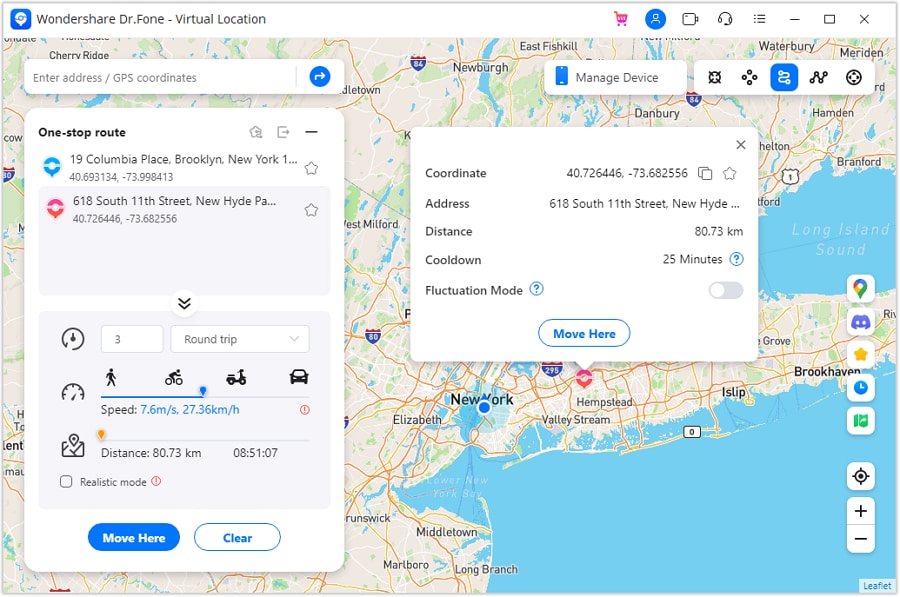
The complete setup ends here, after the route illustration. Test success means that the intended permitted app receives the simulated data; it does not mean a game account is protected from detection or penalties. Verify real location again before using navigation.




3-2. iTools: compare the specific Virtual Location feature
ThinkSky's iTools is the other iPhone utility discussed in the source. Its official product page describes a Virtual Location function and says restarting the iPhone restores its real location. That supports the existence of the feature, not a claim that every current iOS build or Pokemon GO release works with it.
In the source's tethered workflow, the computer supplies the chosen virtual position to the connected phone. Before relying on it, check your exact iTools edition and iOS version, establish a normal device connection and verify the feature is present. If setup fails, do not assume that jailbreaking or installing a modified game is the solution.
No comparative stability test is claimed here. The original assertion that one tool is more stable than another is not supported by measured evidence, so choose based on documented requirements, a usable restoration path and the permitted purpose of the test.
Part 4. Android mock-location settings are not game support
Android includes a developer mechanism for supplying mock coordinates, but an app can identify or refuse that data. Choosing a mock provider does not redirect every possible location signal or bypass server-side checks. Dr.Fone - Virtual Location must not be presented as an Android Pokemon GO solution because its product page expressly excludes that game.
Step 1Locate the developer controls
For an authorized app-development or GPS test, many phones reveal Developer options after seven taps on Build number under Settings and About phone. Menu placement differs among manufacturers. Do not enable unrelated developer settings to address a game warning.
Step 2Select a provider for the permitted test
Open Select mock location app and choose the installed utility. Fake GPS Go is the example named in the source, not a verified current game-compatibility recommendation. Inspect the publisher and permissions before installation, and never provide game credentials to a GPS utility.
Step 3Check accuracy settings without assuming concealment
The source suggests Device Only or GPS Only to avoid other positioning inputs. Those labels may not exist on your phone, and disabling Wi-Fi or cellular assistance does not make mock data invisible. Keep the normal accuracy configuration for ordinary use, stop simulation after the test and remove the mock provider.

If normal GPS fails after a test, restore the standard settings, reopen the affected app and consult official troubleshooting. Do not keep changing mock utilities to bypass a warning or assume that a missing spawn proves you need a different tool.
Conclusion
Understanding Pokemon GO location spoofing starts with its rules and platform limits, not an assurance of safe travel from home. Dr.Fone - Virtual Location and iTools describe iPhone GPS functions; Android's developer setting supplies mock coordinates and does not establish game compatibility. Preserve your account by stopping prohibited behavior when warned, retaining standard device protections and using the game's own allowed participation features. Neither a VPN nor a realistic route removes the risk of permanent termination.
FAQ
1. Is any Pokemon GO GPS spoofing method guaranteed safe in 2026?
No. The published policy treats falsifying GPS as cheating. A system-level tool, cooldown timer or standard game client does not create an exemption from account penalties.2. Can a phone change location without a computer?
Android mock-location apps can submit simulated coordinates without a desktop, but that is not proof of Pokemon GO support. The iPhone methods described here use a computer; avoiding it does not justify a jailbreak or an unknown modified client.3. Does Dr.Fone guarantee that I will not be banned?
No. Its route and destination controls simulate reported location, not enforcement immunity. The official Android scope excludes Pokemon GO, and iOS use remains subject to the game's rules and current compatibility.4. Are Zaragoza, Pier 39 and Akihabara guaranteed Pokemon locations?
No. These are places named in the source's community-style destination examples, not verified live nests or guaranteed rare encounters. Check current in-game information and official event details for any legitimate visit; do not infer availability from an old location list.
 Add Wondershare Dr.Fone as a preferred source on Google