Bypass iCloud Activation Lock and Android FRP without password.

 100% Security Verified | No Subscription Required | No Malware

 :
: 
 ChatGPT
 Perplexity
 Gemini
 Claude
 Grok
Grok
I bought a second-hand iPhone 16 Pro Max, but it's stuck on the iCloud Activation Lock screen. I can't contact the previous owner. Is there a way for iPhone activation lock removal without the password?
Sarah Jenkins Digital Nomad

Acquiring a high-quality pre-owned iDevice is often a smart financial move, but it comes with a significant risk: the dreaded iCloud Activation Lock. If a previous owner forgets to sign out or disable "Find My," you may find yourself with a beautifully crafted brick that demands a password you don't have.
While this security feature is designed to deter theft, it often penalizes legitimate buyers. This comprehensive 2026 guide explores the most reliable mechanisms for iPhone activation lock removal. Whether you have access to the original owner or need a professional bypass solution to regain control of your hardware, we have documented the proven steps below.
In this article
Part 1. What is iPhone Activation Lock? A Quick Look
The Activation Lock is a core component of Apple's "Find My" ecosystem. Automatically enabled the moment a user signs into iCloud, this feature serves as a powerful anti-theft deterrent. It effectively binds the physical device to a specific Apple ID, ensuring that even if a device is remotely erased, it cannot be reactivated without the authorized credentials.
Understanding the significance of bypassing Apple activation lock requires looking at why this feature exists in 2026. Beyond basic security, it offers several critical layers of protection:
- Theft Prevention: It renders a stolen device useless for resale, significantly decreasing the incentive for theft.
- Data Privacy: Combined with AppleCare+ Theft and Loss, it ensures that your sensitive information remains inaccessible to unauthorized parties.
- Tracking & Recovery: It allows the rightful owner to track the device's physical location via GPS, play an audible sound, or activate "Lost Mode" to display a contact number.
When you encounter this screen on a legitimate purchase, you are essentially facing a security protocol that requires either official verification or specialized software to override.
1. Second-Hand Purchases
Many buyers find that a previous owner did not properly factory reset the device, leaving it tethered to an old iCloud account.
2. Forgotten Credentials
Long-term users may forget their Apple ID password or lose access to the recovery email associated with the account.
Part 2. How to Bypass Apple Activation Lock?
Navigating the activation lock removal process depends entirely on your specific situation. We have categorized these solutions based on whether or not you can communicate with the person who originally set up the device.
2-1. Scenario 1: If you can't get in touch with the previous owner
This is the most challenging scenario. If you cannot find the original seller or owner, you must rely on technical bypasses or official documentation to regain access to your iPhone.
1. Professional iPhone Activation Lock Removal Tool [Highly Recommended]
For most users, a professional software solution is the most efficient path. These tools are designed to interact directly with the device's firmware to remove the lock screen without requiring an iCloud username or password.
Using Dr.Fone - Screen Unlock (iOS) is the gold standard for this process. Unlike unreliable scripts found online, this tool is updated to support the latest hardware, including the iPhone 17 series and iOS 26. It provides a guided, secure environment to reactivate your device locally.
 Unlock iPhone/iPad passcode in minutes.
- Remove Face ID, Touch ID, and screen lock.
- Bypass iCloud Activation Lock easily.
- Support all iOS versions and devices.
- Simple steps, no technical skills needed.
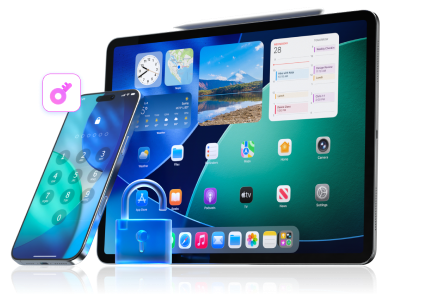
Step 1 Launch Dr.Fone and Select Unlock Feature
Download and install Wondershare Dr.Fone on your computer. Navigate to Toolbox > Screen Unlock > iOS, then select iCloud Activation Lock Removal.
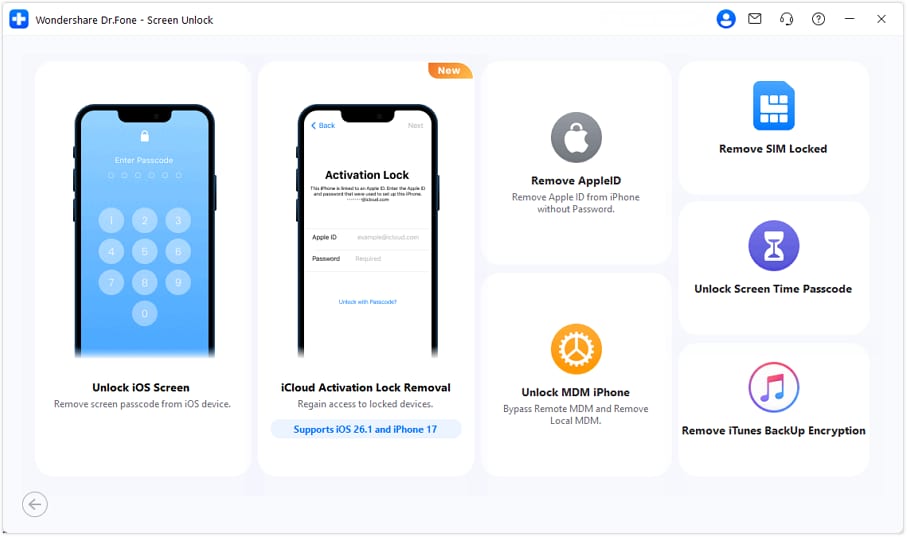
Step 2 Connect Device and Verify Information
Click Start, then connect your iPhone/iPad to the computer. Once the tool diagnoses your device and displays its information, confirm the details are correct and click Unlock Now.
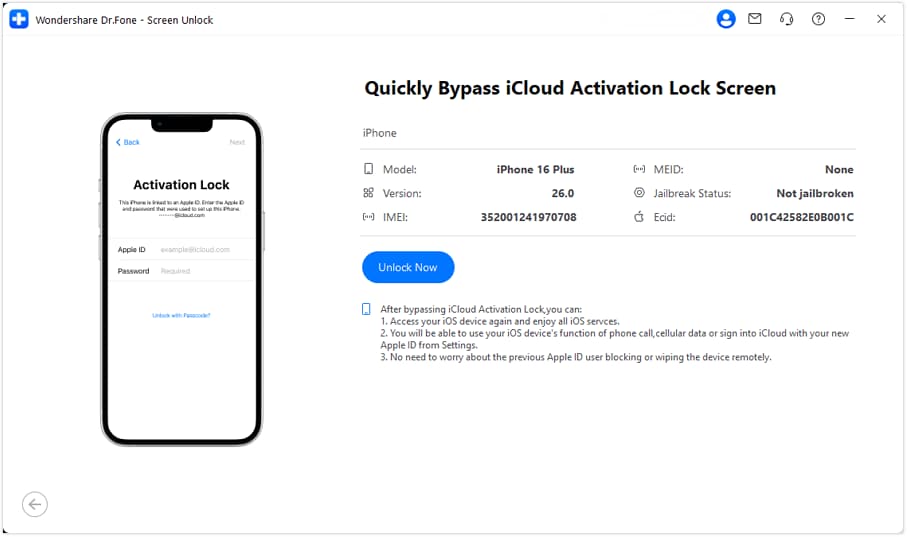
Step 3 Accept Agreement and Install Driver
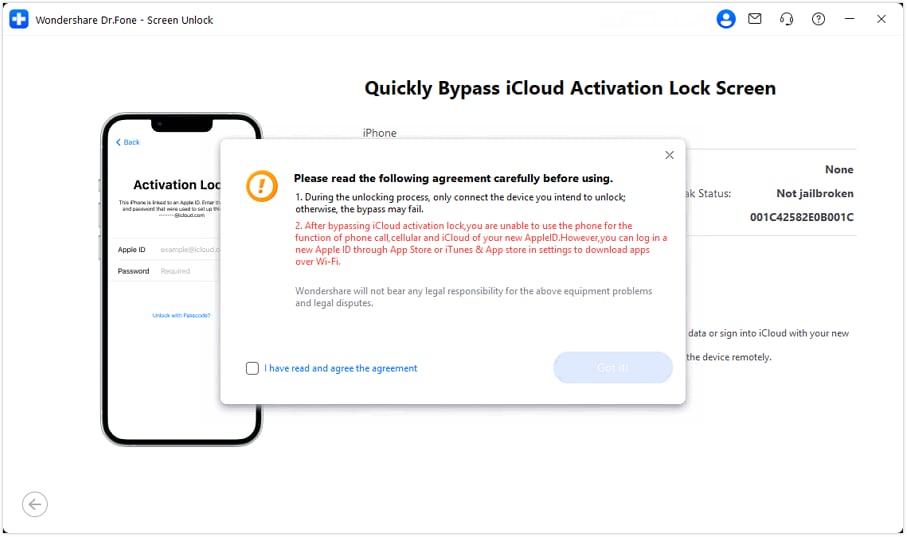
Read the warning prompt carefully, check I have read and agree to the agreement, and click Got It!. The tool will automatically download and install the necessary driver for your device.
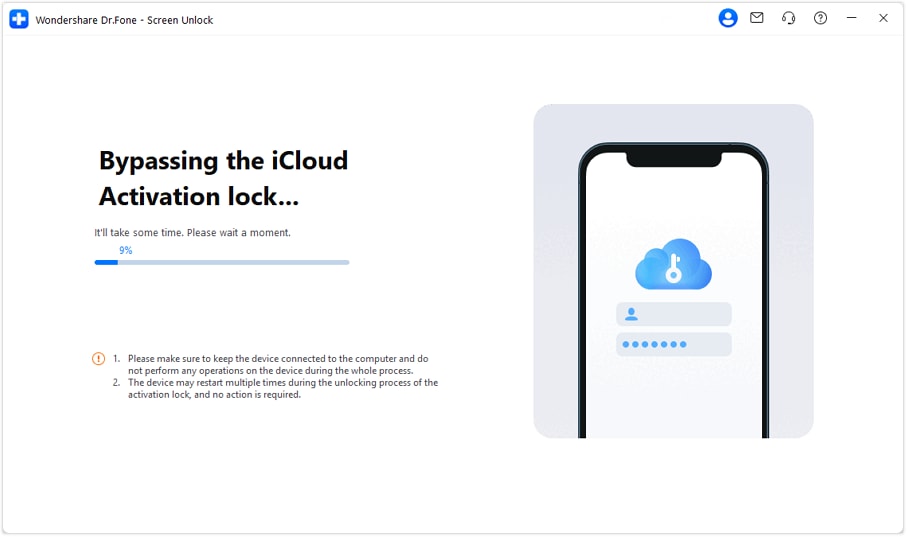
Step 4 Wait for Bypass Process to Complete
Monitor the real-time progress. Keep your device connected. It will reboot several times during the process, which is perfectly normal behavior for the bypass firmware.
Step 5 Unlock Complete
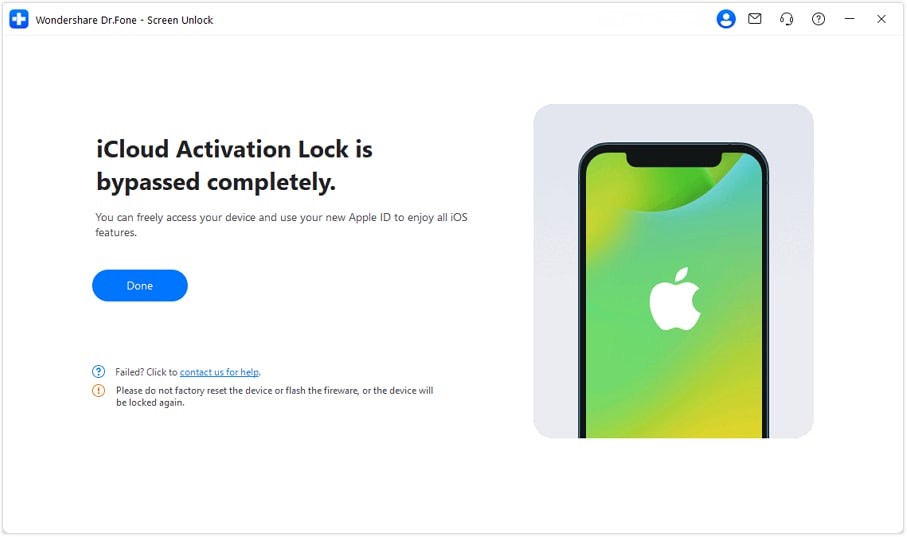
When the success message appears, your Activation Lock has been removed. You can now access your device as a new user with complete security.




2. Online Activation Lock Bypassing Services
You may encounter websites offering activation lock removal via IMEI submission. While some claim to be free, they often lack the security and high success rates of local software. These services carry risks, including potential data harvesting or scams where payment is taken without a successful unlock.
- No software installation required
- Works via IMEI/Serial number
- Can be done from any device
- High risk of scams/privacy loss
- Low success rates for 2026 models
- No verified support or warranty
3. DNS Bypass: A Technical Loophole
The DNS method exploits a vulnerability in Wi-Fi settings to trick the device into thinking it's verified. It is important to note that this bypassing Apple activation lock method only works on older iOS versions and does not provide full device functionality.
- Step 1: Begin set-up and navigate to Wi-Fi settings.
- Step 2: Tap the 'i' icon next to your network and select 'Configure DNS'.
- Step 3: Set to 'Manual' and input these IP values based on your region: North America (104.154.51.7), Europe (104.155.28.90), Asia (104.155.220.58).
4. The Official Approach - Apple Support
If you have original documentation (receipt, serial number, AppleCare agreement), you can contact Apple Support for activation lock removal. This is a legitimate path but requires proof of purchase that matches the device's history. Apple usually ignores requests for devices purchased through third-party unverified vendors.
2-2. Scenario 2: If you can get in touch with the previous owner
If the seller is cooperative, the removal process is instantaneous and can be done physically or remotely.
1. Direct Removal via Passcode
If the owner is with you, have them enter their screen passcode or Apple ID credentials. Once unlocked, immediately go to Settings > [Name] > Sign Out to fully release the device.
2. Remote Removal via iCloud.com
If the seller is in a different location, ask them to follow these steps to perform an activation lock removal remotely:
Step 1 Sign in to iCloud
The owner must log in to iCloud.com using their Apple ID.
Step 2 Locate the Device
Open Find My and select the specific iPhone from the All Devices list.
Step 3 Remove from Account
Click Erase Device and, once completed, select Remove from Account. The device is now free to be activated by you.

Conclusion
Encountering a locked iPhone can be frustrating, but iPhone activation lock removal is possible in 2026 through the right channels. While official Apple support is the best manual option for those with original receipts, professional software like Dr.Fone provides the most reliable and secure bypass for users who lack access to the previous owner. Always ensure you verify the status of a used device before purchase to avoid these hurdles in the future.
FAQ
1. Is it legal to perform iPhone activation lock removal?
Performing a bypass on a device you legally own (such as one bought second-hand) is generally permissible for personal use to regain access to your hardware. However, these tools should never be used on stolen property. Professional tools often require a disclaimer of ownership.2. Will erasing my iPhone remove the Activation Lock?
No. Simply erasing or factory resetting an iPhone through the physical buttons or Recovery Mode will not remove the lock. The Activation Lock is server-side; it requires the correct Apple ID credentials or a specialized bypass tool that interacts with the device's activation server handshake.3. Can Apple Support help me if I don't have the receipt?
It is highly unlikely. Apple requires valid proof of purchase (original sales receipt) that includes the device's serial number or IMEI to verify ownership. Without this documentation, they cannot legally or technically authorize a lock removal.4. Does the DNS bypass method work on iOS 18/19 or later?
Generally, no. The DNS loophole was largely patched in modern iOS versions. Even when it works on older systems, it only allows access to a limited "captive portal" for web browsing and simple apps, rather than giving you full access to the iPhone's core features.
 Add Wondershare Dr.Fone as a preferred source on Google