 Teleport your device anywhere instantly with one click.


 100% Security Verified | No Subscription Required | No Malware


 :

 ChatGPT
 Perplexity
 Gemini
 Claude
 Grok
An Apple decoy location update is an informal name for showing a different location, not an Apple setting or an official software update. Two commonly discussed approaches are simulating GPS coordinates and choosing another Apple device as the source of your shared location. They work differently, and neither should be mistaken for a guarantee that your iPhone becomes untraceable.
Find My does not let arbitrary people track every iPhone. Location visibility depends on sharing permissions, account access, family settings, and the particular Find My feature. If your immediate goal is privacy rather than testing another map position, review Apple's sharing controls first. This 2026 guide explains the two approaches, their practical limitations, and the full desktop GPS simulation workflow.

In this article
Part 1. Two Approaches to an Apple Decoy Location Update
You may want to limit location exposure to friends, avoid revealing a home address, or check how an app responds to a different map position. Start by identifying the actual requirement: stopping a person from seeing your location is not the same task as supplying different GPS coordinates to an app. Changing an Apple Maps label also does not change the phone's physical position or its location permissions.
There is no native Apple decoy-location button that places your iPhone anywhere you choose. Apple does provide controls to stop sharing with an individual or everyone. In Find My, use People to select a person and stop sharing, or open Me and turn off Share My Location. Where the Hide Location option is available, Apple's safety guidance says sharing resumes the next day. Other people may notice that location is no longer available.
1. Use Dr.Fone - Virtual Location on a Supported iPhone
 Set your map route to simulate GPS movement.
- Set your wanted movement speed.
- HD and large map view to check location.
- Fake GPS location to anywhere.

Dr.Fone - Virtual Location is a GPS simulation utility. Its desktop workflow lets you select a map destination or simulate movement along a route without jailbreaking a supported iPhone. That makes it relevant when the task is to test a different reported position, rather than simply turn a sharing permission off.
The original walkthrough discussed iOS 17. Compatibility should still be checked against the exact phone, installed iOS release, desktop build, and desired app before proceeding. A successful change on a map is not proof that every Apple service uses the same position, that Find My updates instantly, or that nobody can detect an inconsistency.

The principal capabilities and boundaries are:
- Destination selection: Teleport Mode changes the reported GPS position to a selected point on supported devices. Verify the result in the receiving app rather than assuming it changed everywhere.
- Route simulation: One-stop and multi-stop tools model movement between locations, with adjustable simulated speed.
- App-dependent results: Life360, Snapchat, Instagram, WhatsApp, and other apps may combine GPS with their own permissions, account settings, network information, or server checks. GPS simulation does not override all of those systems.
- No-jailbreak desktop setup: Follow the current connection prompts for your iOS version; an older screenshot is not an assurance of identical controls on every release.
- Multiple iOS devices: The product page describes support for up to five iOS devices on one computer, subject to the applicable product configuration.
Pokémon GO is a separate compatibility and account-policy question. The current product page explicitly excludes Android Pokémon GO support. Its iOS marketing does not provide permission from the game operator or a promise against account action. Do not treat simulated movement, a timer, or a particular speed as a way to make prohibited gameplay safe.
2. Choose Another Device as Your Shared Location Source
A second Apple device provides a different mechanism: it can supply the location shared through Find My while your primary iPhone is elsewhere. The shared point is the secondary device's real position, not an arbitrary coordinate typed into Apple Maps. This requires another suitable device that you control, signed in to the appropriate Apple Account.
There is no need to follow the outdated instruction to log out of a separate Find My Friends app. On the device you want to use, open Find My > Me, enable Share My Location if appropriate, and choose Use This iPhone as My Location when offered. Check the Sharing From entry to confirm which device supplies the location. Apple's instructions also note that a paired cellular Apple Watch can supply location under certain conditions, so verify your complete device setup.

This option is useful only if you already have, or are willing to obtain, another device. It depends on that device remaining available to report its position. It changes the location-sharing source; it does not relocate the primary iPhone in the Devices tab, rewrite its GPS readings in other apps, or conceal account access. For straightforward privacy, stopping unnecessary sharing is usually more direct than maintaining a second device.
Part 2. Change a Reported GPS Position with Dr.Fone - Virtual Location
The following walkthrough retains the original connect, select, and confirm sequence. Use it for supported GPS simulation on a device you control. Keep the distinction between an app's reported map position and Find My's wider device-finding services in mind throughout the process. Do not rely on a simulated location for emergencies, personal safety, or a guarantee of invisible travel.
Step 1Install the desktop utility and connect your iPhone
Open the installed program on Windows or Mac and select Virtual Location. Connect the iPhone with a USB cable and respond to the required device trust and connection prompts. The official product workflow allows Wi-Fi connections after an initial wired connection on supported setups; do not assume a first-time wireless session needs no preparation.
Step 2Review the available modes and select a destination
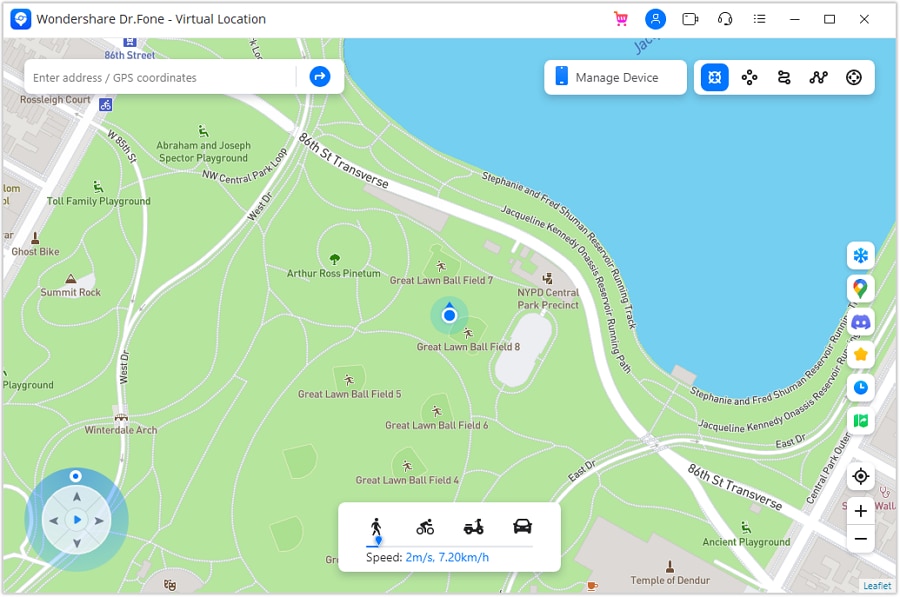
Wait for the map to identify the connected device. Choose the mode that matches the simulation you want, rather than enabling a route when you only need one fixed position.
- One-Stop Route: Specify a starting point and destination to simulate travel along the generated route.
- Multi-Stop Route: Place several waypoints and configure the movement speed for the planned journey.
- Jump Teleport Mode: Move between selected positions without simulating the intervening walk. This is a location-control feature, not a guarantee of compatibility with any particular game.
For a single destination, activate Teleport Mode, enter the location in the search bar, and press Enter. Inspect the returned point on the map before applying it, especially when several places share the same name.
Step 3Apply the position, verify it, and restore it afterward
Select Move Here to apply the chosen map position. Open the relevant map or app on the phone and check what it actually reports. If Find My is your concern, examine the sharing source and relevant Find My view separately; changing one map does not prove that every service has changed.
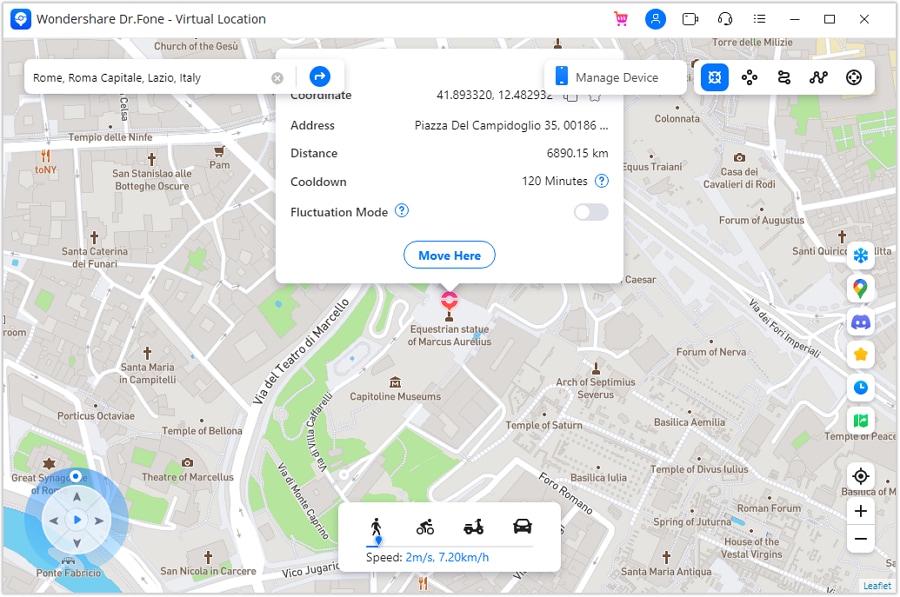
The official guide describes restarting the connected phone to return to its actual location, including a restart prompt when closing the utility. Follow that recovery workflow and verify the restored position. Do not assume a simulated point will persist for a fixed duration across reconnects, app updates, or all iOS versions.
The complete workflow is therefore connection, destination selection, confirmation, and an on-device check, followed by restoration when finished. No jailbreak is required in the supported workflow, but platform compatibility and the receiving app's behavior remain conditions rather than universal guarantees.




Conclusion
An Apple decoy location update is not an official Apple privacy feature. GPS simulation supplies a selected reported position to supported apps, while a second device changes the source used for location sharing. Choose according to that distinction, check your exact setup, and prefer Apple's native controls when the actual goal is to stop sharing. Neither approach guarantees an undetectable Find My location or protection from a game's enforcement rules.
FAQ
1. Does Apple offer a decoy location update?
No. The phrase refers to workarounds such as GPS simulation or choosing another sharing device. Apple provides location-sharing controls, not a built-in setting for placing your iPhone at an arbitrary point.2. Will a GPS change hide my iPhone from everyone?
No. Find My visibility depends on permissions, account and family settings, and the relevant service. A changed map position should not be treated as proof that the device cannot be located.3. Must I sign out to share from a second iPhone?
The supported approach is to select the sharing device in Find My. On that device, open Me, review Share My Location, and use Use This iPhone as My Location when available.4. How do I return to my actual location after simulation?
The Dr.Fone guide describes restarting the connected phone, including the restart option shown when closing Virtual Location. Afterward, check the phone's map and any sharing settings you changed.
 Add Wondershare Dr.Fone as a preferred source on Google


