Teleport your device anywhere instantly with one click.


 100% Security Verified | No Subscription Required | No Malware

 :

 ChatGPT
 Perplexity
 Gemini
 Claude
 Grok
If Find My Friends seems to have disappeared, look for Find My: on current iPhones, people sharing and device finding are in that combined app. To control what friends see, review Share My Location and the device listed under Sharing From. Changing the sharing device, stopping sharing and simulating GPS are different actions, not interchangeable privacy guarantees.
There is no normal Find My control that lets you enter arbitrary coordinates as your real position. Apple's supported options let you share from another device you own, stop sharing with selected people or turn sharing off. Do not send an Apple Account password or verification code to a friend to make this work, and do not assume Airplane Mode makes your location invisible.
In this article
Part 1. Understand why someone might change location sharing
Find My can help consenting friends and relatives coordinate travel or check a shared position. Its map should not be treated as infallible, continuously updated evidence of a person's whereabouts. Connectivity, permissions, the selected sharing device and reporting time all affect what appears.
Before changing anything, identify your actual goal: limit who receives your position, take a short sharing break, choose a different source device or run a location test. The appropriate control depends on that goal. A false coordinate is not automatically safer than using the sharing permissions Apple supplies.
Review privacy and the people who can see your position

Personal location sharing is not anonymous to its recipients: the purpose is to show a selected person's position. Apple's security protections do not mean every recipient is appropriate or that you should share indefinitely. Review the People tab and remove access you no longer want to grant.
Location shared through Find My can also be visible through related Apple interfaces such as Messages, Maps and Contacts. Review the overall sharing relationship instead of judging privacy only by whether one app is open. If a location-sharing change could affect your personal safety, consider that others may notice the change and plan accordingly.
Take a temporary break without inventing a false journey

Wanting a few hours of personal time does not require sharing a made-up address. Turn off Share My Location for everyone or stop sharing with a specific person. On supported interfaces, Hide Location offers a pause with one person; Apple's current safety guide says sharing resumes automatically the next day.
Choose an option whose duration you understand and verify its status afterward. Do not assume that closing Find My or deleting its icon stops an existing sharing relationship. Likewise, a last-updated timestamp or a missing position can reveal that updates have stopped even without a direct alert.
Keep jokes separate from safety-related location information

Some users consider changing a map position as a prank. That can cause unnecessary concern if someone relies on the information for a pickup, travel check-in or emergency. A demonstration should be consensual and clearly identified as a test rather than presented as a real journey.
If you run a controlled demonstration, explain it immediately, restore real positioning and confirm the correct source device afterward. Do not describe GPS manipulation as a reliable way to mislead someone who depends on your shared location. For ordinary privacy, the supported sharing controls are more direct.
Understand the role and limits of a GPS simulation tool
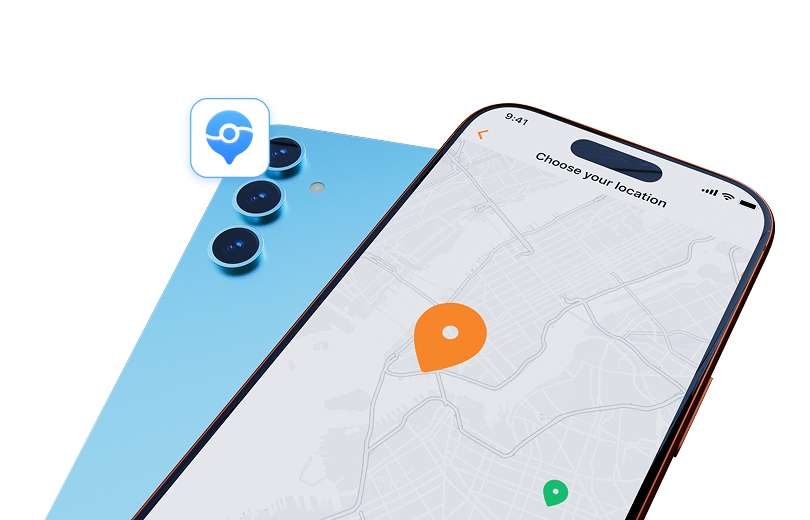
 Set your map route to simulate GPS movement.
- Set your wanted movement speed.
- HD and large map view to check location.
- Fake GPS location to anywhere.
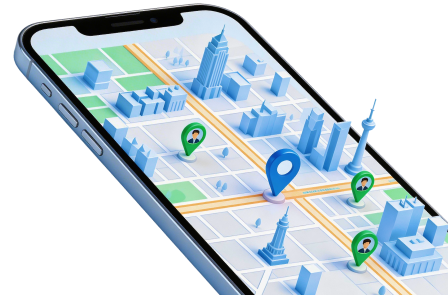
Dr.Fone - Virtual Location provides map-based GPS selection and simulated movement on supported devices. Its route and speed controls can be useful for permitted location testing. They are not Apple permission settings, and they do not guarantee that Find My will show a chosen point, remain frozen there or conceal a change from other people.
For a test on your own supported phone, connect it to the desktop application and complete the connection and trust prompts. Open Virtual Location, choose Teleport Mode and search for the intended destination. Review the selected pin before confirming Move Here, then check the result in a maps app. Do not assume one app's response establishes how Apple's sharing network will behave.
When testing is finished, restore the actual location using the application's instructions; the official guide describes restarting the device. Confirm real positioning and the chosen sharing source before navigation or a safety check-in. Use the supported controls below if the goal is to stop sharing rather than simulate coordinates.




Part 2. Change the sharing source rather than sharing credentials
Find My automatically obtains the location of its selected source device. Choosing a different device changes that source; it does not relocate your body or create a selectable fake-coordinate field. A location label such as Home or Work is also only a label, not a way to rewrite GPS coordinates.
The original article suggested asking a friend to sign out and then sending your credentials to their phone. That is not a safe account-management method. Sharing a password, two-factor code or device passcode can expose more than a map position, including account access and synced information. Use only a device you own and control, and keep authentication private.
Use another eligible iOS device you own
The following process preserves the other-device approach while removing the unsafe credential handoff. The screenshots are older account-interface references, not instructions to sign another person into your account. If you have no suitable second device, use the sharing controls in Part 3 instead.
Step 1 Inspect the current account without unnecessary sign-out
On your iPhone, open Settings and tap your name. Confirm which Apple Account is in use. The screenshot below shows the sign-out area mentioned by the original guide, but you do not need to sign out of your main iPhone simply to choose a sharing source.

Step 2 Keep credentials to yourself
Do not message your password, two-factor verification code or passcode to anyone. Select a second supported device that you personally own and can operate.
Step 3 Check the second device's account
Open Settings on that device. If it is already signed in to your intended account, leave the session intact. If it is your own unconfigured device, use the sign-in option yourself; do not replace a friend's active iCloud account.

Step 4 Verify the account identity
If sign-in is actually needed, enter your own Apple Account email address or phone number and continue. Make sure the identity matches the one used for your sharing relationships.
Step 5 Authenticate privately
Enter the password directly on your own device. Do not treat an encrypted chat message as permission to disclose it to another person.
Step 6 Complete required verification
Respond to the two-factor prompt using your own trusted device or number. A request to send that code to somebody else is not part of changing your Find My sharing source.
Step 7 Read device and syncing prompts
Follow the displayed passcode and data-sync instructions on the device you control. The older Don't Merge screen below concerns particular data; it is not a universal safeguard that makes using someone else's phone safe.

Step 8 Open the source selector
On the device you intend to use, open Find My and tap Me. Review Share My Location and the device identified next to Sharing From. You can also review sharing settings through Settings > your name > Find My.
Step 9 Choose and verify the source
If offered on the intended iPhone, tap Use This iPhone as My Location. Confirm that Sharing From names the device you chose. Its position can differ from the phone you carry, so communicate that distinction rather than treating the result as proof of your personal whereabouts.
To switch back, open Find My on the phone that should share your actual travel position and choose it as the source where available. Apple also notes that a paired cellular Apple Watch can become the location source when it is on your wrist and out of range of the sharing iPhone. A second device therefore does not establish a guaranteed fixed pin.
Part 3. Stop or limit sharing with the right control
Turning off personal location sharing is different from disabling lost-device protection. If you simply do not want people in the People tab to see your position, start with Share My Location or a person-specific sharing control. Disabling Find My iPhone itself can reduce your ability to recover a missing device.
Method 1: Understand what Airplane Mode does and does not do
Airplane Mode changes radio connectivity; it is not a dedicated privacy switch for Find My. Apple's current instructions say Bluetooth remains on by default, and Wi-Fi can be used again in Airplane Mode. Offline Find My network capabilities and an older report can also matter. Do not assume that an airplane icon guarantees invisibility or no notice.
Step 1 Open the connectivity setting
Go to Settings and locate Airplane Mode, or use its Control Center button. Review the effect on calls and data before changing it.
Step 2 Enable it only for the intended connectivity purpose
Turn the Airplane Mode switch on. Check Wi-Fi and Bluetooth separately if relevant; remembered radio settings can affect the result. This does not revoke a person's sharing permission.

Step 3 Restore the connection when needed
Turn the same switch off to leave Airplane Mode. When connectivity returns, location reporting can resume. Use the next method for an explicit sharing decision.
Method 2: Turn off Share My Location or change a person's access
This is the targeted option for personal sharing. It does not require handing another person your login details or pretending that an offline phone remains at a particular address.
Step 1 Open Settings
Use the iPhone whose sharing settings you are managing. Confirm that you are operating your own account.
Step 2 Open your account profile
Tap your name at the top. Older screenshots use the Apple ID label; the account is now called Apple Account.
Step 3 Select Find My
Open Find My in the account settings. The combined app includes People and Devices functions; the older Find My Friends name is not a separate current app to restore.

Step 4 Change personal sharing
Turn off Share My Location to stop sharing with everyone. Alternatively, in Find My > People select one person and use Stop Sharing My Location. On interfaces that offer Hide Location, a person-specific pause automatically resumes the next day.

Other people may notice that your location is no longer available. Apple warns that earlier operating systems may also show a Messages notification when sharing stops. No method here promises that a change will be undetectable. If you resume sharing, review the recipients and source device rather than assuming every previous relationship has the intended status.
Method 3: Review system-wide Location Services
Turning off Location Services has broader consequences than changing one sharing relationship. Maps, travel apps, local results and other location-dependent functions may lose access to your position. Review individual permissions first if your concern is limited to one app.
Step 1 Open the system settings
Launch Settings on your own iPhone. This is separate from changing a location label inside Find My.
Step 2 Open privacy controls
Choose Privacy & Security; older versions may display Privacy. Review the controls available on your installed system.
Step 3 Inspect Location Services
Open Location Services to see the global switch and per-app permissions. Consider whether restricting a specific app is sufficient.
Step 4 Make the intended change and read the warning
If you choose to turn the global switch off, confirm the prompt and account for the effect on navigation and other apps. Do not describe this as erasing earlier location reports or removing every possible network-based location clue.


Conclusion
Use Find My to review who can see your location and which device supplies it. A second device you own can serve as the source, but sharing credentials with a friend is not a safe substitute. Airplane Mode is not guaranteed concealment, and GPS simulation is not an authoritative Find My privacy setting. For a break from sharing, prefer Apple's explicit controls and remember that others may notice the change.
Keep passwords and verification codes private, and use trusted software sources for any permitted location test.
FAQ
1. Where did the Find My Friends app go?
On current iPhones, personal sharing is in the People tab of Find My, alongside separate device-finding functions. Look for Find My rather than assuming your account or contacts were deleted.2. Can I manually type a fake address in Find My?
There is no normal arbitrary-coordinate control. A location label does not change GPS. You can review the sharing source on a supported device you own, or stop sharing using Apple's controls.3. Should I give a friend my Apple Account password?
No. Do not share passwords, verification codes or passcodes to change a map position. Sign in privately only on devices you own and control, and review syncing consequences.4. Will Airplane Mode stop sharing without anyone noticing?
That is not guaranteed. Bluetooth, Wi-Fi, offline-finding capabilities and prior reports can affect what remains visible. Even explicitly stopping sharing may be noticed, and older systems may show a Messages notification.
 Add Wondershare Dr.Fone as a preferred source on Google