 Teleport your device anywhere instantly with one click.


 100% Security Verified | No Subscription Required | No Malware


 :

 ChatGPT
 Perplexity
 Gemini
 Claude
 Grok
You cannot find a person's current location in Google Maps by entering their mobile number. A number can help identify a contact, but it does not grant access to that contact's GPS coordinates. To see a person's position, they must share it through a supported service, or an eligible guardian must use an established supervised-device setup.
Choose the workflow that matches the real situation: agreed sharing with a friend, a temporary link, Family Link supervision or recovery of your own Android device. The instructions below explain the permissions and limitations before the steps. A separate section covers changing your own reported GPS for testing, not locating another person or bypassing their privacy choices.
In this article
- Part 1. Can You Find the Current Location of a Mobile Number in Google Maps?
- Part 2. 4 Ways to Find or Share a Phone's Location
- Part 3. Can a Mobile Number Tracker Find Someone's Exact Location?
- Part 4. Which Location Method Should You Use?
- Part 5. How to Protect Your Own Location with Dr.Fone - Virtual Location
Part 1. A Mobile Number Is Not a Google Maps Tracking Permission
If you search for 'find current location of mobile number on Google Maps,' the missing ingredient is not a special search command. It is an authorized stream of device-location data. Google Maps can display a location someone chooses to share, but adding their number to your contacts does not start that sharing.
These four workflows use different access arrangements. Even when a service calls a feature real-time, connectivity, device settings and update delays can affect what the map shows. Check the timestamp before treating a displayed pin as the phone's current position.
| Workflow | Is a number enough? | Location information | Required authorization | Suitable situation |
|---|---|---|---|---|
| Direct Maps sharing | No. | Updates from the sharing device when available. | The person starts a share with the selected recipient. | An agreed arrangement with a friend or family member. |
| Maps sharing link | No. | Updates through an active, time-limited link. | The owner creates and sends the link. | A recipient who does not use a Google Account. |
| Family Link | No. | Location from an eligible supervised device. | An appropriate parental account and enabled device sharing. | Managing a child's supported supervised device. |
| Find Hub | No. | Available device location, sometimes a recent rather than current position. | The linked account or an explicitly authorized sharing arrangement. | Recovering your own Android phone. |
Understand Number Information Versus Device Coordinates
Country codes, number ranges and carrier records describe a telephone identifier. They are not measurements of where the handset is now. A number-related region can remain associated with a number even when the owner travels elsewhere, so it should never be presented as a live map fix.
Device location is a separate estimate. Depending on the situation, GPS, nearby Wi-Fi and mobile-network information can contribute to it. An authorized app then decides what to share. Searching for how to trace a mobile number on Google Maps does not remove either the data requirement or the access requirement.
Part 2. Four Authorized Workflows, with Setup Steps
Start from the person or device that will supply the location. The owner should understand who can view it and for how long. Do not sign into another person's account or change settings on their phone without permission. The examples below use the Android Maps flow where applicable; labels may differ slightly on another supported device.
Method 1. Start a Direct Google Maps Location Share
For continuing or time-limited sharing between Google contacts, use the app's built-in Location Sharing feature. The person sharing signs in to their own account and chooses the recipient. The shared view can include a name, profile photo, recent position, battery level and charging status, not merely a pin.
-
Step 1 Select a recipient and sharing period
Open Google Maps, tap your profile picture or initial and choose Location sharing > New share. Older interfaces may label the action Share location. Set a limited duration or the offered Until you turn this off option, choose the intended contact and tap Share. For direct account sharing, use the recipient's appropriate Google contact details rather than assuming any saved phone number is sufficient.
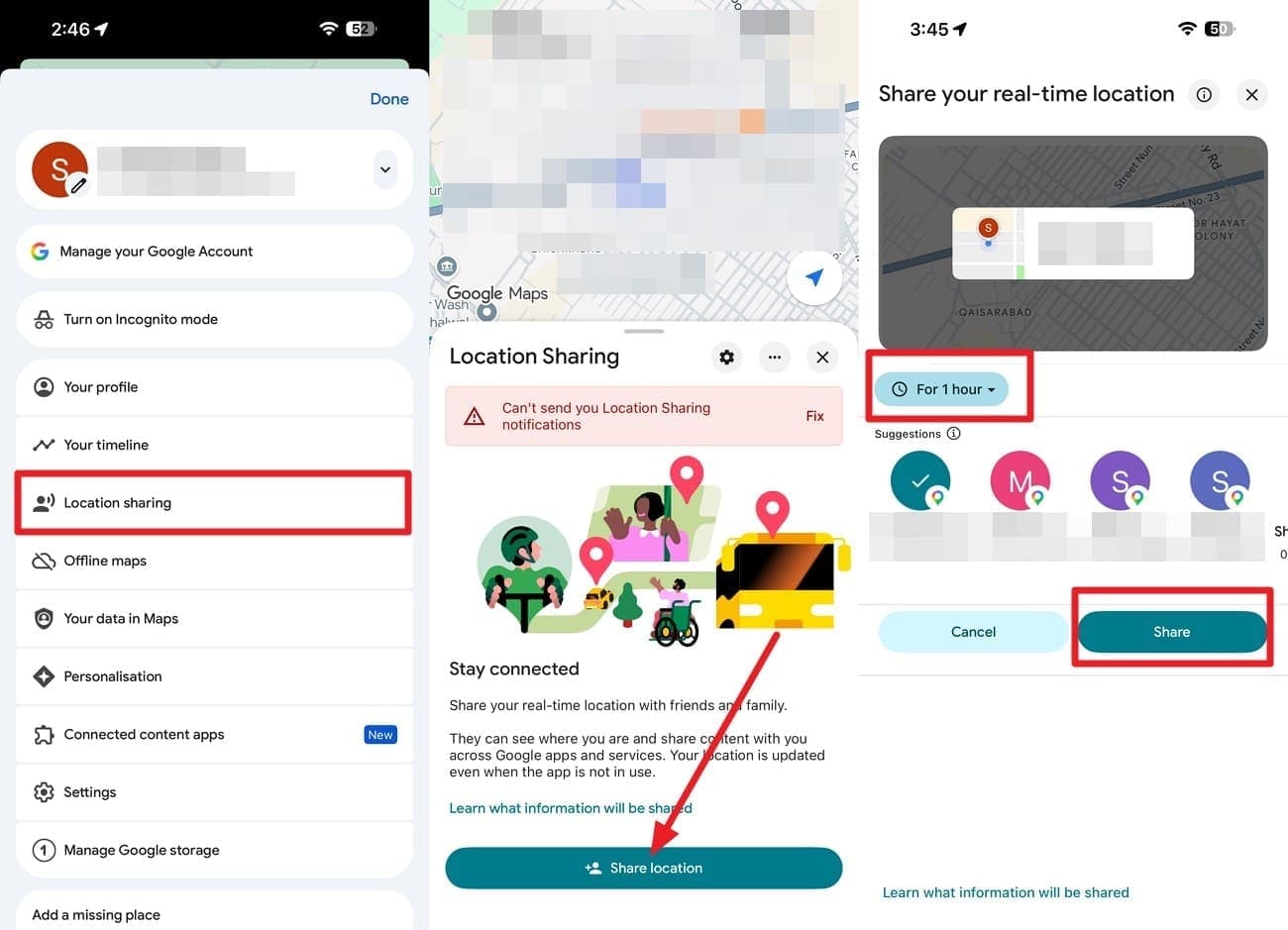
The recipient opens their own Maps Location sharing view and selects the person who is sharing. To revoke access, the sharer returns to Location sharing, selects the recipient and taps Stop. Google also provides account-level sharing controls; check the correct device and account if you have several.
Availability can depend on age, country or region and Workspace administration. Use the full Google Maps app: the lightweight Maps Go edition does not offer real-time location sharing. If a location stays unchanged, ask the sharer to check connectivity and the active share rather than assuming their phone is still at the displayed address.
Reference: Google's current Maps location-sharing instructions describe recipient selection and revocation.
Method 2. Send a Temporary Maps Sharing Link
A link is useful when the viewer does not have a Google Account. The person supplying the location still needs the required account, device and connection. Treat the URL as sensitive: someone who receives a forwarded copy may also be able to view the shared information.
-
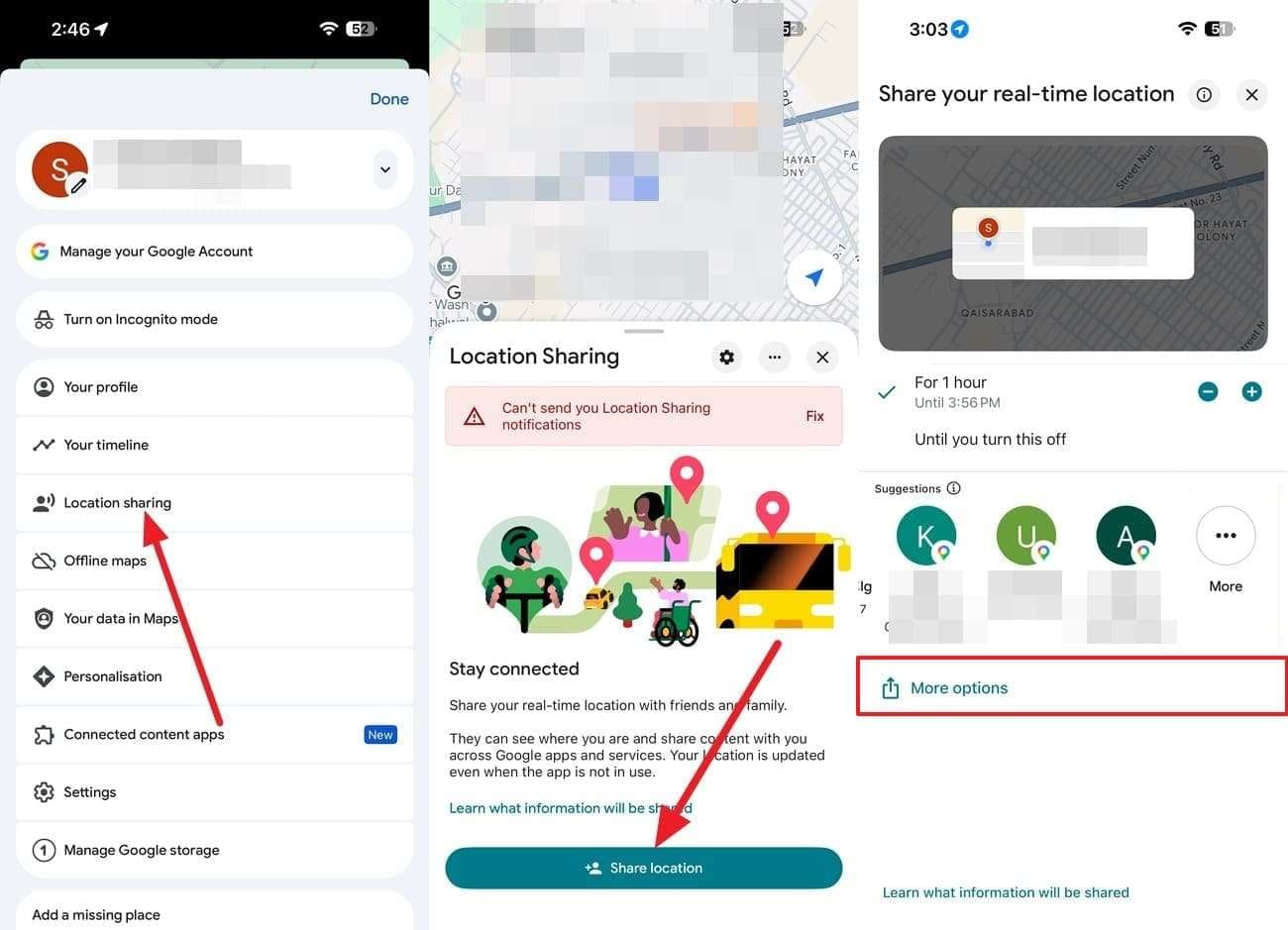
Step 1 Prepare the share
On your own phone, open Maps > profile picture > Location sharing > New share. Choose the intended duration and look for the link-copy or More options control shown by your platform. Google documents Maps link sharing for up to 24 hours; do not assume an indefinite direct-account share can be converted into an indefinite public link.
-
Step 2 Copy and privately deliver the link
Use Copy to clipboard where offered, then paste the link into a direct message or email to the agreed recipient. On platforms that expose a share sheet, choose the messaging app there. Confirm that you are sending the live-location share, not just a static place pin, and stop the share when it is no longer needed.
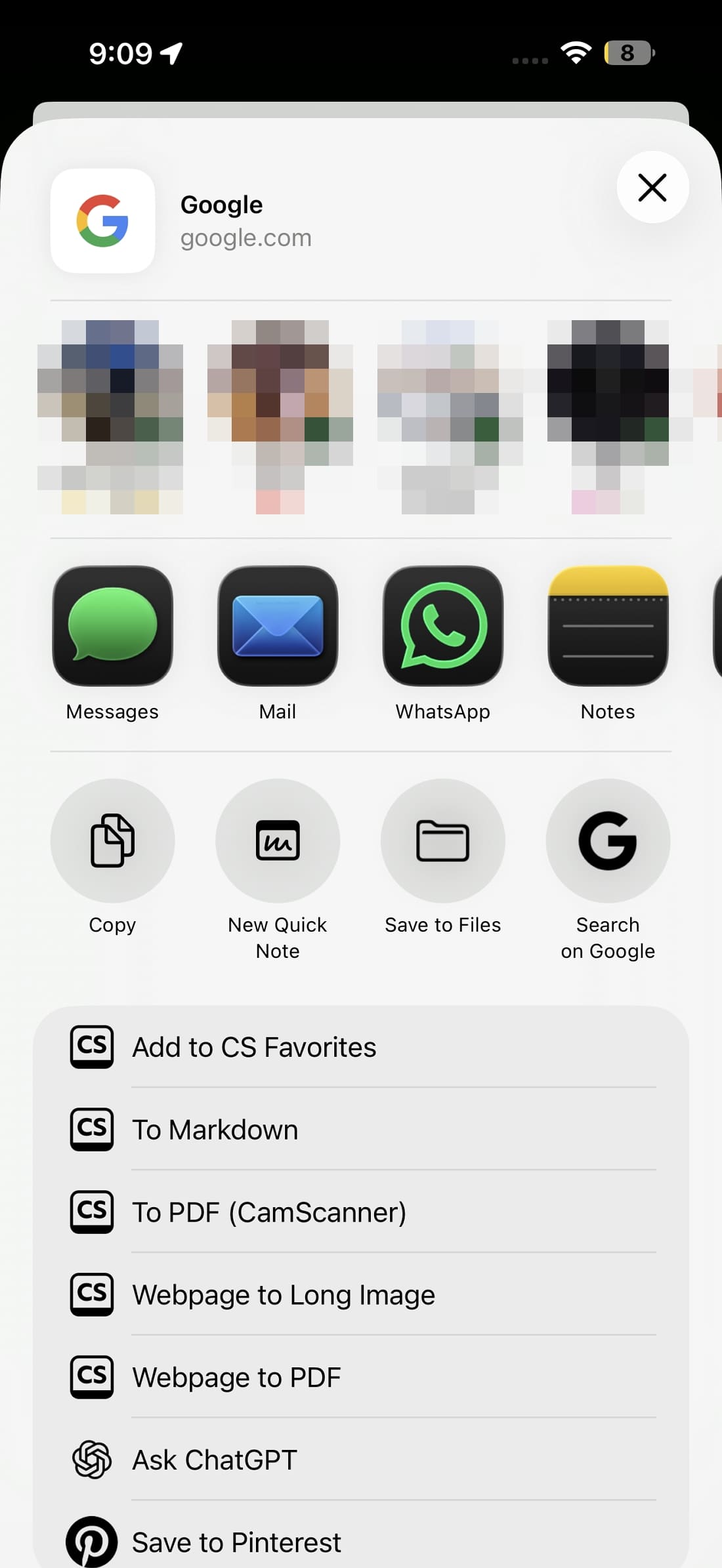
A static address link shows a place you selected; a live-sharing link can disclose movement during the active period. Neither turns the recipient's phone number into a tracking tool. Avoid posting a live link in a public group or on an open profile.
Method 3. Set Up Family Link for a Supervised Child's Device
Family Link is intended for an appropriate parent-managed account and supported supervised device. Google's guide covers eligible Android and compatible Fitbit devices; it is not a universal locator for any phone using a child's number. Explain the supervision arrangement in an age-appropriate way and configure it through the legitimate family setup.
-
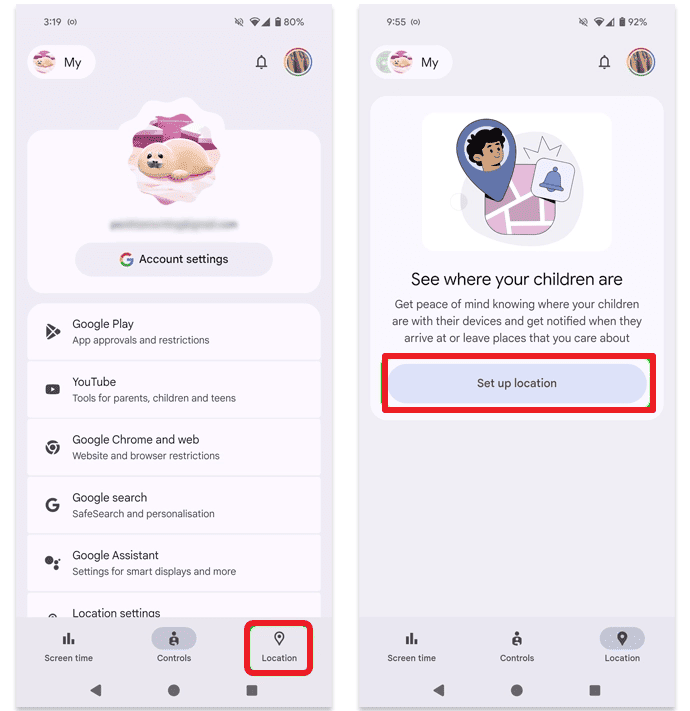
Step 1 Open the location setup
In the parent's Family Link app, select Location and then Set up location. If the setup button is absent, select the child and inspect Location sharing. You need the relevant supervised account, not simply a saved contact.
-
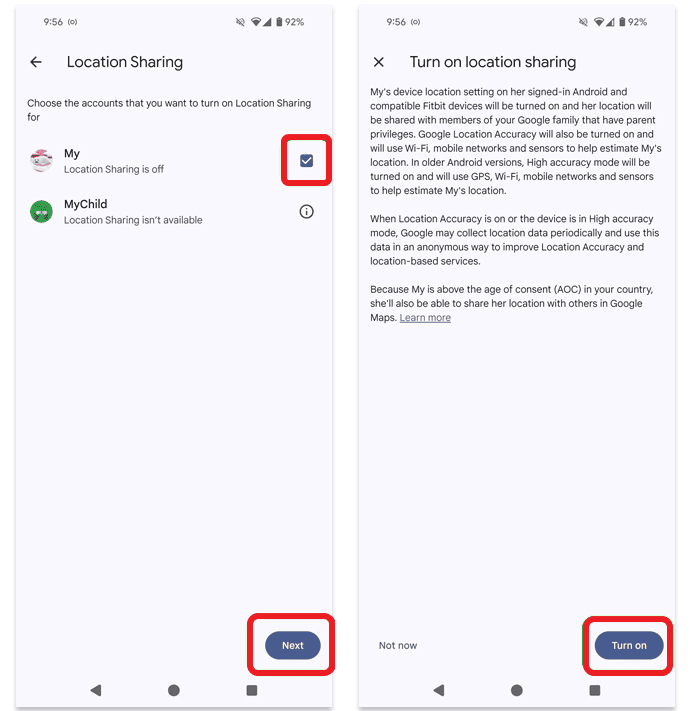
Step 2 Enable sharing for the intended child
Choose the child or children for whom you are configuring the feature, tap Next and read the information before selecting Turn on. Follow any device-specific prompts. A managed family relationship and enabled device sharing are the access conditions.
-
Step 3 Review the available location and its age
Return to Location and inspect the map, last update and any available battery information. The first update can take time. If the child uses multiple eligible devices, Google notes that the most actively used one supplies the location shown, not every device simultaneously.
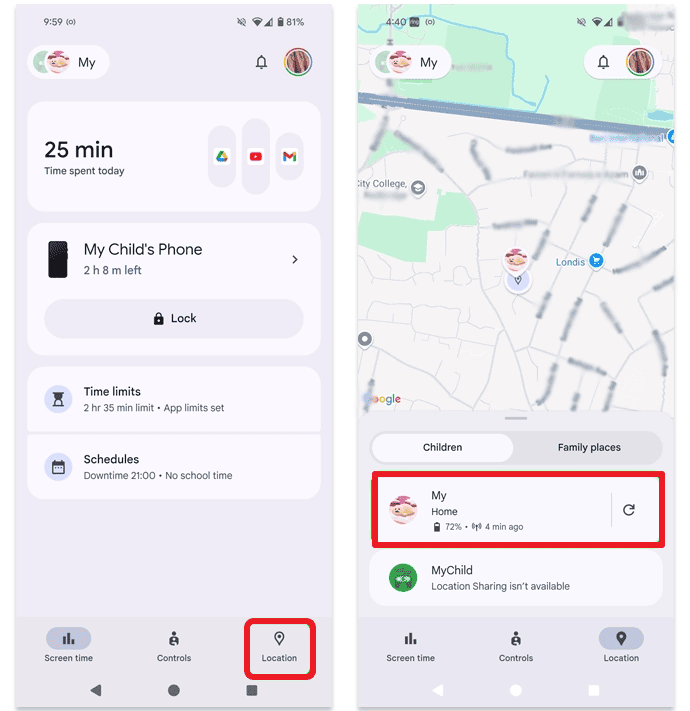
Family Link cannot provide a fresh location when the device is powered off, lacks internet access or has not been used recently. For supported arrival/departure alerts, set up a family place and the required accuracy setting first. Such an alert reflects the device's available location, not independent proof of a child's exact whereabouts.
Reference: Google's Family Link location setup and troubleshooting explains device requirements and family-place alerts.
Method 4. Use Find Hub for Your Device or an Existing Person Share
For your lost Android phone: Open Find Hub on another device or visit Google Find Hub in a browser. Sign in to the account associated with the missing device, select the correct phone and complete any legitimate authentication prompt. When helping a friend, use the guest option and let the friend sign in themselves rather than requesting their password.
Inspect the location's timestamp and accuracy area. Find Hub may show a current position, a last known position or available network-assisted information; none is a promise of continuous exact tracking. The available actions can include Play sound, Mark as lost and a remote reset. Read the warnings carefully: a factory reset permanently deletes device data and ends further Find Hub location availability for that device.
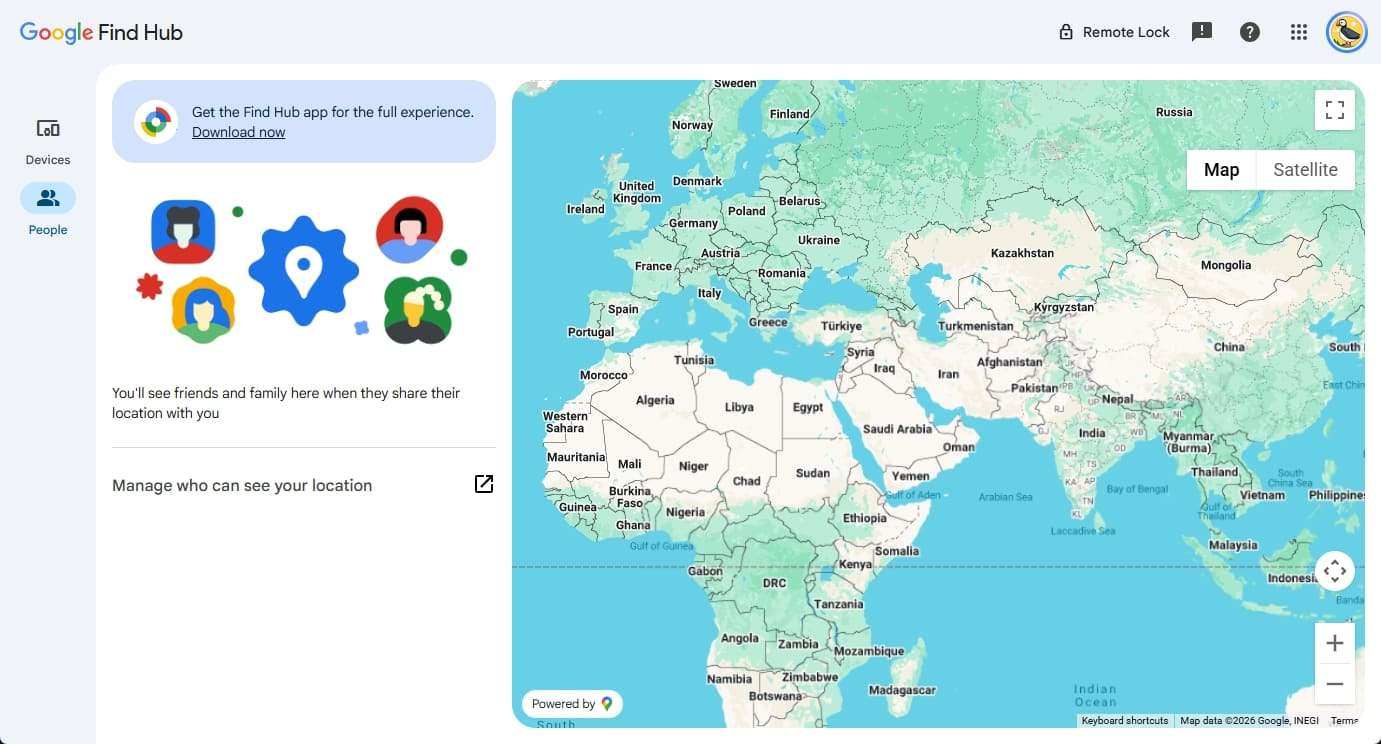
For an agreed person share: The People or Location Sharing area shows people who have shared with your account. Existing shares from supported Google services may appear there automatically. Select a person to inspect the available update time; a request for their location is a request they can decline, not an access override.
Keep device recovery and person sharing distinct. Finding a phone linked to your account is not permission to track an unrelated person's phone number. Google documents lost-device recovery and Find Hub person sharing separately.
Part 3. What Mobile Number Lookup Services Can Actually Tell You
Search results for a 'mobile number tracker Google Maps' can blur ordinary directory information with live device access. Judge a tool by the information source and permission model it discloses, not by whether its results are drawn on a map. A plausible pin does not establish that the handset supplied it.
| Service category | Possible output | Live GPS from a number alone? | Why the result is limited |
|---|---|---|---|
| Reverse number lookup | Directory, carrier or number-associated country information. | No. | A record about a number does not measure a device's present position. |
| Caller identification | A reported caller label or suggested region. | No. | Labels can be incomplete, stale or incorrect. |
| Carrier lookup | Network or number-type information where available. | No. | Network classification is not a GPS coordinate. |
| Registration-region checker | A country or approximate region associated with the number. | No. | The person may currently be somewhere entirely different. |
| 'Instant secret tracker' advertisement | An unsupported claim unless a legitimate location source and access are established. | Not through ordinary number lookup. | A map animation, fee or countdown does not demonstrate authorized live data. |
Why a Number Checker Cannot Produce a Current GPS Fix
A telephone number does not carry a continuously readable coordinate that a public website can extract. To display actual device location, a service needs device-derived information and a permitted route to disclose it. Directory data and GPS estimates therefore answer different questions.
Be wary of pages asking for account credentials, verification codes or a payment before revealing an alleged secret location. Use the official sharing or recovery workflow instead. If the other person does not agree to share, there is no Google Maps number-search workaround that grants you that access.
Part 4. Pick a Method by Relationship and Permission
The decision is about whose device it is and what access already exists, not which website accepts a number. This comparison maps common needs to a legitimate route and its key condition.
| What you need | Appropriate route | Condition to check |
|---|---|---|
| Meet a friend who agrees to share. | Direct Maps location sharing. | The friend initiates a share with your account and can revoke it. |
| Send your position to someone without a Google Account. | A temporary Maps sharing link. | Keep the link private and limit its duration. |
| Manage an eligible child's supervised device. | Family Link. | Set up the family relationship and device-location sharing. |
| Recover your own missing Android phone. | Find Hub's device view. | Use the associated account and distinguish current from recent information. |
| View an existing agreed person share. | Find Hub's People or Location Sharing view. | The person must actually be sharing with you. |
| Find someone who has not granted access. | No number-only Maps method. | Ask for consent rather than attempting an account or permission bypass. |
For your own privacy, revoke the share itself instead of relying on a changed map display. Google's account help notes that changing an individual app's location permission or using Maps Incognito does not necessarily stop Google Location Sharing. Review the active recipients and the account/device-specific Google Location Sharing setting.
Part 5. Manage Your Own Reported GPS, Not Another Person's Location
 Set your map route to simulate GPS movement.
- Set your wanted movement speed.
- HD and large map view to check location.
- Fake GPS location to anywhere.

Dr.Fone - Virtual Location is a GPS simulation tool for supported devices. Its desktop workflow lets you select a map destination, while one-stop and multi-stop modes can simulate movement along a chosen route. Joystick and keyboard controls support manual movement in compatible workflows.
This is relevant when you intentionally test how your own device or a location-based app responds to different coordinates. It does not retrieve another person's GPS, grant access from a mobile number, change your public IP or guarantee anonymity. To stop sharing your real location, use the service's sharing controls first; do not assume a simulated pin permanently freezes or replaces every Google location signal.
Two Steps to Test a Different Reported Position in Google Maps
Use an authorized supported phone and check its platform-specific connection requirements. These source screenshots illustrate the desktop Teleport workflow. Features can differ by operating system, and a successful change in one app is not proof that every background service uses the same location.
-
Step 1 Connect the phone and select Teleport Mode
Launch the desktop program, open Virtual Location and follow Get Started and the connection prompts. Complete only the settings requested for your supported device. Once the map is ready, select Teleport Mode and search for the destination or coordinates you intend to test.
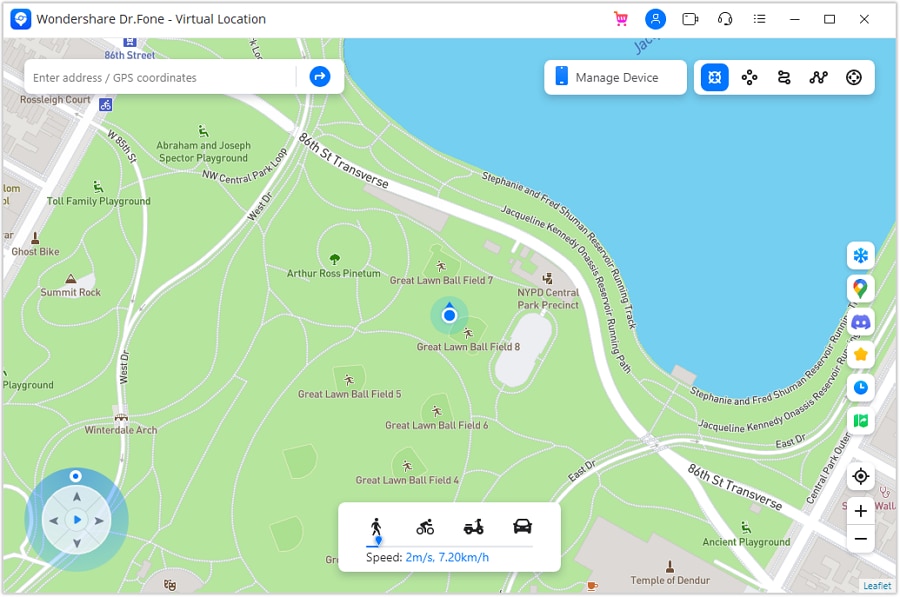
-
Step 2 Confirm the pin and inspect the phone
Submit the search, using Enter where appropriate, and check that the map pin is the intended destination. Select Move Here. Open Google Maps on your phone to inspect the reported position, recognizing that app refresh behavior and device settings can affect the result. Do not use a simulated location for emergency navigation or to misrepresent where someone else is.

When the test is finished, end the simulation and verify that normal location reporting has resumed before relying on navigation or sharing. If the privacy goal is to remove a viewer's access, return to the actual sharing settings and stop that share explicitly.




Conclusion
A mobile number identifies a contact; it does not authorize access to their current map position. Use a willing person's Maps share, an eligible Family Link setup or your own account-linked Find Hub device view. Always read the update time and sharing conditions rather than treating every pin as live.
Dr.Fone - Virtual Location serves a separate purpose: simulating your supported device's reported coordinates. It is not a phone-number locator or a substitute for revoking an unwanted location share.
FAQ
-
1. Can I locate someone in Google Maps just by entering their phone number?
No. The number can identify a contact, but a viewable position requires an authorized share or an appropriate supervised setup. A contact can decline a sharing request; entering their number does not override that decision. -
2. Does the viewer need a Google Account to open my Maps share?
Not when you send the supported location-sharing link. The person creating the share still needs the required setup, and anyone receiving the link may be able to view it during its active period. Send it privately and revoke it when finished. -
3. Which device details can a location recipient see?
Google Maps sharing can show your name, profile photo, recent device position, battery power and charging state. Review the sharing scope before enabling it, especially if you intended to disclose only a meeting place. -
4. Can Maps alert me when a person arrives or leaves?
For eligible account-based shares, arrival and departure notifications may be available. The person can control notification permission, and alerts stop when sharing stops. Google says these notifications are not available for certain accounts or when the location is shared through a link.
 Add Wondershare Dr.Fone as a preferred source on Google



