 Teleport your device anywhere instantly with one click.


 100% Security Verified | No Subscription Required | No Malware


 :

 ChatGPT
 Perplexity
 Gemini
 Claude
 Grok
How can I compare several delivery locations, measure the gaps between them, and see which addresses fall inside a circular service area?
Alex Rivers, Logistics Coordinator, source question paraphrased

A Google Maps distance radius is not the same as a driving distance. The built-in Measure distance command connects selected points with straight segments. A radius circle instead shows locations within a chosen straight-line distance of one center. For road mileage, travel time, or a delivery itinerary, use Directions rather than treating either measurement as a route calculation.
This 2026 guide separates those tasks before walking through the tools. You can draw coverage circles through Map Developers, export a coordinate-based circle through a KML generator, or measure two and multiple points directly in Maps. Choosing the right measurement first prevents a neat-looking map from producing an unrealistic service promise.
In this article
Part 1. Draw a Circle Around a Chosen Map Location
Start with a circle when your question is about coverage: homes near an office, customers around a shop, or sites within reach of a depot. The center represents your reference location, while the radius is the distance from that center to the boundary. A five-mile radius therefore spans ten miles across its diameter.
The standard consumer Maps interface does not offer a dedicated radius-circle control. A separate mapping website supplies that drawing function; it is not an extra button you can enable inside the phone app. Map Developers provides address search, adjustable circles, and a link for revisiting the resulting map.
Step 1 Open the circle-drawing website
Load the Map Developers circle tool in your browser. Work in its own interface rather than searching for these controls in Google Maps. The screenshot below illustrates the external tool, not a native Maps radius menu.

Step 2 Verify the circle's center
Search for the address or select a position directly on the map. Zoom in until you can distinguish the intended building or entrance from a neighboring property. If the marker lands in the wrong place, reposition it before deciding whether nearby addresses qualify.
Step 3 Enter the radius and create the overlay
Choose the distance unit, enter the required radius, and use New Circle. Adjust the boundary and fill colors if those controls are available. Confirm that you entered the center-to-edge distance, not the full width of the service area.

A circle is useful for an initial geographic filter, but rivers, restricted roads, and indirect street layouts can make a short straight-line distance a much longer journey. Check actual travel routes before setting delivery fees, arrival commitments, or commuting expectations.
Part 2. Set and Compare Radius Distances
Once the center is correct, the important variables are the radius value, its unit, and how the circle will be reused. For a quick coverage comparison, edit circles in the browser. For a reusable layer, generate a file and inspect the imported geometry. Neither approach turns a distance boundary into a travel-time boundary.
2-1. Adjust Coverage in Map Developers
To compare a smaller and larger service zone, edit the existing radius or add another circle around the same center. The tool's own instructions describe changing the numeric field and applying Edit Circle, or dragging the marker on the circle's edge. Make sure a drag has not also shifted the center unintentionally.
Multiple circles help expose overlaps between branches and gaps between service territories. Save the generated map link if colleagues need to review the same arrangement. When sharing it, state the units and explain that coverage means straight-line proximity, not a guaranteed driving distance.

2-2. Export a Circle Through a KML Generator
A KML circle generator is another option when you already have latitude and longitude and need a transferable shape. Supply the center coordinates, select the distance unit, enter the radius, and export the result. Review the generator's coordinate order: confusing latitude with longitude can place the shape far from the intended site.
For My Maps, open or create your map on a computer, add a layer, choose Import, and select the KML file. Inspect the boundary after import. A generated circle may be approximated by a polygon, and file support does not establish surveying accuracy. Google Earth is a separate application with its own import workflow.
- Accuracy: coordinate quality, circle approximation, and map interpretation affect the result; entering many decimal places does not prove sub-meter precision.
- Sharing: a KML file lets another person inspect the same saved geometry rather than recreating the circle manually.
- Reuse: an imported layer can retain a planning boundary, provided the target application accepts the file and renders its features correctly.


Part 3. Measure Two Addresses or a Multi-Point Path
Use the native measurement function when you need the separation between specific map positions. For an address-based comparison, search each address and identify the correct point first. Measure distance operates on the positions you click; it does not automatically verify postal addresses, optimize stop order, or follow the streets between them.
Google's help documentation supports a path with two or more points and shows the cumulative total in miles and kilometers. Additional clicks add segments to that path. The result is useful for a rough perimeter or a manually traced line, but it is not a turn-by-turn itinerary.
Step 1 Establish the starting marker
On a computer, open Maps and locate the first address. Right-click the precise starting position and choose Measure distance. Check the marker location before continuing, especially when a large site has several entrances.

Step 2 Add the second position
Click the destination point. Read the total on the bottom card and check both units. If a marker is misplaced, drag it to the correct location; clicking an existing point removes it. These adjustments change the selected geometry rather than correcting the underlying address data.

Step 3 Extend and review the path
Select further positions in the order you want measured. Each segment contributes to the running total. Review the complete line for accidental clicks, then close the measurement card when finished. If your real goal is a multi-stop delivery trip, switch to Directions and assess road mileage separately.

 Set your map route to simulate GPS movement.
- Set your wanted movement speed.
- HD and large map view to check location.
- Fake GPS location to anywhere.

For a different task, such as demonstrating how your own phone's location-aware interface responds to another position, Dr.Fone - Virtual Location offers GPS position and route simulation on supported devices. Its map controls let you select a position or plan movement with a chosen speed. This does not add a radius button to Maps or improve the accuracy of Google's measurement function.
Keep this as an authorized test workflow, separate from real navigation or delivery records. Check the current device requirements before installation, connect your own supported phone using the application's instructions, select the intended test location or route, and verify the result in your test app. Do not rely on a simulated blue dot for actual travel.
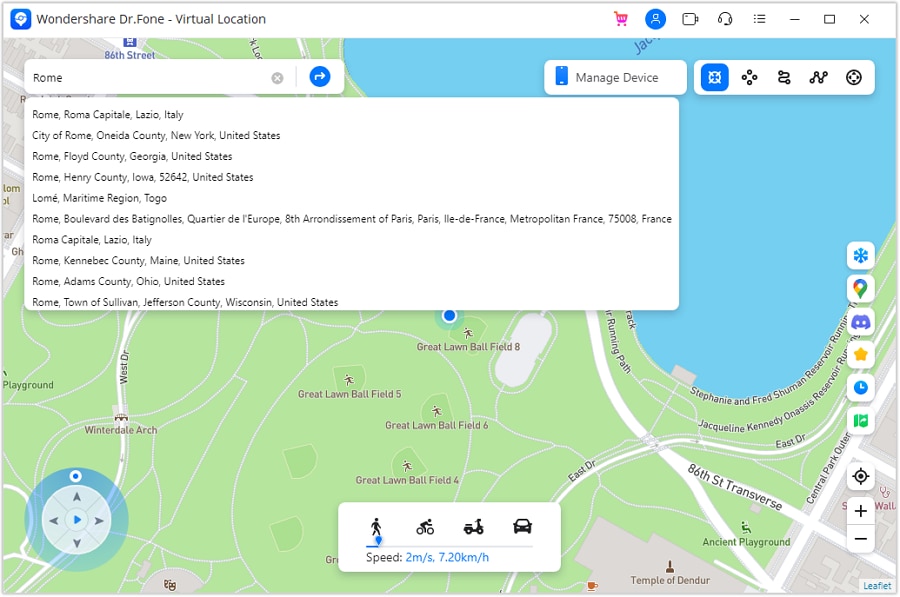
When the demonstration ends, stop the simulation and confirm that the phone again reports its real position before using navigation, location sharing, or emergency services. The product is not a surveying instrument, a travel-time calculator, or a way to validate a service-area promise.




Conclusion
Choose a circle tool for radius coverage, the native measurement command for straight-line segments, and Directions for road journeys. Verify the center, units, and clicked positions before drawing a business conclusion. KML can preserve a reusable boundary, while GPS simulation serves a separate, controlled testing purpose rather than changing the meaning of any distance result.
FAQ
1. Where is the radius control in Google Maps?
The standard consumer interface has no dedicated circle-drawing control. Open an external radius website or prepare an appropriate imported map layer instead. A circle shown on an external map is not a native Maps setting.2. How do I measure the gap between two addresses?
Locate the first address on a computer, right-click its position, and choose Measure distance. Click the second position to read the straight-line separation. Use Directions if you need driving mileage rather than that direct gap.3. Does adding locations calculate a delivery route?
No. Each additional point extends a manually selected series of straight segments. The total does not automatically account for roads, stop order, traffic, or access restrictions.4. Can a phone measure distances and draw radius circles?
The Maps app offers point measurement: drop a pin on an unlabelled position, open the place card, select Measure distance, and add points. Circle drawing still requires a separate compatible tool, which you can try through the phone's browser.
 Add Wondershare Dr.Fone as a preferred source on Google



