Effortlessly manage data through preview, delete, export, etc.

 100% Security Verified | No Subscription Required | No Malware

 :
: 
 ChatGPT
 Perplexity
 Gemini
 Claude
 Grok
Grok

I keep finding the same photos and downloads on both my phone and tablet, but I’m scared to delete anything because I don’t know which copy is the “real” one.
Reddit user, r/android
Avoiding duplicate files across a phone and tablet sounds simple, but missing one step (like choosing a single “source of truth” or skipping a verification scan) can create bigger messes than you started with.
AI helps by turning a vague goal (“stop duplicates”) into a clear workflow: what to check first, what decisions to make, what to back up, and how to confirm results before you change anything.
AI can’t see your storage, apps, or sync settings—and it can’t safely perform device actions. Once the plan is verified, execution needs real tools that can actually move, merge, and back up your files.
In this article
- How to plan without missing critical steps
- Why duplicates happen across devices
- What order to check and act in
- Identify “point-of-no-return” actions
- Protect originals before any removal
- What the AI needs to know
- Using AI prompts to build a safer workflow
- AI plan vs. real device constraints
- Execute the workflow safely with Dr.Fone

Part 1. How to Plan avoid duplicate files across phone and tablet Without Missing Critical Steps
You might have photos, downloads, and documents scattered across a phone and a tablet—some synced via cloud apps, some moved manually, and some copied multiple times through chat apps. You want “one clean set” without losing anything.
The uncertainty usually isn’t “what is a duplicate?” but “in what order do I check and act?” If you delete first, you can accidentally remove the only full-resolution version, or break a sync that was preserving the newest edits.
Your point-of-no-return moment is any bulk deletion, “merge and remove originals” action, or emptying a recently deleted/trash folder before you’ve confirmed you can restore the correct versions.
Part 2. What the AI Needs to Know
Share the specifics below so the AI can plan a safe, verifiable workflow tailored to your setup:
- Devices and OS versions (e.g., Android phone + Android tablet, or iPhone + iPad)
- Main file types involved (photos, videos, PDFs, audio, app documents)
- Where files currently live (internal storage, SD card, specific apps, cloud drives)
- What sync services are enabled (Google Photos/iCloud Photos/OneDrive/Dropbox, etc.)
- Your preferred “source of truth” (phone, tablet, or a cloud folder/PC backup)
- Your tolerance for change (do you want to keep both copies in some cases?)
- Constraints (storage space, slow internet, limited time window)
- What “duplicate” means for you (same filename, same content, same photo at different resolutions)
- Any must-not-lose areas (WhatsApp/LINE media, work folders, camera originals)
Part 3. Using AI Prompts to Build a Safer avoid duplicate files across phone and tablet Workflow
Use the prompts below to make the AI produce a sequence with checkpoints, not generic advice.
3-1. Level 1: Basic Prompt
I need a planning checklist to avoid duplicate files across my phone and tablet without deleting anything by mistake. Ask me the minimum questions you need, then give a step-by-step order with verification checks before any removal.
3-2. Level 2: Advanced Prompt
Design a structured workflow to prevent and clean up duplicate files across my phone and tablet.
Split the plan into Preparation, Execution, and Verification, and label steps as critical vs optional. Include decision points for: choosing a single source of truth, handling cloud sync conflicts, and dealing with “same photo but different resolution” duplicates.
3-3. Level 3: Evidence Prompt
Here’s my situation:
- Devices: (Android phone, Android tablet)
- Files: (photos/videos + PDFs)
- Storage locations: (DCIM/Camera, Downloads, WhatsApp Images, Google Drive folder “Docs”)
- Sync: (Google Photos on phone only; Drive on both)
- Source of truth preference: (Phone camera originals; Drive for PDFs)
- Constraints: (Only 5 GB free on tablet; slow Wi‑Fi)
Create an evidence-based plan with:
- Checks before execution (what inventories to gather, what settings to screenshot, what folder counts to record)
- Checks during execution (how to confirm you’re moving the right direction, what to pause if counts mismatch)
- Checks after execution (spot-check rules, conflict review, and how to confirm duplicates are not re-created next week)
Also list the high-risk “do not do yet” actions (e.g., bulk delete, empty trash) and exactly what must be verified before each one.
3-4. Prompt Refinement
Give me a decision tree: if files are in (cloud + local) vs (local only), what sequence changes, and what’s the safest branch?
Produce a one-page runbook with headings: Goal, Source of Truth, Inventory, Safety Backup, Execution Steps, Verification, Rollback Plan.
Define my duplicate rules as tests (same hash/content, same creation date, same filename) and tell me which rule to use for (photos vs PDFs).
Add a stop condition after each step (e.g., “If totals differ by >5%, stop and re-scan”), and specify what data to collect before continuing.
List common re-duplication causes in my setup (chat app auto-downloads, multiple photo backup apps, “Download originals” toggles) and the exact settings I should verify.
Part 4. AI Plan vs. Real Device Constraints
| Planning with AI | Reality on devices |
|---|---|
| Creates a safe order of operations and decision points | Needs access to storage locations, permissions, and device states |
| Defines what to verify (counts, settings, sample checks) | Actual file counts vary by hidden caches/app folders |
| Flags irreversible moments (bulk deletion, emptying trash) | Those actions happen in real apps/tools and may be hard to undo |
| Produces rollback and “stop conditions” | Rollback depends on having a real backup and working transfer method |
AI improves planning, but it cannot scan your devices, move files, merge libraries, or confirm what actually changed—execution requires device-level tools.
4-1. When to Stop Planning avoid duplicate files across phone and tablet and Start Execution
- You have defined a single source of truth for each file type (e.g., photos = phone originals; documents = Drive folder).
- You’ve captured an inventory baseline (folder locations, approximate counts, and any sync settings that matter).
- You have a rollback path (backup location + you know how to restore at least a small sample).
- You have written down your high-risk actions and the exact verifications required before doing them.
If these are true, you’re at the point where planning stops being helpful and controlled execution becomes the next risk-managed step.
Part 5. Avoid duplicate files across phone and tablet: Execute the Workflow Safely with Dr.Fone
Execution now matters because duplicates are usually created by real transfers and sync collisions; once you start moving or removing files, you need consistent handling and a way to back out if results don’t match your baseline. If you need a practical way to back up and transfer data between devices, Dr.Fone - Phone Transfer can help you carry out the plan you built with AI.
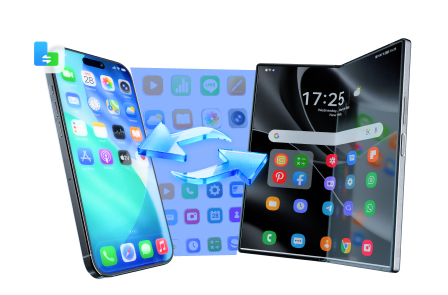
 Move data between iOS to Android and vice versa.
- Transfer contacts, SMS, photos, videos, music, and more types.
- Available with all phones with Android and iOS versions.
- Simple, click-through process.
5-1. Create a safety backup baseline
Action: Use Dr.Fone to back up the device(s) according to your plan before any cleanup or consolidation.
Limitation: AI cannot confirm what was actually included in the backup or whether app-specific data is captured the way you expect.
5-2. Transfer/consolidate toward the source of truth
Action: Use Dr.Fone to transfer files so that your chosen source of truth contains the complete, correct set before you remove any duplicates elsewhere.
Limitation: AI cannot see transfer results, detect mismatched versions, or verify that cloud sync won’t re-download copies afterward.
5-3. Verify first, then perform any irreversible removal
Action: Use Dr.Fone only after verification to proceed with cleanup actions that remove duplicates, and do not empty any trash/recently-deleted area until spot checks pass.
Limitation: AI cannot validate you selected the right items, and bulk deletion is a point of no return if your backup/restore test wasn’t proven.
-
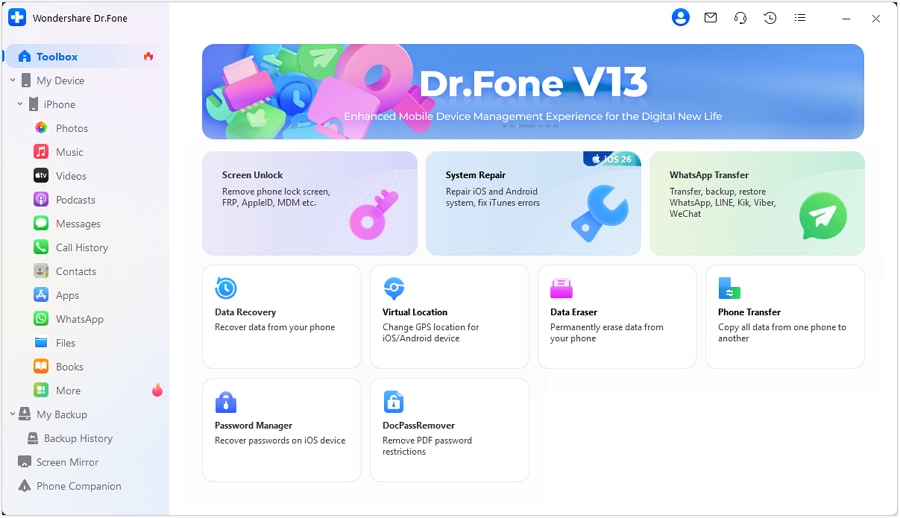
Step 1 Launch the phone transfer tool on your computer
Open Dr.Fone and go to the Phone Transfer feature so you can run the transfer in a controlled, repeatable way.
-
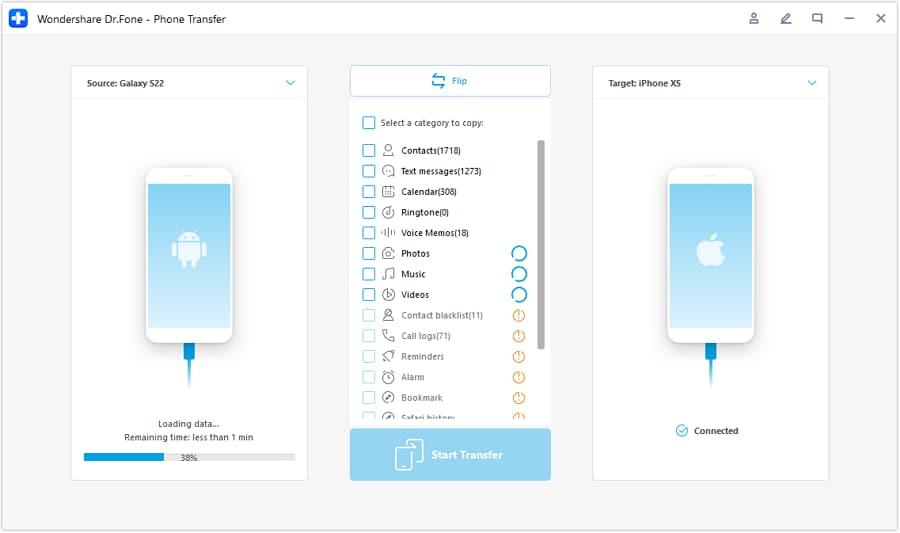
Step 2 Set the device path (source → destination)
Match the direction to your “source of truth” decision (for example, phone → tablet if the phone holds camera originals).
-
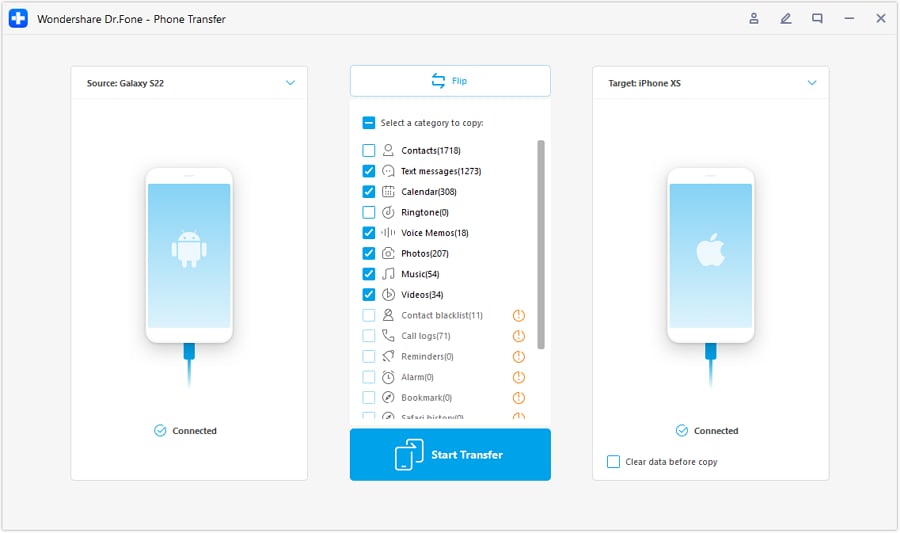
Step 3 Choose data types and start the transfer
Select the categories you intend to consolidate (based on your inventory baseline) and begin the transfer.
-
Step 4 Monitor transfer progress and then verify against your baseline
After completion, verify using your planned checks (counts, spot checks, and conflict review) before you do any irreversible removal elsewhere.




Conclusion
Use AI to define the safest sequence, the verification gates, and the “don’t cross yet” irreversible moments; then use a real tool like Dr.Fone to execute transfers and backups on your devices in a controlled, verifiable way.
FAQ
-
What’s the biggest cause of duplicates across a phone and tablet?
Overlapping sync paths (e.g., Photos app backup + a cloud drive auto-sync + manual copy) and messaging apps that re-save media into multiple folders. -
How do I verify I’m not deleting the only “best” version of a file?
Decide your “best version” rule first (resolution, edit recency, original metadata), then spot-check a sample set in each category before any bulk removal. -
When is it safe to do bulk deletion?
Only after you (1) backed up, (2) transferred/consolidated to the source of truth, and (3) verified with counts + spot checks that the complete set exists where you expect. -
What should I record before I touch anything?
Folder paths, approximate item counts, sync settings screenshots, and which device/app is the source of truth for each file type. -
Why can’t AI just tell me exactly what to delete?
AI can’t access your actual files, versions, metadata, or app folders; it can only help you plan what to check and in what order.
 Add Wondershare Dr.Fone as a preferred source on Google