Effortlessly manage data through preview, delete, export, etc.

 100% Security Verified | No Subscription Required | No Malware

 :
: 
 ChatGPT
 Perplexity
 Gemini
 Claude
 Grok
Grok

I tried to delete duplicates to free up space, but I’m scared I’ll remove the only good copy or the edited version by mistake.
Apple Support Community user
Cleaning up duplicate photos on an iPhone sounds simple, but one missed step can mean deleting the wrong images or losing “only copy” photos you meant to keep.
AI helps by turning a vague goal (“remove duplicates”) into a clear sequence with decision points, verification checks, and a definition of what “safe to delete” actually means for your situation.

1. Start with a safety-first definition of “duplicate.”
Separate exact duplicates from near-duplicates (bursts, edits, Live Photos, app saves), and write clear keep/delete rules so you don’t delete the better version.
2. Give AI the minimum context it needs to produce a checkable plan.
Share iOS version, iCloud Photos status, storage pressure, duplicate sources, backup status, and risk tolerance so the workflow includes the right stop points.
3. Use prompts + refinement to add gates, sampling checks, and batch limits.
AI can design decision rules and verification steps, but it can’t see your library—so you must validate results on-device before any irreversible action.
In this article
- Plan the workflow without missing critical steps
- Why duplicates are tricky (exact vs near-duplicate)
- Fix the sequence (prep → cleanup → verify)
- Define the “point of no return”
- Write rules before you delete
- What the AI needs to know
- Prompts to build a safer workflow
- AI plan vs. real device constraints
- Execute safely with Dr.Fone (steps)
Part 1. How to plan find and remove duplicate photos on iPhone without missing critical steps
You’re trying to free up iPhone storage, and you suspect your library has a mix of exact duplicates, near-duplicates (burst shots, edits, Live Photos), and app-imported copies (WhatsApp/Instagram downloads). The problem is you don’t want to lose important originals while cleaning.
After an AI answer, it’s common to still feel unsure about sequence: Should you back up first? Should you merge iOS “Duplicates” or clean albums first? How do you confirm you’re not deleting the higher-quality version?
There’s also a point of no return moment: once you delete large batches and then empty Recently Deleted (or the retention window passes), recovery may be impossible—so you should not reach that step until verification is complete.

Part 2. What the AI needs to know
Share the minimum facts needed to design a safe workflow for your Photos library and risk tolerance:
- iPhone model and iOS version (e.g., iPhone 13, iOS 17.5)
- Photo storage status (approx. Photos storage used / free space)
- iCloud Photos status (On/Off) and available iCloud storage
- Where duplicates come from (e.g., multiple imports, messaging apps, burst mode, edits)
- What “duplicate” means to you (exact only vs. similar/near-duplicate)
- Must-keep rules (e.g., keep originals, keep highest resolution, keep favorites, keep edited versions)
- Your backup situation (recent backup to iCloud/Finder/PC, or none)
- Your risk tolerance (conservative cleanup vs. aggressive space recovery)
- Time constraints (need space today vs. can review slowly)
Part 3. Using AI prompts to build a safer find and remove duplicate photos on iPhone workflow
Use the prompts below to make the plan specific, checkable, and hard to misinterpret.
3-1. Level 1: Basic prompt
Help me plan a safe workflow to find and remove duplicate photos on my iPhone without deleting important originals.
I want a step-by-step sequence with checks before I delete anything.
Keep it planning-only—no tool instructions.
3-2. Level 2: Advanced prompt
Design a workflow to remove duplicate photos on my iPhone with three sections: **Preparation**, **Execution**, and **Verification**.
Mark each step as **Critical** or **Optional**, and include “stop points” where I should pause to verify before continuing (especially before any irreversible deletion).
3-3. Level 3: Evidence prompt
Create a conservative duplicate-photo cleanup plan for my iPhone using my context below, and include checks **before**, **during**, and **after** cleanup.
Context: iPhone (iPhone 12), iOS (17.4), Photos storage (~38 GB), iCloud Photos (On), iCloud storage (almost full), duplicates likely from (WhatsApp saves + repeated imports), priority rules (keep highest resolution, keep Live Photos over stills, keep edited versions, never delete Favorites).
Also include: how to define “duplicate vs similar,” what evidence I should confirm (file info, resolution, date, album membership), and what I must do before I reach the point of no return (emptying Recently Deleted).
3-4. Prompt refinement (follow-ups)
Convert this into a checklist with **gates**: “If X is true, do Y; if not, stop and fix Z,” especially for iCloud Photos and backups.
Give me a decision rule for each conflict: **original vs edited**, **Live Photo vs still**, **higher resolution vs smaller file**, **same photo in multiple albums**.
Provide a “sampling verification” plan: how many items to spot-check per batch (e.g., 20 per 500 deletions) and what to look for before proceeding.
Create a batch strategy that limits risk: maximum deletions per session, when to pause, and what to document (counts, screenshots, dates).
Add a “recovery readiness” section: what conditions must be true before I delete anything (backup present, sync stable, enough time to review Recently Deleted).
Part 4. AI plan vs. real device constraints (and when to stop planning)
4-1. AI plan vs. real device constraints
| Planning item (AI can help) | Reality check (device/tool constraint) |
|---|---|
| Define what counts as “duplicate” and what must never be removed | The Photos app may group only exact duplicates; near-duplicates require judgment |
| Sequence preparation → cleanup → verification with stop points | Your library size and iCloud sync state can slow changes and complicate timing |
| Create batch sizes, sampling checks, and decision rules | Actual photo metadata/quality differences must be verified on-device |
| Identify irreversible moments and guardrails | Once Recently Deleted is cleared (or expires), recovery may not be possible |
AI improves planning, but cannot execute changes inside your Photos library, confirm what’s truly safe to delete, or perform recovery—those require real device access and tools.
4-2. When to stop planning and start execution
- You have a written definition of “duplicate” that fits your goal (exact-only or includes similar), plus keep/delete rules.
- You have confirmed your backup and sync situation, and you know how recovery would work if something goes wrong.
- You have a verification method (spot-check sampling + batch limits) and know your stop points.
- You can name the irreversible moment you will not cross until final verification (e.g., clearing Recently Deleted).
If all four are true, you’re no longer deciding what to do—you’re ready to carry out the plan with controlled risk.
Part 5. Find and remove duplicate photos on iPhone: execute the workflow safely with Dr.Fone
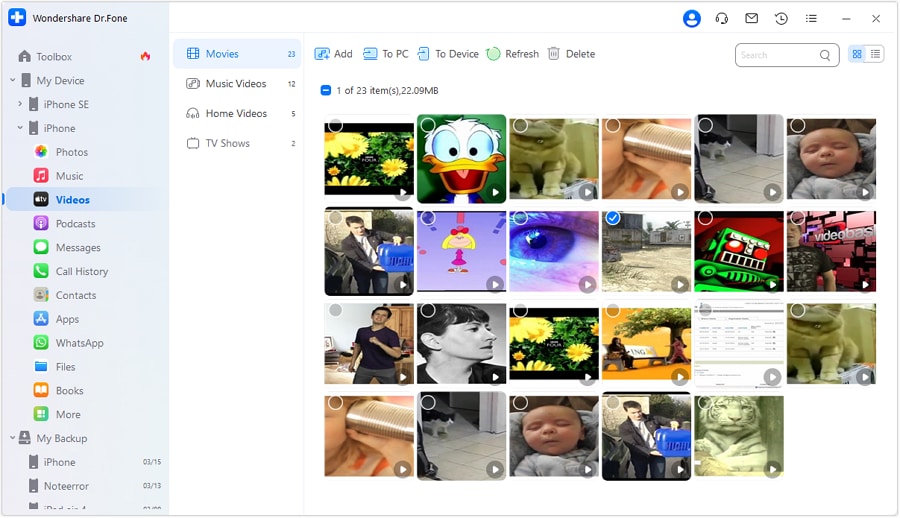
Execution now matters because the safest plan still fails if you rush deletions, skip verification, or hit the irreversible step before confirming results. To execute the workflow with more control, you can use Dr.Fone Basic - Data Manager as your on-device management layer while you follow the rules and stop points you defined with AI.
 Easily manage data through preview, delete, export, etc.
- Transfer all data between devices.
- Robust backup solutions for reliable data protection.
- Mirror screens to PC for meetings, teaching, and control.

-
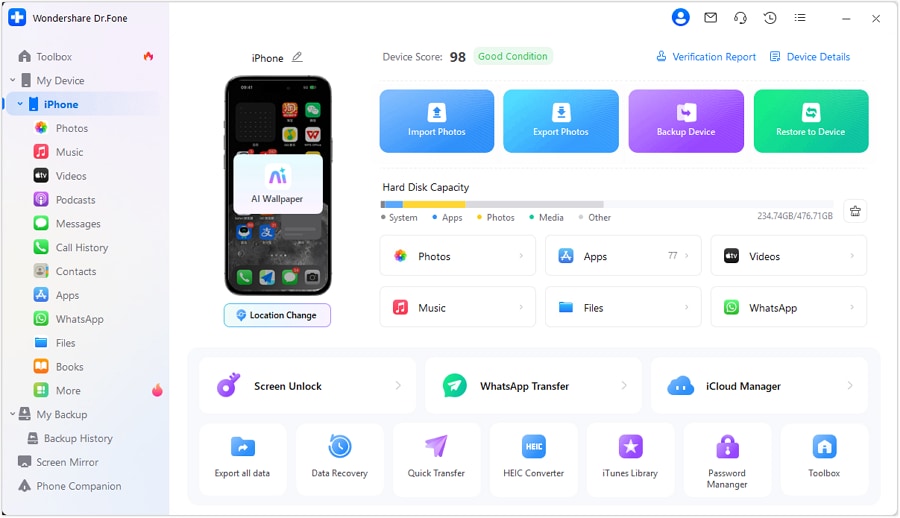
Step 1 Pre-execution safety check (backup/sync + must-keep rules)
Confirm your backup/sync status and apply your “must-keep” rules so you know what you’re protecting before any cleanup actions. AI cannot confirm your backup integrity or iCloud sync state—verify on your actual device and in your chosen tools.
-
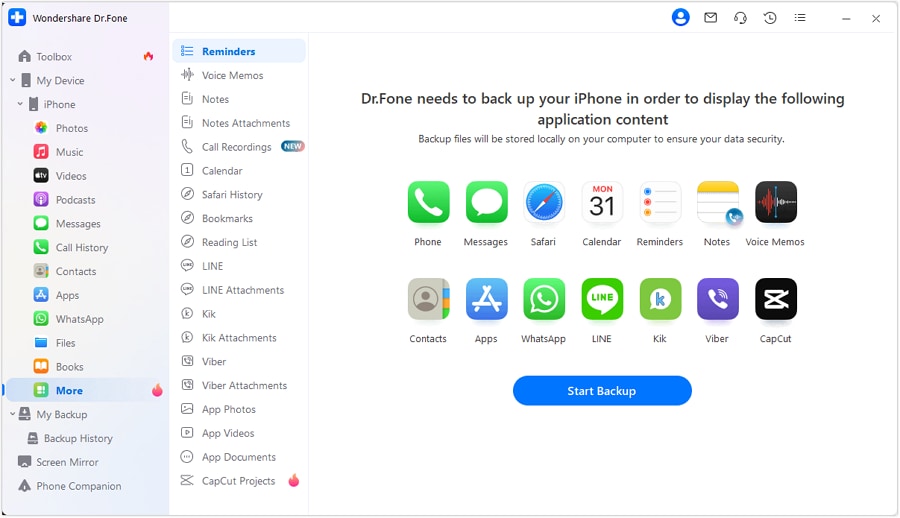
Step 2 Open device management and prepare for controlled batches
Set up your execution session so you can work in batches and pause for your sampling checks at preset intervals (instead of deleting everything at once).
-
Step 3 Run duplicate cleanup in controlled batches (review before confirming)
Follow your AI-defined decision rules (edited vs original, Live Photo vs still, resolution conflicts, Favorites protection). AI cannot see which files are flagged or validate matches—review results against your rules before confirming removals.

-
Step 4 Post-execution verification before the point of no return
Verify storage gained and confirm key albums/Favorites/edits are intact. Only then decide whether to clear Recently Deleted. Clearing it (or waiting past retention) can be irreversible.




Conclusion
Use AI to define duplicates, set keep/delete rules, add stop points, and build verification checks; then use Dr.Fone to execute the cleanup on-device—because planning reduces risk, but only real tools can safely carry out the changes.
FAQ
-
Do I need a backup before removing duplicates?
If you care about avoiding irreversible loss, yes—especially before large deletions or any step that could permanently remove photos. -
Are “Duplicates” and “Similar photos” the same thing on iPhone?
Not necessarily. Exact duplicates can be detected reliably, but similar/near-duplicates often need human judgment and clear rules. -
What’s the biggest irreversible mistake in this workflow?
Deleting in bulk and then clearing Recently Deleted (or letting it expire) before verifying that important originals, edits, and Favorites are still present. -
How do I verify safely without reviewing thousands of photos?
Use batch limits and sampling: spot-check a set number per batch, prioritize edge cases (edits, Live Photos, screenshots, sent/received images), and stop if you see mismatches. -
Can AI tell me which duplicates are safe to delete?
No. AI can define rules and checks, but it cannot inspect your library, compare image fidelity, or confirm which version is truly best.
 Add Wondershare Dr.Fone as a preferred source on Google