Effortlessly manage data through preview, delete, export, etc.

 100% Security Verified | No Subscription Required | No Malware

 :
: 
 ChatGPT
 Perplexity
 Gemini
 Claude
 Grok
Grok

I thought I was just deleting extra Burst shots, but I ended up removing the best frame—and then it disappeared on my other devices too.
Apple Support Community user
Cleaning up Burst photos on iPhone sounds simple, but one missed step can delete the best frame, remove it across synced devices, or make it hard to recover later.
AI helps by turning “I just want to free space” into a clear sequence: what to check first, what to back up, what to delete, and how to confirm nothing important is gone.
AI can’t access your Photos app, iCloud settings, or storage state, so it can’t actually select, export, or delete anything—execution needs real device tools once the plan is verified.
In this article
- How to plan burst cleanup without missing critical steps
- Why burst cleanup feels risky with iCloud Photos
- Identify your point of no return
- Define your keeper rule and target
- Pick a batch size you can review safely
- What the AI needs to know
- Using AI prompts to build a safer workflow
- When to stop planning and start execution
- Execute the workflow safely with Dr.Fone

Part 1. How to Plan how to clean up burst photos on iphone Without Missing Critical Steps
You have dozens (or thousands) of Burst sets from sports, kids, pets, or travel, and storage is tight. You want to keep the best shots, remove duplicates, and avoid accidentally deleting favorites.
The uncertainty is usually not “how do Bursts work,” but “what order should I do this in?”—especially if iCloud Photos is enabled and deletions might sync to other Apple devices.
1-1. Why burst cleanup feels risky with iCloud Photos
If iCloud Photos is enabled, deletions may sync to other Apple devices (like a Mac or iPad) on the same Apple ID. That’s why the safest plan starts with confirming your sync setup before you delete anything.
1-2. Identify your point of no return
The point-of-no-return moment is when you permanently remove photos by clearing Recently Deleted (or when deletions sync across devices and you realize later a keeper was removed).
1-3. Define your keeper rule and target
Before you touch deletion, decide what “keepers” means for you (sharpest frame, best expression, least motion blur, etc.). This reduces mis-taps and second-guessing during cleanup.
1-4. Pick a batch size you can review safely
Set a batch size you can review without rushing (for example, a fixed number of Burst sets per session). This helps you add verification checkpoints and limits the impact if something goes wrong.
Part 2. What the AI Needs to Know
Answer these so the workflow can be planned safely:
- Your iPhone model and iOS version (e.g., iPhone 13, iOS 17)
- Whether iCloud Photos is on, and if you use other Apple devices (Mac/iPad) linked to the same Apple ID
- Your current storage pressure (e.g., “iPhone storage almost full” vs “just decluttering”)
- Whether you need the originals preserved somewhere (computer drive, external drive, cloud)
- How you shoot Bursts (sports, kids, product photos) and what “keepers” means for you
- Your tolerance for risk (must-not-lose vs okay-to-prune aggressively)
- Your time window (quick cleanup in 15 minutes vs careful review over multiple sessions)
Part 3. Using AI Prompts to Build a Safer how to clean up burst photos on iphone Workflow
Use the prompts below to force a clear order of operations and prevent irreversible mistakes.
3-1. Level 1: Basic Prompt
I need a safe workflow to clean up Burst photos on my iPhone while keeping the best frames.
Please give me the correct sequence of steps and the main risks to avoid, especially around iCloud syncing and “Recently Deleted.”
3-2. Level 2: Advanced Prompt
Build me a structured workflow to clean up Burst photos on iPhone with three phases: preparation, execution, and verification.
Mark each step as critical or optional, and call out any irreversible actions (like permanently deleting from Recently Deleted) that must not happen until verification is complete.
3-3. Level 3: Evidence Prompt
I’m on (iPhone 12, iOS 17.5) with (iCloud Photos ON) and I also use (a MacBook Photos app) on the same Apple ID. Storage is (1.5 GB free), and I have about (300 Burst sets).
Create a cleanup plan with checks before, during, and after deletion.
Include: how to confirm which device(s) will be affected, how to confirm my keepers are safe (e.g., exported/backed up), and a clear “stop” rule before any permanent deletion (Recently Deleted emptying).
Also list quick spot-checks I can do after each batch (e.g., after every 20 Burst sets).
3-4. Prompt Refinement
Ask me 10 yes/no questions first, then output a workflow that matches my risk level and iCloud setup; include a “do not proceed if” checklist.
Give me a batch-based plan (e.g., 20 Burst sets per batch) with a verification checkpoint after each batch and an end-of-day checkpoint before I continue.
Produce a decision tree for iCloud Photos ON vs OFF, and tell me exactly where the point-of-no-return is in each branch.
Write a verification script: the exact things I should check in Photos (Albums, Recents, Favorites, Recently Deleted) before any permanent deletion step is allowed.
3-5. AI Plan vs. Real Device Constraints
| Planning Item | What AI Can Do | Real-World Constraint | What You Must Verify |
|---|---|---|---|
| Identify safest sequence | Propose an order (backup → select keepers → delete → verify) | Your iCloud/Photos settings differ by device | iCloud Photos status, sync behavior, available storage |
| Reduce deletion risk | Add checkpoints and stop rules | One mis-tap can delete a whole Burst set | Keepers saved, backups exist, Recently Deleted not cleared early |
| Define verification steps | Provide a checklist | Photos indexing/sync can lag | Confirm changes on iPhone and any synced devices |
| Scope the cleanup | Suggest batch sizes and criteria | Actual Burst count and time vary | Confirm you’re targeting Bursts (not Live Photos/favorites) |

Part 4. When to Stop Planning how to clean up burst photos on iphone and Start Execution
- You have confirmed whether iCloud Photos is ON and understand whether deletions will sync to other devices.
- You have a backup path decided (and tested) for any Burst sets you might regret deleting.
- You have a clear “keepers rule” (what qualifies as keep) and a batch size you can review without rushing.
- You have a verification checklist, including a rule that Recently Deleted will not be cleared until final review is complete.
At this point, the remaining risk comes from execution mistakes, not from missing planning details.
Part 5. How to clean up burst photos on iphone: Execute the Workflow Safely with Dr.Fone
Execution matters now because the safest plan still fails if files aren’t backed up correctly, selections aren’t reviewed, or deletions happen before verification.
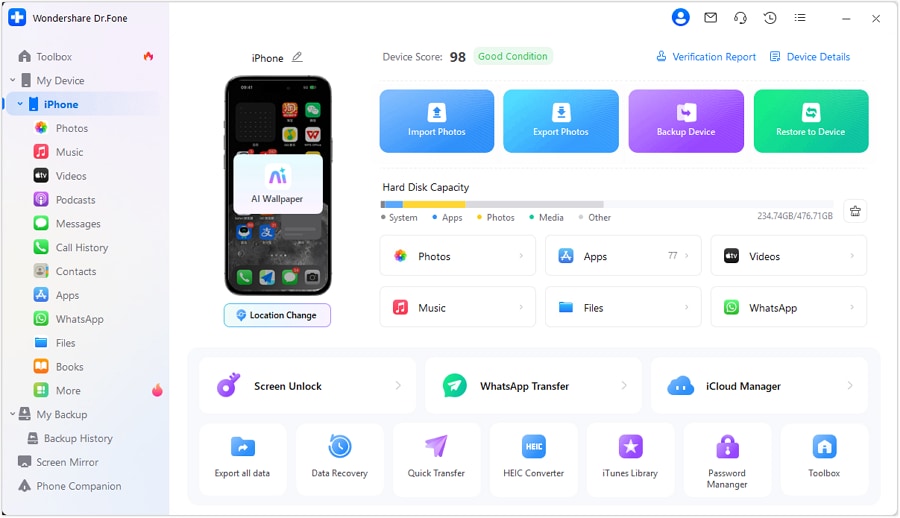
If you want a device-side way to back up, review, and remove confirmed rejects more carefully, use Dr.Fone Basic - Data Manager.
-
Step 1 Create a safety copy first
Back up or export your photo library (or at least your most important albums/date ranges) to a computer before you start deleting Burst content.
AI can tell you what to protect, but it cannot confirm that your backup/export actually completed and is readable.
-
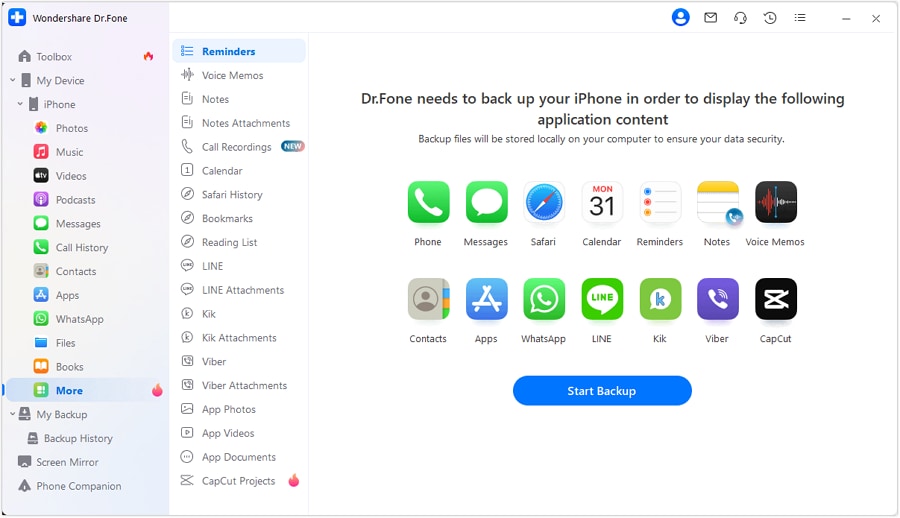
Step 2 Review Bursts in controlled batches
Browse your photos and work in small batches to identify keepers and separate them from obvious rejects before deleting.
AI can suggest criteria (sharpness, eyes open, duplicates), but it cannot see your images or judge which frame you personally need.
-
Step 3 Export/confirm keepers before deleting rejects
Before you delete anything irreversible, make sure your chosen keepers are safely exported/backed up in the location you decided during planning.

-
Step 4 Delete, then verify before any permanent removal
Delete the confirmed rejects, then verify on-device that keepers remain and that you have not triggered unintended synced deletions.
Do not clear “Recently Deleted” until verification passes.
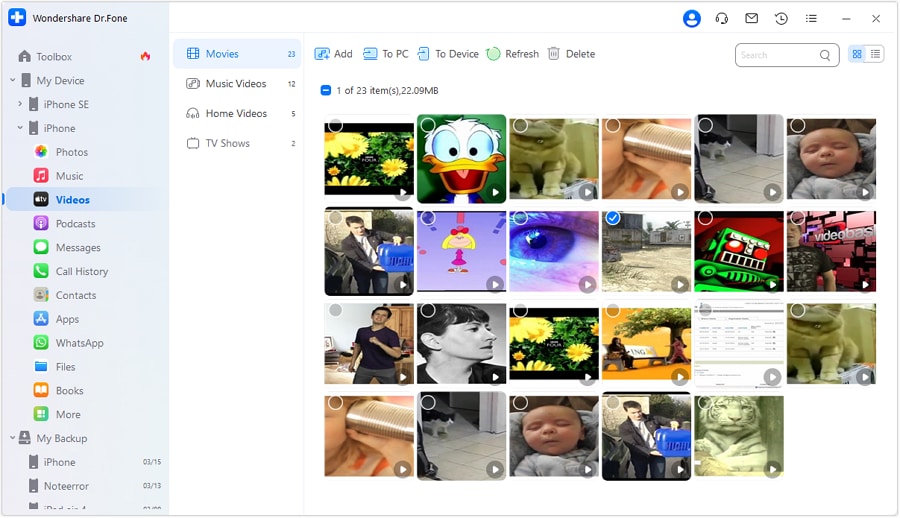
Recommended tool for safer execution
Once your AI-generated plan is ready, Dr.Fone Basic - Data Manager can help you execute the real-world parts—previewing data, exporting a safety copy, and managing deletions more deliberately.
 Easily manage data through preview, delete, export, etc.
- Transfer all data between devices.
- Robust backup solutions for reliable data protection.
- Mirror screens to PC for meetings, teaching, and control.

Keep your “stop rule” intact: don’t permanently remove anything (like emptying Recently Deleted) until you’ve checked that keepers exist where you expect on every affected device.




Conclusion
Use AI to design a careful, check-driven workflow (sequence, risks, and verification), then rely on real tools like Dr.Fone to execute the backup, review, and deletion steps safely.
FAQ
-
Will deleting Burst photos on my iPhone delete them on my iPad/Mac too?
If iCloud Photos is enabled on the same Apple ID, deletions typically sync across devices—verify your iCloud Photos status before deleting. -
What’s the biggest “point of no return” in this workflow?
Emptying Recently Deleted (or otherwise permanently removing items) is the highest-risk moment; don’t do it until you’ve verified keepers and backups. -
How do I avoid deleting keepers by mistake when cleaning Bursts?
Work in small batches, decide a keeper rule upfront, and add a checkpoint after each batch to confirm the best frames still exist where you expect. -
When should I do the verification checks—only at the end?
Do quick checks after every batch and a final full check before any permanent deletion step; this reduces the blast radius of a mistake. -
Can AI recover photos if I delete them permanently?
No. AI can only help you reduce the chance of loss by planning backups and verification; recovery requires real tools and may not be possible.
 Add Wondershare Dr.Fone as a preferred source on Google