Effortlessly manage data through preview, delete, export, etc.

 100% Security Verified | No Subscription Required | No Malware

 :
: 
 ChatGPT
 Perplexity
 Gemini
 Claude
 Grok
Grok

I set up my new phone and ended up with duplicate photos and repeated contacts because I restored a backup and then turned on sync—now it’s a mess to clean up.
Apple Support Community user
Starting a new phone setup sounds simple until duplicate photos, repeated contacts, or overlapping cloud libraries create a mess that’s hard to unwind later.
AI can help you map the cleanest sequence, decide what to migrate vs. re-sync, and build verification checks so you don’t discover duplicates after everything is merged.

AI can’t see what’s truly on your devices or clouds, and it can’t perform device actions—so once the plan is verified, you’ll need real tools to execute the transfers and backups safely.
In this article
- Part 1. Plan the setup to avoid duplicates
- Where duplicates usually start
- Order-of-operations pitfalls
- “Point of no return” merge steps
- What to verify before merging
- Part 2. What the AI needs to know
- Part 3. AI prompts for a safer workflow
- Part 4. AI plan vs. real device constraints
- Part 5. When to stop planning and start execution
Part 1. How to Plan set up new phone without moving duplicate files Without Missing Critical Steps
You’re moving to a new phone and want your essentials (contacts, messages, photos, apps, WhatsApp, etc.) without importing the same files twice from cloud + cable + backup.
The uncertainty usually starts after an AI answer sounds “reasonable” but doesn’t clarify order: Do you sign into iCloud/Google first, or transfer first? Do you restore a backup, then also sync Photos? Which step creates duplicates?
The point-of-no-return moment is any step that merges libraries (e.g., enabling full photo sync on the new phone after already copying photos manually, or restoring a backup and then importing the same media again). Don’t do those until your verification checklist is complete.
Part 2. What the AI Needs to Know
Share the minimum facts so the workflow can be sequenced correctly and duplication risk can be predicted.
- Old phone OS and model (e.g., iPhone 12 iOS 17 / Galaxy S21 Android 14)
- New phone OS and model
- What you’re transferring: photos/videos, contacts, messages, call logs, files, app data, WhatsApp/LINE/WeChat, etc.
- Current cloud setup: iCloud Photos/Google Photos/OneDrive, iCloud Drive/Google Drive sync status
- Whether both phones will use the same Apple ID/Google account
- Approximate library sizes (e.g., Photos 80GB, Files 10GB)
- Where duplicates tend to come from in your case (multiple backups, multiple clouds, prior imports, shared family libraries)
- Your preferred “source of truth” for each category (e.g., “Google Contacts is primary,” “iCloud Photos is primary”)
- Constraints: time limit, storage limits, metered data, work profile/MDM, damaged old phone, no SIM/eSIM yet
- Your risk tolerance: prioritize speed vs. prioritize zero-duplication and auditability
Part 3. Using AI Prompts to Build a Safer set up new phone without moving duplicate files Workflow
Use the prompts below to force a clear sequence, identify duplication triggers, and define checks before any merge happens.
3-1. Level 1: Basic Prompt
I’m setting up a new phone and want to avoid moving duplicate files. Ask me the minimum questions you need, then give me a step-by-step plan with a “do not do this yet” list for the steps that can create duplicates. Include a short checklist to confirm I’m safe before I start.
3-2. Level 2: Advanced Prompt
Design a workflow to set up my new phone without creating duplicate photos/files/contacts.
Split it into **Preparation**, **Execution**, and **Verification**, and label steps as **critical** vs **optional**.
For each critical step, list: duplication risks, what to confirm before proceeding, and what to avoid (e.g., “don’t enable full photo sync yet”).
3-3. Level 3: Evidence Prompt
Here’s my context: old phone (iPhone 11 iOS 17), new phone (Android 14), same Google account on both, photos are in Google Photos (about 60GB), contacts are in Google Contacts, and I also have some local folders like “Downloads” and “Camera” that may overlap. I previously used OneDrive auto-upload for a few months.
Create a workflow with **checks before/during/after** that prevents duplicates across (Google Photos, local folders, OneDrive).
Include example verification items (e.g., “confirm Google Photos shows ~18,200 items” / “confirm OneDrive Camera Upload is OFF”).
Also include a “stop immediately if…” list for warning signs during execution.
3-4. Prompt Refinement
Convert the plan into a table with columns: **Step**, **Goal**, **Risk of duplicates**, **Evidence to capture**, **Pass/Fail check**, **Rollback option**.
Write a “cloud-first vs cable-first vs backup-restore” decision tree for my exact devices and accounts, and show which branches most often create duplicates.
List the top 10 duplication triggers in my situation, then map each trigger to a prevention action and a verification check.
Produce a pre-flight checklist I can complete in 10 minutes, and a post-flight audit checklist I can complete in 15 minutes, both with measurable signals (counts, folder names, sync toggles).
Part 4. AI Plan vs. Real Device Constraints
| What AI can do (planning) | What AI can’t do (on-device reality) |
|---|---|
| Sequence steps to avoid merge/overlap | Detect your actual on-device duplicates in real time |
| Identify risky “double import” patterns | Toggle sync settings or run transfers on your phone |
| Produce verification checklists and pass/fail criteria | Guarantee counts match across apps that hide items (archived, hidden, trashed) |
| Draft rollback strategy and “stop conditions” | Restore data if you already merged libraries without a backup |
AI improves planning, but cannot execute. Once your checks are defined and you know which sync/transfer actions are safe, you need device tools to perform the real migration steps.
Part 5. When to Stop Planning set up new phone without moving duplicate files and Start Execution
- You can name a single “source of truth” for photos, contacts, and files (and you know which other sources must stay OFF initially).
- You have a written order of operations that prevents “restore + sync + import” overlap.
- Your verification checklist includes at least two measurable signals per category (counts, storage size, last sync date, folder list).
- You have identified the irreversible moment(s) you will not trigger until verification is complete (e.g., enabling full cloud photo sync after a manual copy).

Recommended tool: Execute the Workflow Safely
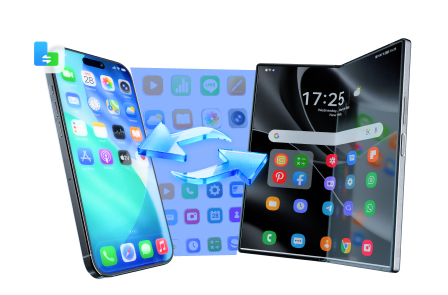
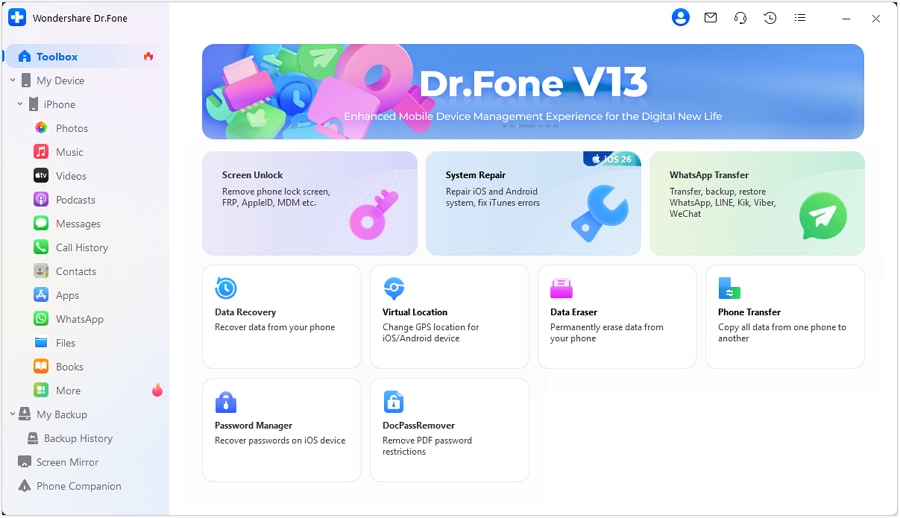
Execution now matters because the same action done in the wrong order can silently create duplicates that take hours—or paid tools—to clean up later. If you need a hands-on way to transfer selected data types while following your verified plan, use Dr.Fone - Phone Transfer.
 Move data between iOS to Android and vice versa.
- Transfer contacts, SMS, photos, videos, music, and more types.
- Available with all phones with Android and iOS versions.
- Simple, click-through process.
-
Step 1 Lock the “source of truth” and prevent automatic merging
Before moving any data, set the new phone so only the chosen primary account/library will sync, and keep other auto-sync/import features disabled until the first verification passes.
Limitation: AI can’t confirm your actual toggles or which apps are silently uploading in the background; use Dr.Fone for the hands-on device transfer/management steps once your plan specifies what to move and what to exclude.
-
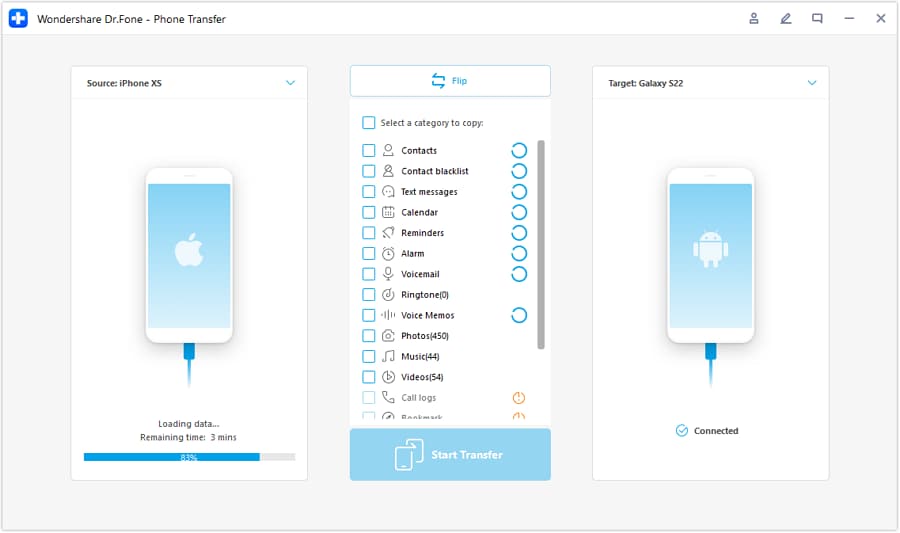
Step 2 Transfer only the categories you’ve approved (no overlap paths)
Use Dr.Fone to execute the transfer method you selected (e.g., phone-to-phone transfer for specific data types) while avoiding “double paths” like copying DCIM manually and enabling full cloud photo sync at the same time.
Limitation: AI can’t run the transfer or enforce exclusions on-device; you must follow the verified plan and use Dr.Fone to perform the actual migration actions.
-
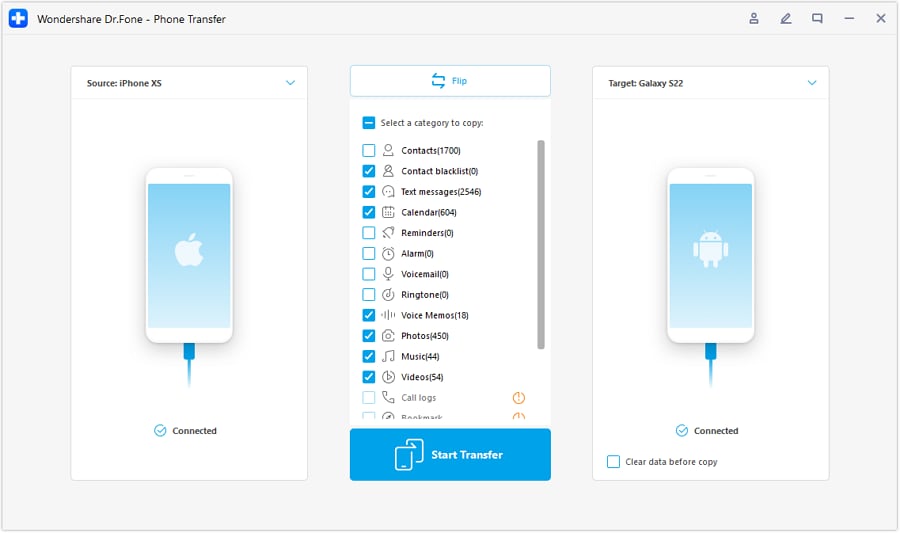
Step 3 Verify counts, spot-check, then enable remaining syncs
After transfer, validate with your predefined checks (counts, sample albums/folders, contact totals, recent messages), then only enable the next sync/import feature once the previous category passes.
Limitation: AI can help interpret your verification results, but it can’t see hidden/archived items or confirm app-level indexing; you must verify directly on the phone and proceed cautiously.
-
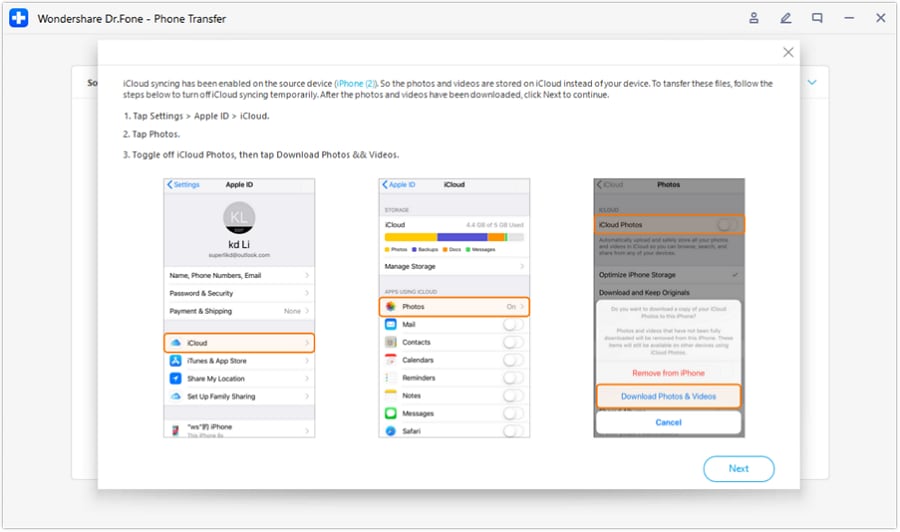
Step 4 Keep cloud auto-uploads disabled until your verification passes
Do not turn on any full photo/file auto-upload (such as iCloud Photos, Google Photos backup, or OneDrive camera upload) until you’ve confirmed your post-transfer checks and you’re ready for a controlled merge.




Conclusion
Use AI to define the safest sequence, the “do-not-merge-yet” moments, and the verification checks; then use a real execution tool like Dr.Fone to perform the transfers according to that verified plan.
FAQ
-
What usually causes duplicates during a new phone setup?
Using multiple paths for the same data (restore + cloud sync + manual copy), or enabling photo/file sync after you already imported the same folders.
-
How do I decide whether cloud sync or direct transfer is safer?
Pick one primary path per data type. Cloud sync is cleanest if one cloud library is already the “source of truth.” Direct transfer is safer when cloud libraries are inconsistent—but only if you keep cloud auto-sync off until verification.
-
What is the irreversible step I should avoid until I’m sure?
Any merge-triggering action like enabling full photo library sync (iCloud Photos/Google Photos/OneDrive upload) after already copying media, or restoring a backup and then importing the same content again.
-
What should I verify before I start execution?
At minimum: which account is primary, what sync toggles will be OFF initially, approximate item counts (photos/contacts), and that you have a rollback option (a backup or an untouched source).
-
Can AI guarantee I won’t get duplicates?
No. AI can reduce risk by planning the sequence and checks, but it can’t observe your real device state or enforce what apps do during setup.
 Add Wondershare Dr.Fone as a preferred source on Google