Effortlessly manage data through preview, delete, export, etc.

 100% Security Verified | No Subscription Required | No Malware

 :
: 
 ChatGPT
 Perplexity
 Gemini
 Claude
 Grok
Grok

I tried clearing media to free up space and only later realized my backup wasn’t current. I didn’t lose everything, but the “important” chats were missing attachments I needed.
Reddit user, r/WhatsApp
Reducing a messaging app’s storage sounds simple until one missed step wipes media, deletes local chat history, or breaks your ability to restore messages later. Most mistakes happen when you clean first and verify backups second.
AI helps you structure a safe sequence: what to preserve, what to remove, what to verify, and when to stop. It can also surface risk points (cloud vs local backups, encryption, multi-device sync) before you touch anything.
AI cannot access your phone, confirm what’s really backed up, or perform device actions. Once the plan is clear, you still need real tools to back up and restore data reliably.

In this article
- How to plan a safe storage-reduction workflow
- Why sequence matters
- Define key chats and boundaries
- Set verification “stop points”
- Avoid point-of-no-return actions
- What the AI needs to know
- Using AI prompts to build a safer workflow
- When to stop planning and start execution
- Execute the workflow safely with Dr.Fone
Part 1. How to Plan reduce messaging app storage without losing key chats Without Missing Critical Steps
You’re running low on storage, and your messaging app is the biggest culprit—often because of videos, forwarded media, large group chats, and duplicated downloads. You want space back, but you can’t afford to lose key chats, attachments, or proof-of-work messages.
Even with an AI answer, the uncertainty is usually the sequence: What do you back up first? What do you verify? What can you safely delete? People often mix “free up space” steps with “archive/backup” steps and discover too late that only part of their chat history was preserved.
The point of no return is any action like clearing chat history, deleting the app, removing local backup files, or “delete for everyone/device” cleanup before you’ve confirmed you can restore what matters. Don’t cross that line until verification is complete.
Part 2. What the AI Needs to Know
Share the minimum details below so the workflow can be planned around your real constraints.
- Device OS (iOS/Android) and model (e.g., iPhone 13, Galaxy S22)
- Messaging app(s) involved (e.g., WhatsApp, LINE, Telegram, WeChat)
- Backup method currently used (cloud backup on/off, local backups, none/unsure)
- Storage pain source (videos, voice notes, documents, stickers, multiple groups)
- What “key chats” means to you (specific contacts/groups, date ranges, attachments needed)
- Whether you have a second device or computer available for verification
- Any time limit and acceptable downtime (minutes vs hours)
- Your risk tolerance (must preserve everything vs OK to lose non-essential media)
Part 3. Using AI Prompts to Build a Safer reduce messaging app storage without losing key chats Workflow
Use these prompts to make the plan specific, ordered, and verifiable before you touch your device.
3-1. Level 1: Basic Prompt
I need to reduce my messaging app storage without losing key chats.
Create a safe, step-by-step plan that prioritizes backup and verification before any deletions, and call out the highest-risk steps to avoid.
3-2. Level 2: Advanced Prompt
Build a workflow to reduce messaging app storage without losing key chats, split into Preparation / Execution / Verification.
Label steps as critical vs optional, and include “stop points” where I must confirm something before proceeding.
3-3. Level 3: Evidence Prompt
Context: I’m on (Android 14, Samsung S22), my messaging app is (WhatsApp), it uses about (18 GB), and the biggest contributors are (videos in group chats).
“Key chats” = (2 client chats + a family group) and I need to keep (messages + images/documents from the last 12 months). I’m unsure whether my cloud backup is current, and I have (a Windows PC).
Create a plan with checks before / during / after each phase, including: what evidence to capture (e.g., backup timestamp, storage breakdown screenshots), what to verify on-device, and what to do if verification fails.
3-4. Prompt Refinement
Return the plan as a checklist with three columns: Action / Proof I must capture / What could go wrong.
Add a “Do Not Do Yet” section that lists irreversible actions (e.g., clear chat history, uninstall app) and the exact verification required before each.
Ask me exactly 8 clarifying questions, then produce two workflows: fast-and-safe and slowest-but-safest.
Include a rollback plan: if I delete media and later realize it was needed, what are my recovery options and what evidence would make recovery possible?
Split “key chats” preservation into: messages, media, documents, voice notes, and explain how each should be protected before cleanup.
3-5. AI Plan vs. Real Device Constraints
| Planning item | AI can help with | Reality you must verify | Typical failure mode |
|---|---|---|---|
| Backup readiness | Define what “good backup” means and what to check | Actual backup exists, is current, and includes needed content | Backup is old, incomplete, or not enabled |
| Storage targeting | Decide what’s safe to remove first (e.g., large videos) | What categories actually occupy space on your device | You delete the wrong items and gain little space |
| Sequence control | Put steps in order with stop points | App behavior differs by OS/version and account setup | You follow generic steps that don’t match your app |
| Proof and rollback | Specify screenshots/logs to capture | Restore actually works end-to-end | You only discover restore failure after deletion |
AI improves planning, but cannot execute backups, inspect your device state, or confirm restore integrity.
Part 4. When to Stop Planning reduce messaging app storage without losing key chats and Start Execution
- You have a written list of key chats (which chats, what date range, whether media must be preserved).
- You know your backup target (cloud, computer, or both) and what “successful” looks like (timestamp + size + restore test).
- You have identified the biggest storage categories (videos, documents, duplicates) and what you’re willing to delete.
- You have defined your point-of-no-return rule: no chat clears/uninstalls/deletions until verification passes.
If those are true, planning is “complete enough” to move into controlled execution.
Part 5. Reduce messaging app storage without losing key chats: Execute the Workflow Safely with Dr.Fone
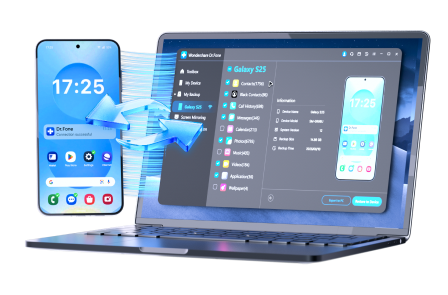
Execution is where most data loss happens—because cleanup actions are fast, but recovery is slow (or impossible) without a verified backup. To keep rollback options available, start by creating a computer-side copy using Dr.Fone Basic - Data Manager.
 Easily manage data through preview, delete, export, etc.
- Transfer all data between devices.
- Robust backup solutions for reliable data protection.
- Mirror screens to PC for meetings, teaching, and control.

-
Step 1 Create a verified backup first
Connect your phone to your computer and start a controlled backup/transfer so you have a recovery path before removing anything.
-
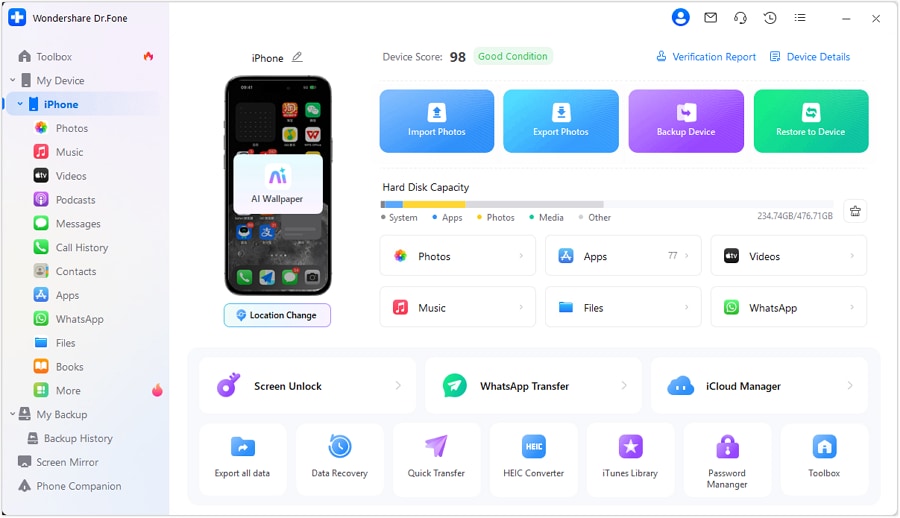
Step 2 Preview and select what you plan to offload
Use data management views to locate large items (for example, videos) and confirm you’re targeting non-essential content first.
-
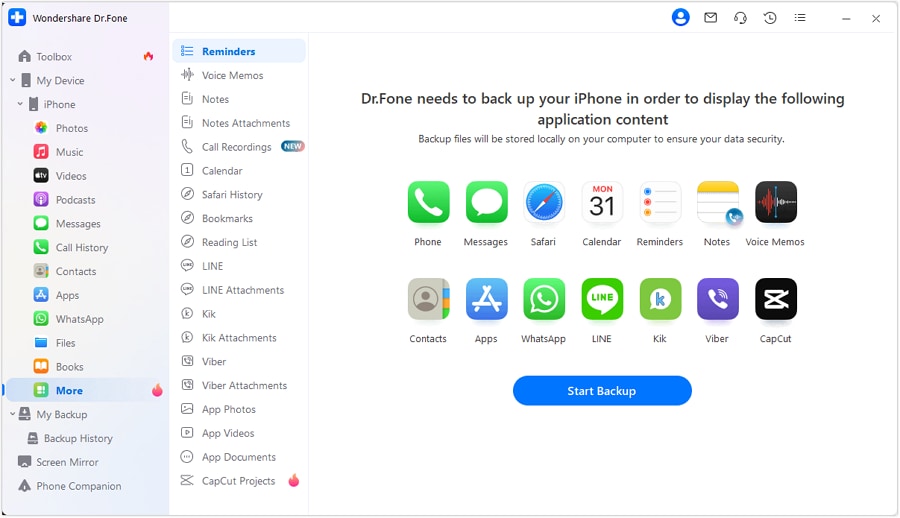
Step 3 Verify restore viability (before any deletion)
Confirm the backup is usable (for example, by previewing content where available or performing a controlled restore test in a safe environment).

-
Step 4 Reduce storage only after verification passes
After verification, proceed with your messaging app’s built-in storage tools to remove non-essential large media first, keeping rollback available if you misjudge what’s “non-essential.”
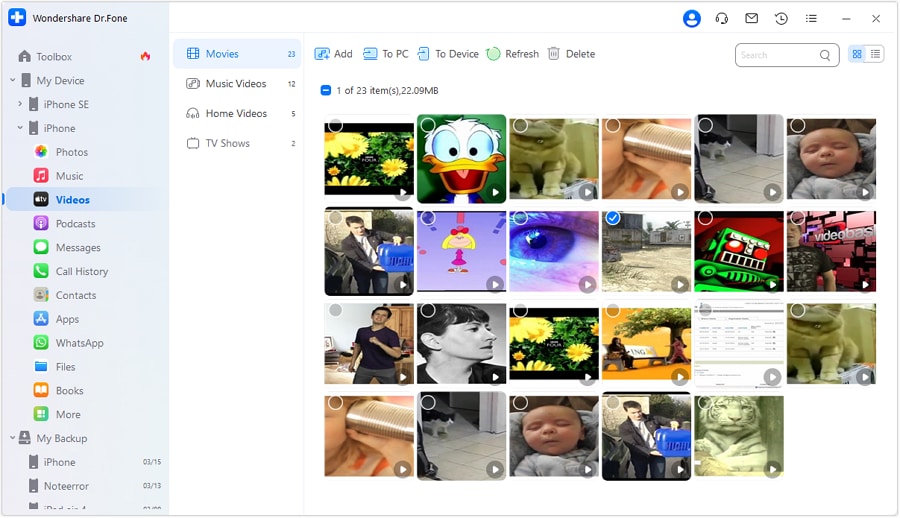
Only then perform storage reduction, keeping rollback available
After verification, proceed with your app’s built-in storage management to remove non-essential large media first, knowing you can revert via a verified backup if you misjudge what’s “non-essential.”
Limitations to remember
Verification may require time and storage space, and deleting chat history or uninstalling the app can be irreversible depending on app/account settings—do not do it unless your verification criteria were fully met.




Conclusion
Use AI to define the sequence, risk points, and verification checks for reducing messaging app storage without losing key chats—but rely on real tools like Dr.Fone to execute backup/restore safely once the plan is complete.
FAQ
-
What’s the biggest risk when reducing messaging app storage?
Deleting data before confirming a restorable backup (especially clearing chats, deleting local backup files, or uninstalling). -
Is “cloud backup enabled” the same as “safe to delete”?
No. You need evidence it’s current and complete (timestamp, size, and ideally a restore test). -
Do I need to back up media, or just messages?
If “key chats” include attachments, you must treat media as critical; messages-only backups won’t protect files you later need. -
When should I take screenshots or notes as proof?
Before execution (backup settings, timestamps, storage breakdown) and after (backup completion details, restore validation result). -
Can AI tell me whether my backup will restore correctly?
No. AI can define checks, but only real tools and a restore/validation step can confirm.
 Add Wondershare Dr.Fone as a preferred source on Google