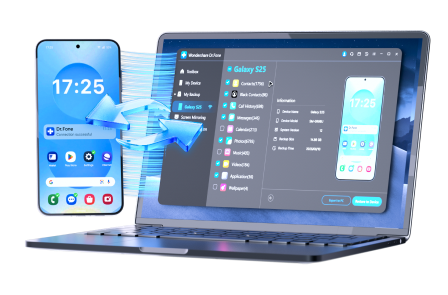
Effortlessly manage data through preview, delete, export, etc.

 100% Security Verified | No Subscription Required | No Malware

 :
: 
 ChatGPT
 Perplexity
 Gemini
 Claude
 Grok
Grok

My phone keeps saying storage is full, and WhatsApp/Instagram are taking huge space. I’m scared to delete anything because I don’t want to lose chats or photos—what’s the safest order to clean things up?
Reddit user, r/Android
Social apps can quietly consume most of your phone storage through cached files, downloaded media, and “invisible” attachments—missing one step can mean you delete the wrong things or lose chats and media you actually needed.
AI is useful here for turning a messy situation into a clear sequence: what to check first, what to back up, what to clean, and what to verify before you do anything irreversible.
AI can’t see your device, measure what’s truly largest, or run the cleanup safely for you—so once the workflow is verified, you need real tools to back up, move data out, and remove what you’ve confirmed is safe to delete.

In this article
- How to plan without missing critical steps
- Why storage “barely changes” after cleanup
- What “safe to delete” really means
- Point-of-no-return actions to delay
- What a safe sequence looks like
- What the AI needs to know
- Using AI prompts to build a safer workflow
- AI plan vs. real device constraints
- When to stop planning and start execution
Part 1. How to plan social apps taking too much storage on phone without missing critical steps
You notice your phone is “full,” and social apps (e.g., WhatsApp, TikTok, Instagram, Snapchat, Telegram) are the top storage users. You try clearing a few items, but storage barely changes—or the app grows again the next day.
The uncertainty usually isn’t “what is storage,” but “what exactly is safe to remove, in what order, and how do I prove it’s safe before I tap delete?” Without a sequence, it’s easy to delete the wrong folder or remove media that wasn’t backed up.
Your point-of-no-return moment is anything that removes unique data: deleting app data, uninstalling an app that holds local-only downloads, or deleting chat media before confirming backups are complete and restorable.
Part 2. What the AI needs to know
Share your situation so the AI can build a workflow that fits your device, apps, and risk tolerance.
- Phone OS and model (Android 14 / iPhone iOS 17, device model)
- Which apps are taking space and their reported sizes (e.g., WhatsApp 18 GB, TikTok 9 GB)
- What kind of space you’re short on (internal storage only, SD card available, iCloud/Google Drive space)
- What you cannot lose (chats, photos/videos, voice notes, drafts, downloads)
- Where your media currently lives (in-app only vs saved to Photos/Gallery)
- Backup status (last successful backup date, where it’s stored, encryption/password known)
- Your time window and risk tolerance (need space in 30 minutes vs can do a careful cleanup)
- Any constraints (work phone policies, limited PC storage, slow internet)
Part 3. Using AI prompts to build a safer social apps taking too much storage on phone workflow
Use the prompts below to make the AI produce a sequence with checks, not a generic list of tips.
3-1. Level 1: Basic prompt
I have social apps taking too much storage on my phone. Create a safe step-by-step plan to free space without losing important chats or media. Include what I should verify before I delete anything and the “stop” points where I should not proceed.
3-2. Level 2: Advanced prompt
Build a structured workflow for reducing storage used by social apps on my phone.
Separate it into **Preparation**, **Execution**, and **Verification**, and label steps as **critical** vs **optional**.
Include a clear order of operations (what must happen before uninstalling apps, deleting media, or clearing data), plus a rollback plan if something goes wrong.
3-3. Level 3: Evidence prompt
I’m on (Android 14, Samsung S22) and my storage is almost full (1.5 GB free). Top apps are (WhatsApp 18 GB, Instagram 7 GB, TikTok 6 GB). I cannot lose (WhatsApp chats + voice notes), and I’m unsure whether media is backed up. I have (a Windows laptop with 200 GB free) and (Google Drive limited to 5 GB free).
Create a workflow with **checks before/during/after** each risky action. Include:
- How to confirm what’s actually consuming space (app size vs media folders vs downloads)
- How to confirm backups are **complete and restorable** before any deletions
- The exact “point of no return” actions to avoid until verification is done (e.g., clearing app data, uninstalling, deleting local media)
- A final verification checklist showing what “safe to delete” means for each app
3-4. Prompt refinement
Produce the plan as a table with columns: **Step**, **Goal**, **Exact Check**, **Pass/Fail Outcome**, **Next Action**.
Add a “Do Not Touch Yet” list that names the highest-risk actions and what must be verified first.
Ask me 10 targeted questions first, then generate the workflow only after you have my answers.
Split the cleanup into two tracks: **quick win (15 minutes)** and **deep cleanup (60–90 minutes)**, each with its own verification gates.
For each app, list: **where large files typically live**, **how to confirm they’re duplicated elsewhere**, and **how to estimate space recovered** before deleting.
Part 4. AI plan vs. real device constraints
| Planning with AI | What can break in real life | What to verify first | What you use to execute |
|---|---|---|---|
| Identify likely storage culprits per app | Storage labels can be misleading (cache vs documents vs media) | Confirm actual large folders/files and app “Documents & Data” | Your device + a device-management tool |
| Build a deletion sequence that avoids data loss | Backups may be incomplete, stalled, or not restorable | Prove backup completion and that you can access/export key items | A backup/export tool before deletion |
| Estimate what you’ll reclaim | Deleting inside the app may not reduce OS-reported size immediately | Check free space before/after + restart/reindex time | Device + file/app manager tooling |
| Define “point of no return” actions | One tap can erase local-only data permanently | Confirm what’s local-only vs synced vs already exported | Verified backup + deliberate execution |
AI improves planning, but it cannot inspect your phone, confirm what’s truly backed up, or perform the cleanup steps safely on the device.
Part 5. When to stop planning social apps taking too much storage on phone and start execution
- You can name exactly what you’re trying to protect (e.g., “WhatsApp chats + voice notes”) and where it will be backed up.
- You have a written order of operations that delays irreversible steps (clear data/uninstall/delete originals) until verification passes.
- You know what “success” looks like (target free space, which apps reduced, what data remains accessible).
- You have a rollback path (how you would restore/export if you realize something important is missing).
Once those are true, planning should pause so you can gather real evidence from the device and proceed step-by-step.
Recommended tool: execute the workflow safely
Execution now matters because the only reliable way to reduce risk is to back up/export first, then remove data only after checks pass—especially before any irreversible deletion. To do that with less guesswork, you can use Dr.Fone Basic - Data Manager to back up, export, and manage space-heavy files before you delete anything on the phone.
 Easily manage data through preview, delete, export, etc.
- Transfer all data between devices.
- Robust backup solutions for reliable data protection.
- Mirror screens to PC for meetings, teaching, and control.
-
Step 1 Create a safety backup first
Back up the phone data you cannot afford to lose before making any cleanup changes. A backup is only protective if you can confirm it completed successfully and you know how to restore/access it.
-
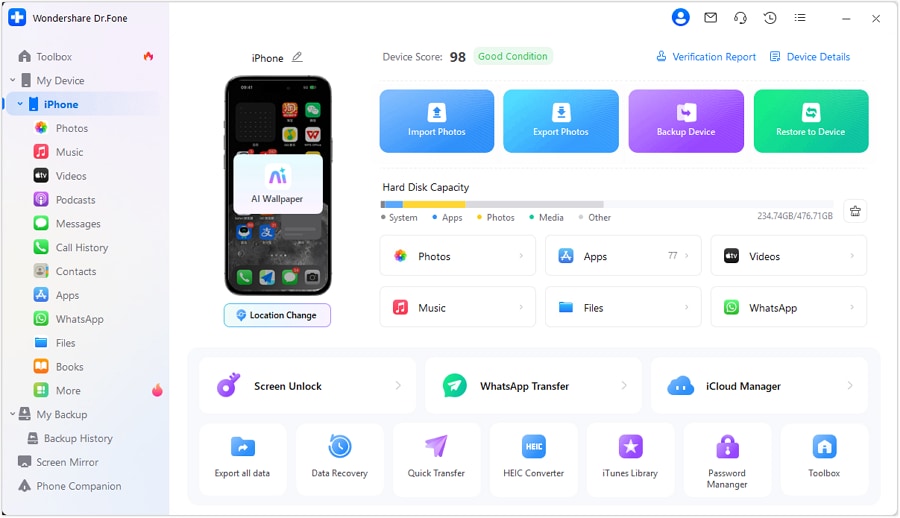
Step 2 Export space-heavy media out of the phone
Transfer/export large photos and videos (including social-app-saved media) to a computer to relieve internal storage pressure. Verify you can open the exported files before removing originals.
-
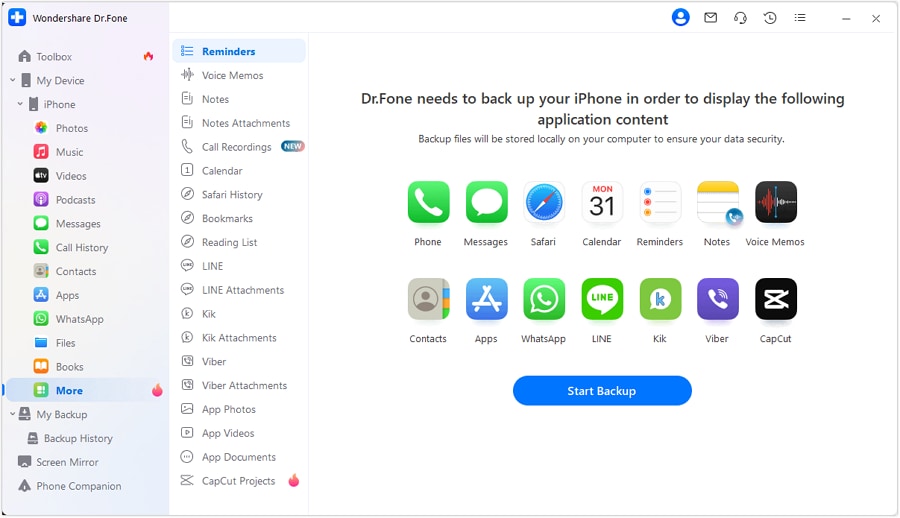
Step 3 Identify the biggest categories before deleting anything
Use the device and your management workflow to confirm what’s actually taking space (app-reported size vs media folders vs downloads) so you don’t delete the wrong items.

-
Step 4 Remove confirmed-safe items (point of no return)
Delete only the specific files/media you already exported and verified. Only then consider removing/reinstalling apps if your plan requires it. Deletion can be irreversible—don’t proceed unless your verification checklist is fully satisfied.
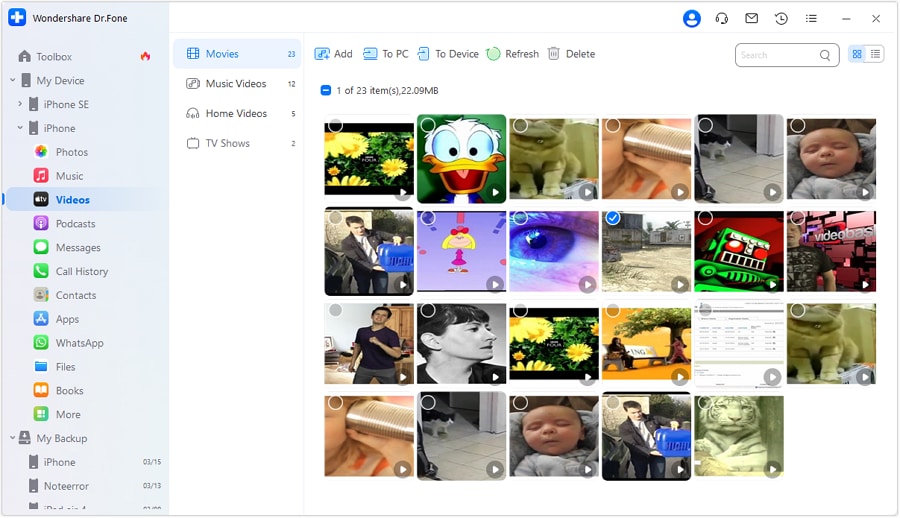
After each step, re-check free space and confirm the data you’re protecting is still accessible (on-device and in your backup/export location) before you proceed to anything more aggressive like clearing app data or uninstalling.




Conclusion
Use AI to design a sequence with verification gates and clear “do not proceed yet” rules; then use a real tool to execute backups, exports, and deletions carefully—because the device is where storage reality and irreversible actions actually happen.
FAQ
-
What’s the biggest risk when social apps take too much storage?
Deleting local-only media or chat content before confirming it’s backed up and accessible elsewhere. -
Why doesn’t “clear cache” always free meaningful space?
Because the largest portion is often “documents/data” (downloads, media, attachments), not just cache—AI can help you plan what to verify, but the device must confirm the true sources. -
What is the most dangerous step in this workflow?
Any irreversible removal: clearing app data, uninstalling without a verified backup, or deleting originals before confirming exports and backup integrity. -
How do I know my backup is actually usable?
Your plan should require proof: backup completed without errors, you can locate it, and you can restore or at least access the critical content you’re protecting. -
Should I do a quick cleanup or a deep cleanup first?
Start with a quick, low-risk pass (backup → export large media → delete only verified duplicates). Deep cleanup (app resets/reinstalls) should wait until verification gates are passed.
 Add Wondershare Dr.Fone as a preferred source on Google