Effortlessly manage data through preview, delete, export, etc.

 100% Security Verified | No Subscription Required | No Malware

 :
: 
 ChatGPT
 Perplexity
 Gemini
 Claude
 Grok
Grok

I tried deleting a couple “big” apps to free space, and then realized I’d lost offline downloads and couldn’t get some chats back. I wish I’d known what to verify first.
Reddit user, r/Android
Finding heavy apps is easy; removing the wrong ones (or removing them in the wrong order) is where people lose downloads, chat history, game progress, or access to accounts. AI can help you turn “free up space” into a careful, step-by-step workflow with verification points—then you execute it on your device with real checks and backups.

In this article
- How to plan a safe heavy-app cleanup
- Why generic “delete these apps” advice fails
- The point-of-no-return actions
- What to verify before removing anything
- What a safe sequence looks like
- What the AI needs to know
- AI prompts (Level 1–3) + prompt refinement
- AI plan vs. real device constraints
- Execute the workflow safely with Dr.Fone
Part 1. How to Plan “Find Heavy Apps That Are No Longer Worth Keeping” Without Missing Critical Steps
You’re low on storage and your phone feels slow. You suspect a few large apps (social, video, games, shopping) are taking up space, but you’re not sure which ones are “safe to remove” versus “big but essential.”
You ask AI which apps to delete, and it gives generic advice—yet you still don’t have a sequence: what to check first, how to confirm what’s backed up, and how to avoid deleting something that’s hard to recover.
The point of no return is uninstalling an app or clearing its local data before you’ve verified what’s stored only on the device (offline downloads, cached maps, local project files, unsynced chats, game saves). After that, recovery may be impossible.
Part 2. What the AI Needs to Know
Share a few specifics so the plan can match your device and risk tolerance:
- Device OS and model (iPhone 13 iOS 17 / Samsung S22 Android 14)
- Storage pressure (e.g., “128GB, 2GB free”)
- Your goal (free X GB, speed up, reduce background drain, or all three)
- App types you rely on daily (banking, work MFA, messaging, navigation)
- Apps with offline content (Spotify/Netflix downloads, maps, podcasts)
- Anything you can’t risk losing (WhatsApp chats, game progress, drafts, photos)
- Your backup/sync status (iCloud/Google, OneDrive/Google Photos, in-app sync)
- Whether you’re willing to sign back into apps / redo settings
- Time window (5 minutes now vs 30 minutes later with a computer)
Part 3. Using AI Prompts to Build a Safer “Find Heavy Apps That Are No Longer Worth Keeping” Workflow
Use these prompts to make the workflow precise before you touch anything on the device.
3-1. Level 1: Basic Prompt
Help me plan a safe workflow to find heavy apps I no longer need and free up storage.
I want steps in the correct order, including what to check before uninstalling anything.
Assume I might have offline downloads or unsynced data in some apps.
3-2. Level 2: Advanced Prompt
Design a workflow to identify and remove “heavy apps that are no longer worth keeping” on my phone.
Preparation:
- List critical checks to prevent data loss (sync status, offline downloads, app-specific backups).
Execution:
- Give a sequence for reviewing storage, deciding what to remove, and what to remove first.
Verification:
- Provide post-removal checks to confirm storage reclaimed and nothing essential broke.
Also label each step as Critical vs Optional, and include “stop points” where I must verify before continuing.
3-3. Level 3: Evidence Prompt
Create a cautious, evidence-driven plan to find and remove heavy apps I don’t need.
My context:
- Device: (iPhone 12 iOS 17) or (Pixel 7 Android 14)
- Free space: (1.8GB left on 128GB)
- Target: (free 15GB)
- High-risk apps for me: (WhatsApp, Photos, Banking app, Work authenticator)
- Offline content: (Spotify downloads ~8GB, Netflix downloads, Google Maps offline areas)
- Backup status I know: (Google Photos on, WhatsApp backup uncertain)
What I need from you:
1) Before: exact checks to confirm what’s backed up vs local-only, including app-by-app risk notes.
2) During: decision tree for each big app: keep, offload (if available), delete cache/downloads, uninstall, or replace with lighter alternative.
3) After: verification checklist (storage freed, logins/MFA still work, media still accessible), plus a rollback plan where possible.
Include a “DO NOT CROSS” point: uninstalling/clearing app data before backup verification.
3-4. Prompt Refinement
Convert your plan into a checklist with “Verify / Evidence / Action” columns, so I know what proof I need before each deletion.
Create a risk table for my top 10 largest apps: what I might lose, how to back it up, and the safest removal option (delete downloads vs uninstall).
Ask me the minimum questions required to decide safely for each large app (e.g., “Is there offline content?” “Is account recovery enabled?”).
Add explicit stop points: after identifying large apps, after confirming backups, and before the first uninstall. Tell me what must be true to proceed.
Rewrite the execution sequence to minimize disruption: remove low-risk space first (downloads/caches), then medium-risk apps, then high-risk apps last.
Part 4. AI Plan vs. Real Device Constraints
| AI plan output | Real device constraint |
|---|---|
| A ranked list of what to remove first | AI can’t see your actual storage breakdown or app sizes on-device |
| A “safe to uninstall” recommendation | AI can’t confirm whether an app has local-only data or completed backups |
| A verification checklist for backups | AI can’t validate login recovery (2FA, authenticator transfers) without device access |
| A rollback suggestion | Some actions are irreversible (clearing app data/uninstalling without backup) |
AI improves planning and reduces avoidable mistakes, but it cannot execute or verify device-level results; that requires direct checks on the phone and reliable tools.
4-1. When to Stop Planning and Start Execution
- You have a short list of candidate heavy apps and you know which are high-risk (messaging, authenticators, games, offline media).
- You’ve identified the point of no return actions (clear app data / uninstall) and placed them after backup verification.
- You have a verification checklist for before/during/after, including what “success” looks like (e.g., “+15GB free, apps still log in”).
- You’ve chosen a fallback path for anything uncertain (delay removal, export data first, or keep the app).
If all four are true, you’re no longer deciding—you’re ready to perform controlled, verified changes.
Part 5. Find Heavy Apps That Are No Longer Worth Keeping: Execute the Workflow Safely with Dr.Fone
Execution matters because the safest cleanup depends on real backups and real device outcomes, not assumptions. Once you start deleting, your ability to recover data can drop sharply. If you want a practical way to manage and protect data during this process, consider Dr.Fone Basic - Data Manager.
 Easily manage data through preview, delete, export, etc.
- Transfer all data between devices.
- Robust backup solutions for reliable data protection.
- Mirror screens to PC for meetings, teaching, and control.

-
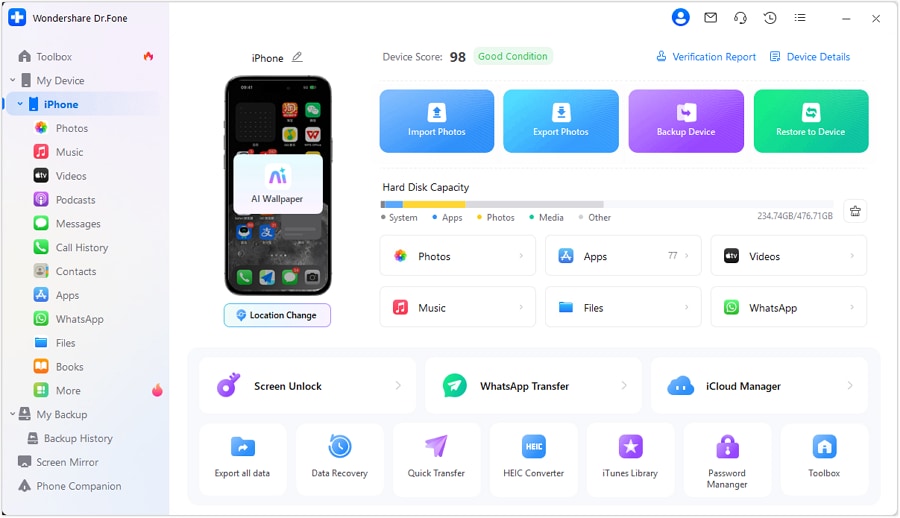
Step 1 Create a safety backup before any removals
Use Dr.Fone to back up the device data you can’t afford to lose (especially items that might be stored locally). Limitation: AI cannot confirm what your backup contains; you must verify the backup completed and is readable.
-
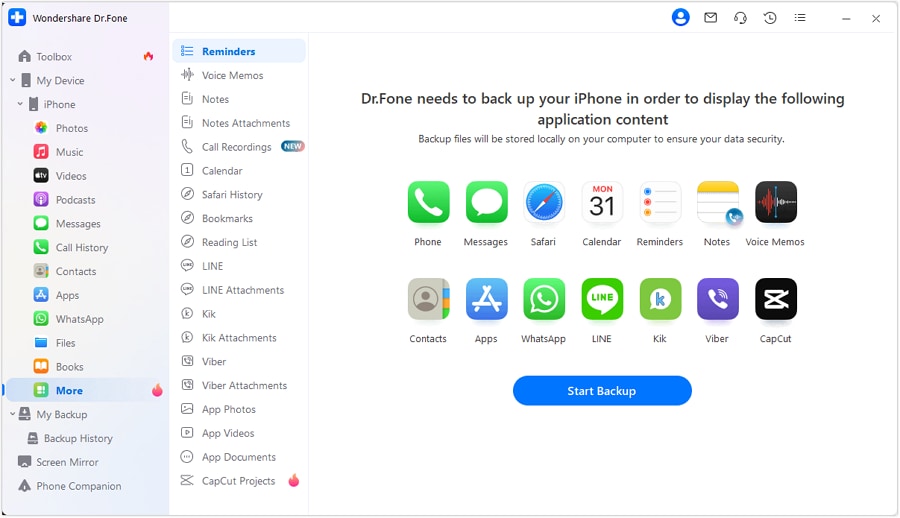
Step 2 Verify what’s stored locally vs. synced before freeing space
Before you delete anything, double-check where the “big” storage comes from (offline downloads, in-app media, local files). This is where most “can’t recover it” losses happen.
-
Step 3 Reclaim low-risk space first, then uninstall selectively
Use your device’s storage settings to identify the largest apps and remove low-risk storage (offline downloads/caches) before uninstalling apps you “might” still need. Limitation: AI can’t see which apps are truly largest on your phone or which ones hide local-only files—check each app’s storage details before acting.

-
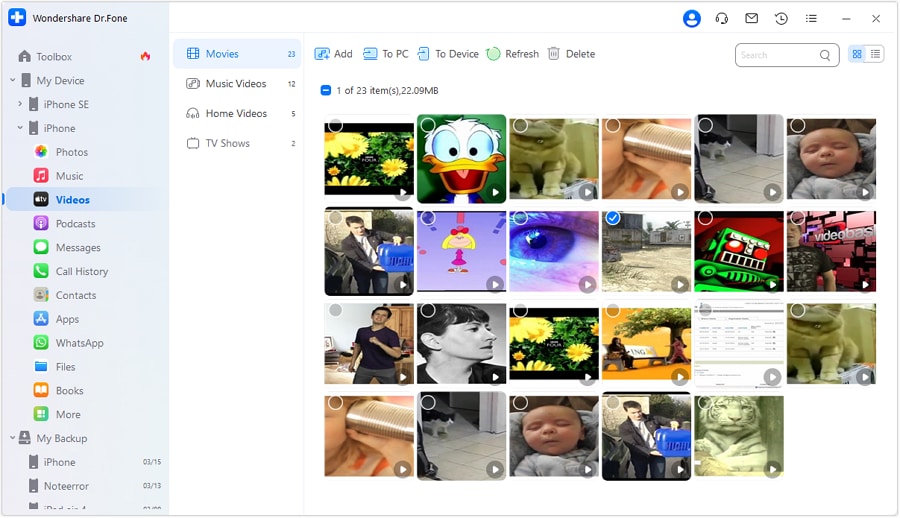
Step 4 Perform irreversible removals only after verification
After confirming backups and account recovery (especially for messaging and authenticator apps), use Dr.Fone/device tools to proceed with uninstalling apps you’ve marked as not worth keeping. Limitation: uninstalling or clearing app data can be irreversible if the app doesn’t sync everything; once done, AI cannot restore what was never backed up.




Conclusion
Use AI to design a cautious sequence, define verification checkpoints, and identify “do not cross” moments; then use real tools like Dr.Fone to execute backups and removals safely on the actual device.
FAQ
-
What’s the biggest risk when removing heavy apps?
Deleting local-only data (offline downloads, unsynced chats, project files, game saves) by uninstalling or clearing app data before verifying backups. -
Is “clearing cache” always safe?
Usually lower risk than uninstalling, but some apps blur the line between cache and downloads; confirm what will be removed inside the app first. -
How do I know an app is “not worth keeping”?
If it’s large, rarely used, easy to reinstall, and doesn’t contain irreplaceable local data—after you verify backups and account recovery. -
When should I avoid uninstalling an app even if it’s huge?
When it’s tied to access (banking, work MFA/authenticator), contains critical history (messaging), or stores local-only content you haven’t exported/backed up. -
Can AI tell me exactly which apps are taking the most space on my phone?
No. AI can help you interpret what you see and decide safely, but you must check the on-device storage list.
 Add Wondershare Dr.Fone as a preferred source on Google