Effortlessly manage data through preview, delete, export, etc.

 100% Security Verified | No Subscription Required | No Malware

 :
: 
 ChatGPT
 Perplexity
 Gemini
 Claude
 Grok
Grok

I deleted a bunch of “Downloads” to free space and then realized some apps needed those files for offline access. Now I’m not sure what’s safe to remove without breaking something.
Forum user
Finding large downloads that silently consume phone storage sounds simple, but missing one verification step can lead to deleting something important (like offline files, work attachments, or app-managed downloads).
AI helps by turning a vague goal (“free up space”) into a structured workflow: where to look first, what to classify as “safe to remove,” and what to verify before you touch anything.
AI can’t see your phone’s actual folders, file sizes, or app download locations—so it can’t perform the scan or deletion itself; you still need real device tools to inspect, move, and remove files safely.

In this article
- How to plan without missing critical steps
- Why “Downloads” isn’t the only place to check
- How to avoid deleting app-owned offline files
- Where the point of no return happens
- What “verification” means in practice
- What the AI needs to know
- Use AI prompts to build a safer workflow
- When to stop planning and start execution
- Execute safely with Dr.Fone
Part 1. How to plan identify large downloads taking up phone storage without missing critical steps
You’re low on storage, your phone is slow, and you suspect the Downloads folder (and other “download-like” locations) has ballooned—but you’re not sure what’s actually safe to remove versus what an app still needs.
After asking AI “what should I delete,” you may get a list of general suggestions, but not a reliable sequence: where to check first, how to confirm what a file belongs to, and how to avoid removing something that will break offline access.
The point-of-no-return moment is when you delete files permanently (or empty a trash/recycle bin, or run a secure erase): once that happens, recovery may be impossible if you didn’t verify what you were deleting and whether you already backed up what you need.
Part 2. What the AI needs to know
Share your situation so the plan can match your device, apps, and risk tolerance.
- Phone OS and model (e.g., Android 14 on Galaxy S23 / iOS 17 on iPhone 13)
- Current free storage and target to free up (e.g., 2 GB free; need +10 GB)
- What you mean by “downloads” (browser downloads, messaging attachments, streaming offline files, email attachments, file-sharing apps, etc.)
- Any “must-not-lose” categories (work PDFs, school files, receipts, offline maps, music, videos)
- Backup status and destination (none / cloud / computer) and how recent it is
- Apps you use heavily that store offline content (Netflix/YouTube, Spotify, WhatsApp/Telegram, OneDrive/Google Drive, podcasts, etc.)
- Your comfort level with risk (conservative cleanup vs aggressive cleanup)
- Whether you want to move large files off-device instead of deleting
Part 3. Using AI prompts to build a safer identify large downloads taking up phone storage workflow
Use the prompts below to make AI produce a checklist-driven plan you can follow without guessing.
3-1. Level 1: Basic prompt
I need a planning checklist to identify large downloads taking up storage on my phone without deleting anything important. Give me the safest order to check common download locations and what to verify before removing any files. Keep it practical and short.
3-2. Level 2: Advanced prompt
Build me a structured workflow to identify large downloads taking up phone storage.
Separate it into Preparation, Execution, and Verification, and clearly mark critical steps vs optional steps.
Include “stop points” where I should pause and confirm file ownership (which app created it), backup status, and whether the file is replaceable.
3-3. Level 3: Evidence prompt
Design a cautious workflow to find and handle large downloaded files on my phone, using my context below, and include checks before/during/after I remove anything.
Context:
- OS/device: (Android 14, Samsung Galaxy S22)
- Storage: (1.8 GB free out of 128 GB; goal free +12 GB)
- Likely sources: (Chrome downloads, WhatsApp media, Telegram files, podcast downloads, Google Drive offline)
- Must keep: (tax PDFs, work spreadsheets, travel tickets)
- Backup: (Google Photos on; no recent computer backup)
- Risk tolerance: (conservative; prefer moving files to computer first)
Output:
- A location-by-location search order (Downloads, app media folders, offline caches where applicable)
- A “keep/move/delete” decision rule with examples (e.g., “.mp4 > 500MB from Telegram = move first”)
- A verification checklist for each deletion batch (file type, last opened date if available, app association)
- A final confirmation step that prevents irreversible deletion until I sign off
3-4. Prompt refinement
Rewrite the plan as a two-pass workflow: Pass 1 only identifies candidates and totals potential savings; Pass 2 performs removals only after confirmation.
Create a decision matrix with columns: file type, size threshold, source app, replaceable (Y/N), action (keep/move/delete), verification required.
Produce a batching rule so I never delete more than (1 GB) at a time without re-checking storage and app behavior.
Add a “high-risk list” of items I should not delete unless I confirm backups (e.g., offline docs, encrypted app folders, messaging databases).
Ask me exactly 8 clarification questions that remove ambiguity about what counts as a “download” on my phone.
3-5. AI plan vs. real device constraints
| Planning element | What AI can do | Real-world constraint | What to do about it |
|---|---|---|---|
| Locate “largest downloads” | Suggest likely folders and app sources | Actual file locations differ by OS/app/version | Verify paths and sizes on-device before acting |
| Decide what’s safe to delete | Provide rules and risk tiers | Only you know what you truly need | Use a keep/move/delete list and confirm ownership |
| Estimate storage impact | Help you forecast totals by category | Storage reporting may lag or include hidden data | Re-check storage after each batch of changes |
| Prevent irreversible mistakes | Add stop points and verification gates | Deletion/emptying trash can be permanent | Don’t cross the “permanent delete” step until verified |
AI improves the workflow and reduces avoidable mistakes, but it cannot inspect your actual files or execute changes on your device.
Part 4. When to stop planning identify large downloads taking up phone storage and start execution
- You have a clear definition of what counts as “downloads” for your phone (which apps and locations are included).
- You have a written keep/move/delete rule and a short “do-not-touch” list.
- You have a backup plan for anything non-replaceable (or you’ve explicitly decided what risk you’re accepting).
- You’ve set a stop point before any irreversible action (permanent deletion/secure erase/emptying trash).
At this point, the remaining uncertainty is best resolved by inspecting real files and sizes on the device.
Part 5. Identify large downloads taking up phone storage: execute the workflow safely with Dr.Fone
If you’re ready to execute, Dr.Fone Basic - Data Manager can help you inspect what’s actually on your device (by category/location) before you move or delete anything.
 Easily manage data through preview, delete, export, etc.
- Transfer all data between devices.
- Robust backup solutions for reliable data protection.
- Mirror screens to PC for meetings, teaching, and control.

Execution now matters because file size, location, and “what’s safe” can only be confirmed by looking at your real device data before you remove anything.
-
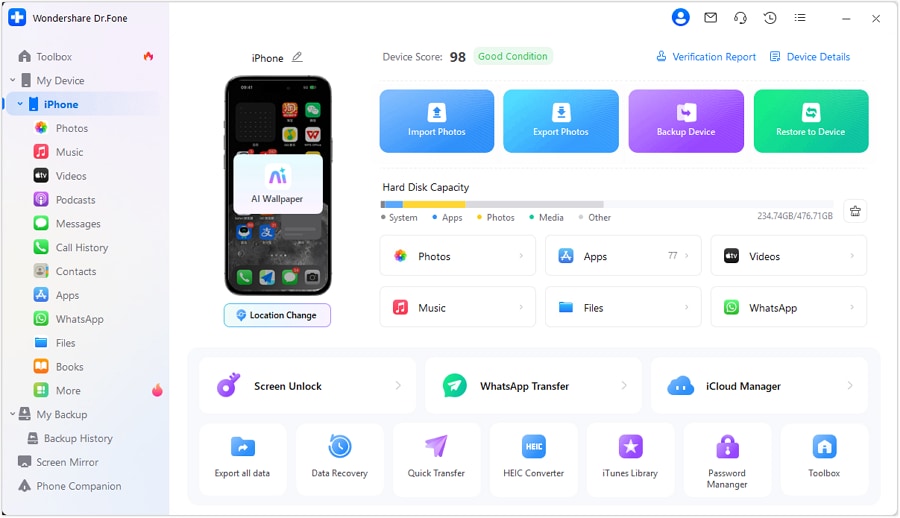
Step 1 Connect your phone and open data management
Connect your device to the computer and open the data management view so you can inspect content without immediately deleting anything.
-
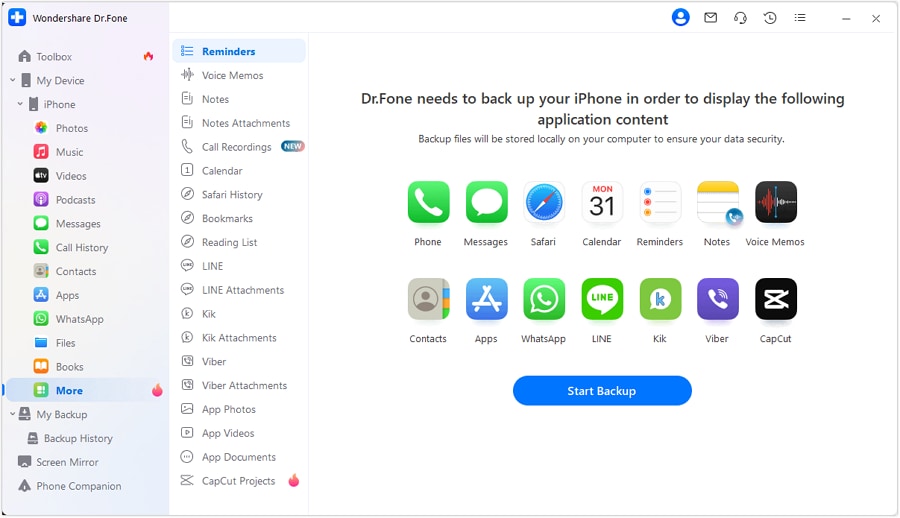
Step 2 Inspect likely “download-like” areas and identify large candidates
Review categories/areas where downloaded items often accumulate (browser downloads, messaging media, offline files, and similar) and note the biggest files first.
-
Step 3 Move or export what you might need before deleting
Export large videos/documents you may still need to a safer destination (computer or cloud) so freeing space doesn’t create immediate loss.

-
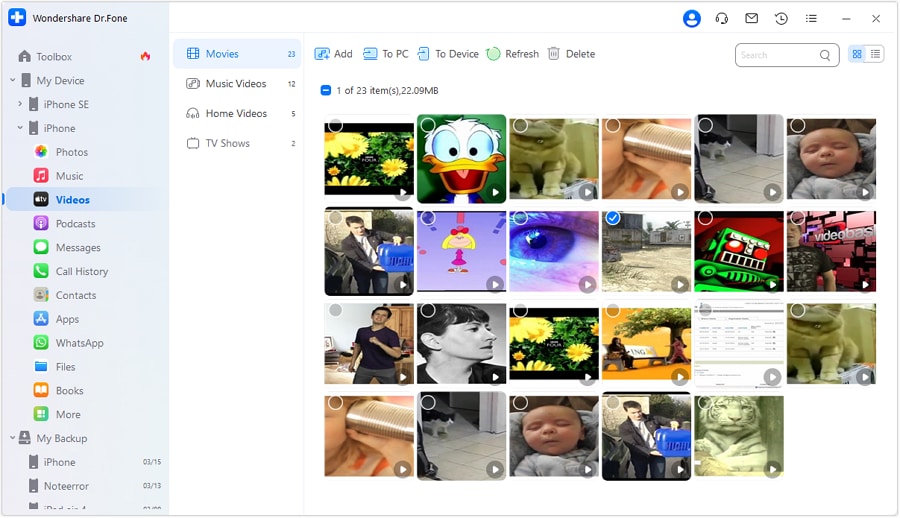
Step 4 Delete only after verification (irreversible risk point)
Delete only items you’ve verified (source app, replaceable, backed up if needed). Avoid any permanent/secure deletion behavior until your final checklist is satisfied.
Important limitations to keep in mind: you still must confirm what’s emotionally, legally, or work-critical before changes; and after any transfer, verify the copied file opens correctly before removing the original.




Conclusion
AI is best used to plan a cautious, verification-first workflow for identifying large downloads, while a real tool is needed to inspect files and execute moves/deletions; keep irreversible actions behind a final confirmation gate.
FAQ
-
How do I know whether a big file is truly “safe to delete”?
Treat it as unsafe until you can answer: what app created it, can it be re-downloaded, and do you have a verified copy elsewhere. -
What should I verify before I delete anything large?
Confirm file type, source/app association, whether it’s replaceable, and whether a working backup/export exists for anything important. -
Why should I delete in batches instead of all at once?
Batching limits damage: if you remove something essential, you’ll notice quickly and can stop before compounding the loss. -
When is the point of no return?
Permanent deletion (including emptying trash/recycle bins or using secure erase) can make recovery impossible if you guessed wrong. -
Can AI tell me exactly which files are biggest on my phone?
No—AI can only propose where to look and how to decide; it can’t see your device’s real file sizes or folders.
 Add Wondershare Dr.Fone as a preferred source on Google