Effortlessly manage data through preview, delete, export, etc.

 100% Security Verified | No Subscription Required | No Malware

 :
: 
 ChatGPT
 Perplexity
 Gemini
 Claude
 Grok
Grok

I deleted photos, checked my Gallery, and even waited a while—but they still don’t come back. I can’t tell if they’re in a cloud bin somewhere or actually gone from the phone.
Forum user
Deleted photos on Android can be confusing because they may still exist in a cloud trash/bin, on the device in a recoverable state, or be gone after sync or cleanup. This often happens right after you tapped Delete, cleared a gallery “Trash,” reinstalled an app, or restarted the phone—yet nothing seems to come back after several minutes.

AI (like ChatGPT or Gemini) can help you map what likely happened by asking the right questions: which app you deleted from, whether backup/sync was enabled, and whether “recently deleted” folders were emptied. It can also help you compare low-risk checks (cloud bin) versus higher-risk actions (writes to storage).
AI can’t see your account state, trash folders, or device storage directly, and trial-and-error can reduce recoverability (for example, taking new photos or cleaning storage). Use AI to diagnose and plan, then use a dedicated tool only when you’re ready to execute.
In this article
- Part 1. Why you should check cloud or device first for deleted photos matters
- Why the “where you deleted from” detail changes everything
- Cloud-first vs device-first: risk and timing
- What info to gather before asking AI
- How “sync deletion” creates misleading symptoms
- Part 2. Using AI prompts to decide cloud or device first for deleted photos
- Part 3. When to stop deciding whether to check cloud or device first for deleted photos
- Part 4. Should i check cloud or device first for deleted photos with Dr.Fone - Data Recovery (Android)
- Part 5. A lowest-risk-first decision rule (cloud vs device)
Part 1. Why you should check cloud or device first for deleted photos matters
If you deleted photos on an Android phone (for example, a Samsung Galaxy S22 or Google Pixel 7), where you should look first depends on where the “delete” occurred: inside Google Photos, the phone’s Gallery app, a file manager, or a third-party app like WhatsApp. Each path has a different “trash/bin” behavior and retention window.
Cloud-first checks are usually low-risk because they don’t write new data to your phone’s storage. Device-first attempts can be time-sensitive, but they’re also easier to accidentally sabotage if you keep using the phone and generating new data.
The uncertainty is normal: the photos may appear missing in Gallery but still exist in Google Photos’ Bin, or cloud sync might have propagated the deletion across devices—making it unclear whether anything is still “recoverable” without careful triage.
1-1. Before You Prompt the AI
Gather these basics first so the AI can narrow causes quickly:
- Android model + Android version
- Where you deleted from (Google Photos / Gallery / Files / app)
- Whether backup/sync was on (Google Photos, Samsung Cloud, OneDrive, etc.)
- Whether you emptied any Trash/Bin/Recently Deleted folder
- Rough timing (minutes/hours/days) and whether the phone has been used since
Part 2. Using AI prompts to decide cloud or device first for deleted photos
2-1. Level 1: Basic Prompt
I deleted photos on my Android phone and I’m unsure whether to check the cloud or the device first. Ask me the minimum questions needed, then tell me the safest order of checks (cloud bins vs on-device recovery) to maximize my chances without causing extra data writes.
2-2. Level 2: Advanced Prompt
Act as a cautious triage assistant for deleted photos on Android.
Goal: decide whether I should check cloud or device first.
Please:
1) Ask up to 8 questions.
2) Then rank the most likely scenarios from most to least likely (cloud bin, local trash, sync deletion, permanent deletion, app-specific storage).
3) For each scenario, give low-risk next steps first and label any step that could reduce recoverability.
4) End with a recommended sequence of actions (do-first / do-later) and explain why.
2-3. Level 3: Evidence Prompt
Help me diagnose deleted photos on Android and decide whether to check cloud or device first, using evidence and risk control.
Evidence I have:
- Phone model: (e.g., Samsung Galaxy S22)
- Android version: (e.g., Android 14)
- Where deleted: (e.g., Google Photos / Samsung Gallery / Files by Google / WhatsApp)
- Cloud services signed in: (e.g., Google account, Samsung account, OneDrive)
- Backup & sync status: (On/Off/Unsure)
- Trash/Bin checked?: (Not checked / Checked but empty / Checked and found items)
- Bin emptied?: (Yes/No/Unsure)
- Time since deletion: (e.g., 2 hours / 3 days)
- Actions since deletion: (e.g., took new photos, installed apps, cleaned storage, rebooted)
- Storage type clues: (internal storage / SD card / unsure)
Output format I want:
A) 5 clarifying questions you still need
B) A ranked list of likely causes with confidence levels and why
C) A “lowest-risk-first” checklist that prioritizes cloud checks before any action that writes to device
D) A short “do not do” list to avoid overwriting data
E) A decision rule: at what point I should stop DIY checks and switch to a dedicated recovery workflow
2-4. Prompt Refinement
If the AI’s answer feels generic, use these follow-ups to force specificity:
“What 5 questions would change your recommendation from cloud-first to device-first?”
“Separate the possibilities into: cloud-bin still available, cloud synced deletion, on-device trash, on-device permanent deletion.”
“Rank the top 3 causes and list the single best piece of evidence for each.”
“Which actions since deletion are most likely to reduce recoverability, and why?”
“Given my answers, what is the safest step-by-step order for the next 20 minutes?”
2-5. AI Output vs Reality
AI can guide decisions, but it can’t verify your actual account/device state.
| What AI can infer | What you still must confirm |
|---|---|
| Whether cloud-first is lower-risk in most cases | Whether the photos are actually in Google Photos Bin / Gallery Trash |
| How sync settings typically affect deletions | Whether sync deletion already propagated across devices |
| Which on-phone actions increase overwrite risk | Whether the phone has written new data since deletion |
| A safe decision tree for next steps | Whether a recovery tool can detect any recoverable items on your device |
Use the AI’s ranking to choose a conservative sequence, but treat the result as a plan—not proof—until you check bins and verify settings yourself.
Part 3. When to stop deciding whether to check cloud or device first for deleted photos
Stop and switch approaches if you hit any of these signals:
- You already emptied the cloud Bin/Trash and device Trash, and the deletion is older than you expected.
- You’re unsure which account(s) were used, and repeated sign-ins/cleanups might trigger sync changes.
- You’ve continued heavy phone usage (new photos, downloads, app installs), increasing overwrite risk.
- The photos are business-critical or irreplaceable, and you can’t risk trial-and-error.
Once you’ve used AI to narrow the most likely scenario and safest order of checks, the next step is execution—verifying what remains accessible and, if needed, attempting on-device data retrieval with a purpose-built workflow.
Part 4. Should i check cloud or device first for deleted photos with Dr.Fone - Data Recovery (Android)
If your AI triage suggests the photos are not in any cloud bin (or cloud sync likely removed them) and you need to check what’s still recoverable from the Android device itself, Dr.Fone - Data Recovery (Android) becomes relevant as an execution step. At this point, the goal is to minimize guesswork: you’ve already prioritized low-risk cloud checks, and now you’re testing the device for recoverable photo data in a controlled way—ideally reducing extra phone usage while you do it.
 Scan Android phones and tablets directly.
- Preview and recover only what you want.
- Supports WhatsApp, photos, videos, contacts, and more.
- Works with 6000+ Android devices.
-
Step 1 Pause new data writes
Stop taking photos/downloading files and keep usage minimal to reduce the chance of overwriting recoverable data.
-
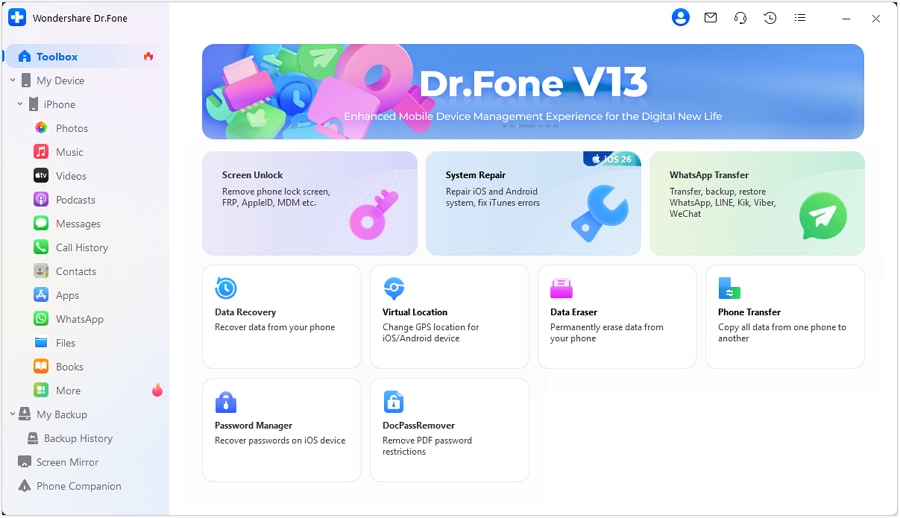
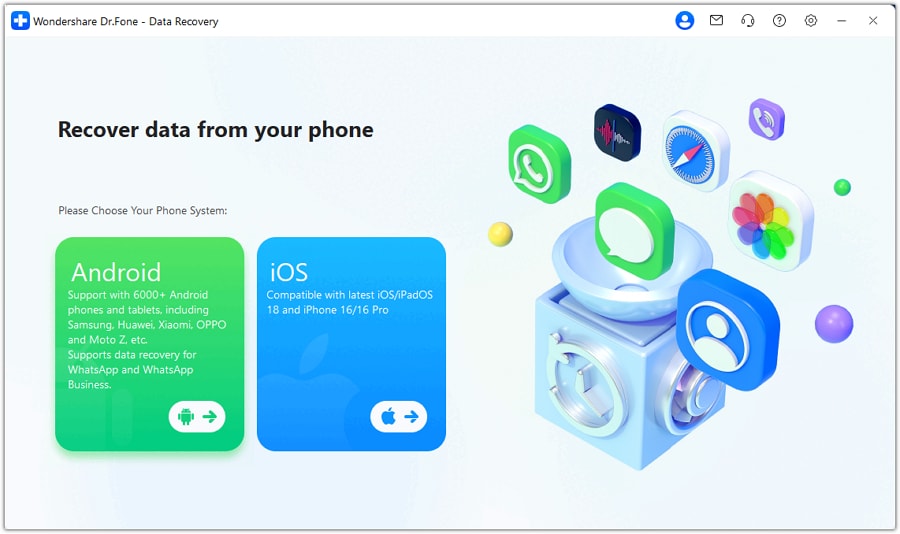
Step 2 Open Dr.Fone Android data recovery
Launch Dr.Fone - Data Recovery (Android) on your computer and choose Recover Data from Android Device to start a device-focused scan.
-
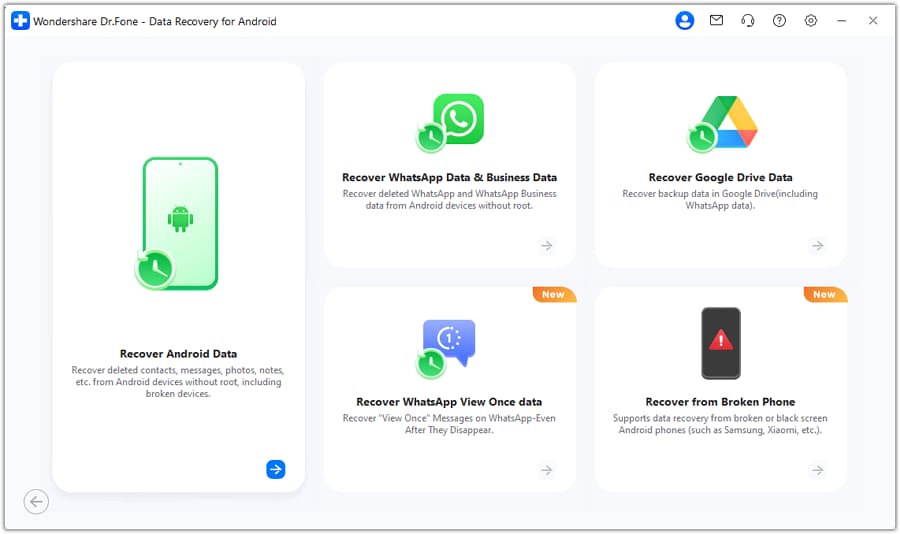
Step 3 Connect your Android carefully
Connect the phone via USB and follow on-screen prompts; avoid disconnecting mid-process to prevent scan interruptions.
-
Step 4 Preview and select photos to export
Review scan results, filter for photos, and select only what you need to keep the process focused and organized.
-
Step 5 Save recovered files to the computer
Export the selected photos to your computer first (not back onto the phone immediately) to avoid extra writes to the same storage.




Part 5. A lowest-risk-first decision rule (cloud vs device)
If your goal is maximum recoverability with minimum risk, use this order of operations:
- Do first (lowest risk): check cloud “Bin/Trash/Recently Deleted” in the exact service/app that handled deletion (for example, Google Photos Bin, Samsung Gallery Trash, OneDrive recycle bin).
- Then: confirm which account is signed in and whether backup/sync is enabled, because sync can propagate deletions across devices.
- Only after cloud/trash checks are exhausted: move to on-device recovery attempts, and minimize phone usage to reduce overwrite risk.
- Stop DIY and switch workflow: if the photos are critical, the phone has been heavily used since deletion, or you’re unsure what actions might trigger additional sync/cleanup.
Conclusion
Use AI to classify where the deletion likely occurred and decide a low-risk sequence (cloud bins first, device actions second), then hand off to an execution tool like Dr.Fone - Data Recovery (Android) when you need to test the device for recoverable photo data without relying on guesswork.
FAQ
-
Should I always check Google Photos Bin before trying on-device recovery?
Usually yes, because checking a cloud bin is low-risk and often resolves “missing” photos without touching device storage.
-
If I delete a photo on my phone, will it delete from the cloud too?
It depends on the app and sync settings; many photo apps sync deletions, so verifying sync behavior is part of the diagnosis.
-
Does emptying the Trash/Bin mean the photos are permanently gone?
It often means they’re no longer available through that app’s recycle bin, but on-device recoverability can still depend on time and overwrite activity.
-
What should I avoid doing right after noticing photos were deleted?
Avoid taking new photos, installing apps, downloading large files, or running “cleaner” tools, because they can overwrite recoverable data.
-
When is checking the device first the better choice?
If you’re confident the photos were stored locally (not synced) and you haven’t used the phone much since deletion, device-first may be time-sensitive—still keep actions minimal.
 Add Wondershare Dr.Fone as a preferred source on Google