Effortlessly manage data through preview, delete, export, etc.

 100% Security Verified | No Subscription Required | No Malware

 :
: 
 ChatGPT
 Perplexity
 Gemini
 Claude
 Grok
Grok

I started deleting big videos to free space, then realized some never actually uploaded. Now I’m scared to touch anything because I might erase the only copy.
Reddit user, r/iPhone
Moving fast with video cleanup can erase the wrong files, break album organization, or leave you with “freed space” but missing memories. One missed check (like confirming what’s already backed up) can turn a simple optimization into a recovery problem.
In this article
- How to plan a safe storage-optimization sequence
- Why “sequence” matters more than tips
- Where videos usually hide (and mislead)
- The point-of-no-return moments to avoid
- What a verification-first plan looks like
- What the AI needs to know (inputs)
- AI prompts to generate a checklist workflow
- AI plan vs. real device constraints (comparison table)
- When to stop planning and start execution
Part 1. How to Plan Storage Optimization for Phones with Lots Of Videos Without Missing Critical Steps
1-1. Why “sequence” matters more than generic advice
You have a phone that’s constantly “Storage Almost Full,” mostly because of videos: 4K clips, duplicated downloads, edited exports, and chat app media. You want space back, but you’re not sure what’s safe to remove—and different apps show different “largest files” lists.

1-2. The typical “missing piece”: verification before deletion
After asking AI, you may get general advice like “use cloud backup” or “delete duplicates,” but the missing piece is sequence: what must be verified before any deletion, what counts as “backed up,” and how to avoid wiping the only copy of a video that never uploaded.
1-3. The point-of-no-return moments to avoid
The point-of-no-return moment is when you permanently delete videos (or empty “Recently Deleted/Trash”), or when you “optimize storage” assuming cloud originals exist—without confirming uploads and playback on another device first.
1-4. What AI is good for (and what it’s not)
AI is useful for turning a vague goal (“clear space”) into a sequenced workflow: what to assess first, what to back up, what to delete last, and what to verify at each stage. It also helps you define decision rules (keep vs. remove) so you don’t improvise under pressure.
AI can’t see your device storage, confirm what’s truly uploaded, or safely run deletes on your behalf. Once the plan is solid, you still need a real tool to execute backups/transfers and reduce the chance of human error during high-risk steps.
Part 2. What the AI Needs to Know
Answer these so the plan matches your device and risk level:
- Phone OS and model (e.g., iPhone 13 iOS 17 / Samsung S22 Android 14)
- Current free space and total storage (e.g., 3 GB free of 128 GB)
- Where videos live: Camera Roll, WhatsApp/Telegram, Downloads, editing apps, screen recordings
- Your backup destinations (iCloud/Google Photos/OneDrive/PC/Mac/external drive/NAS)
- Whether “Optimize Storage” is enabled anywhere (Photos, messaging apps, streaming apps)
- Your tolerance for compression (keep originals vs. accept re-encoding)
- Must-keep categories (kids, travel, work, legal, receipts)
- Time constraints and connectivity (Wi‑Fi speed, data limits, power availability)
- Any past issues (failed uploads, missing timestamps, corrupted files)
- Your “do not touch” rules (e.g., never delete within last 30 days)
Part 3. Using AI Prompts to Build a Safer Storage-Optimization Workflow
Use the prompts below to make AI produce a checklist-driven plan with clear verification gates before any irreversible step.
3-1. Level 1: Basic Prompt
I need a step-by-step plan to optimize storage on my phone that’s full mostly because of videos.
Prioritize preventing accidental deletion and include verification checks before I remove anything.
Keep it platform-aware for my device type.
3-2. Level 2: Advanced Prompt
Build a structured workflow for storage optimization focused on large videos, separated into: Preparation, Execution, and Verification.
Label each action as “Critical” or “Optional,” and include stop points where I must confirm backups before proceeding.
Also include a final “safe-to-delete” rule set for what can be removed last.
3-3. Level 3: Evidence Prompt
Create a storage-optimization workflow for my situation and include checks before / during / after each high-risk step.
Context: (iPhone 13, iOS 17), (128 GB total, 2.8 GB free), videos are in (Photos + WhatsApp + CapCut exports), backup targets are (iCloud Photos + Windows PC), Wi‑Fi is (stable), must keep (family videos), okay to compress (no), time available (2 hours).
Include:
- A triage method to find biggest space wins without deleting originals first
- A “proof of backup” checklist (e.g., play 10 random videos on the backup device, confirm date ranges)
- A deletion order that avoids the point-of-no-return until the end (including Recently Deleted/Trash)
3-4. Prompt Refinement (follow-ups)
Rewrite the plan as a table with columns: Step, Goal, Where (app/location), Risk, Verification, Rollback option.
Add explicit criteria for “backed up” vs “not backed up” (e.g., upload complete + playable elsewhere + correct date range).
Insert two decision gates: one before any deletion, and one before emptying Recently Deleted/Trash; list exactly what I must confirm at each gate.
Reduce ambiguity: for each step, state the exact outcome that signals completion (e.g., “X GB freed” or “Y videos transferred and verified”).
Customize the workflow for my constraints: no compression, limited time, and videos spread across Photos + chat apps; remove any steps that don’t fit.
Part 4. AI Plan vs. Real Device Constraints
| What AI can plan well | What AI cannot do | What you must verify yourself | Common failure mode |
|---|---|---|---|
| A safe sequence and decision rules | Read your storage breakdown live | Which folders/apps actually hold the biggest videos | Cleaning the wrong place first |
| Backup + deletion gates | Confirm upload status is truly complete | Videos are playable on another device/account | Assuming “synced” means “safe” |
| Risk labeling (critical/optional) | Transfer files off your phone | File counts/date ranges match after transfer | Missing a date range (older videos) |
| Checklists to avoid mistakes | Empty trash / delete permanently | “Recently Deleted/Trash” state before final purge | Point-of-no-return reached too early |
AI improves planning, but cannot execute the transfers, backups, scans, or deletions on your actual device.
Part 5. When to Stop Planning Storage Optimization and Start Execution
- You have a written sequence with at least two verification gates: pre-delete and pre-permanent-delete.
- You’ve defined “proof of backup” (playable elsewhere + correct date ranges + file count spot-check).
- You know your highest-impact targets (e.g., chat media cache, duplicate exports, screen recordings) and the order you’ll address them.
- You’ve decided your non-negotiables (no compression, keep originals, don’t delete recent items, etc.).
At this point, the remaining risk is mostly operational—doing the right actions in the right order without skipping verification.
Storage Optimization for Phones with Lots Of Videos: Execute the Workflow Safely with Dr.Fone
Execution now matters because the plan only becomes safe when your backups/transfers are completed and verified before you reach irreversible deletion steps. If you want a hands-on way to manage videos across phone and computer, Dr.Fone Basic - Data Manager can help you run the operational part (transfer/backup/management) while you follow your verification gates.
 Easily manage data through preview, delete, export, etc.
- Transfer all data between devices.
- Robust backup solutions for reliable data protection.
- Mirror screens to PC for meetings, teaching, and control.

Keep the same safety logic from your AI plan: (1) capture a baseline, (2) complete transfers/backups, (3) verify independently, and only then (4) delete—delaying any permanent purge until the very end.
-
Step 1 Prepare and capture a baseline
Connect your phone and record your starting state (free space and where your key videos are stored) so you can measure changes and avoid “random cleaning.”
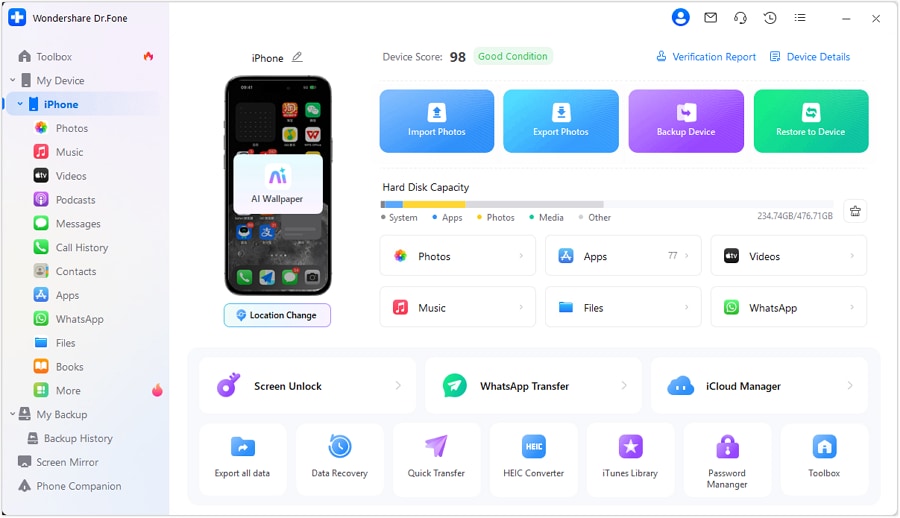
Limitation: AI cannot confirm what a tool detects on your device or guarantee which items are stored where.
-
Step 2 Run transfers/backups before any deletion
Carry out the backup/transfer portion of your plan first, then verify on the destination (open/play a sample across date ranges) before you remove anything from the phone.
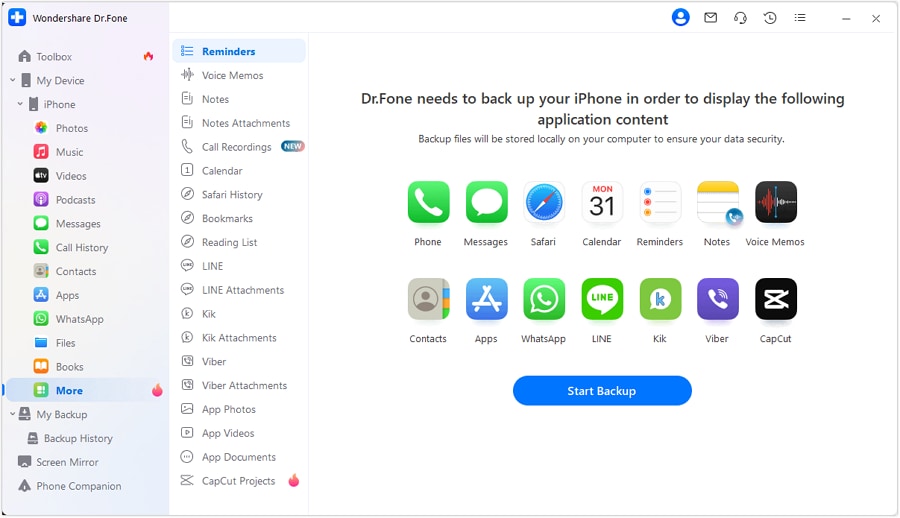
Limitation: AI can’t validate transfer integrity; you must confirm files are playable and complete on the receiving device/storage.
-
Step 3 Triage videos by location and risk (don’t delete originals first)
Focus on the biggest space wins that are not your only originals (for example: duplicated exports, downloaded copies, and chat-app media caches) while keeping “must-keep” categories protected.

Limitation: AI can define rules, but it can’t see which specific files are duplicates or the only copy.
-
Step 4 Delete only after verification—then delay permanent purge
After verification passes, remove the agreed “safe-to-delete” items and pause before emptying Recently Deleted/Trash until you re-check that you still have the needed videos elsewhere.
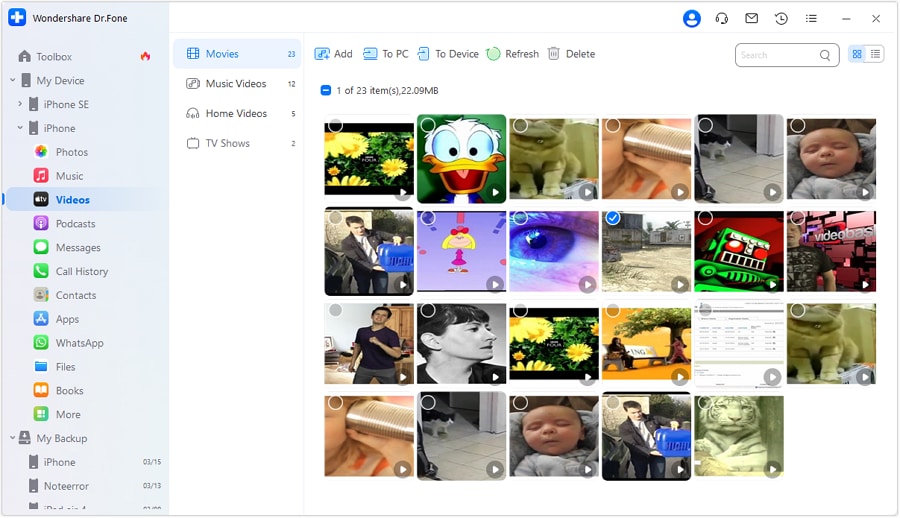
Limitation: Once you permanently delete (or empty Trash/Recently Deleted), recovery may be impossible; AI can’t undo it.




Conclusion
Use AI to design a verification-first workflow with clear stop points and a defined “proof of backup,” then rely on a real execution tool to run the backups/transfers and only proceed to deletion after checks pass—especially before any permanent purge.
FAQ
-
What’s the biggest mistake when optimizing storage with lots of videos?
Deleting first and trying to “reconstruct” later—especially assuming cloud sync equals a verified backup. -
How do I prove a video is backed up (not just “synced”)?
Confirm it’s accessible on another device/account, playable end-to-end, and that the backup covers the correct date ranges and folders. -
Should I empty “Recently Deleted/Trash” immediately to free space?
No—treat that as the final irreversible step after you’ve double-verified backups and you’re confident nothing important was removed. -
What should I delete first for the safest space win?
Non-original sources: duplicated exports, downloads, chat-app media caches, and screen recordings—after confirming they aren’t the only copy. -
Can AI tell me which videos are safe to remove on my phone?
AI can define rules and checks, but it can’t see your actual files or confirm backup integrity; you must verify using real tools and spot-checks.
 Add Wondershare Dr.Fone as a preferred source on Google