Effortlessly manage data through preview, delete, export, etc.

 100% Security Verified | No Subscription Required | No Malware
 :
: 
 ChatGPT
 Perplexity
 Gemini
 Claude
 Grok
Grok

I only want a few chats and their photos moved to my new phone—not a full transfer. But I'm worried one wrong step will overwrite something and I'll have to start over.
Reddit user, r/whatsapp
Moving only specific chats and media (not everything) can go wrong when one missed step forces you to restart, overwrites data, or leaves key attachments behind.
AI helps by turning your situation into a sequence: what to decide first, what to verify, what to back up, and what should not happen until checks pass.
AI can't access your devices, apps, storage state, encryption keys, or account permissions—so it can't perform the move. Execution needs real device tools once the plan is clear.
In this article
- Part 1. How to plan a selective move without missing critical steps
- Clarify the end format you need
- List what will not carry over
- Set “point-of-no-return” gates
- Define validation evidence before you start
- Part 2. What the AI needs to know
- Part 3. Using AI prompts to build a safer workflow
- Part 4. When to stop planning and start execution
- Part 5. Execute the workflow safely with Dr.Fone
Part 1. How to plan a selective move without missing critical steps
You're switching phones and you don't want a full transfer. You only need certain conversations and their media (photos, videos, voice notes, documents), and you want them on the new device in a usable way.
The uncertainty usually starts after an AI answer says “export chats” or “transfer media,” but doesn't clarify the exact order: which app first, what formats you'll end up with, what will not carry over (searchability, metadata, stickers), and how to confirm completeness.
There's also a point of no return: actions like “resetting” a phone, deleting an app to “reinstall clean,” or enabling a sync that merges libraries can permanently remove local-only media or overwrite chat databases. You should not reach any destructive step until you've verified backups and counted what must be preserved.
Part 2. What the AI needs to know
Share the minimum details needed to create a precise plan and verification checklist:
- Messaging app(s) involved (e.g., WhatsApp, LINE, WeChat, Telegram, iMessage/SMS)
- Old phone OS + model and new phone OS + model (e.g., Android 13 → Android 14, iPhone 12 → iPhone 15)
What "selectively" means for you:
- specific chats (names), date ranges, or message types (media-only, starred, documents)
- whether you need chats restored in-app vs “exported archive” is acceptable
Media scope and storage:
- where media currently lives (in-app only, Photos/Gallery, SD card)
- approximate size (e.g., 12 GB WhatsApp media, 4 GB documents)
Account constraints:
- same phone number/account on new device? any 2FA?
- iCloud/Google Drive enabled or avoided?
Your non-negotiables:
- keep timestamps? keep sender info? preserve voice notes? preserve original filenames?
Risk tolerance:
- can the old phone remain untouched until verification is complete?
Available hardware:
- cable type, computer access, external drive space
Part 3. Using AI prompts to build a safer workflow
Use the prompts below to force a clear sequence, reduce “unknowns,” and define verification before you do anything on the devices.
3-1. Level 1: Basic prompt
Create a step-by-step plan to move only selected chats and their media from my old phone to my new phone.
Include what I must decide first, what I should verify before starting, and what actions I should avoid until the end.
Do not give execution clicks—only planning and checks.
3-2. Level 2: Advanced prompt
Design a workflow for selectively moving chats and media to a new phone with Preparation / Execution / Verification sections.
Mark steps as Critical vs Optional, and list the top failure modes (missing media, overwritten database, wrong account/number, partial date ranges) and how to detect each one before proceeding.
3-3. Level 3: Evidence prompt
Here is my context: old phone (Android 13, Samsung S21), new phone (Android 14, Pixel 8), app (WhatsApp), selective scope (3 chats: “Family,” “Work,” “Landlord”; date range: Jan 2022–Dec 2024), media types (photos + videos + PDFs; exclude memes folder), estimated size (about 18 GB).
Build a plan that includes: pre-checks, during-execution checks, and post-move validation.
For validation, give specific evidence I can collect (e.g., message count estimates, media folder size comparisons, spot-check samples like “10 random videos across months”), and include a “stop conditions” list if a check fails.
3-4. Prompt refinement + AI plan vs. real device constraints
Return the workflow as a table with columns: Step, Goal, Inputs Needed, Risk, Verification Evidence, Stop/Go Rule.
List exactly which items cannot be preserved when doing selective exports (e.g., reactions, searchable chat history, in-app threading), and how that affects my choice between “restore in-app” vs “export archive”.
Create a minimal verification set: the smallest number of checks that still gives high confidence I didn't miss media (include size comparisons and sampling rules).
Define my point-of-no-return actions for this scenario and put them behind a “Do Not Do Until Verified” gate (e.g., deleting app data, factory reset, enabling auto-delete, turning on full cloud sync).
Give two alternative workflows: one that prioritizes preserving in-app chat history, and one that prioritizes extracting media reliably, and explain trade-offs.
| Planning with AI (what it can do) | Real device constraints (what it can't do) |
|---|---|
| Turn your goal into a sequenced workflow with gates | Access your chat database, encryption, or app permissions |
| Identify failure modes and define stop/go checks | Guarantee exported content equals in-app content |
| Suggest evidence to collect (counts, sizes, sampling) | See what's “local-only” vs cloud-only on your device |
| Reduce risky moves before backups are confirmed | Perform the transfer, backups, or restore on hardware |
AI improves planning, but cannot execute or confirm results on your devices—verification must be performed with real tools and observable evidence.
Part 4. When to stop planning and start execution
- You can clearly state your end format: restored in the messaging app vs exported archive (and you accept what each loses).
- You have a written checklist of pre-checks, stop conditions, and post-move validation evidence.
- You've identified the point-of-no-return actions (delete app data, reset device, enabling merges/sync) and placed them after verification.
- You have enough storage, power, cables, and time to run the workflow without interruptions.
Once those are true, planning risk drops and execution risk becomes the main factor to manage.
Part 5. Execute the workflow safely with Dr.Fone
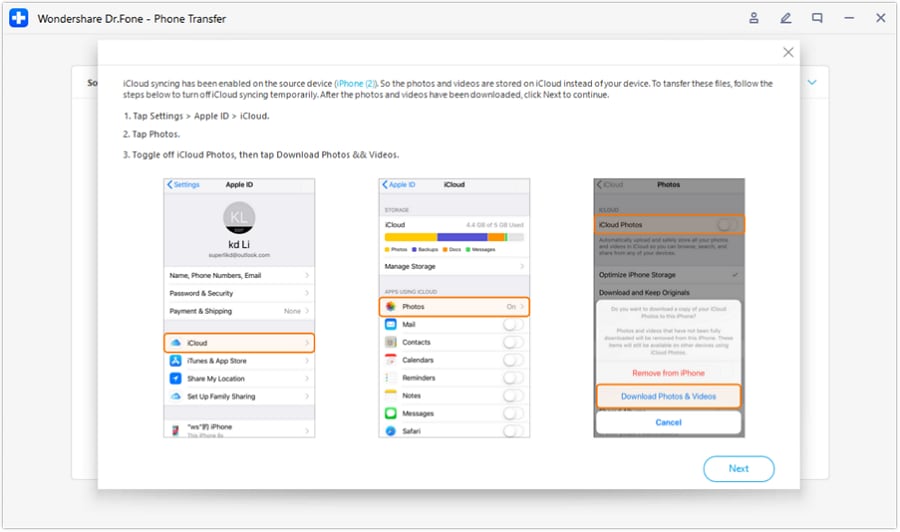
Execution now matters because the main risks shift from “unclear steps” to “data loss, partial transfers, and irreversible overwrites.” If you need a practical execution layer after your plan is approved, Dr.Fone - Phone Transfer can help you run the transfer in a controlled way while you follow your own scope and verification gates.
 Move
data between iOS to Android and
vice versa.
Move
data between iOS to Android and
vice versa.- Transfer
contacts, SMS, photos,
videos, music, and more types.
- Available
with all phones with Android
and iOS versions.
-
Simple, click-through process.
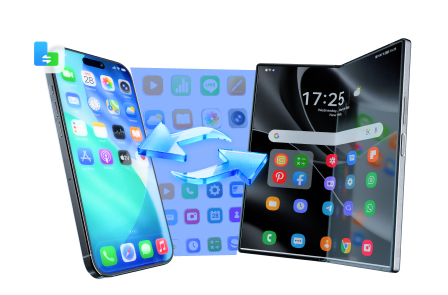
Use your plan and checks to keep the move controlled. The key is to avoid improvising mid-transfer and to delay any destructive cleanup until you've validated results on the new phone.
-
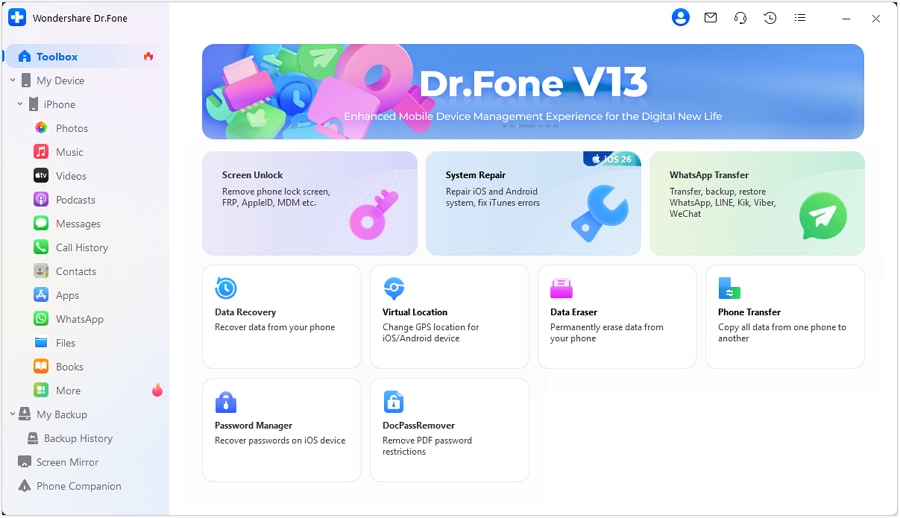
Step 1 Freeze the source and capture baseline evidence
Action: On the old phone, stop anything that changes chat/media state (auto-cleaners, auto-delete, aggressive sync/optimization) and record baseline evidence you'll later compare (approx chat ranges, media size totals, a short list of must-have messages/media).
Limitation: AI can't read your phone state or confirm what is stored locally versus cloud-only—your baseline must be observable and written down.
-
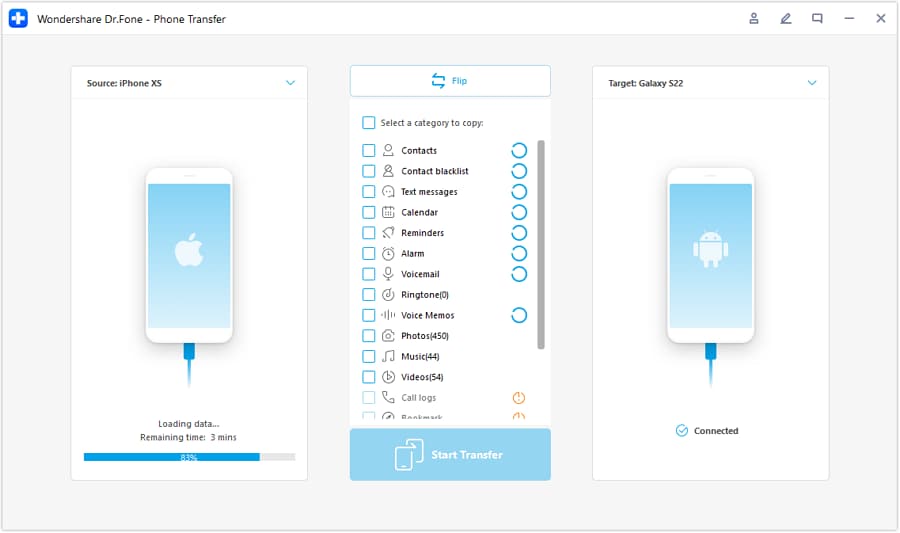
Step 2 Start the transfer setup and lock the direction
Action: Connect both devices (or follow the on-screen connection method) and set the source → destination direction to match your plan, so you don't accidentally overwrite the wrong phone.
Limitation: AI can't see your device pairing state, account prompts, or connection errors—pause and troubleshoot if the source/destination path isn't unambiguous.
-
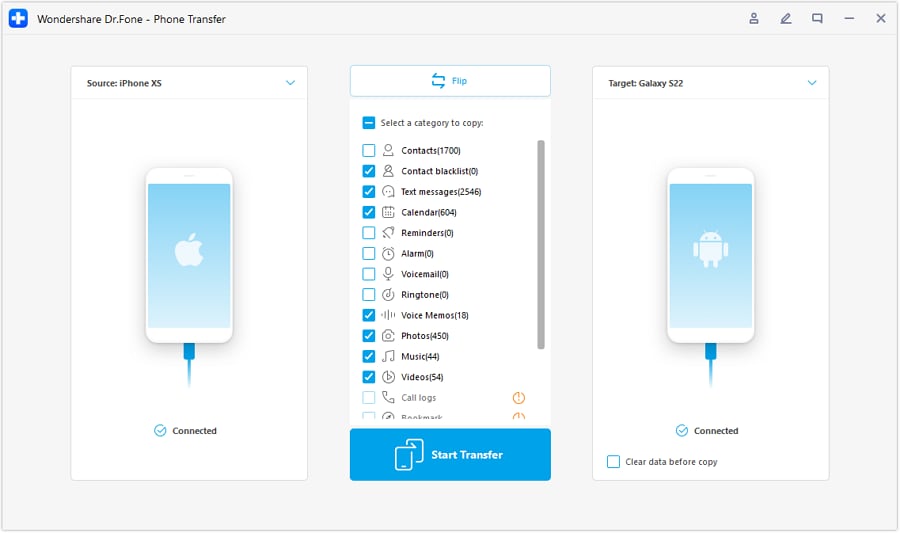
Step 3 Execute the transfer based on your approved scope
Action: Use Dr.Fone as the execution layer to perform the planned move for the selected chats/media (no improvising), keeping the old phone untouched during the process.
Limitation: AI can't run Dr.Fone, select items inside the tool, or see transfer logs—follow your predefined scope and stop conditions if anything diverges.
-
Step 4 Verify on the new phone before any destructive cleanup
Action: Perform your post-move validation (counts/size comparisons, month-by-month spot checks, open representative attachments, confirm playback of videos/voice notes) and only then consider cleanup actions.
Limitation: The irreversible moment (deleting old data, factory resetting, removing backups) must not happen until verification passes—AI cannot certify completeness.




Conclusion
Use AI to define the scope, sequence, risks, and verification gates for selectively moving chats and media; then use a real execution tool to perform the move and validate results before any irreversible cleanup.
FAQ
-
Can I truly “selectively transfer” chats so they appear normally inside the messaging app?
Sometimes selective movement results in exports/archives rather than a fully restored, searchable in-app history. Your plan should decide the required end format and accept the trade-offs before executing. -
What's the highest-risk mistake in this workflow?
Doing a destructive action (delete app data, reset old phone, enable a sync/merge) before confirming backups and validating the moved content on the new phone. -
How do I verify I didn't miss media without checking every file?
Use layered evidence: total media size comparisons, a checklist of must-have attachments, and a sampling rule (e.g., 10 items across different months and types: videos, PDFs, voice notes). -
When should I keep the old phone untouched?
Until you complete post-move validation and you're confident the new phone has what you need in the required format. -
Why can't AI just tell me exactly what will transfer?
Because transfer results depend on app rules, encryption, OS permissions, local vs cloud storage state, and tool logs—none of which AI can access or observe directly.
 Add Wondershare Dr.Fone as a preferred source on Google