Effortlessly manage data through preview, delete, export, etc.

 100% Security Verified | No Subscription Required | No Malware

 :
: 
 ChatGPT
 Perplexity
 Gemini
 Claude
 Grok
Grok

My iPhone died overnight, and after I plugged it in, it just keeps showing the Apple logo and restarting. I can’t tell if it’s charging, booting, or stuck—nothing changes even after waiting.
Apple Support Community user
Your iPhone may restart over and over after the battery fully drained—often right after you plug it in, see the Apple logo, or try a forced restart. This can happen on models like an iPhone 13 or iPhone 14, and it’s frustrating because nothing seems to change even after several minutes.
AI (like ChatGPT or Gemini) can help you describe the symptoms clearly, narrow likely causes, and decide which low-risk checks are worth trying first—without guessing.
AI can’t “do” the device-side work, and repeated trial-and-error can increase risk (data loss, longer downtime, or hardware stress). Use AI for diagnosis and decision-making, then use a purpose-built tool for execution when needed.
In this article
- Why iPhone boot loop after battery drain happens (and what it means)
- Common boot-loop patterns
- Most likely trigger after 0% battery
- What the loop can indicate
- Before you prompt the AI
- AI prompts to diagnose safely (Level 1–3 + refinement)
- AI output vs reality: what you can infer vs what you must verify
- When to stop troubleshooting to avoid risks
- Resolve iPhone boot loop safely with Dr.Fone (guided steps)
Part 1. Why iPhone boot loop after battery drain happens and what it means

An iPhone boot loop after battery drain typically shows up as a repeating Apple logo, a black screen that keeps returning, or a cycle where the phone briefly turns on then restarts. The trigger is commonly: the battery hit 0%, you charged it, then it never finishes booting.
What it can mean varies. Sometimes it’s a temporary power/charging instability (insufficient power, cable/adapter issue). Other times it points to iOS startup corruption exposed by the sudden shutdown, low storage during boot, or a battery that can’t hold stable voltage under load.
The uncertainty is normal: the screen behavior can look similar across very different causes, and it’s not always clear whether the device is still “starting up” or repeatedly failing the same step.
Before You Prompt the AI
Collect a few facts first so the AI can narrow causes faster:
- iPhone model and iOS version (if known)
- What happened right before the loop (battery drain, charging, update, storage full)
- Charging setup (cable, adapter wattage, wireless vs wired)
- Exact loop pattern (Apple logo duration, black screen duration, repeats)
- Any computer recognition (Finder/iTunes sees it? recovery/DFU mode possible?)
Part 2. Using AI prompts to diagnose iPhone boot loop after battery drain safely
Level 1: Basic Prompt
My iPhone is in a boot loop after the battery drained to 0%. I charged it and now it keeps restarting. Ask me the minimum questions needed to identify the most likely causes, and suggest the safest first checks that won’t risk data.
Level 2: Advanced Prompt
Diagnose my iPhone boot loop after battery drain using a ranked list of likely causes. For each cause, give:
1) why it fits,
2) what evidence would confirm/deny it,
3) the lowest-risk next step,
4) what NOT to do to avoid data loss.
Start with power/charging causes, then iOS startup issues, then hardware/battery health.
Level 3: Evidence Prompt
You are helping me triage an iPhone boot loop after battery drain. Use my details to:
- separate possibilities into: power/charging, iOS system, storage, battery/logic board
- rank the top 5 causes with confidence (0–100%)
- list the 3 most important missing facts to ask next
- recommend a safe step-by-step decision tree (least risk first)
Details:
- iPhone model: (e.g., iPhone 13 Pro)
- iOS version: (unknown / iOS 17.x)
- What happened before issue: (e.g., battery died overnight; plugged in; tapped restart; loop started)
- Current screen pattern: (e.g., Apple logo 10s → black 5s → repeats)
- Time since started: (e.g., 30 minutes)
- Charging method: (e.g., Lightning cable + 20W Apple adapter)
- Cable/adapter tried: (e.g., tried 2 cables, 1 adapter)
- Any heat or swelling: (yes/no)
- Storage before issue: (e.g., “almost full”)
- Computer detection: (Finder/iTunes sees it? recovery mode available?)
- Buttons responsive: (yes/no)
- Prior drops/water exposure: (yes/no)
- Any recent update/install: (e.g., tapped Install Now yesterday)
Prompt Refinement
Use these follow-ups to force clearer, safer conclusions:
What 3 questions would most change your ranking, and why?
Separate the causes into ‘power delivery’ vs ‘iOS startup corruption’ and tell me how to distinguish them within 10 minutes.
Rank the causes again assuming my charger/cable are known-good, and explain what changes.
What is the single strongest piece of evidence that points to hardware vs software here?
If I can’t get it to boot normally, what is the safest way to check whether a computer detects the device?
AI Output vs Reality
AI can guide decisions, but it can’t confirm hardware states or perform device-side operations.
| What AI can infer | What you still must verify on the device |
|---|---|
| Likely causes from symptom patterns | Whether the phone is recognized by Finder/iTunes |
| Low-risk next checks to try first | Whether recovery mode or DFU mode is reachable |
| Red flags that suggest stopping | Whether charging/power delivery is stable with known-good accessories |
| A decision tree to reduce guessing | Whether a system repair process completes without errors |
AI narrows the path; execution still depends on what the iPhone and your computer actually report in real time.
Part 3. When to stop troubleshooting iPhone boot loop after battery drain and avoid risks
Stop “trying random things” when the situation suggests rising risk or diminishing returns:
- The iPhone gets unusually hot, smells odd, or the battery looks swollen.
- The boot loop continues after you’ve confirmed a known-good cable/adapter and a stable power source.
- The device can enter recovery/DFU mode but repeatedly fails to restore/exit the loop using standard methods.
- A computer never detects the iPhone at all, even after changing ports/cables/computers.
At that point, you’ve done enough diagnosis to choose a controlled execution step (system-level repair) rather than repeating forced restarts and hoping it changes.
Part 4. iPhone boot loop after battery drain: resolve it safely with Dr.Fone
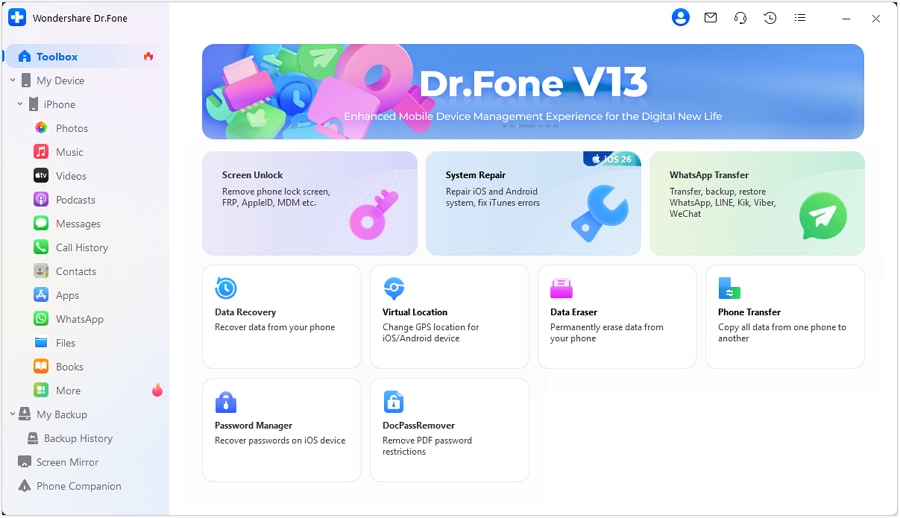
Once AI has helped you narrow the most likely category (power vs iOS startup issue), Dr.Fone - System Repair (iOS) becomes relevant because it’s designed to execute a structured iOS system repair workflow when a device won’t boot normally. If your iPhone is stuck looping after charging from 0%, using the Repair iOS Issues feature can be a practical next step to attempt stabilization without relying on repeated restarts.
Follow the guided flow in the Dr.Fone iOS system recovery guide and use the option that best matches your risk tolerance.
-
Step 1 Confirm stable power
Charge with a known-good cable/adapter and keep it connected during the process to avoid interruption.
-
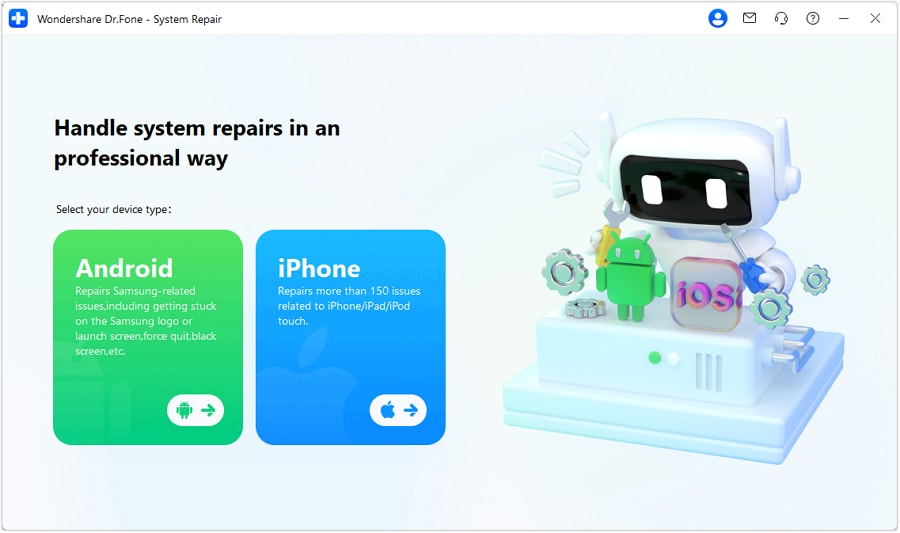
Step 2 Connect to a computer
Open Dr.Fone and connect the iPhone via cable, avoiding loose ports or hubs that may drop the connection.
-
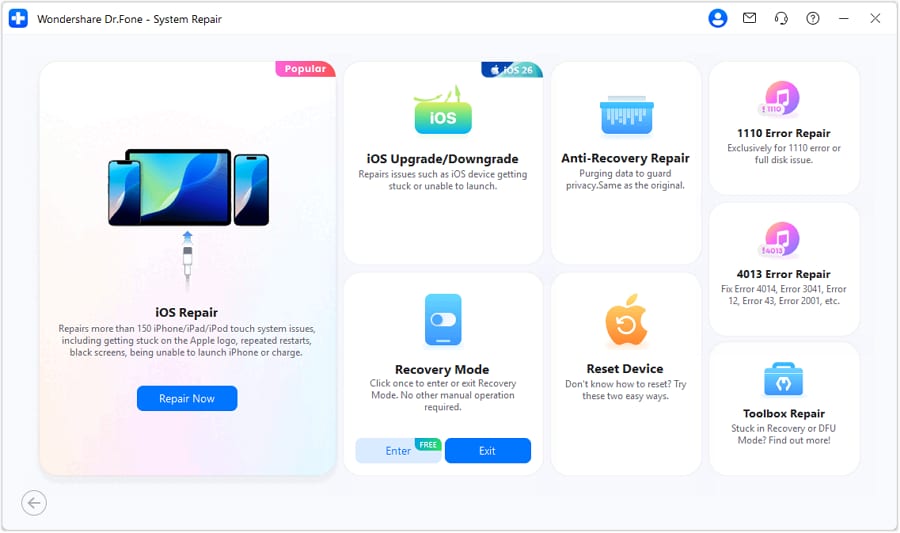
Step 3 Select iOS System Repair
Choose System Repair (iOS) and then Repair iOS Issues to proceed with the guided detection steps.
-
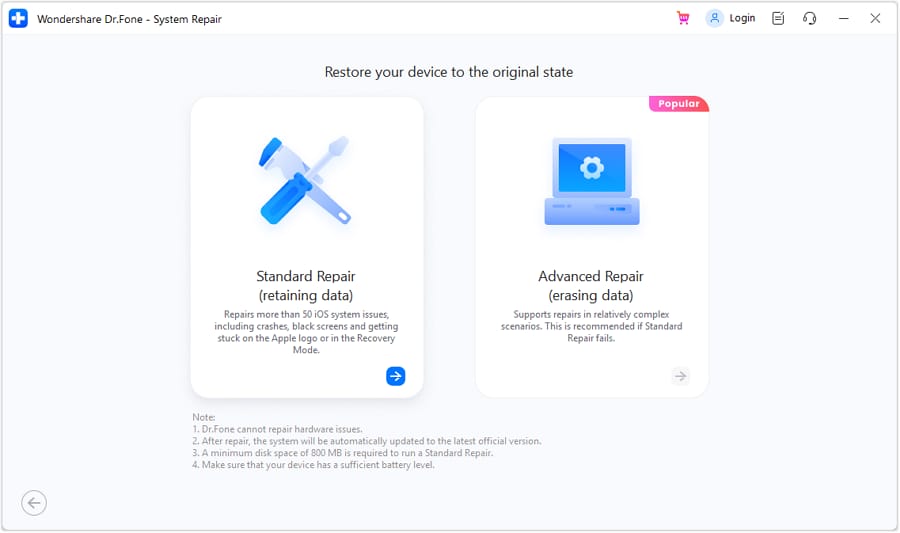
Step 4 Choose the appropriate repair mode
Start with the lowest-risk mode offered first, and only escalate if the loop persists after a completed run.
-
Step 5 Complete the on-screen firmware step
Follow the prompts carefully and don’t disconnect until the process finishes and the device reaches a stable screen.

Recommended tool for a controlled repair attempt
If your iPhone stays in a boot loop after confirmed stable charging, and standard detection checks suggest an iOS startup issue, Dr.Fone - System Repair (iOS) can help you run a structured iOS system repair workflow instead of repeating forced restarts. It’s meant to turn a “guess-and-try” situation into a guided process when the device won’t boot normally.
 Fix iOS issues, no data loss.
- One-click repair for all iOS problems.
- Solve recovery mode, Apple logo, black screen, etc.
- Upgrade or downgrade iOS without iTunes
For best results, keep the power source stable, avoid disconnecting during firmware/repair stages, and start with the lowest-risk repair option first. If the phone shows physical warning signs (heat, swelling, or suspected liquid damage), stop and choose professional inspection over continued software attempts.




Conclusion
Use AI to translate your boot-loop symptoms into a ranked cause list and a low-risk decision path, then hand off the device-side execution to Dr.Fone’s iOS System Repair workflow when basic power checks and standard detection steps aren’t enough.
FAQ
-
Why does an iPhone boot loop after the battery drains completely?
A sudden power loss can expose unstable charging/power delivery or interrupt iOS startup processes, leading to repeated restarts when the system can’t complete boot.
-
How long should I leave my iPhone charging before assuming it’s stuck in a loop?
If it’s truly at 0%, give it a stable charge for 20–30 minutes; if the Apple logo cycle repeats continuously beyond that, treat it as a boot loop symptom.
-
Can a bad cable or adapter cause a boot loop?
Yes. Unstable power can repeatedly drop voltage during boot, which can look like an iOS problem; testing with known-good accessories is a low-risk first check.
-
What’s the difference between recovery mode and DFU mode for a boot loop?
Recovery mode is a standard restore/update state; DFU mode is deeper and can help in harder cases, but it also increases the risk of wiping data depending on the action taken.
-
If my computer doesn’t recognize the iPhone, what does that suggest?
It can indicate a cable/port issue, a device stuck too early in the boot chain, or possible hardware trouble; confirm with multiple ports/cables/computers before concluding hardware failure.
 Add Wondershare Dr.Fone as a preferred source on Google