Effortlessly manage data through preview, delete, export, etc.

 100% Security Verified | No Subscription Required | No Malware

 :
: 
 ChatGPT
 Perplexity
 Gemini
 Claude
 Grok
Grok

I tried moving my Samsung photo/video library to an iPhone and realized one missed step can cause duplicates, missing albums, wrong timestamps, or even accidental deletion before I confirm everything actually transferred.
Forum user
Moving a large photo/video library from Samsung to iPhone sounds straightforward, but one missed step can mean duplicates, missing albums, lost timestamps, or—worst case—permanent deletion before you confirm the transfer worked.
AI is useful here for turning a vague goal into a clear sequence: what to check first, what to do in what order, and how to verify you didn’t lose anything (especially if you have years of media).
AI can’t access your devices, cables, storage, or app permissions—and it can’t actually move files. You still need real tools to execute actions once the plan is verified.
In this article
- How to plan the transfer without missing critical steps
- Map all media sources
- Add verification before cleanup
- Protect the point-of-no-return step
- Decide what “success” looks like
- What the AI needs to know
- Using AI prompts to build a safer workflow
- When to stop planning and start execution
- Execute the workflow safely with Dr.Fone
Part 1. How to Plan Move Samsung Photos and Videos to iPhone Without Missing Critical Steps
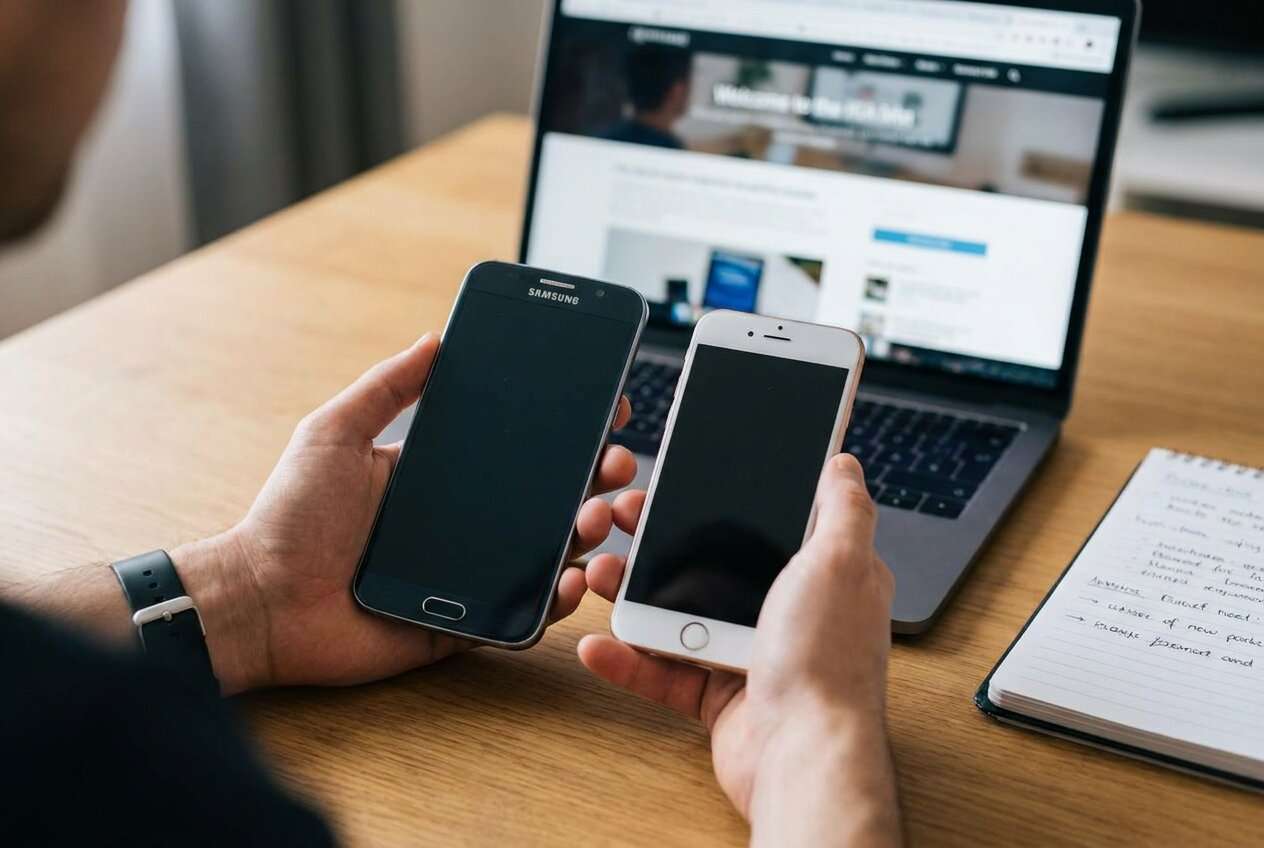
1-1. Map all your media sources (not just what you can “see”)
You have photos split across Camera, Downloads, WhatsApp, Screenshots, and possibly an SD card. Some items may be in cloud sync (Google Photos/Samsung Cloud/OneDrive), while others exist only locally—so “I see it in an app” doesn’t always mean it’s truly stored on the phone.
1-2. Demand a reliable sequence (not a list of options)
After you ask AI “How do I move everything?”, you often get a list of options but not a reliable sequence. The missing pieces are usually verification (counts and samples), handling Live Photos/HEIC/4K video, and deciding whether you want albums preserved or only the raw media copied.
1-3. Put verification gates before any destructive step
The point-of-no-return moment is when you delete originals on the Samsung phone, format an SD card, or reset the Samsung device. Don’t approach that step until you’ve verified the iPhone has the full library and it’s accessible offline as expected.
1-4. Define your success criteria up front
Before executing, decide what matters most: no missing items, no duplicates, correct timestamps, and whether album/folder structure is required or just “nice-to-have.” This definition will drive your inventory method and your verification checks.
Part 2. What the AI Needs to Know
Share the details below so the workflow can be planned precisely:
- Samsung model and Android version (e.g., Galaxy S21, Android 14)
- iPhone model and iOS version (e.g., iPhone 15, iOS 18)
- Rough library size (e.g., 18,000 photos / 900 videos / ~220 GB)
- Where media currently lives: internal storage, SD card, Google Photos, OneDrive, Samsung Gallery only
- Whether you need albums/folders preserved or just all media in one library
- Whether “original date/time” metadata must be preserved
- Available storage on the iPhone (free GB) and whether iCloud Photos is on/off
- Your connection options (USB-C/Lightning cable availability, PC/Mac access, Wi‑Fi reliability)
- Any special formats: Live Photos, Motion Photos, 4K60, HDR, HEIC/HEVC, WhatsApp media
- Your risk tolerance: “no duplicates allowed” vs “duplicates okay if nothing is missing”
Part 3. Using AI Prompts to Build a Safer Move Samsung Photos and Videos to iPhone Workflow
Use the prompts below to make AI produce a sequence you can actually follow—and, crucially, a verification plan before any destructive cleanup.
3-1. Level 1: Basic Prompt
I need a safe plan to move all photos and videos from a Samsung phone to an iPhone.
Create a simple step-by-step workflow with verification steps so I can confirm nothing is missing before I delete anything.
Include common pitfalls like duplicates, missing folders, and wrong timestamps.
3-2. Level 2: Advanced Prompt
Design a structured workflow to move Samsung photos/videos to iPhone with three phases: Preparation, Execution, and Verification.
In each phase, list critical steps vs optional steps, and call out risks (duplicates, missing SD card media, cloud-only items, metadata loss).
End with a “do-not-do-yet” checklist that blocks deletion/reset until verification is complete.
3-3. Level 3: Evidence Prompt
Build a move plan using this context and require evidence-based checks before/during/after:
- Samsung: (Galaxy S21, Android 14), iPhone: (iPhone 15, iOS 18)
- Library: (~18,000 photos, ~900 videos, ~220 GB)
- Sources: (Samsung Gallery + DCIM + Downloads + WhatsApp folder + SD card)
- Goal: (keep original dates; albums nice-to-have)
Produce:
1) A preparation checklist (storage, power, cable, permissions, cloud sync status)
2) A transfer sequence with decision points (what to transfer first and why)
3) A verification protocol with measurable checks (counts per folder/app, spot-check samples across years, random video playback, “recent” vs “oldest” items)
4) A “stop” rule that prevents deletion/reset until all checks pass.
3-4. Prompt Refinement
Convert your plan into a table with columns: Step, Purpose, Input needed, Expected output, Verification method, Failure signs, Recovery action.
Add a media inventory method: how to estimate counts by source (DCIM, Screenshots, WhatsApp, SD card) before transfer, and how to compare after transfer.
Add explicit metadata checks: how I confirm original capture dates and ordering are preserved (include at least 5 spot-check rules).
Add a duplicate-control strategy: how to prevent duplicates during re-runs, and how to safely re-transfer only what’s missing.
3-5. AI plan vs. real device constraints
AI improves planning, but cannot execute transfers or confirm results—you still need to run the workflow on real devices and verify with actual evidence.
| Planning element (AI can help) | Device reality (AI can’t do) |
|---|---|
| Define safest sequence and decision points | Read your phone storage, scan folders, or detect what’s “cloud-only” |
| Create verification checklist and sampling rules | Confirm actual file counts, view hidden folders, or validate metadata on-device |
| Identify risks (duplicates, missing SD card media, format issues) | Grant permissions, maintain stable connections, or resolve driver/cable issues |
| Draft rollback/contingency steps | Perform the transfer, retries, backups, or any device actions |
Part 4. When to Stop Planning Move Samsung Photos and Videos to iPhone and Start Execution
- You have an inventory plan that covers every source (Camera/DCIM, Screenshots, Downloads, app media like WhatsApp, and SD card if present).
- You have a verification method that includes counts + spot checks (oldest/newest, multiple years, multiple folders, multiple video playbacks).
- You’ve chosen how to handle cloud sync (iCloud Photos on/off; whether Google Photos is a source of truth or just a viewer).
- You have a clear “no point-of-return yet” rule: no deleting, formatting, or resetting until verification passes.
Once these are true, you’re no longer guessing—you’re ready to execute with a tool and follow the checks.
Part 5. Move Samsung Photos and Videos to iPhone: Execute the Workflow Safely with Dr.Fone
Execution matters now because the risks come from real-world interruptions (storage limits, permission prompts, cable drops, partial transfers) that only show up when you run the transfer—not when you plan it. If you need a controlled way to move media, use Dr.Fone - Phone Transfer.
 Move data between iOS to Android and vice versa.
- Transfer contacts, SMS, photos, videos, music, and more types.
- Available with all phones with Android and iOS versions.
- Simple, click-through process.
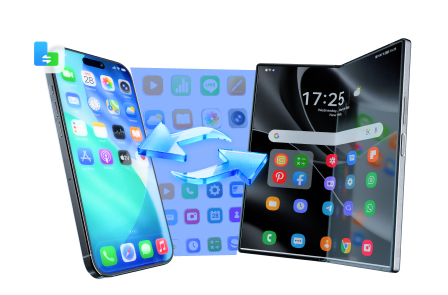
-
Step 1 Pre-transfer safeguard (storage, power, stability)
Confirm both devices have enough free storage, are charged, and you can keep them connected/stable for the full duration before starting the transfer.
AI can’t confirm your real storage, connection stability, or permission prompts—verify these on-device.
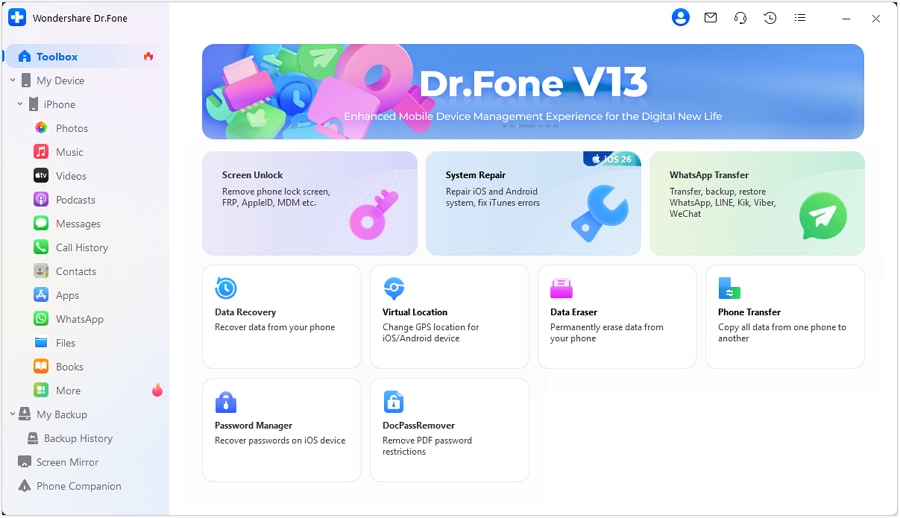
-
Step 2 Connect devices and set the transfer direction
Connect your Samsung and iPhone and ensure the path is set correctly (Android to iOS) before you proceed.
If you see permission prompts on either device, approve them so the tool can access your media.
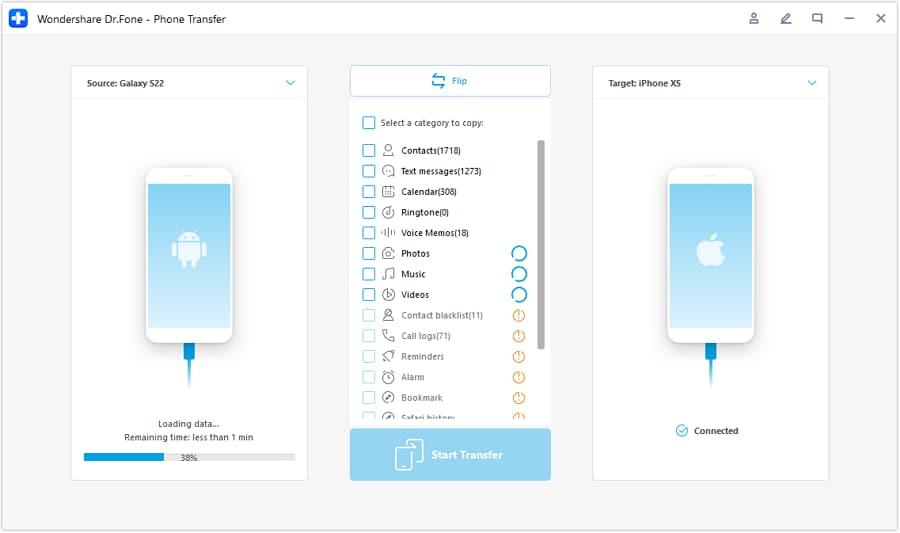
-
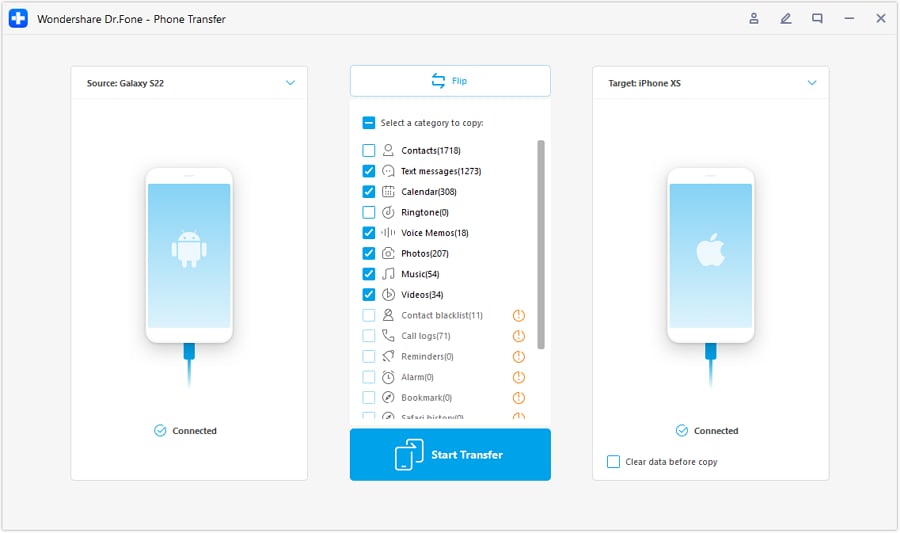
Step 3 Transfer photos and videos in a controlled run
Choose photos and videos, then start the transfer. Avoid multitasking and interruptions during the process.
AI cannot perform or monitor the transfer; if the run is interrupted, rely on your verification plan to detect gaps or duplicates.
-
Step 4 Monitor progress, then verify before irreversible cleanup
Monitor transfer progress, then validate results on the iPhone using your pre-defined checks (counts, source coverage, random samples across years, and video playback).
Deleting/formatting/resetting is irreversible if the transfer was incomplete—do not proceed without evidence.




Conclusion
Use AI to define a clear sequence, risks, and verification gates—then use a real tool to execute the transfer and only proceed to irreversible cleanup after your checks prove the iPhone library is complete.
FAQ
-
What’s the biggest risk when moving Samsung photos/videos to iPhone?
Assuming everything moved when only a subset did (missing SD card/app folders), then deleting the originals.
-
How do I know I didn’t miss WhatsApp/Downloads/Screenshots?
Include those folders as explicit sources in your inventory and verify coverage after transfer with counts + spot checks, not just “I see recent photos.”
-
When is it safe to delete photos from the Samsung phone?
Only after you verify: (1) expected counts match your inventory, (2) old/new items exist, (3) multiple videos play correctly, and (4) key metadata (dates) looks right.
-
Will albums transfer exactly the same way?
Not always. Plan upfront whether album structure is critical; if it is, add extra verification for album/folder mapping rather than only total photo counts.
-
Why can’t AI just tell me the one best method and guarantee it works?
Because success depends on device storage, cable reliability, permissions, cloud sync states, and what’s stored locally vs in the cloud—AI can’t read or validate your devices.
 Add Wondershare Dr.Fone as a preferred source on Google