Effortlessly manage data through preview, delete, export, etc.

 100% Security Verified | No Subscription Required | No Malware

 :
: 
 ChatGPT
 Perplexity
 Gemini
 Claude
 Grok
Grok

I deleted the “duplicate” that looked the same—and later realized it was the only full-resolution original. The one I kept was smaller and had missing metadata.
Apple Support Community user
Choosing the “best” copy among duplicate photos and videos sounds simple, but one missed step can mean deleting the only original, the only high-resolution version, or the only file with correct metadata. AI can help you define what “best” means and design a safer sequence, but it can’t read your real library or delete files safely—execution still requires device-aware tools and manual verification.

In this article
- How to plan without missing critical steps
- Where duplicates come from
- Why “keep the highest quality” isn’t enough
- The point-of-no-return moment
- What a safe sequence must include
- What the AI needs to know
- Using AI prompts to build a safer workflow
- AI plan vs. real device constraints
- Execute the workflow safely with Dr.Fone
Part 1. How to plan how to choose the best version of duplicate media without missing critical steps
You might have duplicates from messaging apps, cloud sync, importing from a camera, or restoring from a backup. The duplicates often look identical, but differ in resolution, format (HEIC/JPG/MP4), edit history, and date/location metadata.
After an AI answer, the common gap is sequence: you get rules like “keep the highest quality,” but not how to confirm quality, when to check albums vs. camera roll, and how to prevent deleting a version that another app references.
The point-of-no-return moment is deletion/cleanup: once you remove media from the device (and especially if it also clears from a synced cloud or “Recently Deleted” window), you may not be able to reconstruct the original version or its metadata.
Part 2. What the AI needs to know
Share the context so the AI can build a workflow and verification checklist that matches your library and risk level.
- Your device type and OS (iPhone iOS 17 / Android 14, etc.)
- Where duplicates came from (cloud sync, WhatsApp, import, restore, multiple albums)
- Media types involved (photos, Live Photos, videos, burst shots, screenshots)
- Your definition of “best” (highest resolution, least compressed, original timestamp, edited version, smallest size, etc.)
- Whether you use cloud services (iCloud Photos, Google Photos, OneDrive) and if “optimize storage” is enabled
- Your tolerance for loss (zero-loss archive vs. “good enough” cleanup)
- Your storage constraint and goal (free 20 GB, reduce clutter, keep only originals)
- Any must-keep folders/albums (family album, work, legal/docs, shared albums)
- Whether you have an existing backup you trust (and where it is stored)
Part 3. Using AI prompts to build a safer how to choose the best version of duplicate media workflow
Use the prompts below to force a clear rubric, a safe sequence, and explicit verification before any deletion.
3-1. Level 1: Basic prompt
I have duplicate photos/videos and I need to choose the best version to keep without losing originals.
Help me define a simple “best version” rule set and a safe step-by-step plan with checks before deleting anything.
3-2. Level 2: Advanced prompt
Build a structured workflow for choosing the best version among duplicate media, separated into Preparation, Execution, and Verification.
Mark each step as critical or optional, and include a decision rubric that prioritizes (1) original quality, (2) metadata integrity, and (3) edit/version preference, while minimizing irreversible deletion risk.
3-3. Level 3: Evidence prompt
Here’s my situation: I’m on (iPhone 14, iOS 17), duplicates came from (iCloud sync + WhatsApp saves), and I have (photos + videos) with limited storage (need to free ~15 GB).
I define “best” as (highest resolution + original date/location preserved), but I also want to keep (edited versions in Favorites).
Create a plan with checks before/during/after, including: how to confirm which copy is compressed (e.g., smaller file size), which has better resolution (e.g., 4032×3024 vs 1920×1080), and how to avoid deleting a file that exists only locally because of (Optimize Storage).
End with a “Do not proceed to deletion unless…” checklist.
3-4. Prompt refinement
Create a decision matrix with columns: Resolution, File size, Format, Edited?, Metadata present?, Source (camera/app), Keep/Delete, and explain how to score each row consistently.
Rewrite the workflow as gates: “Gate 1: backup verified,” “Gate 2: sampling check passed,” “Gate 3: deletion scope confirmed,” with pass/fail criteria for each gate.
List the top 10 edge cases that cause accidental loss (Live Photos, burst, shared albums, cloud-only originals, edited vs original, screenshots with annotations, etc.) and add a mitigation step for each.
Produce a small test plan: how to test on a subset (e.g., 50 items) to confirm the rules work before applying to the full library, including what evidence to record.
Part 4. AI plan vs. real device constraints
AI improves planning, but cannot execute: it can’t read your actual file attributes, detect true duplicates in your library, or perform deletions safely—those require device-aware tools and your verification.
| Planning item | AI can help with | Reality constraint on devices | What to verify before continuing |
|---|---|---|---|
| Define “best version” criteria | Create a clear rubric and tie-breakers | File properties vary by app/sync source | Confirm criteria match what you can actually inspect (resolution/size/format/metadata) |
| Build a safe sequence | Order steps to minimize irreversible actions | Deletions can propagate via cloud sync | Confirm cloud behavior and “Recently Deleted” rules for your setup |
| Risk and edge-case checklist | Identify likely failure modes | Some duplicates aren’t true duplicates (edits/Live Photos) | Confirm you can distinguish originals vs derivatives before removal |
| Verification plan | Create sampling and acceptance checks | You must perform checks on real files | Confirm sample results match expectations before scaling up |
4-1. When to stop planning how to choose the best version of duplicate media and start execution
- You can state your “best version” rule in one sentence and you have tie-breakers for exceptions (edited vs original, Live Photos, videos).
- You have confirmed where your originals live (device vs cloud) and whether deleting locally will affect synced copies.
- You have a verification method that works on a small sample (e.g., 50 items) and you know what “pass” looks like.
- You have identified the irreversible moment (deletion/cleanup) and you have not approached it without a confirmed backup and a rollback path.
If all four are true, your workflow is stable enough to move from planning to controlled execution.
Part 5. How to choose the best version of duplicate media: execute the workflow safely with Dr.Fone
Execution now matters because this is where mistakes become permanent: selecting and removing the wrong copy can erase higher-quality originals or break the version you intended to keep.
-
Step 1 Connect your device and prepare for a controlled review
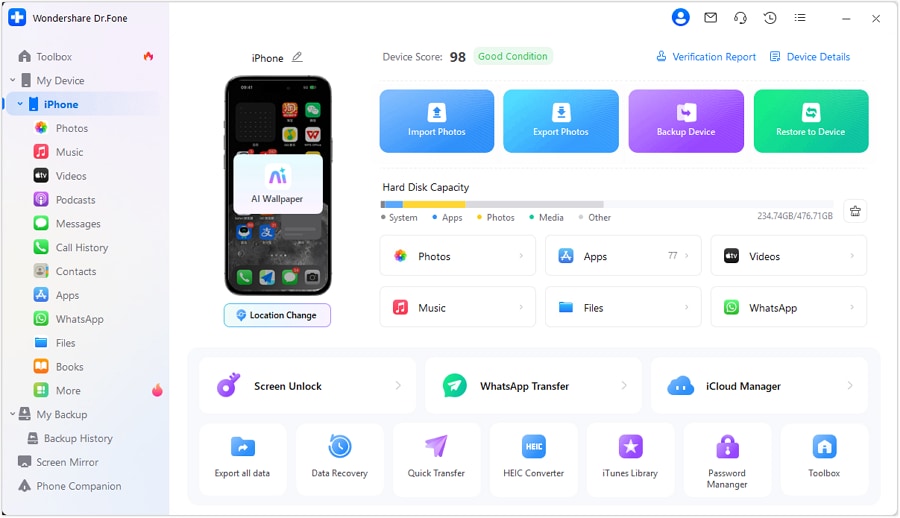
Use Dr.Fone Basic - Data Manager to connect your phone to a computer so you can review media with a consistent rubric before taking any cleanup action. This helps you stay in a controlled workflow instead of making ad-hoc decisions inside multiple apps.
-
Step 2 Open media management and scope the duplicates you’ll evaluate
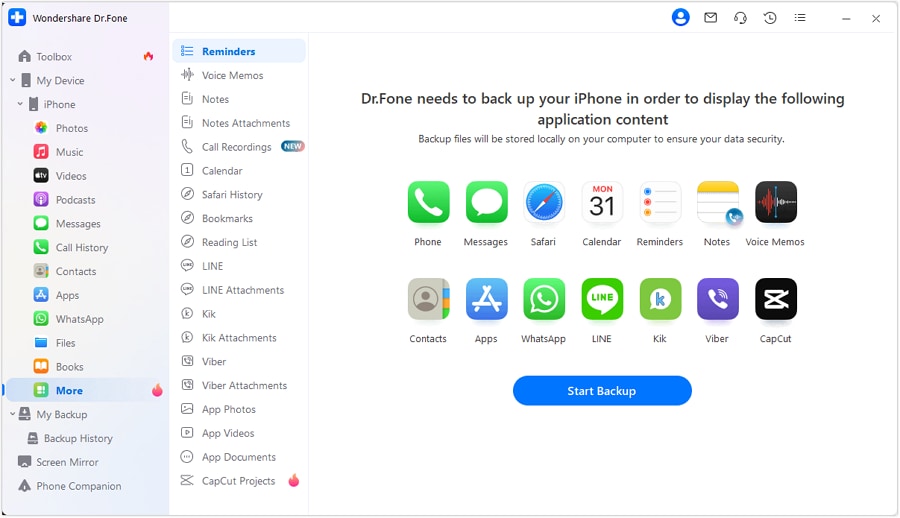
Review candidates against your “best version” rules (resolution, file size/compression, format, edits, and metadata). Limitation: a tool can surface and organize items, but only you can confirm which version is truly “best” for your use case.
-
Step 3 Validate your rules on a small batch first

Apply your keep/delete decisions in a small test set (for example, a single album or ~50 items) and confirm the retained files have the expected resolution, intact date/location, and the right edit state (e.g., Favorites edits kept where intended). AI cannot validate outcomes on your device—verify manually before expanding scope.
-
Step 4 Proceed to cleanup only if verification checks pass
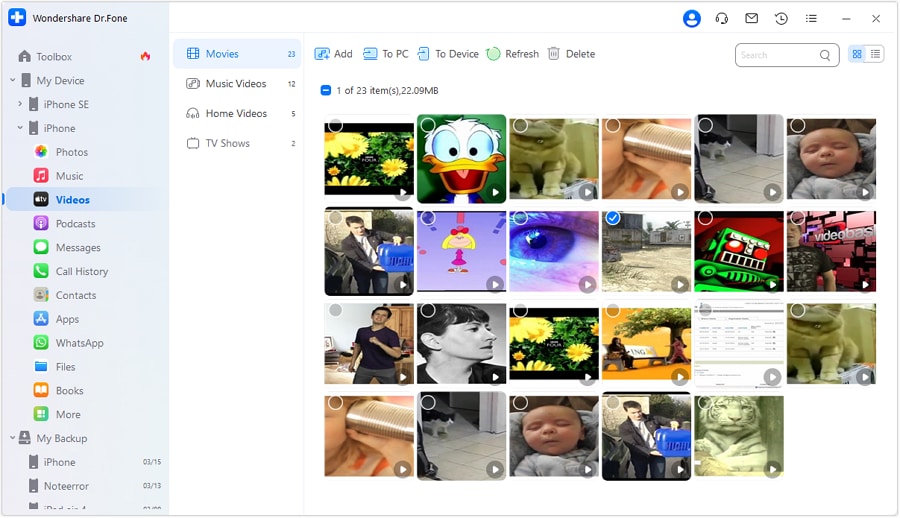
Complete the broader cleanup only after your checks confirm nothing critical was removed and cloud behavior is understood for your setup. Deletion is the high-risk, potentially irreversible moment—if verification is incomplete, stop rather than trying to “fix it later.”
Recommended tool to execute your plan
If you already have a clear “best-version” rubric and verification gates, Dr.Fone Basic - Data Manager can help you move from planning to controlled execution—so you can review, manage, and clean up media more reliably than doing everything manually across multiple apps.
 Easily manage data through preview, delete, export, etc.
- Transfer all data between devices.
- Robust backup solutions for reliable data protection.
- Mirror screens to PC for meetings, teaching, and control.
For best results, keep your process “gated”: verify backup status, run a small-batch test, confirm cloud sync behavior, and only then expand cleanup. This keeps the AI plan practical and reduces the chance of deleting the wrong version when duplicates are visually identical but technically different.




Conclusion
Use AI to define what “best” means, sequence the work, and set verification gates; then use a real tool to execute the scan and cleanup—because planning reduces risk, but execution is where loss becomes permanent.
FAQ
-
What’s the biggest risk when choosing the “best” duplicate?
Keeping the visually identical but lower-quality/compressed copy while deleting the original with higher resolution or intact metadata. -
How do I avoid deleting something that only exists in the cloud or only exists locally?
Treat cloud sync as a separate risk layer: confirm your sync settings and validate on a sample whether deletions propagate before doing bulk removal. -
Should I keep the edited version or the original?
Decide upfront: many workflows keep both (original for archive, edited for sharing). If storage is tight, define a tie-breaker (e.g., keep edited only for Favorites). -
When should I stop and re-plan instead of continuing?
If sample results don’t match your rubric (wrong versions kept, missing metadata, unexpected cloud behavior), stop before scaling up. -
Is “Recently Deleted” a reliable safety net?
Sometimes, but not always—timers, cloud sync propagation, and app-specific behavior vary. Don’t rely on it as your only rollback plan.
 Add Wondershare Dr.Fone as a preferred source on Google