Effortlessly manage data through preview, delete, export, etc.

 100% Security Verified | No Subscription Required | No Malware
 :
: 
 ChatGPT
 Perplexity
 Gemini
 Claude
 Grok
Grok

I tried to “clean up” my Camera Roll and realized later some receipts were gone. Now I'm scared to delete anything because I can't prove I've backed up everything correctly.
Reddit user, r/iPhone
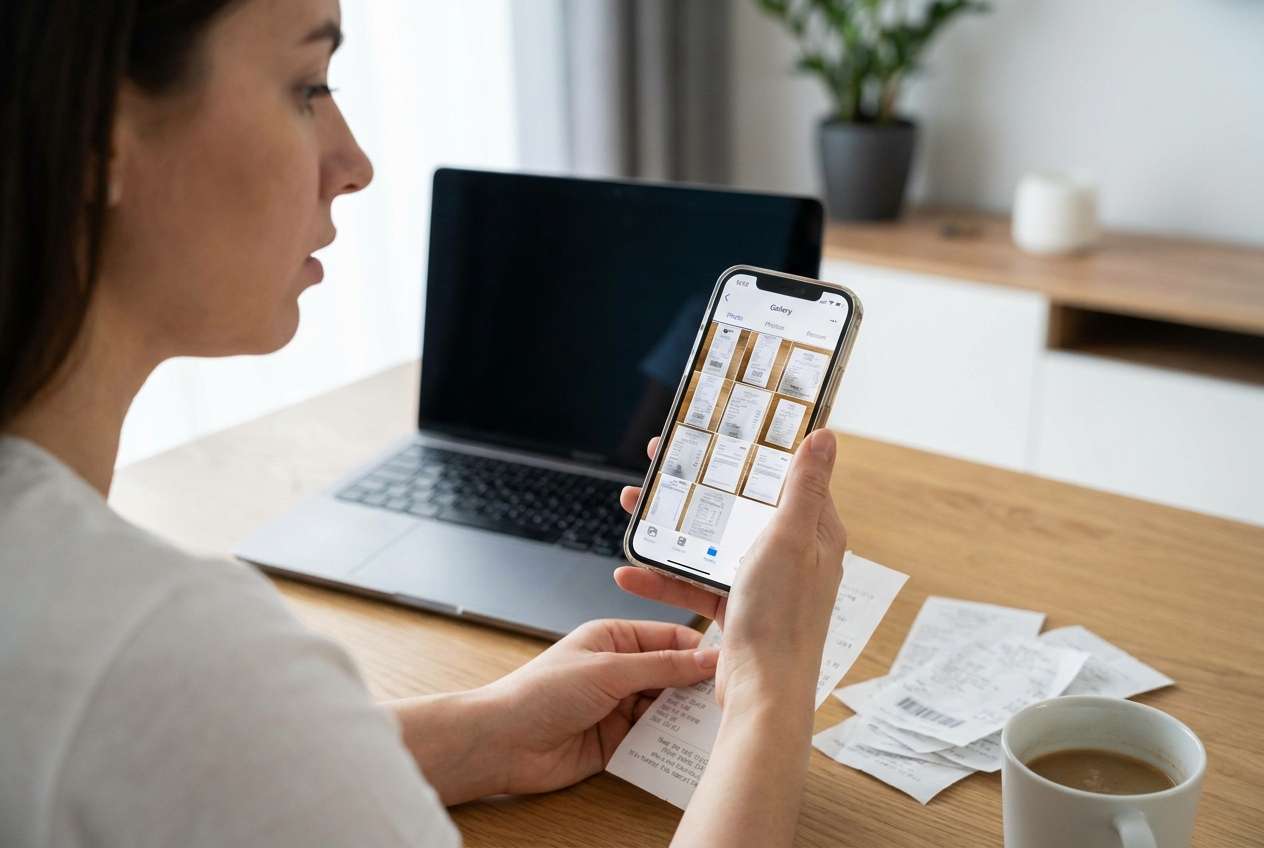
A photo library full of receipts and document scans is easy to “clean up” the wrong way—one missed step can mean lost proof, missing warranties, or deleted originals. AI can help you design a safe sequence (sort → back up → export → verify → only then clean up), but it can't touch your real storage or cloud sync. You still need a verified backup/export before any irreversible actions.
In this article
- How to plan a safe workflow (without missing steps)
- Why receipt cleanups go wrong
- Choose where your “source of truth” lives
- Put verification before deletion
- Define your point of no return
- What the AI needs to know
- AI prompts (Level 1–3) + prompt refinement
- AI plan vs. real device constraints (and when to start execution)
- Execute safely with Dr.Fone (backup → export → verify → cleanup)
Part 1. How to plan manage receipts and document scans in photo library without missing critical steps
You've got receipts mixed into Camera Roll, screenshots, and scanned PDFs-as-photos. You want them easy to find (by vendor/date/category), but you're not sure whether to organize on-device, in cloud albums, or by exporting to a computer folder structure.
Even after AI gives “ideas,” the uncertainty is usually the sequence: Do you dedupe first or back up first? Do you rename files before exporting? What's the minimum verification to prove nothing is missing?
1-1. The high-risk moment: bulk deletion
The point-of-no-return moment is typically bulk deletion (duplicates, “bad scans,” or “already uploaded” copies). If you delete before confirming your backup/export is complete and readable, you can permanently lose receipts you only discover you need months later.
1-2. What a “safe sequence” looks like
A safer plan usually follows this order:
- Find and group receipts/scans (without deleting anything).
- Back up the current state (protected baseline).
- Export a working/archive copy (to computer/cloud folder structure).
- Verify using measurable checks (counts, spot checks, gap checks).
- Only then do cleanup (dedupe, remove from Camera Roll, delete bad scans).
Part 2. What the AI needs to know
Answer these so the workflow can be planned safely and verified.
- Phone OS and model (iPhone/Android; storage size)
- Where photos live now (device only / iCloud Photos / Google Photos / OneDrive / mixed)
- Approx. volume (e.g., 300 receipts, 8,000 total photos)
- Receipt types (paper photos, app receipts, email screenshots, PDFs saved as images)
- Your target system (keep in Photos albums / export to computer folders / both)
- Search needs (by merchant, date, amount, project, tax year)
- Retention rules (e.g., keep 7 years; keep warranties until expiry)
- Risk tolerance (OK to delete from camera roll later, or must keep originals)
- Your naming preference (e.g., YYYY-MM-DD_merchant_amount_category)
- Collaboration needs (shared access with accountant/partner)
Part 3. Using AI prompts to build a safer manage receipts and document scans in photo library workflow
Use these prompts to make the plan unambiguous before you touch any originals.
3-1. Level 1: Basic prompt
Create a safe, step-by-step plan to organize my receipts and document scans that are mixed into my phone photo library.
Include a “do not do yet” list so I don't delete or move anything too early.
End with a short verification checklist to confirm nothing is missing.
3-2. Level 2: Advanced prompt
Design a workflow with three phases—Preparation, Execution, and Verification—to manage receipts and document scans inside a photo library and optionally export them to a computer.
In each phase, list critical steps vs optional improvements, and call out any steps that are irreversible (like bulk deletion).
Include a clear stopping point where I must verify backups/exports before proceeding.
3-3. Level 3: Evidence prompt (with your setup)
I need a workflow to manage receipts and document scans in my photo library with minimal risk.
My setup: (iPhone 13, iOS 17), (iCloud Photos ON), about (9,500 photos), around (450 receipts/screenshots) across (2022–2026).
My goal: keep receipts searchable and also export a copy to my laptop.
I prefer naming like (2025-04-02_HomeDepot_128.44_tools).
Give me:
- A preparation checklist (what to confirm about iCloud sync status, storage, and where originals live)
- A sorting plan (how to triage: “keep / rescan / discard,” and how to separate receipts from personal photos)
- Checks before, during, and after export/backups (include sample spot-check counts, random sampling, and how to detect missed months)
- A “point of no return” warning: exactly what I must verify before deleting duplicates or originals
- A rollback plan if I realize items are missing after cleanup
3-4. Prompt refinement (follow-up prompts)
Rewrite the plan as a table with columns: Step, Goal, Risk if skipped, How to verify, Stop-if condition.
Add explicit decision rules: when two images look similar, when do I keep both vs delete one? Include tie-breakers.
Create a minimal “first pass” workflow that takes 30 minutes and reduces risk most, without perfect organization.
Define verification with numbers: what counts should match (total receipts found, per-year counts), and how many random samples to open-check (e.g., 20 files).
Give me a checklist for cloud-sync edge cases: iCloud/Google Photos optimization, “recently deleted,” and duplicates created by exports.
Convert the workflow into a “gates” system: Gate 1 backup proven, Gate 2 export proven, Gate 3 cleanup allowed.
Part 4. AI plan vs. real device constraints (and when to start execution)
4-1. AI plan vs. real device constraints
| AI can plan | Real device constraints |
|---|---|
| A safe sequence (backup → export → verify → cleanup) | Sync delays, “Optimize Storage,” and multi-device libraries can hide originals |
| Naming and folder taxonomy that stays consistent | Some photo libraries don't preserve filenames or metadata the way you expect |
| Verification rules (counts, spot-checks, month-by-month gaps) | You still must open files and confirm readability/legibility on real storage |
| Risk flags and stop conditions before deletion | Deletion can propagate via cloud sync and become hard to undo after grace periods |
AI improves planning, sequencing, and verification design—but it cannot perform the backups, exports, transfers, or deletions on your actual devices.
4-2. When to stop planning and start execution
- You can clearly state where the “source of truth” is (device vs cloud) and what will be preserved as the master copy.
- You have a written naming and grouping scheme you can follow without improvising mid-way.
- Your verification method is measurable (expected counts, sampling size, and specific stop-if conditions).
- You have identified the irreversible moment (bulk deletion / dedupe / cleanup) and placed it after proof of backup and export.
If all four are true, you're ready to move from a plan to controlled execution.
Part 5. Manage receipts and document scans in photo library: execute the workflow safely with Dr.Fone
Execution is where most losses happen—because actions are fast, but verification is often skipped. Keep deletion and dedupe locked until your backups/exports are proven complete and readable. For hands-on device backup and export, you can use Dr.Fone Basic - Data Manager.
-
Step 1 Capture a protected baseline backup
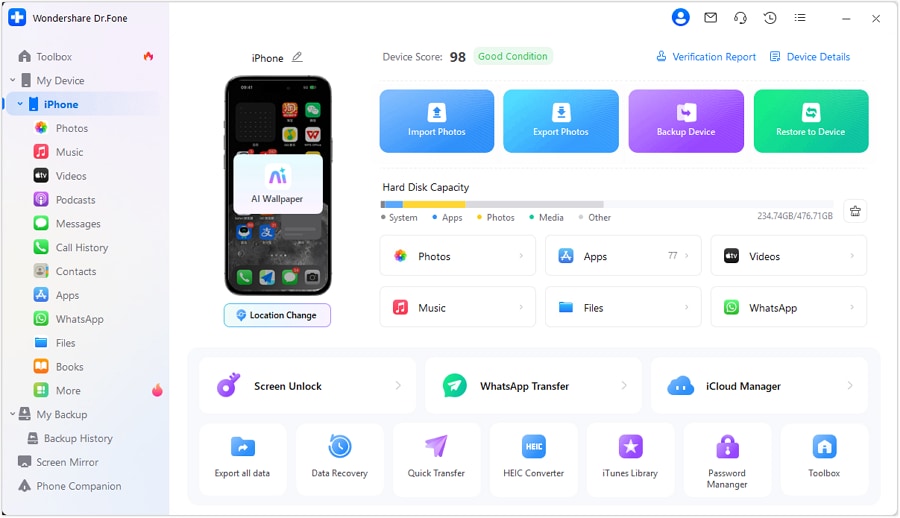
Action: Create a computer backup of your device data/photos so you have a recoverable baseline before reorganizing or removing anything.
Limitation: A backup only helps if it completes successfully and you can confirm it contains the items you care about.
-
Step 2 Choose the content to manage and protect (receipts/scans first)
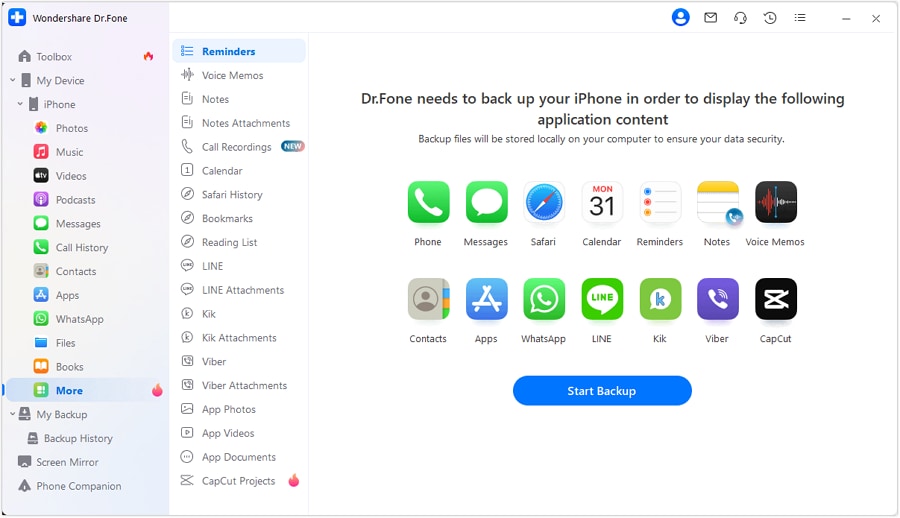
Action: Focus on your receipts/scans set first (the high-value subset), so verification is easier than trying to validate the entire library at once.
Limitation: If cloud sync is involved, make sure you understand whether you're viewing full originals or optimized placeholders before you decide anything is “safe to delete.”
-
Step 3 Export receipts/scans to your chosen archive location

Action: Transfer/export the selected receipt and document images to a clearly named folder structure on your computer (for example, by year and category).
Limitation: Exports may not preserve the exact filenames/metadata you expect—verify a sample set for correct dates and readability.
-
Step 4 Verify first, then perform cleanup (only if proven safe)
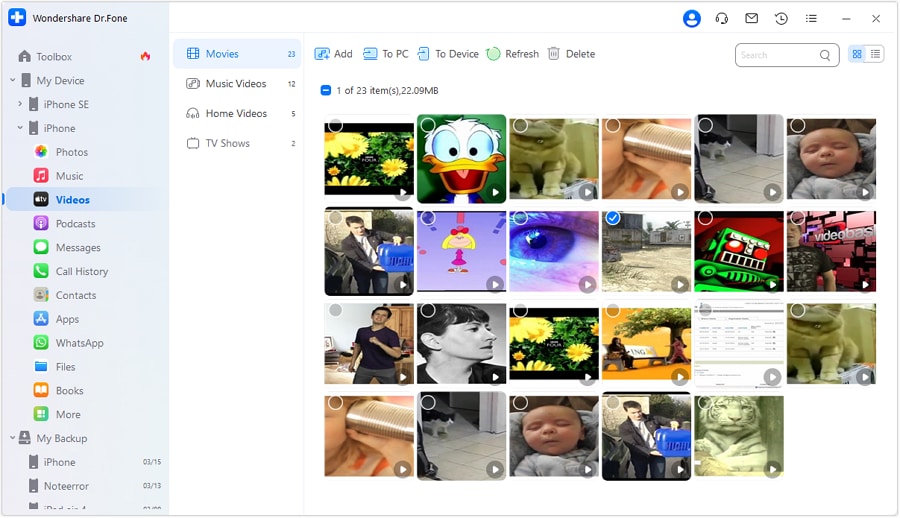
Action: After confirming counts and spot-checks, proceed with your planned cleanup (duplicates, blurry scans, or removing receipts from Camera Roll) based on your verified archive.
Limitation: Bulk deletion is the high-risk, potentially irreversible step—if cloud sync is enabled, deletions can propagate to other devices and accounts.
Recommended tool for backup and export
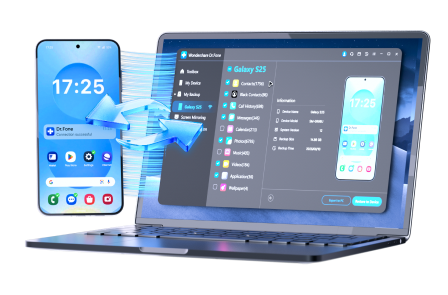
If you're ready to move from planning to action, prioritize two things: (1) a baseline backup you can restore from, and (2) an export you can open and audit outside your photo library. That's the safest way to protect originals before any cleanup.
 Easily manage data through preview, delete, export, etc.
- Transfer all data between devices.
- Robust backup solutions for reliable data protection.
- Mirror screens to PC for meetings, teaching, and control.
Whatever tool you use, keep your verification “gates” strict: do not delete anything until you can prove your archive is complete and readable (counts match expectations, random samples open-check cleanly, and month/year gaps have been reviewed).




Conclusion
Use AI to design the sequence, define verification gates, and identify the irreversible moment you must delay; then use a real tool to execute backups and exports safely, with proof before any cleanup.
FAQ
-
What's the biggest mistake people make when organizing receipt photos?
Doing dedupe or deletion before proving there's a complete, readable backup/export of the receipts. -
How do I verify I didn't miss anything without checking every file?
Use counts (total receipts found, per-year/month totals) plus random sampling (open-check a fixed number like 20–30) and a gap check (confirm each month has expected activity). -
When should I rename files—before or after exporting?
Plan it first, but only rename in the location you've designated as the archive copy. Renaming inside some photo libraries can be inconsistent or not supported in the way you expect. -
What's the “point of no return” in this workflow?
Bulk deletion of duplicates/originals from your photo library—especially with cloud sync—because removals can propagate and become unrecoverable after retention windows. -
Can AI tell me whether iCloud/Google Photos has the full originals?
No. AI can tell you what to check (sync status, storage optimization settings, spot-checking originals), but you must confirm on your devicesOUR EXPERT
staff editor
Alice is a seasoned technology writer and Android specialist known for making complex mobile topics more accessible through clear, solution-oriented content.
 Add Wondershare Dr.Fone as a preferred source on Google