Effortlessly manage data through preview, delete, export, etc.

 100% Security Verified | No Subscription Required | No Malware

 :
: 
 ChatGPT
 Perplexity
 Gemini
 Claude
 Grok
Grok

I updated my iPhone, and now the screen looks “broken”—black and unresponsive. I can’t tell if it’s a display issue or if iOS is stuck, and I don’t want to do something that wipes my data.
Reddit user, r/iPhone
A common iPhone dilemma: the screen looks “broken” (black, frozen, unresponsive, ghost touches), but the real problem might be iOS underneath. This often happens right after tapping Install Now, a forced restart, or a storage-cleanup reboot—then nothing changes after several minutes, and it’s unclear whether the phone is still updating.
AI (like ChatGPT or Gemini) can help you translate symptoms into likely causes, separate “display hardware” signs from “system crash” signs, and choose the lowest-risk next check before you spend money or take irreversible steps.
AI can’t confirm hardware damage or safely run repair operations for you. Trial-and-error (random resets, repeated restores, unknown tools) can increase lockouts, data loss, or worsen a failing screen—so use prompts to narrow the path, then hand off execution to a purpose-built tool.
In this article
- Part 1. Should you repair the screen first or repair the iOS system first?
- The core question: display “dead” vs iOS failing to boot
- Triggers that change the odds
- Why uncertainty is normal (and risky)
- Before you prompt the AI: what to collect
- Part 2. Using AI prompts to decide screen repair vs system repair
- Part 3. When to stop DIY fixes before screen or system repair
- Part 4. Repair iOS issues safely with Dr.Fone System Repair
- Part 5. AI output vs reality: a quick gap-check

Part 1. Should you repair the screen first or repair the iOS system first?
1-1. The core question: is the phone “alive” but the display isn’t, or is iOS failing to boot?
If your iPhone 13 or iPhone 14 suddenly shows a black screen, won’t respond to touch, or keeps looping on the Apple logo, the decision often comes down to one question: is the phone “alive” but the display isn’t, or is iOS failing to boot?
1-2. Triggers that change the odds
Triggers matter. After an iOS update, a low-battery shutdown, a water exposure incident, or a drop, symptoms can overlap: you may hear notifications but see nothing, or you may see the Apple logo but never reach the Lock Screen.
1-3. Why uncertainty is normal (and risky)
Uncertainty is normal here: a failing screen can mimic a system freeze, and a boot loop can look like “the screen is broken.” The goal is to pick a safe diagnostic order that reduces the chance of data loss and avoids unnecessary hardware work.
1-4. Before you prompt the AI: what to collect
Collect these details first so the AI can differentiate screen failure vs iOS failure:
- iPhone model and iOS version (if known)
- What happened right before the issue (update, drop, water, battery drain)
- What you can still observe (sound, vibration, charging icon, backlight)
- Whether a computer recognizes the device (Finder/iTunes/Device Manager)
- Whether buttons work (Volume, Side button) and what you see when pressed
Part 2. Using AI prompts to decide screen repair vs system repair
2-1. Level 1: Basic Prompt
My iPhone screen is [black/frozen/unresponsive/ghost touching], and this started after [update/restart/drop/water/battery drain]. I need help deciding whether to repair the screen first or repair the iOS system first. Ask me the minimum questions needed and then recommend the lowest-risk next step.
2-2. Level 2: Advanced Prompt
Act as a diagnostic assistant. Based on my symptoms, rank the most likely causes across these categories: (1) display hardware, (2) touch digitizer, (3) iOS crash/boot corruption, (4) battery/charging, (5) port/cable/PC recognition.
For each cause, list: confidence (0–100), what evidence would increase/decrease it, and the safest next test I can do without risking data loss.
Also warn me which actions are high-risk (factory reset, repeated force restarts, unknown tools).
2-3. Level 3: Evidence Prompt
Diagnose whether I should repair the screen first or the iOS system first using the evidence below. If you need info, ask focused questions. Then provide a decision tree with the lowest-risk path first.
Device info
- iPhone model: (e.g., iPhone 13 Pro)
- iOS version (if known): (e.g., iOS 17.x)
- Storage status before issue: (e.g., nearly full / unknown)
- Battery level when it happened: (e.g., 10%, 80%, unknown)
Trigger
- What I did right before: (e.g., tapped Install Now, forced restart, dropped phone)
- Any prior issues: (e.g., random reboots, overheating, touch lag)
Current symptoms
- Screen shows: (black / Apple logo / spinning wheel / lines / dim backlight / normal image)
- Touch response: (none / partial / ghost touches)
- Buttons response: (works / not sure)
- Sounds/vibration: (yes / no)
- Charging behavior: (normal / gets hot / no sign)
Computer detection
- Finder/iTunes sees device: (yes/no)
- Recovery Mode works: (yes/no/not sure)
- DFU Mode attempted: (yes/no)
Constraints
- I must avoid data loss: (yes/no)
- I can use a computer: (Mac/Windows/no)
- Any physical damage or water exposure: (yes/no)
2-4. Prompt Refinement
Use these follow-ups to force clearer separation between “screen” and “system” signals:
What are the minimum discriminating questions you still need to choose screen-first vs system-first?
Separate causes into hardware display, touch layer, and iOS boot categories—then rank within each category.
Which single observation would most strongly confirm iOS boot failure vs a dead display (and how can I check it safely)?
Given I want the lowest risk of data loss, what is the safest order of actions and what should I avoid?
If a computer doesn’t recognize the phone, list the top reasons and the least invasive ways to test each.
Part 3. When to stop DIY fixes before screen or system repair
Stop early when continuing experiments increases risk faster than it increases certainty.
- The iPhone gets unusually hot, rapidly drains battery, or shows swelling/chemical smell.
- You see clear physical damage (cracked panel with ink-like blotches, liquid indicators, bent frame) and touch becomes erratic.
- The device fails to be recognized by any known-good cable/port/computer and won’t enter Recovery/DFU reliably.
- You have critical data you can’t lose, and the next suggested step involves restore/erase or repeated restart cycles.
Once you’ve used AI to narrow the likely cause (screen path vs system path), move to a controlled execution method rather than stacking more random attempts.
Part 5. AI output vs reality: a quick gap-check
AI can guide your decision-making, but it can’t validate physical faults or perform repairs. Use this gap-check to confirm what’s suggested against what you can safely observe.
| AI suggests | Reality check you should do |
|---|---|
| “Likely screen damage” | Confirm with indirect signs (sounds/vibration, backlight glow, PC detection). |
| “Likely iOS crash” | Verify whether Recovery Mode works and whether the device is recognized by a computer. |
| “Try a force restart” | Repeated force restarts can worsen unstable storage or battery issues—limit attempts. |
| “Restore to fix it” | Restore can erase data; only consider after you’ve confirmed your data tolerance. |
AI helps you choose the safest branch; execution still depends on what the device actually does when you test detection modes and connections.
Part 4. Repair iOS issues safely with Dr.Fone System Repair
If your prompts point to iOS boot corruption (Apple logo loop, stuck update screen, repeated restarts, device recognized but won’t boot), Dr.Fone - System Repair (iOS) can be the execution step to address common system-level faults under its Repair iOS Issues capability. At this stage, the value is consistency: you’re no longer guessing which mode to enter or which firmware to match—you’re applying a defined system-repair flow after you’ve ruled out obvious screen-only signs. You can reference the product workflow on the Dr.Fone iOS System Repair page and the step-by-step interface guidance in the iOS system recovery guide.
 Fix iOS issues, no data loss.
- One-click repair for all iOS problems.
- Solve recovery mode, Apple logo, black screen, etc.
- Upgrade or downgrade iOS without iTunes
-
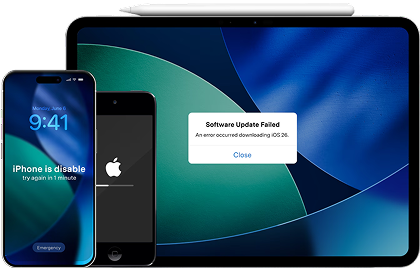
Step 1 Confirm it’s a system path
Use your AI checklist results to ensure the phone is detected by a computer or can enter Recovery Mode, since a truly dead device may require hardware service.
-
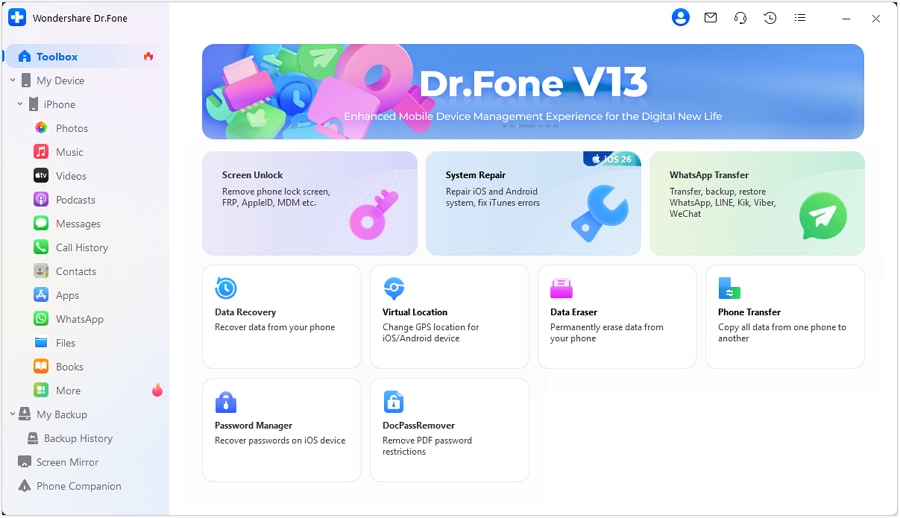
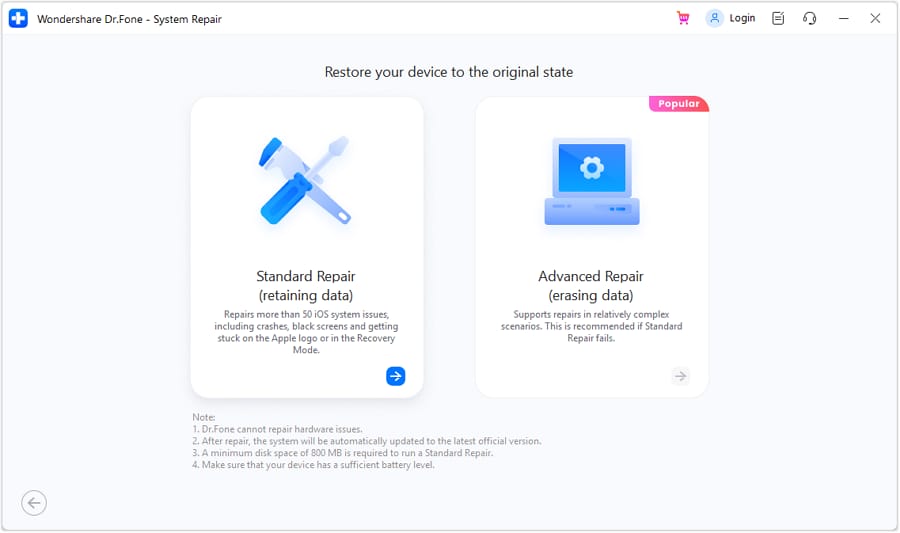
Step 2 Open System Repair (iOS)
Launch Dr.Fone and select the iOS System Repair option, keeping the phone connected with a known-good cable to avoid mid-process disconnects.
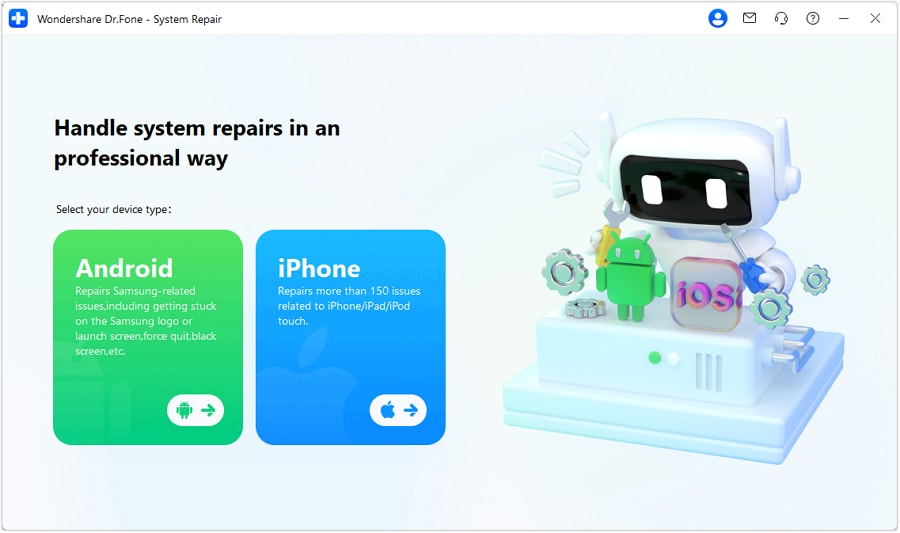
-
Step 3 Choose the appropriate repair mode
Select the mode that matches your risk tolerance (prioritize data-preserving options when available, and avoid erase-based steps unless you’ve accepted data loss).
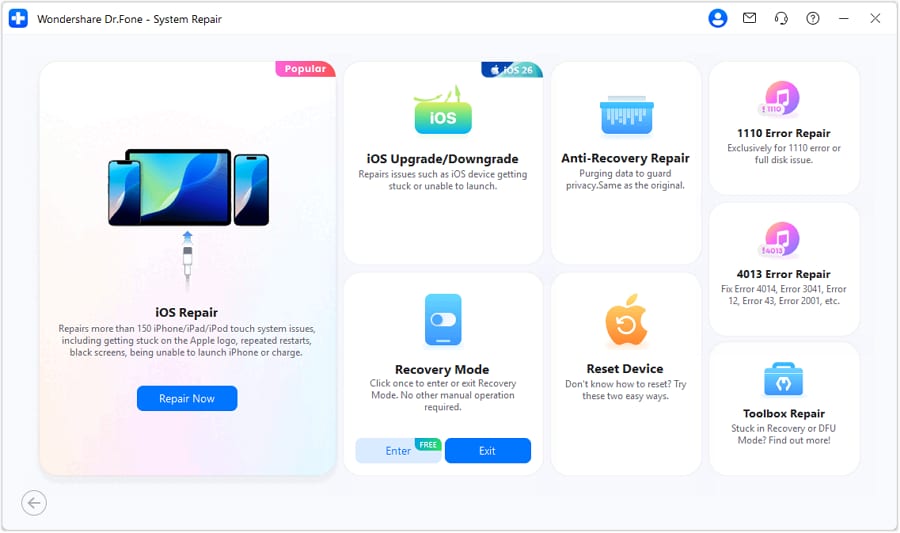
-
Step 4 Download the matched firmware package
Let the tool fetch the correct iOS package for your model to reduce mismatch errors caused by manual downloads.
-
Step 5 Run the repair and re-check symptoms
After completion, reassess the original symptom set (boot, touch response, charging, detection) to confirm whether the issue was system-level or if hardware is still implicated.




Conclusion
Use AI to convert confusing symptoms into a ranked “screen vs system” decision with the least risky next checks, then hand off execution to a controlled iOS repair workflow (such as Dr.Fone System Repair) once you’ve confirmed the problem is likely system-level rather than purely display hardware.
FAQ
-
How do I know if it’s a screen problem or an iOS problem?
If the phone makes sounds/vibrates/gets detected by a computer but the display stays black or shows visual artifacts, screen hardware is more likely; if it boot-loops or won’t complete startup, iOS/system issues are more likely.
-
Should I repair the system first if my screen is unresponsive to touch?
Only if other evidence suggests iOS is unstable (boot loops, update stuck, repeated restarts); pure touch failure after a drop is often digitizer hardware.
-
Can a failed iOS update look like a broken screen?
Yes. A device stuck on the Apple logo, spinning wheel, or a black screen with intermittent rebooting can be mistaken for display failure.
-
Is Recovery Mode detection important for deciding the order?
Yes. If the phone reliably enters Recovery Mode and is recognized, that supports a system-first approach; if it can’t be detected at all, hardware/connection issues move up the list.
-
What should I avoid if I’m trying not to lose data?
Avoid restore/erase steps, repeated force restarts, and random “one-click fix” tools until you’ve confirmed the risk and captured the minimum evidence to choose a safe path.
 Add Wondershare Dr.Fone as a preferred source on Google