Effortlessly manage data through preview, delete, export, etc.

 100% Security Verified | No Subscription Required | No Malware

 :
: 
 ChatGPT
 Perplexity
 Gemini
 Claude
 Grok
Grok

My phone is crawling and I just realized I’m basically out of storage. I’m scared to delete anything because I don’t want to lose photos or chats—what’s the safest order to fix this?
Apple Support Community user
A phone that’s nearly out of storage can feel “mysteriously” slow, but rushing to delete the wrong things can cause avoidable data loss or make the slowdown worse.
AI is useful here to map a clean sequence: confirm whether storage pressure is the cause, identify what’s consuming space, choose the safest cleanup order, and define verification checks before you touch anything risky.
AI can’t see your device, confirm what’s truly safe to remove, or perform backups/transfers/deletions—so once the plan is solid, you’ll need real device tools to execute carefully.
In this article
- How to plan a safe workflow before deleting anything
- Common slow-storage symptoms
- Why the order matters
- The point-of-no-return moment
- What “verification gates” look like
- What the AI needs to know
- Using AI prompts to build a safer workflow
- When to stop planning and start execution
- Execute the workflow safely with Dr.Fone

Part 1. How to Plan “Is My Phone Slow Because Storage Is Full” Without Missing Critical Steps
You’re seeing lag (apps opening slowly, keyboard delays, camera taking longer to save photos) and you notice storage is almost full. You search for quick fixes and get mixed advice: “clear cache,” “delete apps,” “move photos,” “factory reset.”
The uncertainty isn’t just what to do—it’s what order to do it in, and how to prove each step worked. If you delete first and verify later, you can lose the only copy of important photos, chats, or files.
There’s also a point-of-no-return moment: deleting originals after moving them (or doing a reset) before you’ve verified the backup/transfer is complete and restorable.
Part 2. What the AI Needs to Know
Share a quick snapshot of your device and constraints so the workflow can be sequenced safely.
- Phone OS and model (e.g., iPhone 13 on iOS 17 / Samsung S22 on Android 14)
- Current free storage and total storage (e.g., 1.2 GB free of 128 GB)
- Main symptoms (slow boot, app crashes, camera fails to save, overheating, etc.)
- Largest storage categories you see (Photos, Videos, Apps, Messages, “System Data,” Downloads)
- What data is non-negotiable (photos, WhatsApp/LINE chats, work files, notes)
- Backup options available (PC/Mac access, external drive, cloud storage limits)
- Time window and risk tolerance (need results today vs. can do a careful multi-step process)
- Whether you’ve already tried anything (cache clears, app deletions, reboots)
Part 3. Using AI Prompts to Build a Safer “Is My Phone Slow Because Storage Is Full” Workflow
Use the prompts below to make the AI produce a clear, check-driven plan before you delete or move anything.
3-1. Level 1: Basic Prompt
I think my phone is slow because storage is almost full. Build a safe step-by-step plan to confirm the cause, free space without losing important data, and verify performance after each step. Include “stop points” where I should verify before continuing.
3-2. Level 2: Advanced Prompt
Create a structured workflow to address phone slowness that may be caused by full storage.
Split it into Preparation / Execution / Verification, and label steps as critical vs optional.
In Preparation, include a backup strategy and a “do not delete yet” list; in Execution, prioritize lowest-risk space recovery first; in Verification, include checks for both freed storage and performance improvements.
3-3. Level 3: Evidence Prompt
Here’s my context: (Android 14, Pixel 7), (0.9 GB free of 128 GB). Symptoms: (apps reload constantly, camera takes 10–15 seconds to open, occasional “storage full” alerts). Storage breakdown: (Photos+Videos ~45 GB, Apps ~30 GB, Downloads ~8 GB, Messages ~6 GB). Constraints: (I have a Windows laptop with 200 GB free; cloud storage is nearly full). Non-negotiable: (family photos, WhatsApp chats, work PDFs).
Build a workflow with checks before/during/after each stage. Include:
- How to confirm storage pressure is the main cause vs other causes (battery health, OS issues, malware, overheating)
- A safe order to reduce storage (with the least risky actions first)
- A specific “point of no return” warning (e.g., deleting originals, clearing app data, factory reset) and what verification must be complete before that step
- A short checklist I can tick off as I go
3-4. Prompt Refinement
Put the plan into a table with columns: Step, Why it matters, Risk level, What to check before, What to check after, Rollback option.
List the top 10 space consumers I should look for on my OS, and for each one, tell me the safest way to reduce it without losing data.
Give me two variants of the plan: “30-minute minimal-risk cleanup” and “thorough cleanup with full verification”, and specify what I’m skipping in the faster version.
Define exact verification thresholds to proceed (e.g., “at least (10–15 GB) free,” “camera saves a photo within (2 seconds),” “no app reloads during (5 minutes) of switching”).
Identify which actions are reversible vs irreversible on my phone model/OS (e.g., “uninstall app” vs “clear app data” vs “factory reset”) and where I must pause.
3-5. AI Plan vs. Real Device Constraints
| Planning need | What AI can do | What AI cannot do | What you must verify on-device |
|---|---|---|---|
| Find the safest cleanup order | Prioritize low-risk steps and flag irreversible ones | See your actual storage breakdown live | Storage categories + biggest files/apps are real |
| Prevent data loss | Suggest backup-first decision gates | Confirm your backup contains everything | Open random photos/files/chats from the backup |
| Diagnose root cause | Provide differential checks (storage vs OS vs battery) | Measure device performance directly | Repeatable performance test results before/after |
| Define “done” criteria | Set measurable thresholds and stop conditions | Enforce them during execution | Free-space target + symptoms improved in normal use |
AI improves planning, but it cannot execute changes on your phone—so the workflow must include verification gates that you can actually perform before you hit any irreversible step.
Part 4. When to Stop Planning “Is My Phone Slow Because Storage Is Full” and Start Execution
- You can clearly name the top 2–3 storage drivers on your phone (not just “System” vaguely).
- You have a backup/transfer destination ready (enough space, correct cable/account access, stable connection).
- You have defined verification checks (before/after metrics for free space and performance).
- You have identified your point-of-no-return step (e.g., deleting originals, clearing app data, factory reset) and you agree not to reach it without proof the backup is usable.
Once those are true, you’re no longer deciding what might work—you’re ready to carry out the sequence you’ve already validated.
Part 5. Is My Phone Slow Because Storage Is Full: Execute the Workflow Safely with Dr.Fone
Execution is where most mistakes happen: deleting before backing up, moving files without confirming they open elsewhere, or “cleaning” by wiping app data that you later realize contained the only copy.
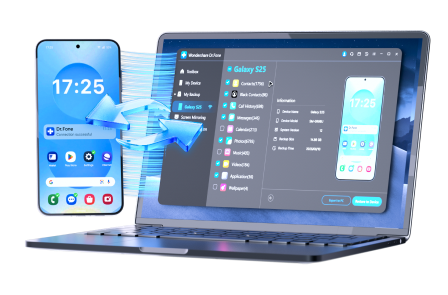
If you’re ready to execute carefully, Dr.Fone Basic - Data Manager can help you back up/transfer files and manage large data categories from a computer, so you can follow your plan with verification gates.
 Easily manage data through preview, delete, export, etc.
- Transfer all data between devices.
- Robust backup solutions for reliable data protection.
- Mirror screens to PC for meetings, teaching, and control.
-
Step 1 Secure a restorable copy first
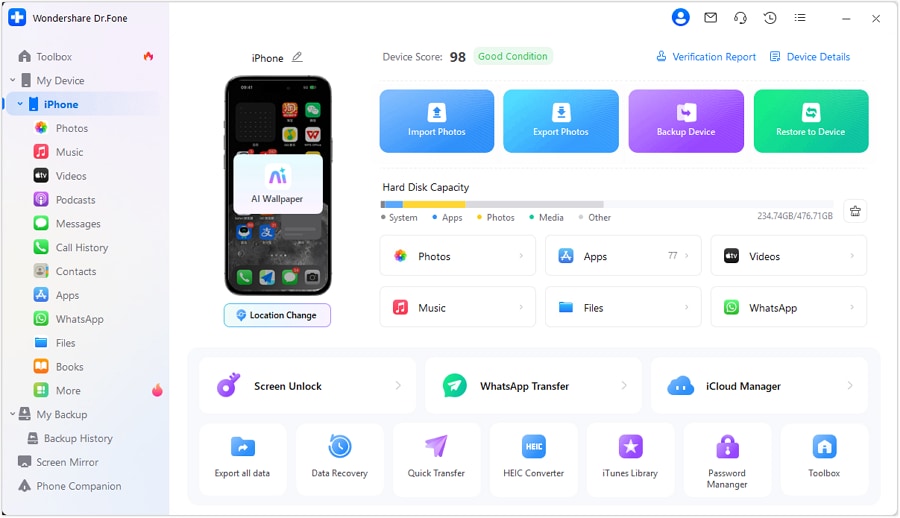
Use a computer-based workflow to back up or transfer the data you cannot lose (photos/videos, documents, and key app data where supported) to a safe destination before any cleanup.
Verification gate: manually open a sample of transferred items and confirm counts/sizes look plausible before proceeding.
-
Step 2 Confirm you’re targeting the real space drivers
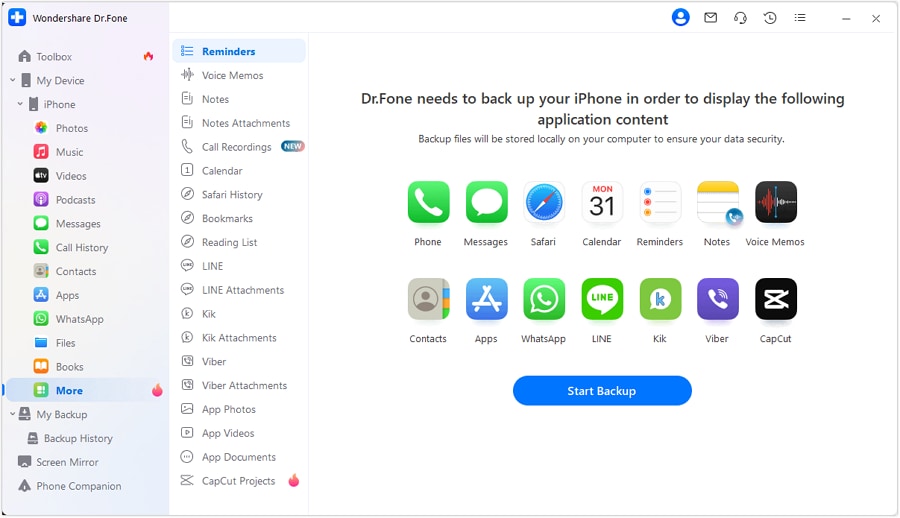
Compare what you planned (top 2–3 storage categories) with what your device shows right now, then focus on the biggest categories first rather than random deletions.
Verification gate: confirm the category you’re about to change is actually a major contributor on your phone.
-
Step 3 Reduce storage using the lowest-risk wins

Move large personal media off-device first, then remove only safely replaceable items (for example, content you’ve already confirmed is backed up), following the order you planned.
Verification gate: after each category change, re-check free space and confirm the content is accessible off-device.
-
Step 4 Only then consider irreversible cleanup
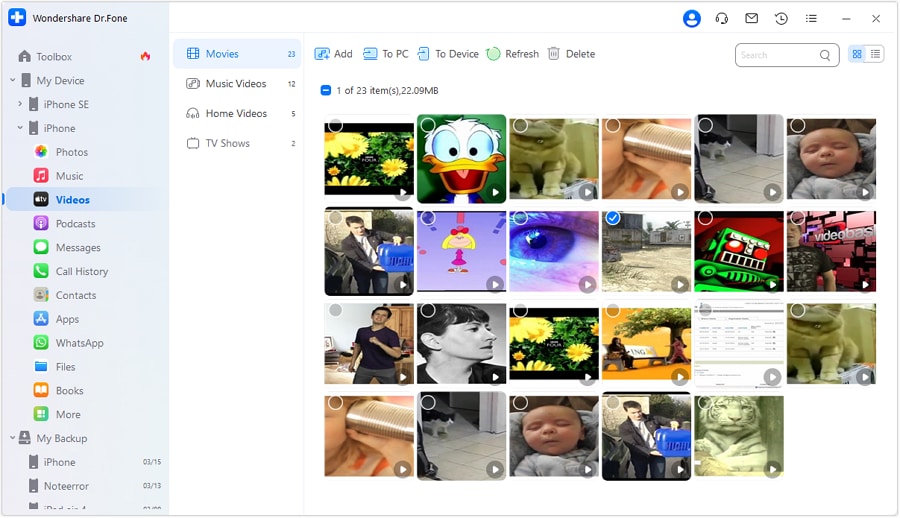
If still needed, proceed with high-risk actions (like deleting originals after transfer, clearing app data, or resetting) only after your verification gates are satisfied and you can restore from backup.
 Note: AI cannot recover data you permanently erase—do not cross this step unless you’ve tested restore access and you’ve documented what will be lost.




Conclusion
Use AI to plan a verification-first workflow—what to check, what order to act in, and where the irreversible risks are—then use a real tool like Dr.Fone to execute the backup/transfer/cleanup steps once you’ve confirmed you won’t cross the point of no return blindly.
FAQ
-
Can full storage really make a phone slow?
Yes—very low free space can degrade performance, increase app reloads, and cause camera/apps to fail saving files, but it’s not the only possible cause. -
How much free space should I aim for to reduce lag?
A practical target is often at least 10–15 GB or roughly 10–15% of total storage, then retest your specific symptoms. -
What’s the biggest “don’t do this yet” mistake?
Deleting originals (photos/videos/files) or clearing app data before you’ve verified a usable backup/transfer. -
How do I verify a backup is actually usable?
Open random samples (photos, videos, PDFs), confirm file sizes look right, and confirm you can locate the full folder set—not just a few thumbnails. -
If storage isn’t the cause, what else should I check?
Overheating, failing battery/thermal throttling, OS bugs, low RAM pressure, runaway background apps, or corrupted system storage—your plan should include quick checks to rule these in/out.
 Add Wondershare Dr.Fone as a preferred source on Google