Effortlessly manage data through preview, delete, export, etc.

 100% Security Verified | No Subscription Required | No Malware

 :
: 
 ChatGPT
 Perplexity
 Gemini
 Claude
 Grok
Grok

My Wi‑Fi feels slow, but I can’t tell if it’s my router, my phone, or the network. Everything looks the same—pages crawl, videos buffer, and calls drop.
Forum user
Slow Wi‑Fi can look the same whether the problem is your router, your phone, or the network itself—pages crawl, video buffers, and calls drop. This often shows up right after you reconnect to Wi‑Fi, restart the phone, or move rooms, and then nothing seems to improve after several minutes.
AI can help you analyze symptoms and narrow the likely cause by comparing patterns (only one device vs all devices, only one room vs everywhere, only one app vs everything). You can use a tool like ChatGPT or Gemini to turn your observations into a clearer diagnosis plan.
AI can’t verify your signal quality, router health, or ISP congestion directly, and trial-and-error changes (like resetting network settings or factory-resetting the router) can create new problems. The goal is to keep steps low-risk until you’re confident what’s most likely.
In this article
- Why slow Wi‑Fi might be caused by the router or the phone
- Router-side vs phone-side patterns
- Network-side timing clues
- Why Wi‑Fi “bars” can mislead
- Before You Prompt the AI
- Using AI prompts to diagnose slow Wi‑Fi causes safely
- When to stop troubleshooting slow Wi‑Fi and avoid making it worse
- Mirror Android to PC to document slow Wi‑Fi with Dr.Fone
- Recommended tool: Dr.Fone Basic for mirroring and documentation

Part 1. Why slow Wi‑Fi might be caused by the router or the phone
If Wi‑Fi suddenly feels slow on a specific device—say an iPhone 13, iPhone 14, or your Android phone—right after you tapped Connect, installed an update, or toggled Airplane mode, it’s easy to assume “the phone is broken.” But the same symptom can also come from router channel interference, weak signal in one room, or ISP congestion.
A quick meaning check: router-side issues tend to affect multiple devices or certain areas of your home, while phone-side issues tend to follow one device across locations or show up after a phone setting/update change. Network-side issues often appear at certain times (evenings) and affect everything.
Uncertainty is normal here because speed tests can fluctuate and Wi‑Fi “bars” don’t reliably reflect real throughput—so you need a few structured observations before you change anything big.
1-1. Before You Prompt the AI
Collect a few facts first so the AI can reason from evidence instead of guesses:
- Which devices are slow (only this phone, or also laptop/TV)?
- Where it’s slow (one room vs near the router)
- What’s slow (all apps vs one app)
- Any recent changes (router reboot, firmware update, OS update, new VPN, new mesh node)
- Your router model + internet plan speed (if known)
Part 2. Using AI prompts to diagnose slow Wi‑Fi causes safely
2-1. Level 1: Basic Prompt
I have slow Wi‑Fi and I can’t tell if it’s caused by my router or my phone. Ask me the minimum questions needed to narrow it down, then give the top 3 likely causes and the safest next step for each.
2-2. Level 2: Advanced Prompt
Diagnose my slow Wi‑Fi by ranking causes across three categories: **router**, **phone**, and **ISP/network**.
For each category, list (1) what evidence would strongly support it, (2) one low-risk test I can do in 2 minutes, and (3) what I should avoid doing that could make things worse (like resets).
Finish with a short decision tree I can follow.
2-3. Level 3: Evidence Prompt
Help me determine whether slow Wi‑Fi is caused by my router or my phone using the data below. Please:
1) rank the most likely causes with probabilities,
2) list contradictions/gaps in my evidence,
3) propose the lowest-risk next 5 actions in order,
4) tell me what results would confirm each hypothesis.
**Device info**
- Phone model: (e.g., Samsung Galaxy S23 / iPhone 14)
- OS version: (e.g., Android 14 / iOS 17.x)
- VPN/security apps: (on/off, which app)
**Wi‑Fi environment**
- Router brand/model: (e.g., TP-Link Archer AX55)
- Network type: (2.4 GHz / 5 GHz / Wi‑Fi 6)
- Distance + walls: (e.g., 8 meters, 2 walls)
- Other devices affected: (yes/no, which)
**Symptoms**
- What’s slow: (web, video, gaming, calls)
- Only at certain times: (yes/no, when)
- Wi‑Fi signal strength shown: (e.g., 2/3 bars)
- Speed test results: (download/upload/ping, multiple runs)
**What changed right before**
- (e.g., OS update, router reboot, new DNS, new location, new mesh node)
**What I already tried**
- (e.g., forget network, restart router, reset network settings)
2-4. Prompt Refinement
Use these follow-ups to force clearer conclusions and reduce guesswork:
“What’s the *single missing data point* that would most change your ranking, and how do I collect it safely?”
“Separate causes into **signal**, **congestion**, **authentication/DNS**, and **device software**. Which bucket fits best and why?”
“Rank the top 5 causes again, but this time require one specific observation that supports each.”
“Which tests can I do that won’t interrupt other people on the network?”
“If only one phone is slow but all other devices are fine, what are the most common phone-side causes and how do I confirm each?”
“What outcome would clearly indicate the router is fine and the phone is the bottleneck?”
2-5. AI Output vs Reality
AI helps you choose which evidence to collect and which low-risk tests to run first. Execution still depends on what you can actually measure on your devices and network.
| What AI suggests | What you verify in reality |
|---|---|
| “It’s probably router congestion.” | Test another device on the same Wi‑Fi at the same time/place. |
| “It might be phone DNS/VPN.” | Toggle VPN off, try a different DNS only if you can revert safely. |
| “The signal is weak in that room.” | Compare speed near the router vs the problem spot. |
| “Your ISP is throttling/peaking.” | Check time-of-day pattern and compare to mobile hotspot speed. |
Part 3. When to stop troubleshooting slow Wi‑Fi and avoid making it worse
Stop and switch to safer documentation or support paths if:
- You’re about to factory reset the router or erase network settings without a backup of credentials/config.
- The network is mission-critical (work exam/calls) and experiments could disrupt others.
- You see signs of account/security issues (unknown devices, repeated password prompts, captive portal loops).
- Multiple devices lose connectivity intermittently (could be ISP line issues or hardware instability).
Once you’ve narrowed the likely category (router vs phone vs ISP), the next step is to capture clear evidence and reproduce the issue reliably—so you can apply the right fix without escalating risk.
Part 4. Mirror Android to PC to document slow Wi‑Fi with Dr.Fone
When you’re comparing “router vs phone” causes, the hardest part is often collecting consistent evidence (speed tests, Wi‑Fi settings, timestamps, which apps stall) without fumbling on a small screen or missing what changed. Dr.Fone Basic - Screen Mirroring becomes relevant once your AI prompts have identified what to verify: you can mirror your Android screen to a PC to run the exact checks the AI recommends, observe behavior more clearly, and capture what you see for support or for your own comparison across locations and networks. For mirroring setup details, follow the official guide for mirroring an Android screen to PC.
-
Step 1 Start Android screen mirroring
Use Dr.Fone Basic to mirror your Android screen to your PC so you can watch Wi‑Fi changes in real time without constantly switching apps.

-
Step 2 Reproduce the slowdown intentionally
Open the affected app or run a speed test while mirrored, keeping conditions consistent (same room, same network, same time window).

-
Step 3 Check phone-side settings without guesswork
While mirrored, review Wi‑Fi band (2.4/5 GHz), VPN status, and any “randomized MAC” or private DNS settings, changing only one item at a time so you can roll back safely.

-
Step 4 Capture evidence for comparison
Record key screens/results (speed, ping, Wi‑Fi details) so you can compare “near router vs far room” or “Wi‑Fi vs hotspot” cleanly.

-
Step 5 Share findings or escalate efficiently
Use the captured evidence to contact ISP/router support or to refine your AI prompts with exact numbers and timestamps.

Part 5. Recommended tool: Dr.Fone Basic for mirroring and documentation
If your AI plan depends on careful comparisons (same time, same room, same app, different network), mirroring your phone to a bigger screen can make each test easier to reproduce and easier to document—especially when you need to capture settings, timestamps, and speed/ping results clearly.
 Easily manage data through preview, delete, export, etc.
- Transfer all data between devices.
- Robust backup solutions for reliable data protection.
- Mirror screens to PC for meetings, teaching, and control.
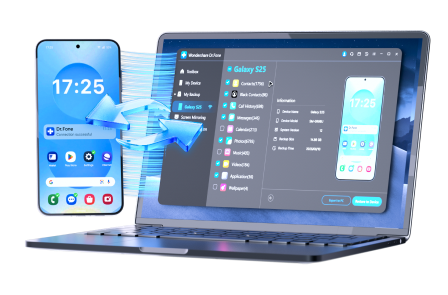
After you mirror, stick to the same low-risk philosophy used in the AI prompts: change one variable at a time (location, band, VPN on/off, private DNS on/off), retest quickly, and log results so you can decide whether the bottleneck is your phone, your router, or the ISP/network.




Conclusion
AI is most useful here for turning “Wi‑Fi feels slow” into a ranked set of hypotheses and low-risk tests, while tools like Dr.Fone Basic – Screen Mirroring help you execute those checks more consistently and document what you observe for accurate next steps.
FAQ
-
Is slow Wi‑Fi usually caused by the router or the phone?
It depends on scope: if multiple devices are slow, suspect router/ISP; if only one phone is slow across places, suspect phone settings/software. -
How can I tell if my router is the bottleneck?
Test a second device at the same time and same location; if both are slow similarly, the issue is more likely router/ISP than the phone. -
Can VPN or private DNS make Wi‑Fi feel slow?
Yes—VPN or DNS changes can increase latency or break certain connections; a quick low-risk test is temporarily disabling them and retesting. -
Why is Wi‑Fi fast near the router but slow in another room?
That pattern usually points to signal attenuation/interference (walls, distance, neighboring networks) rather than a phone-specific problem. -
How does screen mirroring help diagnose slow Wi‑Fi?
Mirroring helps you reproduce the issue consistently and capture speed results and settings changes clearly, which makes comparisons and support escalation easier.
 Add Wondershare Dr.Fone as a preferred source on Google