 Recover photos, messages, WhatsApp, and more — no backup
needed.


 100% Security Verified | No Subscription Required | No Malware


 :

 ChatGPT
 Perplexity
 Gemini
 Claude
 Grok
You kept a museum bulletin for its exhibition notes, but the email and downloadable catalogue are now missing when you want to revisit them. At the same time, newer issues have stopped arriving after an inbox tidy-up. To recover deleted Gmail emails on Google Pixel 6 Series, treat that lost received issue separately from the question of whether you are still subscribed.
Dr.Fone - Data Recovery (Android) gives supported Pixel 6, Pixel 6 Pro and Pixel 6a users a practical way to look for local Gmail text and actual attachments. Preview what is available, identify the exhibition notes or catalogue that are genuinely useful and save selected results to a PC. This keeps the recovery focused on material you want to read, not simply on restoring a stream of promotional emails.
In this article
Before you start
Check the specific Pixel 6 Series support row
Google Pixel 6, Google Pixel 6 Pro and Google Pixel 6a are listed separately in the support table. Each retains Android 14; the Pixel 6a has its own two listed Kernel values. These confirmed conditions are not replaced by a generic Android 9-13 upper limit. Use the actual model and software information, not a series-wide assumption or an unverified firmware change.
Prepare a Windows local-data recovery session
Advanced Recovery is Windows-only and saves selected discoverable results to a PC. Prepare a USB data cable and a destination folder. Keep Gmail installed and the account in place; do not clear Gmail storage, uninstall, reset or follow an invented Root or bootloader procedure. A local scan does not refill your online Inbox, recover Google server mail permanently deleted there, or download a catalogue stored only at a remote website or Drive URL.
Identify the issue you actually received
Record the publisher, exhibition or issue title, approximate delivery date and whether the catalogue was attached or merely linked. A current subscription entry is not a historical delivery log. The useful recovery target is a previously received local email or file, while an issue never delivered must be sought from an authorised publisher source.
Separate Gmail subscription changes from a deleted received bulletin
Use this check when old reading material is missing and newer issues have also stopped arriving. Gmail's subscription controls concern ongoing mailing lists; they are not a mailbox rollback.
Step 1 Review subscriptions without changing them as a test
In Gmail for Android, open Menu > Manage subscriptions if that feature is available. Google says it is gradually rolling out, so an absent menu is not evidence that your account has no subscriptions. Tap a sender's name or avatar to view its emails. Do not tap Unsubscribe simply to investigate a missing old issue.
Step 2 Understand the scope of any earlier unsubscribe action
Google distinguishes unsubscribing from a specific email, which might affect one mailing list, from Manage subscriptions, which unsubscribes from all active mailing lists related to that sender. It can take a few days for a sender to process the change. These controls do not recover an old deleted bulletin or show whether every historical issue reached your account.
Step 3 Find the previously received issue in the mailbox
Check the correct Gmail account, open Menu > All mail for archived messages and search in:anywhere with the exhibition or issue title to include Spam and Trash. Google's help notes that new messages after unsubscribing can appear in Spam with a banner explaining why. Distinguish such a retained message from a past issue that is no longer available.
Step 4 Recover a Trash copy or move to the local scan
If the issue remains in Menu > Trash, touch and hold it and choose More > Move to and a destination. Trash recovery is available for up to 30 days from deletion, unless the message was permanently deleted earlier; discarded drafts cannot be recovered there. If the issue exists in the same account on a computer but not the phone, check connection, refresh and Sync Gmail before scanning for genuinely missing local records.
- Changing a subscription is not needed to run the Windows Gmail scan.
- An authorised publisher archive or a requested replacement is another source of reading material, not proof that Dr.Fone recovered the deleted email.
- Gmail's in:anywhere operator belongs to mailbox search, not to the Dr.Fone results controls.
Pixel 6 Series support: match every condition to your phone
| Approved device | Android condition | Listed Kernel values |
|---|---|---|
| Google Pixel 6 | Android 14 | 6.1.157 |
| Google Pixel 6 Pro | Android 14 | 6.1.157 |
| Google Pixel 6a | Android 14 | 6.1.145 / 6.1.157 |
Common problems and fixes
Manage subscriptions is absent or does not show the publisher
Use ordinary Gmail search in the correct account rather than treating that screen as a complete history. The feature may not yet be available, and current active subscriptions do not establish which old issues were delivered. Search for the exhibition or issue you remember receiving.
The preview finds a bulletin, but it is the wrong exhibition
Use name, title and date to narrow the candidates, then read the actual exhibition name and notes in the preview. Keep useful background if you want it, but do not assume repeated publisher branding identifies the desired issue. Select the specific record whose contents answer your question.
The email has useful notes but only a catalogue link
Save the useful text and reference available in the record. Check Gmail Attachments separately when found data is shown, but do not treat a remote link as a recovered catalogue. If there is no actual file, use the publisher's authorised archive or request a replacement; the device scan does not retrieve remote-only material.
A catalogue file appears without the matching email
Inspect the actual file for its exhibition title, date and readable pages before selecting it. A useful catalogue can be preserved on its own, while its presence does not reconstruct the missing email's wording or delivery history.
How to use Dr.Fone - Data Recovery (Android)
Dr.Fone - Data Recovery (Android) helps a supported Google Pixel 6 Series phone turn a missing bulletin into a focused search for useful local content. Its Windows-only Advanced Recovery mode lets you preview available Gmail entries, inspect found attachments and save selected results to a PC. You can preserve readable exhibition notes and any actual catalogue the scan finds, without needing to restore unrelated newsletters.
- Inspect available local Gmail records for the exact exhibition or issue rather than choosing by publisher name alone.
- Review found Gmail Attachments separately to distinguish an actual readable catalogue from a link to one.
- Save selected useful email text and files to your PC for a focused reading reference.
 Scan Android phones and tablets directly.
- Preview and recover only what you want.
- Supports WhatsApp, photos, videos, contacts, and more.
- Works with 6000+ Android devices.

Follow the official Advanced Recovery workflow
Step 1 Start Advanced Recovery and connect your Pixel 6 Series phone
Launch Dr.Fone on Windows and go to Toolbox > Data Recovery. Choose Android > Recover Android Data, select Advanced Recovery and click Start Scan. Connect the supported Pixel 6, Pixel 6 Pro or Pixel 6a by USB when prompted and complete the on-screen device-detection instructions.

Step 2 Choose Gmail for the scan
Select Gmail from the available app-data categories and click Start Scan. The official guide requires WhatsApp and WhatsApp Business each to run separately from the other categories; it does not say Gmail must be isolated from every other non-WhatsApp category.

Step 3 Maintain the USB connection while scanning
Keep the phone connected until the scan finishes. If you need to stop, click Cancel before removing the USB cable. If the device is temporarily unresponsive after scanning or recovery, follow the product's displayed restart instructions.

Step 4 Read the bulletin preview and inspect any catalogue data
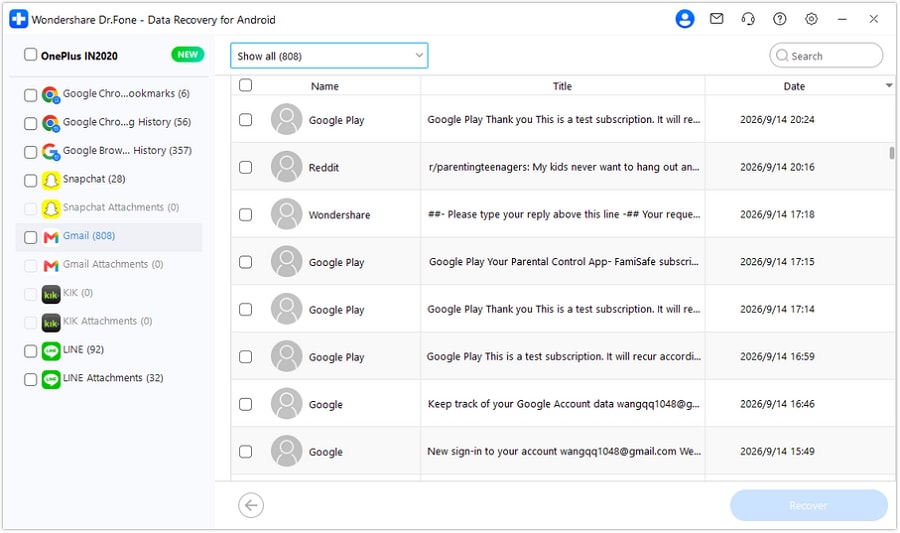
Choose Gmail in the results sidebar and locate likely entries using their name, title and date, plus search or filters where available. Read the actual preview for the exhibition notes and issue identity. If the scan shows found Gmail Attachments, preview that category separately and inspect the actual catalogue or other file. Select the useful entries and attachments.
Step 5 Save selected reading material to your PC
Click Recover, choose a computer folder and complete the save prompts. Open the saved output and check the exhibition text and any selected catalogue pages you need. The selected results are saved to the PC, not imported into Gmail or used to reinstate a subscription.




Conclusion
For a previously received bulletin and its useful reading material, Dr.Fone - Data Recovery (Android) gives a supported Google Pixel 6, Pixel 6 Pro or Pixel 6a a clear local recovery route. Preview the actual issue, review found catalogue attachments and save selected content to your PC. Download the Windows version, connect your compatible Pixel and start looking for the notes and files you want to read again.
FAQ
1. Does unsubscribing in Gmail delete the old emails I want to recover?
The unsubscribe controls described by Google manage ongoing mailing lists; they are not a command to recover or roll back old email. Investigate the previously received issue separately in the correct account, All mail and Trash. A current subscription screen is not proof of historical receipt or deletion.2. Why did several publisher newsletters stop after one unsubscribe action?
Google says Manage subscriptions unsubscribes you from all active mailing lists related to that sender, while unsubscribing from a specific email might affect only one list. The sender can take a few days to process it. This scope difference explains future mailing-list changes, not recovery of a missing old issue.3. Which Google Pixel 6 Series configurations are covered here?
Google Pixel 6 and Google Pixel 6 Pro each list Android 14 with Kernel 6.1.157. Google Pixel 6a separately lists Android 14 with Kernels 6.1.145 / 6.1.157. Retain the exact member's conditions rather than assuming any Pixel or firmware is equivalent.4. Can Dr.Fone recover deleted Gmail attachments and put the bulletin back in Inbox?
Dr.Fone - Data Recovery (Android) can inspect discoverable local data on a supported phone and save selected found attachments and email results to a PC. It does not put those results into Inbox, fetch a remote-only catalogue, guarantee complete original formatting or restore Google's permanently deleted server mail. Review the actual content available.
 Add Wondershare Dr.Fone as a preferred source on Google





