 Recover photos, messages, WhatsApp, and more — no backup
needed.


 100% Security Verified | No Subscription Required | No Malware


 :

 ChatGPT
 Perplexity
 Gemini
 Claude
 Grok
You saved the paper-model diagram, but the deleted Kik note explained which tab belonged inside and what the arrow meant. The drawing alone leaves you unsure whether a label names a piece, an operation or a finished position. To recover deleted Kik messages on Google Pixel 10 Pro Fold without a backup, look for the instruction that made that diagram usable.
Dr.Fone - Data Recovery (Android) gives you a focused recovery attempt on supported app data. Preview the Kik conversations found, inspect available diagram attachments and save selected source records to a PC, so you can keep the useful explanation rather than rely on a guessed assembly step.
In this article
Before you start
Keep the exact Pro Fold support conditions
The supplied device row lists Google Pixel 10 Pro Fold with Android 15 and Kernel 6.6 / 6.6.118. This is the named model's support record, not a guarantee for other Pixel variants or firmware. Follow the product's actual eligibility prompts. The folding screen does not create a different recovery mechanism.
Preserve the local installation
Keep the original phone signed in to Kik and avoid logging out, uninstalling, clearing storage or resetting it during recovery. Kik has no built-in server-side chat restoration for this task. A contact list or a recent conversation does not establish that the specific old instruction remains.
Prepare Windows and a clear recovery target
Advanced Recovery is Windows-only and saves selected discoverable results to a PC rather than into Kik. Prepare a USB data cable and a destination folder. Note the project, piece label and missing instruction you remember. Follow supported device-access instructions without generic Root, unlock, flashing or downgrade procedures.
Check retained diagram explanations before the Kik scan
Use this check if you have an existing diagram, project note, photograph or another participant's retained exchange. It can preserve information from those sources, not undelete your original chat.
Step 1 Separate piece labels from operation labels
Inspect the legend and wording in an already-saved diagram. Identify which labels name physical pieces and which identify an operation or panel. Do not select a piece merely because its number matches the message's step number. If the cropped image omits the legend, look for your existing uncropped copy.
Step 2 Find what each arrow was intended to show
Read any source-present explanation of movement, attachment point or final position. A visible arrow without its legend does not establish which meaning was intended. Keep the actual wording; do not turn an unlabeled arrow into a new fold or placement instruction.
Step 3 Check the face and assembly stage actually shown
Look for explicit labels such as printed face, reverse, inside or outside, and whether the photograph shows a before or after stage. A finished model can hide the tab described in an earlier message. If a view is labeled as an exploded diagram, preserve that label rather than treating every visible gap as an intended finished gap.
Step 4 Ask for the explanation alongside the referenced panel
A willing collaborator may retain the actual message and diagram. Request both with any nearby clarification. If they instead write a new instruction after examining your current model, keep that as new advice, not a recovered historical step. Stop short of making an irreversible assembly change from an incomplete record.
- These are manual checks of labels and context. Dr.Fone does not recognize parts, interpret arrows, calculate geometry or rebuild an assembly plan.
- If the necessary explanation is not in an existing source, continue to Advanced Recovery below to look for available local Kik data.
What to keep from a partial diagram conversation
| Available source | What to verify | Useful next action |
|---|---|---|
| A piece number in text and a numbered diagram | Whether each number labels a piece, step or panel | Preserve the legend and the actual reference instead of equating matching numbers. |
| An arrow with no explanation | Whether a source supplies its intended meaning | Keep the diagram; look for the missing legend or message before acting. |
| An instruction naming an inside tab | Whether the available image shows that face and stage | Save the wording even if the finished-model photo does not expose the joint. |
| A labeled exploded view and a completed-model photo | The different purposes explicitly stated for the two views | Keep each as its own reference rather than inventing final spacing from the drawing. |
Common problems and fixes
The recovered message names a part that I cannot see in the photo
Check whether the source describes an earlier assembly stage or an inside surface. A hidden tab need not be visible in a completed-model photo. Keep the actual label and request a suitable reference view if the missing connection remains unclear; do not guess a different part.
A screenshot has the diagram but cuts off the legend
Check any uncropped file you already saved and inspect Kik Attachments if the scan finds results. A cropped picture does not establish arrow meaning or numbering conventions. If the original legend cannot be found, retain that gap rather than writing your own as recovered instructions.
Only the text or only the diagram is found
Save useful actual results independently. Inspect Kik conversations and available attachments separately; finding one does not promise the other. Do not silently pair a message with a similar diagram from a different panel or project.
The connected Pro Fold cannot start Advanced Recovery
Check Windows use and the exact Android and Kernel information against the Pro Fold record. Follow the product's explanation or contact support with those details. Do not change system software, clear Kik storage or reset the phone to pursue eligibility.
How to use Dr.Fone - Data Recovery (Android)
Dr.Fone - Data Recovery (Android) helps you look for the Kik words that a surviving paper-model diagram does not contain. Its Windows-only Advanced Recovery mode scans supported app data on the Pixel 10 Pro Fold, lets you preview found conversations and available attachments, and saves your selected results to a PC. Concentrate on the piece references, diagram explanation and useful files you actually need for your project.
- Kik-focused scanning: look for the missing explanation rather than assuming a separately saved diagram contains the entire instruction.
- Preview before selecting: read found labels and inspect actual available diagrams to identify relevant records.
- Selective PC preservation: keep useful conversation passages and discoverable reference files outside the phone.
 Scan Android phones and tablets directly.
- Preview and recover only what you want.
- Supports WhatsApp, photos, videos, contacts, and more.
- Works with 6000+ Android devices.

Follow the official Advanced Recovery workflow
Step 1 Open Advanced Recovery for the Pixel 10 Pro Fold
Launch Dr.Fone on Windows and open Toolbox > Data Recovery. Choose Android > Recover Android Data, select Advanced Recovery and click Start Scan. Connect the Pixel 10 Pro Fold by USB when prompted and follow the displayed instructions until it is detected.

Step 2 Choose Kik from the available app categories
Select Kik and click Start Scan. If you also need WhatsApp or WhatsApp Business, scan either separately from the other categories, as required by the guide.

Step 3 Maintain the connection while scanning
Keep the phone connected until scanning finishes. If you need to stop, click Cancel before removing the USB cable. Follow the on-screen restart instruction if the phone becomes temporarily unresponsive after scanning or recovery.

Step 4 Preview the Kik explanation and available diagrams
Choose Kik in the results sidebar and open the conversations found. Use search or filters where available, then read the actual piece references and instruction context. Select Kik Attachments separately when attachment results exist, inspect the available diagram files and select the useful results. Keep uncertain text-to-image pairings unresolved.
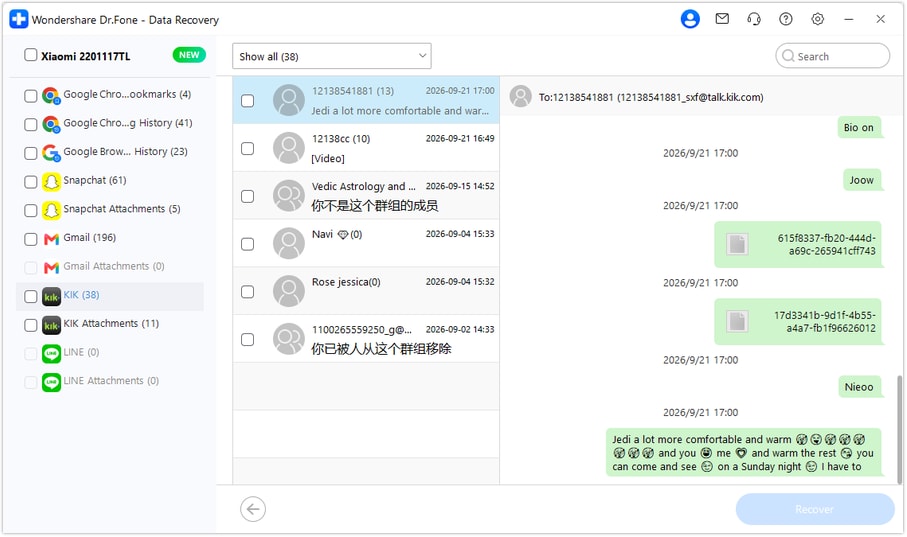
Step 5 Recover the selected reference material to your PC
Click Recover, choose a computer folder and complete the save prompts. Review the saved instruction and any selected diagram files, keeping original source material separate from new project notes. This produces a PC copy, not a restored Kik thread.




Conclusion
Dr.Fone - Data Recovery (Android) gives supported Google Pixel 10 Pro Fold users a focused way to look for lost Kik instructions, inspect available diagram files and save selected references to a PC. Download the Windows version, connect your compatible phone and start the guided scan to find the project details worth preserving.
FAQ
1. Can I recover deleted Kik messages on Google Pixel 10 Pro Fold without a backup?
Dr.Fone - Data Recovery (Android) offers a supported-device scan route without requiring a previous chat backup. The supplied Pro Fold configuration lists Android 15 and Kernel 6.6 / 6.6.118. Use Advanced Recovery on Windows, inspect the found Kik results and save selected discoverable items to a PC.2. Does the folding screen change how Kik data recovery works?
No special folding-screen recovery mechanism is established here. Use the same five-stage Advanced Recovery workflow and the exact model's support conditions. The project examples explain what to inspect in results, not a hardware-specific recovery feature.3. Can a found diagram recover the missing assembly explanation?
Only the wording and labels actually present in available records can supply that explanation. Dr.Fone does not interpret arrows, identify parts or reconstruct absent instructions. Preserve a useful diagram separately if its matching message cannot be found.4. Can I recover deleted Kik photos and diagram attachments?
Check Kik Attachments when the scan supplies attachment results. Preview the actual files and select those you need. A message referring to a diagram does not guarantee that the diagram is also discoverable.5. Will the recovered conversation appear inside Kik again?
No. This Windows-only workflow saves selected discoverable results to your PC. Kik has no built-in server-side chat restoration for this task; logging out or reinstalling is not the route described here and can remove local history.
 Add Wondershare Dr.Fone as a preferred source on Google





