 Recover photos, messages, WhatsApp, and more — no backup
needed.


 100% Security Verified | No Subscription Required | No Malware


 :

 ChatGPT
 Perplexity
 Gemini
 Claude
 Grok
An overseas parcel is ready for collection, but the Gmail notice with its release reference and collection instructions has disappeared from your Samsung W25. You remember reading a translated version, not the original subject line. Searching for the translated wording can leave you unsure whether the email was deleted or you are simply looking for the wrong thing.
Dr.Fone - Data Recovery (Android) offers a focused way to look for available local Gmail records and attachments on a supported W25. You can inspect the message content found, look separately for an attached collection document and save useful selections to a Windows PC. First make two quick distinctions: whether the original email still exists online, and whether only Gmail's translation display is missing.
In this article
Before you start
Check the Samsung W25 recovery conditions
The supplied device record lists Samsung W25 with Kernel 6.1.145; no Android-version restriction is listed for this model. Keep the exact model and Kernel condition together rather than extending this entry to other W-series phones or arbitrary firmware. Have the phone's model and software details ready for the product's compatibility check.
Keep the local Gmail source intact
Prepare a Windows computer, a USB data cable and a private output folder. Advanced Recovery is Windows-only and saves selected discoverable results to a PC, not back into Gmail. Keep Gmail installed and its account and storage intact: do not remove the account, clear app storage, uninstall Gmail or reset the phone as a recovery experiment. Follow displayed connection instructions; do not unlock, flash or invent Root steps.
Identify the original notice and useful file
Note the actual carrier or collection agent, the recipient account, approximate email date and any reference you already know. Separate the email's original wording, its on-screen translation and an attached PDF or image. A mailbox message can exist without its attachment having been downloaded locally, so identify both targets rather than treating one as proof of the other.
Find the original email before treating a missing translation as deletion
A notice you read in another language, especially when the translation banner has disappeared but the message may still be available.
Step 1 Search the right online account by the sender or reference
In Gmail, confirm the account that received the notice and search while connected to the internet. Use the sender's address or an actual collection reference instead of relying only on a remembered translated sentence. Add in:anywhere to include Spam and Trash, which ordinary Gmail searches exclude. Open a matching message and check the parcel reference and actual instructions.
Step 2 Translate a retained message using the Android message menu
If the original email is present but its translation is not, open it and tap More > Translate message. Google says a dismissed translation banner does not prevent manual translation, and the target language can be selected in the translation settings at the top. This Gmail translation feature applies to Google Accounts, not messages in IMAP accounts.
Step 3 Check the document separately from the translated text
Read the notice for the collection location, reference and requested identification, then inspect any actual attached document. Translating a retained email is a reading aid, not recovery of a deleted email or translation of a recovered attachment. If you need clarification of an instruction, ask the collection agent rather than inferring it from a filename or partial translation.
- Offline Gmail searches cover only messages already synced to the W25; an empty offline search is not a complete mailbox check.
- If the full original notice is available in the correct account, use that retained source first. A local scan is useful when the required email or attachment is still missing.
Recover a retained notice from Gmail Trash
An ordinary received email that was deleted recently and still appears in the account's Trash.
Step 1 Look in Trash using the deletion date
Open Gmail's Menu > Trash and inspect the relevant notice. Gmail keeps deleted mail for up to 30 days from deletion, not from the parcel date or the day you last translated the email. Permanently deleting it or emptying Trash ends that Trash recovery route sooner.
Step 2 Move the existing notice to the desired mailbox location
Touch and hold the message, tap More > Move to and choose the destination, such as Inbox. Open the moved email and its available document to verify that you have the collection instructions you need.
- Moving a message out of Trash is an account-side action on retained mail. The Dr.Fone workflow below instead saves phone-local results to a PC.
- Discarded drafts are an exception: they cannot be recovered from Gmail Trash.
Which result helps you collect the parcel?
| What you find | Useful information to inspect | Practical next action |
|---|---|---|
| Original notice still online | Actual reference, collection address and instructions | Read the retained message and use Gmail translation if needed. |
| A Gmail record in the local scan | Available message content, not just a familiar title | Save the useful record and check which collection details are actually present. |
| A collection document in Gmail Attachments | Readable reference and instructions inside the file | Save and open the available file on the PC to assess its usefulness. |
| A reference but no readable collection document | The reference and agent's contact details | Keep the available information and request the missing document from the agent. |
Common problems and fixes
The translated subject you remember produces no match
Remove that phrase and search by the sender address or a reference taken from a genuine retained notice. Broaden the date range and include in:anywhere. Do not treat translated wording, a narrow date filter or an offline no-result search as proof that the original was permanently deleted.
The scan shows a matching title but not the needed release instructions
Open the available Gmail preview and inspect the actual content for the reference and collection location. Then check Gmail Attachments separately if found. Preserve useful partial information, but request the missing instructions if the preview or saved document does not contain them; Dr.Fone does not reconstruct a translation or invent absent text.
How to use Dr.Fone - Data Recovery (Android)
Dr.Fone - Data Recovery (Android) helps you search a supported Samsung W25 for available Gmail data when the original collection notice or its document remains missing. Its Windows-only Advanced Recovery mode lets you preview discoverable local email records, inspect any separate Gmail Attachments and save selected results to a PC. That gives you a practical chance to retain the reference, instructions or usable file you need without exporting every unrelated result.
- Gmail-focused results help you find candidate notices by name, title and date before checking their actual content.
- A separate attachment review helps distinguish a usable collection document from text that merely mentions one.
- Selective PC saving keeps the useful correspondence and files together for convenient reference.
 Scan Android phones and tablets directly.
- Preview and recover only what you want.
- Supports WhatsApp, photos, videos, contacts, and more.
- Works with 6000+ Android devices.

Follow the official Advanced Recovery workflow
Step 1 Open Advanced Recovery and connect the W25
On Windows, launch Dr.Fone and open Toolbox > Data Recovery. Choose Android > Recover Android Data, select Advanced Recovery and click Start Scan. Connect the supported W25 by USB when prompted and follow the displayed instructions until it is detected.

Step 2 Select Gmail as the recovery target
Select Gmail in the available app-data categories and click Start Scan. The guide requires WhatsApp and WhatsApp Business to be scanned separately from other categories; neither is needed for this Gmail notice.

Step 3 Keep the phone connected during the scan
Allow Advanced Recovery to scan while the USB connection remains stable. If you need to stop, click Cancel before disconnecting. If the phone is temporarily unresponsive after scanning or recovery, follow the restart instructions displayed by the product.

Step 4 Inspect the notice and any collection attachment
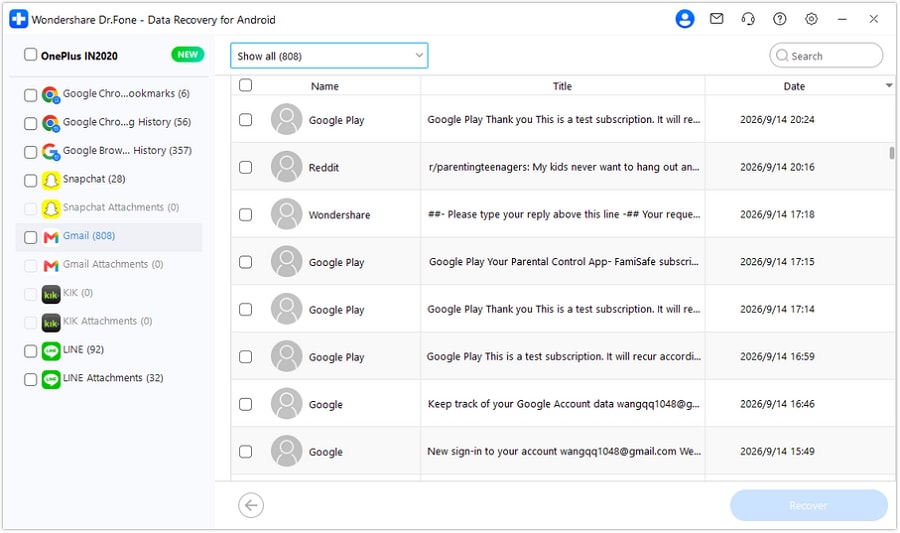
Choose Gmail in the results sidebar. Locate candidates by name, title and date, using search or filters where available, then open the actual preview to check the carrier, reference and instructions. If the scan finds Gmail Attachments, preview that category separately and select the useful document as well as the relevant email record.
Step 5 Save selected Gmail results to the PC
Click Recover and follow the prompts to choose a computer folder. Open the saved output and assess the available message text and document. These are selected PC copies; the workflow does not place the notice back in the W25's Inbox or recreate Google's cloud mailbox.




Conclusion
For a missing Gmail collection notice on Samsung W25, focus on the information that gets you moving: the real reference, readable instructions and an available collection document. Dr.Fone - Data Recovery (Android) brings local Gmail preview, separate attachment inspection and selective PC saving into one guided workflow. Download Dr.Fone - Data Recovery (Android) for Windows and start a scan on your compatible W25 to keep the useful records you find.
FAQ
1. Can I recover deleted Gmail emails on Samsung W25 if there is no translation banner?
A missing translation banner does not establish that the email was deleted. Search for the original message in the correct online account, then use More > Translate message if it remains available. If the email itself is missing, Dr.Fone - Data Recovery (Android) can scan a supported W25 for discoverable local Gmail records and save selected results to a PC.2. Does the Samsung W25 record impose an Android-version limit?
No Android-version restriction is listed for this model in the supplied support record; its listed Kernel is 6.1.145. Keep that exact model and Kernel condition together. This does not extend the record to other W-series models or guarantee that a particular deleted notice remains recoverable.3. Can Gmail's Translate message recover a deleted attachment?
No. That function helps you read a retained email in another language. In Dr.Fone, inspect Gmail Attachments separately if the scan finds them, save the useful selection and open the output on your PC. Neither the translation feature nor a visible email title establishes that the complete attachment is available locally.4. Can a W25 scan recover mail permanently deleted from Google's servers?
The scan looks for phone-local data still discoverable on the supported device. It does not reverse Google's server deletion, extend the up-to-30-day Trash period or restore recovered records directly into Inbox. A useful local copy may still be worth saving even when the account-side Trash route is no longer available.
 Add Wondershare Dr.Fone as a preferred source on Google





