 Recover photos, messages, WhatsApp, and more — no backup
needed.


 100% Security Verified | No Subscription Required | No Malware


 :

 ChatGPT
 Perplexity
 Gemini
 Claude
 Grok
When an application email disappears, you may need more than the attached form: the message can explain where to submit it, which version was requested and what deadline applies. Finding an old PDF on your Pixel 8 is helpful, but it is not the same as recovering the email that gives the document its context.
Dr.Fone - Data Recovery (Android) helps supported Google Pixel 8 series users look for both sides of that loss. Its local Gmail scan lets you preview available email records and inspect Gmail Attachments separately, then save the useful selections to a PC. This guide starts with a targeted attachment search and shows how to evaluate the scan results without confusing a filename with a complete recovered message.
In this article
Before you start
Check the Pixel 8, 8 Pro or 8a entry
Google Pixel 8: listed Android version is Android 14; listed Kernel is 6.1.157. Google Pixel 8 Pro: listed Android version is Android 14; listed Kernel is 6.1.157. Google Pixel 8a: listed Android version is Android 14; listed Kernel is 6.1.157. Match the phone's model and installed software to its own entry before this Advanced Recovery workflow. If its Android version or Kernel differs, confirm the configuration with Dr.Fone support rather than assuming a later update is covered. Do not downgrade or flash the phone to match a recovery list.
Preserve the application records and prepare Windows
Use a Windows PC, a USB data cable and a destination folder for your selected results. Advanced Recovery is Windows-only and saves to PC, not directly into Gmail. Keep Gmail and its local storage intact: do not clear app data, uninstall, reset the Pixel or attempt a bootloader-unlock procedure for recovery. Complete only the connection and access instructions shown by the product.
Identify the email and the file you actually need
Note the receiving Google account, the organization, an approximate date and whether you need the instructions, the attached document or both. Local email entries and attachments may have different scan results, and only discoverable data can be recovered. Gmail retains Trash for up to 30 days after deletion unless permanently deleted sooner; deleted drafts are not recoverable from Trash. A local scan does not restore permanently deleted Google server mail or extend that window.
Search Gmail for the application and its attachment
Use this check when you remember the document or organization but cannot locate the email that accompanied it.
Step 1 Search the receiving Google account
Open Gmail on the Pixel, tap the profile picture at the top right and check the account address. Tap Search in mail and enter in:anywhere followed by a distinctive word such as application or the organization's name. This search includes Spam and Trash, unlike Gmail's standard search.
Step 2 Look for messages with attachments
If too many messages match, use the Attachment search chip or add has:attachment to your search. Gmail also offers a Date chip to narrow the period. If the expected email still does not appear, remove the attachment restriction; the instructions may have been sent without a file or in a separate message.
Step 3 Inspect the matching message, not just its subject
Open a retained result and compare the organization, message date and instructions with the task you need to complete. For an archived message, Menu > All mail lets you find it outside Inbox. If you have the right archived email, touch and hold it and choose More > Move to Inbox if you want it visible there.
- A document mentioned in an email is not automatically a Gmail attachment. If the retained message contains a link rather than an attached file, do not assume that a Gmail Attachments scan will recover the linked document.
- Use an internet connection for the mailbox check; offline search can only find emails already synced to the Pixel.
Restore a retained application email from Trash
Use Gmail's own move operation if the deleted application message is still available in Trash.
Step 1 Select the correct message in Trash
In Gmail, tap Menu > Trash and find the application email. Match its date and organization before selecting it, particularly when you have both a blank form and a later revised version in your correspondence.
Step 2 Move the email and verify the accessible attachment
Touch and hold the message, choose More > Move to and select Inbox or another suitable folder. Open the moved email and check the available attachment against the version you need.
- If the email is not retained in Trash or the required local file is still missing, use the supported Pixel's Dr.Fone scan to inspect available Gmail records and attachment data.
Read Pixel 8 Gmail scan results without losing document context
| What the scan makes available | What to inspect | Useful result |
|---|---|---|
| A relevant Gmail entry and an attachment | Check the entry's title/date and the actual available file | Save both selections and verify their contents on PC |
| A Gmail entry but no attachment result | Review the email information available in preview | Keep useful instructions or references without assuming the file was recovered |
| An attachment but no matching Gmail entry | Inspect the document itself | Keep the available file without claiming the original message was restored |
| Neither the entry nor the required file | Recheck the correct account and supported phone used for scanning | Use retained mailbox information or ask the organization for another copy |
Common problems and fixes
An attachment-focused Gmail search hides the instructions
Remove has:attachment or the Attachment chip and search the organization's name alone with in:anywhere. Application instructions and the form may have arrived in separate emails. Finding one retained message does not establish that the other has been recovered.
Two available files look like different versions of the same form
Preview what the scan makes available and save the selected candidates to PC for inspection. Use any matching Gmail entry's title and date as context, then verify the file contents before deciding which version is useful. Do not assume the tool automatically pairs a recovered file with the correct email.
The Pixel has a different Android version from the listed entry
Keep the current installation unchanged and give Dr.Fone support the exact model, Android version and Kernel. These three Pixel 8 entries specify Android 14 and Kernel 6.1.157; a different configuration needs confirmation, not a downgrade or factory reset.
How to use Dr.Fone - Data Recovery (Android)
Dr.Fone - Data Recovery (Android) gives you a structured way to look for missing application correspondence on a supported Pixel 8, Pixel 8 Pro or Pixel 8a. Its Windows-only Advanced Recovery mode scans local Gmail data, presents email entries and Gmail Attachments for separate review, and saves your chosen results to a PC. That separation helps you focus on the information you need: the instructions, the document or a useful combination of both.
- Preview available Gmail entries by name, title and date to narrow the search to the application correspondence.
- Check Gmail Attachments as well as the email results so a useful document is not overlooked.
- Save selected output to your PC for closer inspection of file contents and message information before using it.
 Scan Android phones and tablets directly.
- Preview and recover only what you want.
- Supports WhatsApp, photos, videos, contacts, and more.
- Works with 6000+ Android devices.

Follow the official Advanced Recovery workflow
Step 1 Open Advanced Recovery for the supported Pixel
Launch Dr.Fone on Windows and choose Toolbox > Data Recovery. Open Android > Recover Android Data, select Advanced Recovery and click Start Scan. Connect your supported Pixel 8 series phone by USB when prompted and follow the on-screen instructions until the device is detected.

Step 2 Choose Gmail as the app data to scan
Select Gmail from the available categories and click Start Scan. This is the email-data selection for the task. WhatsApp and WhatsApp Business, if needed for other recovery work, must each be scanned separately from the other categories.

Step 3 Keep the Pixel connected while the scan runs
Allow Advanced Recovery to scan without unplugging the phone. If you need to stop, click Cancel first and then disconnect. If the phone is temporarily unresponsive after scanning or recovery, use the restart instructions displayed by the product.

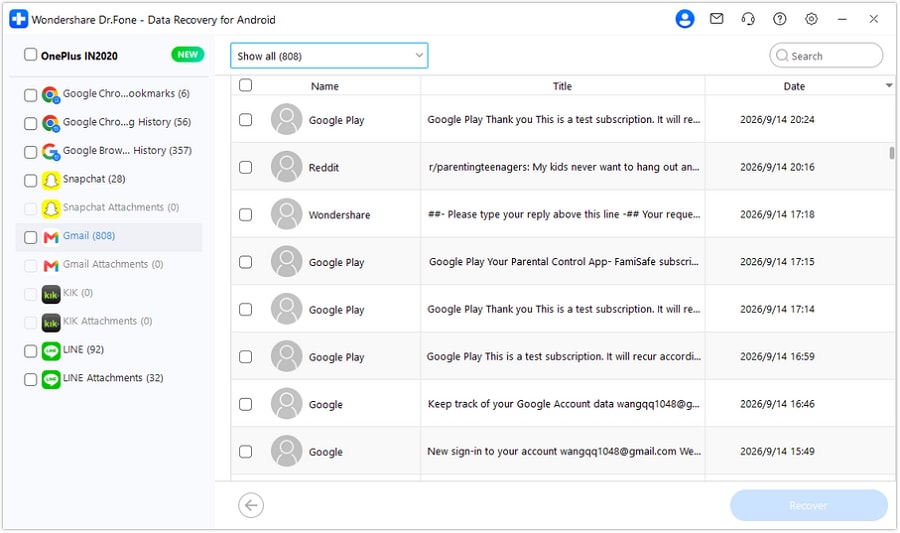
Step 4 Review the application email and attachment results
Choose Gmail in the results sidebar and inspect available entries by name, title and date. Use search or filters where available to locate the relevant correspondence. Open Gmail Attachments separately if attachment data was found, and select the available records and files you want to inspect further.
Step 5 Recover the selected correspondence to your PC
Click Recover and follow the prompts to choose a computer folder. Save the selected results and inspect the output for the instructions and document contents you need. Advanced Recovery saves these copies to PC rather than recreating the email in the Pixel's Gmail Inbox.




Conclusion
For missing application emails and documents on the Google Pixel 8 series, Dr.Fone - Data Recovery (Android) helps you search local Gmail data, preview records and attachments separately, and save the useful selections for closer review on your PC. Download Dr.Fone for Windows, connect your supported Pixel configuration and start a focused Gmail scan to look for the correspondence that helps you move your application forward.
FAQ
1. Can I recover deleted Gmail attachments on Google Pixel 8 Pro?
For the listed Pixel 8 Pro configuration, Android 14 with Kernel 6.1.157, Dr.Fone - Data Recovery (Android) can scan local Gmail data through Advanced Recovery on Windows. Check Gmail Attachments for available file data, preview what is found and save selected results to a PC. Recovery depends on the scan's actual results.2. Is Google Pixel 8a included alongside Pixel 8 and 8 Pro?
Yes. Each of the three named entries specifies Android 14 and Kernel 6.1.157. Match your exact phone and installed software; do not extend the conditions to a different configuration merely because it belongs to the Pixel 8 family.3. Will recovering an attachment also restore the email instructions?
Not necessarily. Gmail entries and Gmail Attachments are reviewed separately, and one may be available without the other. Inspect the actual selected output. An attachment file alone does not recreate the message body or restore the original Gmail conversation.4. Can Gmail Attachments recover a document that was only linked in the email?
Do not assume so. A link to a document is different from an attached file. If the email still exists, use its retained information to access the document normally. This local Gmail workflow does not promise recovery of the separate linked document or another cloud service's files.5. Should I downgrade Android to match the Pixel 8 scan conditions?
No. Do not downgrade, flash or reset the phone as a recovery step. Keep Gmail's local data intact and ask Dr.Fone support to confirm your current model, Android version and Kernel before proceeding with a configuration different from the listed entry.
 Add Wondershare Dr.Fone as a preferred source on Google





