 Recover photos, messages, WhatsApp, and more — no backup
needed.


 100% Security Verified | No Subscription Required | No Malware


 :

 ChatGPT
 Perplexity
 Gemini
 Claude
 Grok
A full-mailbox warning prompts a quick cleanup, and suddenly the broadband installation instructions you read last week are missing. Meanwhile, the provider says it sent another message today. These are two different problems: one email may have been deleted, while the other may not have been delivered at all.
If you need to recover deleted Gmail emails on Xiaomi 17, 17 Pro Max or 17 Ultra, Dr.Fone - Data Recovery (Android) can help you inspect discoverable Gmail records and available attachments on a supported connected phone. Its preview and selective PC saving are useful for correspondence that had local data on the device. First identify which missing messages belong in that recovery search, so you do not spend it looking for an email that never arrived.
In this article
Before you start
Use the individual supported model conditions
The support table below covers only Xiaomi 17, Xiaomi 17 Pro Max and Xiaomi 17 Ultra. Each is listed with Android 16 and Kernel 6.12.23 in the supplied recovery records. These are recovery conditions, not claims about launch software or instructions to change the phone's firmware. Do not extend them to unlisted variants.
Keep account storage separate from phone storage
Google Account storage is shared across Gmail, Google Drive and Google Photos. When that account reaches its limit, Gmail cannot send or receive messages and incoming messages are returned to their sender. This differs from a phone-local deleted record. If the provider received a delivery failure, arrange another delivery after the account can receive mail; a device scan cannot create the email that was never received.
Prepare a non-destructive local-data check
Advanced Recovery is Windows-only and saves selected results to a PC, not back to Inbox. Prepare a USB data cable and PC folder. Preserve Gmail's current local data: do not clear its storage, remove the account, reinstall, reset the phone or empty Trash as a recovery fix. Follow the product's access instructions; the precise Root mechanism and data impact are not established, so do not assume lossless access or use generic unlock or flash instructions.
Sort missing Gmail messages by whether they actually arrived
Use this diagnosis after mailbox cleanup or a storage-limit warning, especially when older read messages and newly expected messages are both absent.
Step 1 List previously read mail separately from expected mail
Write down a subject, sender or reference for each missing message. Mark whether you remember opening it in the account or only being told it was sent. Confirm the receiving Google account before checking its storage usage. A sender's delivery-failure notice is useful evidence of non-delivery; a missing phone notification by itself is not.
Step 2 Look across retained mail, not just the cleaned view
In Gmail, open Menu > All mail for archived messages. Search for the provider name or a distinctive phrase, then use in:anywhere with that phrase to include Spam and Trash. A normal Gmail search leaves those areas out. Search online where possible because offline search checks only messages synced to the device.
Step 3 Recover eligible Trash mail and resolve delivery separately
For a message still in Menu > Trash, touch and hold it, choose More > Move to and pick a destination. Gmail retains deleted messages there for up to 30 days from deletion, unless permanently deleted sooner. For a message returned to its sender because the account was full, ask for a resend once receiving capacity is available. Do not treat either outcome as proof about the other missing messages.
- A deleted draft does not follow the recover-from-Trash path.
- If retained messages are visible elsewhere but the phone's Inbox is stale, check the internet connection, swipe down to refresh and check Menu > Settings > your account > Sync Gmail. These are visibility checks, not recovery of permanently deleted mail.
Supported Xiaomi 17 models in this Gmail recovery guide
| Approved model | Android condition | Kernel condition |
|---|---|---|
| Xiaomi 17 | Android 16 | 6.12.23 |
| Xiaomi 17 Pro Max | Android 16 | 6.12.23 |
| Xiaomi 17 Ultra | Android 16 | 6.12.23 |
Common problems and fixes
The account has room now, but today's expected message is still absent
Check the correct account, broaden the search and ask the sender whether delivery failed. Restored storage capacity is not proof that an earlier rejected message has arrived. Request a fresh send when needed; reserve the local recovery scan for records that may actually exist on the connected phone.
The scan finds older correspondence but not the installation document
Read the available entry content and check Gmail Attachments if attachment results exist. The email may contain a link rather than an attached file, or the document may not be available locally. Save useful instructions you can actually inspect and ask the provider for the missing document instead of treating a matching subject as a complete recovered package.
Advanced Recovery does not offer the expected Gmail access
Use Windows and compare the exact model, Android 16 and Kernel 6.12.23 with the listed conditions. Keep the product's displayed compatibility or access message for support. Do not attempt to enable recovery by downgrading, flashing or resetting the phone.
How to use Dr.Fone - Data Recovery (Android)
Dr.Fone - Data Recovery (Android) offers a targeted next step for Gmail correspondence deleted during cleanup on a supported Xiaomi 17, 17 Pro Max or 17 Ultra. Its Windows-only Advanced Recovery mode examines the connected phone for discoverable local Gmail data, lets you review available records and attachments, and saves the items you choose to a PC. You can concentrate on previously received instructions and useful files rather than confusing local recovery with delivery of new mail.
- Inspect available Gmail names, titles and dates to find older correspondence among the scan results.
- Preview actual content and available attachments before deciding which items are useful.
- Save selected results to a PC without trying to reconstruct the Google mailbox or restore every cleaned-up message.
 Scan Android phones and tablets directly.
- Preview and recover only what you want.
- Supports WhatsApp, photos, videos, contacts, and more.
- Works with 6000+ Android devices.

Follow the official Advanced Recovery workflow
Step 1 Start Advanced Recovery on Windows
Open Dr.Fone and go to Toolbox > Data Recovery. Choose Android > Recover Android Data, select Advanced Recovery and click Start Scan. When prompted, connect the supported Xiaomi 17, 17 Pro Max or 17 Ultra with a USB cable and follow the device-detection instructions.

Step 2 Choose Gmail as the target data
Select Gmail from the available app-data categories and click Start Scan. If you also want WhatsApp or WhatsApp Business data, scan those separately from the other categories as required by the guide; this walkthrough follows Gmail.

Step 3 Allow the connected-phone scan to complete
Keep the phone connected while Advanced Recovery scans. If you need to stop, click Cancel before removing the USB cable. Follow the on-screen restart instruction if the phone becomes temporarily unresponsive after scanning or recovery.

Step 4 Review previously received Gmail records
Select Gmail in the results sidebar and compare available names, titles and dates with your list of previously received messages. Use search or filters where offered, preview the actual content and check Gmail Attachments separately when attachment data is present. Select the records and files you need.
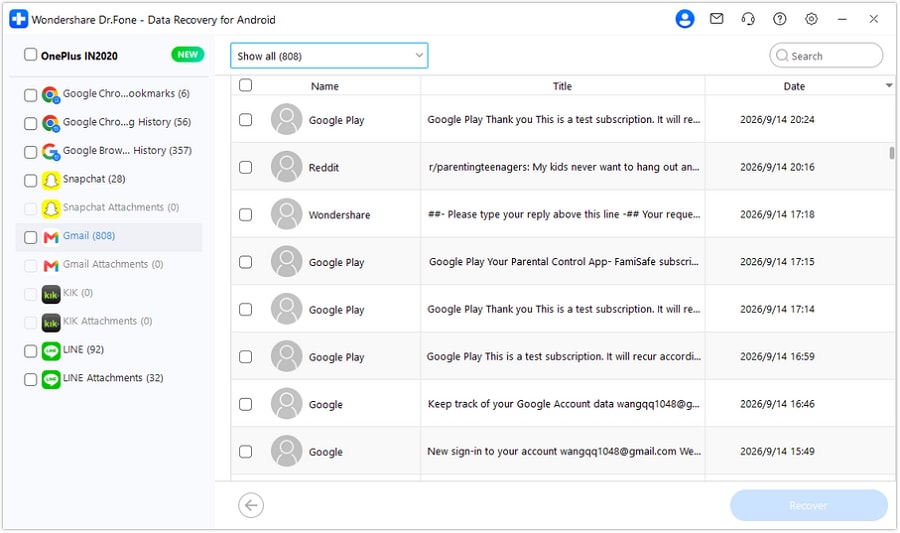
Step 5 Recover the selected items to a PC folder
Click Recover, choose the computer destination through the displayed prompts and save the selected output. Inspect the saved data for the required instructions or documents. The result is a PC copy, not a restored Inbox or delivery of an email the account never received.




Conclusion
Mailbox cleanup does not have to leave you guessing which useful correspondence remains available. Dr.Fone - Data Recovery (Android) helps supported Xiaomi 17, 17 Pro Max and 17 Ultra users inspect local Gmail results, preview relevant content and keep selected records or attachments on a PC. Download Dr.Fone for Windows and start an Advanced Recovery scan after the retained-mail checks, with your previously received messages as clear recovery targets.
FAQ
1. Can I recover deleted Gmail emails on Xiaomi 17, 17 Pro Max and 17 Ultra?
For each listed model, the supplied recovery configuration is Android 16 with Kernel 6.12.23. Check retained mail and Trash first, then use Dr.Fone - Data Recovery (Android) on Windows to inspect discoverable local Gmail records and available attachments. Save useful selected results to a PC.2. Can Dr.Fone recover an email rejected because my Google account was full?
Not if it was never received and no relevant local data exists on the phone. Google says a full account cannot receive mail and messages sent to it are returned to the sender. Resolve receiving capacity and ask for a resend rather than expecting a local scan to supply that undelivered message.3. Does freeing phone storage fix a full Google mailbox?
Not necessarily. Phone storage and Google Account storage are separate. Google Account storage is shared by Gmail, Drive and Photos; phone space can instead affect the app's ability to sync. Identify the actual warning before changing anything, and preserve local Gmail data during recovery.4. Is the Trash deadline counted from cleanup or the email's original date?
It is counted from deletion. Gmail lets you move a message out of Trash for up to 30 days after deletion unless it was permanently deleted earlier. That does not apply to a deleted draft, and the age of an installation instruction does not by itself determine Trash eligibility.5. Will the scan restore all attachments removed in the cleanup?
No complete-set result is promised. Check the available Gmail Attachments results and inspect the saved files individually. A recovered entry, readable instructions, an attached document and a link to a provider page are different outcomes; the scan saves selected discoverable data to a PC.
 Add Wondershare Dr.Fone as a preferred source on Google





