 Recover photos, messages, WhatsApp, and more — no backup
needed.


 100% Security Verified | No Subscription Required | No Malware


 :

 ChatGPT
 Perplexity
 Gemini
 Claude
 Grok
The bookshop's revised bulk-order quantities were visible on your desktop yesterday, but the message and allocation sheet are missing from Gmail on your OPPO K40 today. That timing matters. Another mail client may have downloaded a copy or applied an archive or deletion action, so the useful source may not be the same as the phone's current Inbox.
Dr.Fone - Data Recovery (Android) gives you a focused recovery option for the K40's available local Gmail data. Preview the actual quantity correction, inspect any allocation-sheet file found and save selected useful results to a PC. Start by separating an existing desktop copy from phone-local recovery so you spend time on the source that can answer the missing order question.
In this article
Before you start
Keep the exact K40 conditions
The supplied OPPO K40 row lists Kernel 4.19.157; no Android-version restriction is listed for this model. This does not cover every OPPO phone or remove the Kernel condition. Advanced Recovery is Windows-only. Prepare a Windows computer, a stable USB data cable and an output folder, and use the product's device-detection prompts rather than changing firmware or unlocking the bootloader.
Protect phone and desktop sources separately
Leave Gmail installed and do not clear its local storage, remove the account or reset the K40. Keep any already saved desktop message or attachment intact as well. Note the mail client involved and the time you last read the correction. Do not recreate the account, enable POP or repeatedly delete test messages to investigate.
Set the correct recovery boundary
Normally deleted Gmail messages can remain in Trash for up to 30 days from deletion, unless permanently deleted earlier. Discarded drafts are not recoverable from Trash. An existing desktop copy is a retained source, not a rollback of Gmail. The device scan below saves selected discoverable local results to PC; it does not restore permanently deleted Google server mail or import data into the Inbox.
Check existing POP or IMAP handling before scanning the K40
Mail disappeared after you read or organized the same Gmail account through a desktop email program.
Step 1 Inspect any desktop copy that already exists
Look in the desktop mail program you were already using for the bookshop's message and read the actual revised quantities. Inspect an already saved allocation sheet independently. A real retained copy may solve the information loss immediately; finding the account name or a message list entry without readable content is not enough.
Step 2 Review Gmail's settings on a computer
In a computer browser, open the relevant Gmail account, then Settings > See all settings. Open Forwarding and POP/IMAP, or Forwarding where that is the displayed tab. Review the existing configuration; do not activate a new mail-collection method as a recovery test.
Step 3 Identify the relevant POP or IMAP behavior
Google's missing-mail help explains that a POP setup can use Delete Gmail's copy or Archive Gmail's copy rather than Keep Gmail's copy in the inbox. For an existing IMAP client, inspect that client's own deletion-handling settings. A current setting is a diagnostic clue, not proof of exactly what happened yesterday, and changing future handling does not reconstruct previously deleted mail.
Step 4 Check the retained Gmail source before local recovery
Search that Gmail account using in:anywhere and a known bookshop or order term. Read the actual correction if found outside the Inbox. For a message still in Trash, use Menu > Trash on Android, touch and hold the message, then More > Move to and choose the destination. If the needed record or file remains missing, continue with the K40 scan.
- A synchronized IMAP view is not automatically an independent historical backup. Deletion behavior in another client can affect Gmail.
- The Dr.Fone workflow below scans the connected phone, not the desktop client's mailbox database. Treat those sources as separate checks.
Use the right source for the revised book allocation
| Source or finding | What it can supply | How to interpret it |
|---|---|---|
| An existing readable desktop message | The quantity correction retained in that client | Preserve the useful copy without claiming that Gmail's cloud message has been restored. |
| Gmail mail outside the Inbox | The retained original message and any accessible file | Read the actual correction; an archive action can explain an empty Inbox. |
| A local Gmail result from the K40 | The actual text available in the scan preview | Save the useful correction to PC, keeping it distinct from the original order. |
| An allocation spreadsheet without the correction email | Readable book titles, quantities and version details in the file | Use it as a reference, but confirm any missing final allocation instead of inferring it. |
Common problems and fixes
The message remains on desktop but not in Gmail
Read and preserve the existing desktop source first. Review whether POP handling archived or deleted the Gmail copy, or whether the other client's deletion settings are involved. A retained local copy is useful on its own; it does not establish that the cloud Inbox can be rebuilt.
Changing a mail-client setting did not bring older messages back
Treat the setting as future handling rather than historical restoration. Search retained Gmail and Trash, inspect existing desktop material, then use the separate phone-local scan if the missing K40 data is still needed. Do not repeat account setup or deletion experiments.
The allocation sheet and email show different quantities
Read the actual file content and available correction text, including any visible version or date. Keep the two sources separately identified. A recovery result does not decide which instruction the bookshop ultimately approved; ask for clarification when the final allocation is not established.
How to use Dr.Fone - Data Recovery (Android)
Dr.Fone - Data Recovery (Android) helps you look beyond the K40's current Inbox for useful local Gmail records. Its Windows-only Advanced Recovery workflow offers entry previews, separate review of attachment files found and selective saving to PC. You can concentrate on the missing quantity correction and a readable allocation sheet while keeping the desktop-client investigation separate.
- Locate candidate Gmail entries using visible name, title and date, then verify the available correction text.
- Inspect actual found Gmail Attachments independently for the allocation sheet and its readable version details.
- Save selected useful records to PC without collecting every unrelated order or confusing local output with cloud restoration.
 Scan Android phones and tablets directly.
- Preview and recover only what you want.
- Supports WhatsApp, photos, videos, contacts, and more.
- Works with 6000+ Android devices.

Follow the official Advanced Recovery workflow
Step 1 Connect the K40 to Windows Advanced Recovery
Launch Dr.Fone on Windows and open Toolbox > Data Recovery. Select Android > Recover Android Data, choose Advanced Recovery and click Start Scan. Connect the supported OPPO K40 by USB when prompted and follow the on-screen instructions until the phone is detected.

Step 2 Select the phone's Gmail data
Choose Gmail from the available app-data categories and click Start Scan. This is a connected-phone scan, not an import of the desktop mailbox. If WhatsApp or WhatsApp Business is needed separately, follow the guide's requirement to scan each separately from the other categories.

Step 3 Let the local data scan run
Maintain the K40's USB connection during scanning. If stopping is necessary, click Cancel before disconnecting. Follow the displayed restart instructions if the phone becomes temporarily unresponsive after scanning or recovery.

Step 4 Read the correction and preview available allocation files
Choose Gmail in the results sidebar. Use name, title and date and any available search or filters to find candidates, then open the actual preview for the revised quantities. If the scan finds Gmail Attachments data, inspect the real files there separately and select useful allocation sheets as well as readable message records.
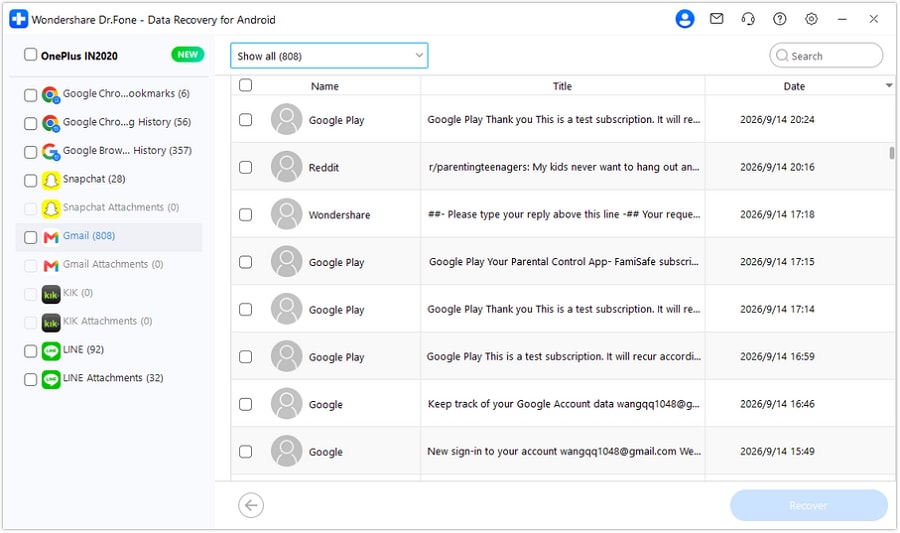
Step 5 Recover the selected order references to PC
Click Recover, choose a computer folder and complete the save prompts. Open the selected output and check the correction text or spreadsheet content. Keep those PC results separately from an existing desktop email archive; the workflow does not place them back into the Gmail Inbox.




Conclusion
Dr.Fone - Data Recovery (Android) gives supported OPPO K40 users focused local Gmail previews, separate attachment inspection and selective PC saving for useful order references. Download Dr.Fone - Data Recovery (Android) for Windows and start Advanced Recovery to look for the missing correction and allocation sheet on your phone.
FAQ
1. Can I recover deleted Gmail emails on OPPO K40?
Dr.Fone - Data Recovery (Android) offers the Windows local-scan route for supported K40 configurations. The supplied record lists Kernel 4.19.157 with no Android-version restriction for this exact model. Preview the actual results and save useful selections to PC; specific missing items are not guaranteed.2. Why can mail disappear after a desktop POP download?
Google's missing-mail help identifies settings such as Delete Gmail's copy and Archive Gmail's copy in an existing POP configuration. Review the actual account and client settings and any retained desktop copy. Do not infer the historical action from the current setting alone or enable POP to test recovery.3. Is an IMAP mail program a separate backup?
Not necessarily. Its view and deletion actions can synchronize with Gmail. Inspect what is actually retained and readable, rather than assuming that a second program preserves every historical message.4. Can this Dr.Fone scan recover a desktop mailbox file?
This article's Advanced Recovery workflow scans available Gmail data on the connected K40 and saves selected results to PC. It does not scan or import the desktop client's mailbox archive. An existing desktop copy is a separate retained source to check.
 Add Wondershare Dr.Fone as a preferred source on Google





