 Recover photos, messages, WhatsApp, and more — no backup
needed.


 100% Security Verified | No Subscription Required | No Malware


 :

 ChatGPT
 Perplexity
 Gemini
 Claude
 Grok
The programme proof is nearly ready, but the email explaining a contributor-credit correction has vanished from your Motorola Razr Fold. A current document may show a different name without explaining who requested the change, while an older PDF may still contain the original wording. You need the actual feedback and the right proof, not another document with a familiar title.
Dr.Fone - Data Recovery (Android) helps supported users look for available local Gmail correspondence, inspect any found attachment files and save selected useful material to a PC. Before that scan, check whether the missing feedback survives as an open or resolved comment in the original Google document. This gives you a practical way to recover deleted Gmail emails on Motorola Razr Fold while keeping document discussion, notification emails and actual attached proofs separate.
In this article
Before you start
Use the exact Razr Fold device condition
The approved Motorola Razr Fold entry is originally labelled Moto Razr Fold and lists Kernel 6.12.38. No Android-version restriction is listed for this named model. This condition is not the Razr 60 Ultra's Kernel and does not cover every Motorola foldable or arbitrary firmware. The phone's form factor does not create a different Gmail recovery mechanism.
Preserve the Gmail data you want to inspect
Prepare a Windows computer, a reliable USB data cable and a destination folder. Advanced Recovery is Windows-only and saves selected discoverable results to a PC rather than restoring them into Gmail. Keep the original phone's Gmail storage intact: do not clear app data, uninstall Gmail, reset, flash or unlock the device to try to recover an email. Use the product's on-screen access instructions.
Know the boundary between the file and its notification
Open only a Google document you already have permission to read. A comment, its notification email, the document's current text and an attached PDF are different records. Gmail Trash normally lasts up to 30 days from deletion, ends earlier after permanent deletion, and cannot restore discarded drafts. The phone scan does not recover deleted Google Docs comments or bypass file permissions.
Read the original document's open and resolved comments
Use this retained-source check when the missing Gmail message concerned feedback in a Google document you can still access. You may be able to read the requested correction at its source without recovering the notification.
Step 1 Open the original file and its comments panel on a computer
Open the relevant Google document in a computer browser with your authorized account. Click Show all comments at the top right. Prefer the actual file used for the discussion, not a similarly named replacement or exported PDF. The current text alone may not contain the explanation you need.
Step 2 Search the discussion and include resolved comments
In the Comments panel, use Search all comments to look for the contributor's name, a distinctive credit term or the reviewer. Select the all-comments tab rather than limiting the view to comments for you, and use All types to inspect open or resolved comments as needed. Google states that resolved comments remain accessible in the original document.
Step 3 Read the request in its actual location
Click a matching comment to find its location and read the available discussion. Check which credit it concerns and what change was actually requested. You do not need to reply, resolve or reopen it merely to read it. If the discussion supplies the correction, use that retained information; if the accompanying email explanation or attached proof is still missing, continue with Gmail.
- A resolved discussion is not proof that the final programme was approved or printed. Check the actual wording and relevant proof rather than inferring approval from the comment's status.
- This checks an existing authorized document. It does not recreate a deleted comment, restore a notification email or give Dr.Fone access to a cloud document.
Find the missing notification or proof in Gmail
Use Gmail itself for the original notification, a separate explanatory message or an actual proof attachment that the document discussion does not provide.
Step 1 Search the notification's content as well as the reviewer's name
In the correct Gmail account, search in:anywhere with the document title or distinctive credit wording. Also try the reviewer's known email address separately. Do not require the message to have a PDF attachment: a comment notification or plain-text explanation can be useful on its own. Open actual messages and distinguish a comment notification from an ordinary email reply.
Step 2 Move a retained message out of Trash when available
If you find the missing email in Trash, open Gmail Menu > Trash, touch and hold the message, then choose More > Move to and a destination. Archived mail found by search is already retained, not newly recovered. If the needed message or proof is absent, scan the supported phone below for available local Gmail records and files.
- Gmail can support interactive Google Docs comment emails. A missing interactive control is not proof the email was deleted; the original document's comments are a separate place to read retained discussion.
- A Drive document link in an email is not an attached PDF. Assess the live document and an actual found local proof file independently.
Match each feedback result to the question it can answer
| Available record | What it can help you establish | What still needs checking |
|---|---|---|
| An open or resolved comment in the original document | The actual requested credit correction and available discussion | Whether the final proof incorporates it and whether a separate explanation is missing |
| A retained or locally discovered Gmail notification | Whatever comment or context the actual message content exposes | The complete discussion, if not present in the message |
| An ordinary email reply about the proof | The reviewer's actual explanation, if readable | Which proof version that explanation refers to |
| A real PDF found under Gmail Attachments | The visible credit wording and pages in that file | Whether it is the requested version; a filename alone cannot establish approval |
Common problems and fixes
The document is available, but the correction is not visible beside the text
Open Show all comments and inspect resolved as well as open discussion. Search the comment panel for the person or wording and confirm you have the original file. Reading a resolved comment does not require reopening it, and an empty current view does not prove that the original Gmail notification is gone.
Only an older proof appears in the attachment results
Inspect the actual credit text and relevant pages, then compare them with any readable correction. Save the older proof if it is useful, but do not label it final because its filename contains final or approved. If the needed version is absent, request it from the authorized editor as a separate replacement, not as evidence the scan recovered it.
How to use Dr.Fone - Data Recovery (Android)
Dr.Fone - Data Recovery (Android) gives you a focused way to look for the Gmail records still missing after the document-source check. On a supported Motorola Razr Fold, its Windows-only Advanced Recovery mode scans available local Gmail data, lets you review discovered entries and found attachment files, and saves your chosen useful records to a PC. That helps you keep an actual explanation and a readable proof rather than relying on a document title or a resolved marker.
- Locate relevant Gmail entries using the available name, title and date, then inspect whatever content can actually be previewed.
- Review Gmail Attachments separately when files are found, so a real proof is evaluated independently of a notification or document link.
- Save selected discoverable results to a PC for convenient side-by-side reference during the credit check.
 Scan Android phones and tablets directly.
- Preview and recover only what you want.
- Supports WhatsApp, photos, videos, contacts, and more.
- Works with 6000+ Android devices.

Follow the official Advanced Recovery workflow
Step 1 Start Advanced Recovery for the connected Razr Fold
Launch Wondershare Dr.Fone on Windows. Go to Toolbox > Data Recovery, select Android > Recover Android Data, then choose Advanced Recovery and click Start Scan. Connect the supported Motorola Razr Fold by USB when prompted and complete the displayed instructions until detection.

Step 2 Choose Gmail data for the scan
Select Gmail from the available categories and click Start Scan. The guide requires WhatsApp and WhatsApp Business to be scanned separately from the other categories; it does not impose that restriction between the non-WhatsApp categories. Gmail is the data source for this missing-feedback task.

Step 3 Wait while the phone's selected data is examined
Keep the phone connected throughout scanning. If you need to stop, use Cancel before removing the USB cable. Follow the product's restart instructions if the phone becomes temporarily unresponsive after scanning or recovery.

Step 4 Review Gmail feedback and actual proof files
Open Gmail in the results sidebar and locate likely entries by name, title and date. Use search or filters where available, then inspect actual previewable content for the credit wording and explanation. If Gmail Attachments contains discovered files, review those separately for a readable proof. Select useful available records without treating a metadata match or cloud link as the missing text or file.
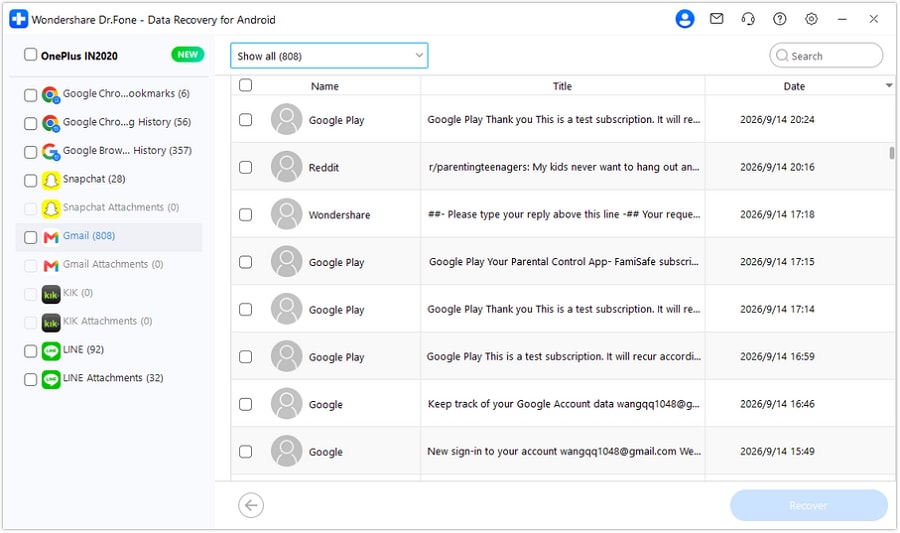
Step 5 Recover the chosen records to a PC folder
Click Recover, choose a computer folder through the save prompts and complete the operation. Open the saved selection and check the available explanation and proof content. The output is stored on the PC; it is not inserted into Gmail or used to change the Google document.




Conclusion
Dr.Fone - Data Recovery (Android) helps supported Motorola Razr Fold users inspect available Gmail feedback, identify usable proof attachments and preserve selected records on a PC. Download the Windows version, connect your compatible Razr Fold and start Advanced Recovery to look for the correspondence and files that make the credit correction easier to finish.
FAQ
1. How can I recover deleted Gmail emails on Motorola Razr Fold?
Check the correct Gmail account and Trash, then use Dr.Fone - Data Recovery (Android) on Windows for a supported phone-local scan. The approved Moto Razr Fold entry lists Kernel 6.12.38 with no Android-version restriction for that model. Preview the available Gmail results and save selected discoverable entries and files to a PC.2. Can I read a resolved Google Docs comment without recovering its email?
Yes, if the comment remains in an original document you can access. On a computer, open Show all comments, search the panel and inspect resolved discussion through All types. This retrieves information from a retained source; it does not undelete a Gmail notification or a deleted document comment.3. Does a resolved comment mean the attached proof was approved?
No. A resolved comment closes a discussion; it does not establish publication, approval or the contents of another file. Read the actual request and inspect the relevant proof. A current document, a notification and an exported attachment can contain different information.4. Can Dr.Fone recover the cloud document from a Gmail link?
This workflow scans phone-local Gmail data, not Google Docs or its comment history. Gmail Attachments provides only actual file data found by the scan. A document link or title is not the cloud file's bytes and does not grant permission to access it.5. Will the recovered email return to Inbox, including after permanent deletion?
Advanced Recovery saves selected discoverable results to the PC, not Inbox. It does not reverse Google server-side permanent deletion. Gmail Trash normally offers up to 30 days from deletion unless mail is permanently deleted earlier, and discarded drafts cannot be restored from Trash.
 Add Wondershare Dr.Fone as a preferred source on Google





