 Recover photos, messages, WhatsApp, and more — no backup
needed.


 100% Security Verified | No Subscription Required | No Malware


 :

 ChatGPT
 Perplexity
 Gemini
 Claude
 Grok
Your to-do list still says Collect race pack, but the Gmail email with the pickup hours and course map is missing. The reminder date you chose does not tell you when the collection desk actually opens. If you need to recover deleted Gmail emails on Vivo T4, use the surviving task as a clue while looking separately for the organizer's instructions and the actual map file.
Dr.Fone - Data Recovery (Android) gives supported Vivo T4 users a focused way to inspect available local Gmail records and attachments. You can read pickup instructions the scan finds, preview a found map document and save selected useful results to a Windows PC. That gives you a practical reference for the event rather than relying on an abbreviated task name.
In this article
Before you start
Check the exact Vivo T4 entry
The approved support entry names Vivo T4 with Kernel 6.1.145; no Android-version restriction is listed for this named model. Match that exact model and Kernel with the phone's displayed software information, then follow Dr.Fone's detection instructions. Do not apply this entry to other T4 variants or treat it as a guarantee that a specific deleted message or map file remains.
Use only an existing task as a retained clue
This check is useful if you already created a related task and can still access it. Google Tasks allows task names, details and dates to be edited, so the surviving to-do is not necessarily the organizer's original wording. Do not install a new app on the recovery phone just to make a task or assume a task is a full email backup. You can check existing Tasks on a computer instead.
Prepare a non-destructive Windows recovery setup
Prepare a Windows computer, a reliable USB data cable and a destination folder. Advanced Recovery is Windows-only and saves selected discoverable results to a PC, not directly into Gmail's Inbox or Google cloud mailbox. Keep Gmail installed and do not clear its storage, remove the account, reset the phone or follow unlocking, flashing or downgrade tutorials. Use the product's on-screen access instructions without inventing a Root procedure.
Read an existing Google Task without mistaking it for the email
Use this if you previously turned the organizer's message into a task or manually noted part of the arrangement. The task may contain a useful project name or a detail you copied, even though it is not the missing email.
Step 1 Open the task source you already use
If Google Tasks is already installed and in use, open it and tap the relevant task to inspect its title and details. Alternatively, on a computer, open the correct Gmail account and select Tasks from the side panel. If the panel is hidden, click Show side panel at the bottom right. Use this existing accessible source without creating a replacement task.
Step 2 Separate your reminder from the organizer's instructions
Read what is actually written in the task and note whether you added details yourself. A task date or deadline is the date set for the to-do, not proof of the event date, pickup hours or email delivery time. A title such as Collect race pack does not supply an address, identification requirement or a map that is not present.
Step 3 Use the retained details to find the original correspondence
Take a distinctive event name or organizer detail from the task into a Gmail search. Keep the task unchanged while checking the source. If it contains only a short title, use your own known event information rather than inventing the rest. A task's completion state is not confirmation from the organizer that you collected the pack.
- Gmail's Add to Tasks action creates a to-do from an accessible email. Creating one now does not restore wording or files that are no longer available.
- For work or school accounts, the administrator controls Tasks access. If that source is unavailable, skip the check or ask the administrator; Gmail recovery does not require a Tasks history.
Find the organizer's retained Gmail instructions and map
Use this to check whether the information remains in Gmail before scanning the supported phone for local data.
Step 1 Search the correct account without a task-date restriction
In Gmail, search online for the event or organizer. Open Menu > All mail for archived correspondence and enter in:anywhere with a known term to include Spam and Trash. If a date restriction based on your task produces nothing useful, remove it. Gmail's offline search covers only messages synced to the device, so an offline no-result search is not a full mailbox check.
Step 2 Read the actual instructions and inspect available files
Open a matching message and check the collection location, pickup hours and relevant event. An early promotional email is not necessarily the pack-collection notice. If a map is accessible, inspect the actual file or authorized source rather than treating a reference to course map as the document itself.
Step 3 Move an available Trash message to the mailbox
In Gmail for Android, open Menu > Trash. Touch and hold the message you need, tap More > Move to and choose the destination. Gmail's Trash availability is up to 30 days from deletion, with earlier permanent deletion possible. A discarded draft is not recoverable from Trash.
- An archived email remains in Gmail; finding it is retained-mail discovery, not undelete.
- If the complete instructions are already accessible, use them directly. The product workflow below addresses the available local data on the connected Vivo T4.
Turn the surviving task and scan results into useful decisions
| What you find | What it can answer | What to do next |
|---|---|---|
| A task with only a title and date | Which to-do you planned and when you scheduled it | Use the event name as a search clue; confirm actual pickup hours from the organizer's source. |
| Task details you previously copied | Whatever specific information is still written there | Keep those details distinct from the original email and verify any missing conditions. |
| An available Gmail collection notice | The instructions actually present in that message | Read the location and hours, then select useful local results for PC saving if scanning. |
| An actual found map file without the notice | The route or event information visible in that file | Preview and save the usable map; obtain missing collection instructions separately. |
Common problems and fixes
The task date is different from the date in Gmail
Use the task date as your planned to-do date, not the email's sent date or the organizer's event schedule. Broaden the Gmail search and read the actual notice. This avoids excluding the right message just because you created a reminder for a later day.
Tasks is unavailable in the account
For a managed work or school account, ask the administrator about access if it matters. Otherwise skip the optional clue source and search Gmail using known event details. Do not create a new task or change the recovery phone's app setup expecting old email content to appear.
The map is found but the pickup conditions are not
Preview the actual map and save it if useful, but do not derive pickup hours or identification requirements from it. Check the available Gmail text separately and ask the organizer for unresolved instructions. A useful file does not need to be mistaken for a complete information set.
How to use Dr.Fone - Data Recovery (Android)
Dr.Fone - Data Recovery (Android) provides a focused Windows-only Gmail recovery workflow for a supported Vivo T4. You can inspect available local email content, separately review attachment results when found and save selected useful records to a PC. For event preparation, that means looking for the actual collection notice and a usable map rather than trying to expand a short to-do into a complete email.
- A Gmail-focused local scan helps you look for the actual instructions behind the surviving reminder.
- Content and separate attachment previews let you identify a useful notice and inspect a real found map file.
- Selective PC saving keeps the relevant instructions and available documents ready for reference.
 Scan Android phones and tablets directly.
- Preview and recover only what you want.
- Supports WhatsApp, photos, videos, contacts, and more.
- Works with 6000+ Android devices.

Follow the official Advanced Recovery workflow
Step 1 Start Advanced Recovery and connect the Vivo T4
Launch Dr.Fone on Windows and open Toolbox > Data Recovery. Choose Android > Recover Android Data, select Advanced Recovery and click Start Scan. Connect the supported Vivo T4 by USB when prompted and follow the on-screen instructions until the phone is detected.

Step 2 Select Gmail data
Choose Gmail among the available app-data categories and click Start Scan. If you also want WhatsApp or WhatsApp Business, scan either of those separately from Gmail and the other categories according to the official guide.

Step 3 Keep the T4 connected while scanning
Let Advanced Recovery scan the phone without removing the cable. To stop, click Cancel before disconnecting. Follow the product's displayed restart instruction if the phone becomes temporarily unresponsive after scanning or recovery.

Step 4 Preview the collection notice and actual found map
Choose Gmail in the results sidebar. Locate candidate entries by name, title and date, then open a candidate and inspect the actual available content for the pickup instructions. Use search or filters where available. If Gmail Attachments is found, open it separately and preview the actual map document; its filename or a reference in the email is not the file's content. Select the useful entries and files.
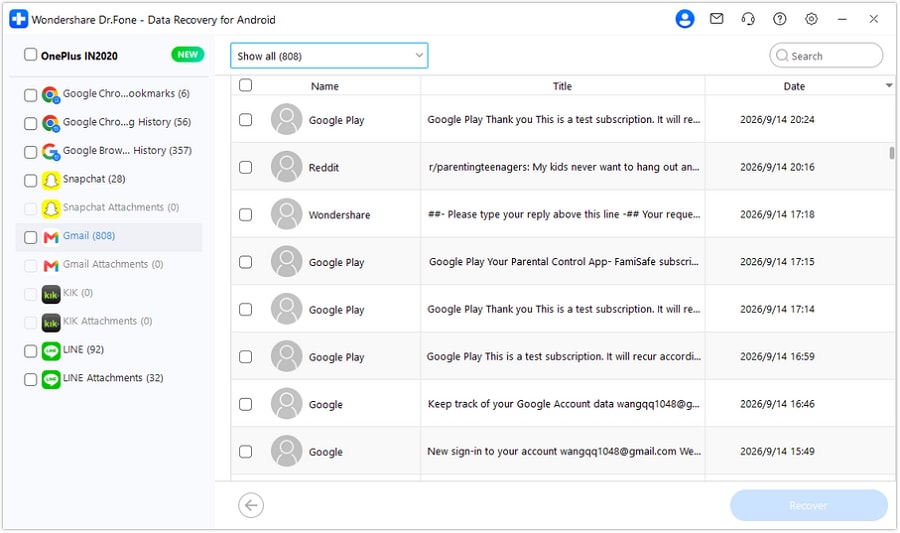
Step 5 Recover selected results to a PC folder
Click Recover, choose a folder on your computer and complete the save prompts. Inspect the saved instructions and files for usability. Advanced Recovery saves the PC copy rather than putting the notice back into Gmail or rebuilding a Google Task.




Conclusion
For a supported Vivo T4, Dr.Fone - Data Recovery (Android) helps you review available local Gmail instructions, preview found map files and preserve selected useful results on your PC. Download Dr.Fone for Windows and start a focused Gmail scan to turn the correspondence and documents you find into a practical event-preparation reference.
FAQ
1. Can I recover deleted Gmail emails on Vivo T4 without an email backup?
Dr.Fone - Data Recovery (Android) offers a supported-phone local scan without requiring an existing email backup. Use Advanced Recovery on Windows, inspect the Gmail and found attachment results, and save selected items to a PC. The exact Vivo T4 entry lists Kernel 6.1.145 with no Android-version restriction for this named model.2. Is the Google Task a backup of the email that created it?
Do not treat it as one. Google Tasks stores editable to-dos with names, details and dates. Inspect the information actually present, but do not assume the task contains the complete email, every later correction or the attachment bytes. This guide uses an existing task as a clue source only.3. Can Add to Tasks restore the missing email now?
No. Google's Android process starts from an email you can already open and uses More options > Add to Tasks. It creates a task for organization; it is not a deleted-mail recovery action. Creating a replacement to-do does not recreate unavailable email text or files.4. Does the date on the task prove the pickup session?
No. Tasks dates and deadlines are editable scheduling information. Read the organizer's actual email or another authorized current source for the pickup session. A completed task also does not establish that the organizer confirmed a collection.5. Will Dr.Fone restore my Inbox or fetch a linked cloud map?
No. This Windows-only workflow saves selected discoverable phone-local Gmail results to a PC. It does not write them into the cloud mailbox, reverse Google's server-side permanent deletion or fetch a remote map merely from a link. Inspect actual found attachments separately.
 Add Wondershare Dr.Fone as a preferred source on Google





