 Recover photos, messages, WhatsApp, and more — no backup
needed.


 100% Security Verified | No Subscription Required | No Malware


 :

 ChatGPT
 Perplexity
 Gemini
 Claude
 Grok
The conference organiser's latest reply is visible, but the earlier email with your microphone requirements and slide cue sheet seems to have vanished. Losing that one message can leave you preparing the wrong presentation setup. If you need to recover deleted Gmail emails on Google Pixel Fold, first separate a message hidden inside a conversation from one that has actually been deleted.
Dr.Fone - Data Recovery (Android) provides a focused next step for supported Pixel Fold configurations: look for phone-local Gmail records, read the useful content available in preview, inspect any found attachments and save selected items to your PC. That gives you a practical way to preserve the equipment instructions and cue sheet you can identify, rather than collecting every email with the same event title.
In this article
Before you start
Match the original Google Pixel Fold support entry
The confirmed entry for Google Pixel Fold is Android 14 with Kernel 6.1.157. It refers to the original Pixel Fold, not every later Pixel Pro Fold. Check your phone's model and software information against that entry; the specifically listed Android 14 support is not excluded by the older Android 9-13 baseline. Follow Dr.Fone's displayed access instructions, without attempting an unverified Root, bootloader-unlock or flashing procedure.
Keep local Gmail data available for inspection
Prepare a Windows PC, a USB data cable and a destination folder. Advanced Recovery is Windows-only and saves selected discoverable phone data to a PC. Leave Gmail installed, keep the account on the phone and avoid clearing Gmail storage or resetting the device. A local scan is not a request to Google to restore a permanently deleted mailbox message, and it does not fetch files that exist only behind remote Drive links.
Identify the particular message, not just the conversation
Note the organiser's address, the approximate message date and a distinguishing detail such as the equipment request or cue-sheet filename. A familiar conversation subject can cover several different messages. The target is the actual instruction and any usable file, not merely a visible thread heading.
Check Gmail conversation view before treating one missing reply as deleted
Use this check when the event conversation still exists but an earlier instruction appears absent. Conversation view changes how retained email is presented, so it can resolve a display problem without a recovery scan.
Step 1 Open the relevant conversation and inspect its messages
In the correct Gmail account, open the event conversation and check the messages it contains, not only the newest reply. Gmail groups replies into conversations and places the latest email at the bottom. Look for the actual message containing your equipment instructions; a later reply that mentions a cue sheet is not the sheet itself.
Step 2 If helpful, display the account's emails separately
For a Gmail address in the Android app, go to Menu > Settings > your account address. Under General, uncheck Conversation view to display emails separately, then search again for the organiser and event. You can re-enable it afterward. This is a viewing preference, not an undelete operation or a way to recreate a missing member of a thread.
Step 3 Check outside Inbox and compare the online mailbox
Open Menu > All mail for archived messages, or search Gmail using in:anywhere with a distinctive event phrase to include Spam and Trash. If the same account has the email in a computer browser but not on the phone, check the connection, refresh the inbox and verify Menu > Settings > the account > Sync Gmail. Do not remove the account or clear Gmail storage as a recovery experiment.
Step 4 Move a retained message out of Trash when available
Open Menu > Trash, touch and hold the relevant message, then choose More > Move to and a destination such as Inbox. Messages may remain in Trash for up to 30 days from deletion, but can be permanently deleted earlier. Discarded drafts cannot be recovered from Trash. If the received email is no longer available online, continue to the phone-local scan below.
- Turning conversation view off can expose a retained individual email; it cannot regenerate deleted text or attachments.
- Use Gmail search operators only in Gmail. Dr.Fone's preview uses its own available search and filter controls.
Identify the useful presentation record in the results
| What you find | What to read or open | Useful next step |
|---|---|---|
| The original equipment email | The actual microphone, connection and presentation instructions | Keep the relevant message as a preparation reference. |
| A later reply with the same subject | Whether it contains the earlier instructions or only refers to them | Save useful updates and continue looking for the missing details. |
| An available cue-sheet attachment | The event name, slide cues and readable contents of the actual file | Save the matching file to your PC alongside useful correspondence. |
| Equipment text without the sheet | Which setup details are present and which cues still need clarification | Preserve the useful text and ask the organiser for the missing sheet. |
Common problems and fixes
Separate-message view still shows only the latest reply
Repeat a broad search in the correct account rather than assuming the viewing change recovered every message. Check All mail and Trash, and use the online comparison to separate phone synchronisation from mailbox loss. A remaining reply can be useful even when its earlier message is not present.
A scan entry has the right subject but not your setup instructions
Use the available name, title and date to identify candidates, then read the actual preview. Save a useful update if appropriate, but do not infer missing microphone or connection requirements from the thread subject. Inspect found Gmail Attachments separately for the cue sheet.
Advanced Recovery is not offered for the connected Pixel Fold
Confirm the Windows workflow, the original Pixel Fold model, Android 14 and Kernel 6.1.157, then check the product's displayed compatibility or connection message. If needed, provide those details to Dr.Fone support rather than changing the firmware to force the option to appear.
How to use Dr.Fone - Data Recovery (Android)
Dr.Fone - Data Recovery (Android) helps you look beyond Gmail's conversation display for discoverable local email data on a supported Google Pixel Fold. Its Windows-only Advanced Recovery workflow lets you inspect available Gmail entries, check found attachments and save selected records to a PC. For presentation preparation, the useful result is a readable instruction or matching cue sheet you can refer to while organising your slides.
- Gmail-focused inspection: locate available entries by name, title and date, then check the words that answer your setup question.
- Separate attachment review: inspect found Gmail Attachments for a usable cue sheet instead of relying on its mention in an email.
- Selective PC saving: retain the relevant instructions, updates and actual files without exporting unrelated correspondence.
 Scan Android phones and tablets directly.
- Preview and recover only what you want.
- Supports WhatsApp, photos, videos, contacts, and more.
- Works with 6000+ Android devices.

Follow the official Advanced Recovery workflow
Step 1 Open Advanced Recovery and connect the Pixel Fold
On Windows, launch Dr.Fone and open Toolbox > Data Recovery. Choose Android > Recover Android Data, select Advanced Recovery and click Start Scan. Connect the supported Pixel Fold by USB when prompted and follow the on-screen instructions until the device is detected.

Step 2 Select Gmail data for scanning
Choose Gmail among the available app-data categories and click Start Scan. WhatsApp and WhatsApp Business each require a separate scan from the other categories; that rule does not make Gmail mutually exclusive with every other non-WhatsApp category.

Step 3 Keep the device connected during the scan
Leave the Pixel Fold connected while Advanced Recovery scans. If you need to stop, click Cancel before removing the cable. If the phone is temporarily unresponsive afterward, follow the restart instructions displayed by the product.

Step 4 Read the Gmail candidates and inspect any cue-sheet file
Choose Gmail in the results sidebar and locate likely records by name, title and date, using search or filters where available. Read the actual preview for the equipment instructions rather than selecting by event title alone. If Gmail Attachments appears with found data, preview that category separately and identify the actual cue sheet. Select the useful entries and files.
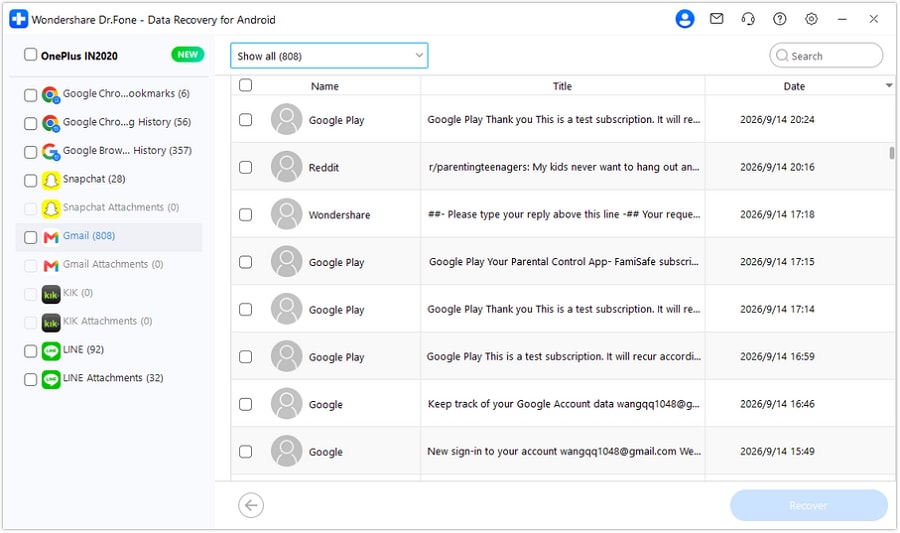
Step 5 Save the selected preparation records to your PC
Click Recover, choose a computer folder and complete the save prompts. Open the saved output and check the instructions and any selected cue sheet you need. These are PC copies of the available results, not messages imported into Gmail or a reconstructed Inbox conversation.




Conclusion
For a missing equipment email or presentation cue sheet, Dr.Fone - Data Recovery (Android) gives a supported Google Pixel Fold a purposeful recovery route: inspect local Gmail text, review actual found attachments and save the useful records selectively to your PC. Download the Windows version, connect your compatible Pixel Fold and start with the event details you want to get back.
FAQ
1. Can conversation view make Gmail emails appear missing on Google Pixel Fold?
Yes. Gmail can group several replies into one conversation, so the latest visible reply is not necessarily the only retained email. For a Gmail address, Menu > Settings > your account > General > Conversation view lets you change that presentation. It does not restore deleted members of the conversation.2. Can I recover deleted Gmail attachments on Google Pixel Fold without restoring an entire mailbox?
On a supported configuration, Dr.Fone - Data Recovery (Android) lets you preview discoverable local Gmail data and inspect Gmail Attachments separately when attachment data is found. You can select the useful results for PC saving. A filename or email reference alone does not establish that the actual file is available.3. Does Pixel Fold support stop at Android 13?
No. The confirmed Google Pixel Fold entry used here is specifically Android 14 with Kernel 6.1.157. Keep those conditions for the original Pixel Fold rather than applying the older baseline as an upper limit or borrowing conditions from a different foldable Pixel.4. Can the scan recover Google's permanently deleted email or preserve every original header?
This Windows workflow scans discoverable local phone data and saves selected results to your PC. It does not reverse Google's permanent server deletion, bypass the Trash retention period or promise a complete original header, original email format or complete conversation. Check the content and saved output actually available.
 Add Wondershare Dr.Fone as a preferred source on Google





