Recover photos, messages, WhatsApp, and more — no backup
needed.


 100% Security Verified | No Subscription Required | No Malware

 :

 ChatGPT
 Perplexity
 Gemini
 Claude
 Grok
You remember being introduced to an illustrator through LINE, but the introduction and the explanation of who would handle the project have disappeared. A familiar profile picture may still be there under a nickname, yet it does not recover the message that explained the person's role or the portfolio you were meant to review.
If you need to recover deleted LINE messages on Samsung Galaxy S22 without a backup, Dr.Fone - Data Recovery (Android) gives you a focused way to look for the missing discussion. Its supported-device scan lets you preview conversation records, review available photos, videos and files, and save selected results to a PC. First rule out a name-related search problem so you spend time recovering the right exchange.
In this article
Before you start
Keep the Galaxy S22 support conditions visible
The confirmed Galaxy S22 entry lists Kernel 5.10, 5.10.81 and 5.10.236. No Android-version restriction is listed for this model; the entry does not remove its kernel conditions or extend to a different Galaxy variant. Note the model and software details under the phone's About phone and Software information screens. Use those details if Dr.Fone support needs to investigate an unavailable recovery entry.
Use the existing phone with a Windows PC
Prepare a Windows computer, a USB data cable and a private output folder. Advanced Recovery is Windows-only, and selected discoverable results are saved to PC rather than inserted into LINE. Preserve LINE's current local data: do not clear storage or cache, uninstall, log out, reset or change firmware as a recovery experiment. Follow the software's access prompts without assuming an unverified Root procedure is required or lossless.
Separate the person from the missing referral wording
Write down the nickname, any locally assigned name, the person who introduced you and a distinctive project word. A known friend profile helps you locate a retained conversation, but it does not prove which role, deadline or introduction wording was in the deleted messages. Recovery is limited to data the scan can still find.
Check names and existing referral conversations before scanning
The introduction may still exist in a chat that is difficult to identify by its current display name.
Step 1 Search the project and the introducer
On the Chats tab, use the search icon in Japan, Taiwan or Thailand, or the search field above the list in other regions. Search a distinctive project term, the introducer's name or a remembered nickname. LINE's chat-list search can find retained chats, messages, friends and groups; a result is useful only after you open and check the actual conversation.
Step 2 Account for how LINE displays friends' names
LINE explains that synced contacts can appear under names stored on the phone, other friends under their own LINE names, and manually renamed friends under the names you assigned. A locally changed name appears that way only in your own friend list. Check the existing profile and conversation without renaming or deleting anything. A name mismatch is not, by itself, evidence that the chat was deleted.
Step 3 Inspect the introduction context or request a precise retained copy
Read both the direct conversation and any existing group exchange that contained the introduction. If you deleted the relevant message only from your screen, the other participant may still have their own copy. Ask specifically for the introduction, the described role and the relevant portfolio item, rather than asking them to recreate an entire thread from memory.
- If a thread was hidden, the main-device route is Home > Settings > Chats > Hidden chats > Edit > Unhide chat. Unhiding reveals retained history; it does not undo deletion.
- Delete and Unsend have different effects. Do not assume a recipient still has an unsent message, and do not treat your linked PC as an independent full backup after whole-chat deletion.
Referral recovery: identify what you have actually found
| Available item | What it helps you establish | What it does not establish |
|---|---|---|
| An existing friend profile or familiar display name | A possible route to the retained conversation | The historical introduction or the person's agreed role |
| The introducer's message | Who was being referred and what that message said | A later acceptance or change unless it is also present |
| A portfolio photo, clip or document | The example work actually visible in that file | That this was the selected item or the final project scope |
| A newly supplied explanation from the introducer | Useful present-day clarification | A verbatim recovered copy of the deleted original |
Common problems and fixes
Two similar names appear and you cannot identify the correct conversation
Use the introducer, project wording and available surrounding messages to narrow the match. Do not choose solely by a nickname or avatar. If the records still leave the identity unclear, confirm through an established contact before sharing project material.
The portfolio is available but the introduction is not
Inspect LINE conversation results as well as LINE Attachments. A recovered file can preserve useful work samples while the role or availability wording remains missing. Record that distinction instead of treating a portfolio filename as proof of the referral terms.
A contact appears in LINE but the old history does not return
Friend information and conversation history are different. A new message can make a deleted chat reappear without restoring its past messages. Use the supported-device scan for the missing local records rather than repeatedly adding the contact or restarting the conversation.
How to use Dr.Fone - Data Recovery (Android)
Dr.Fone - Data Recovery (Android) gives you a practical next step when a surviving contact is not enough to recover the introduction behind it. The Windows-only Advanced Recovery workflow looks for available LINE data on supported Galaxy S22 configurations without relying on a chat backup. Review conversation wording in LINE, inspect photos, videos and files in LINE Attachments, and save only the relevant results to your PC.
- Conversation preview helps you distinguish an actual introduction from a matching name alone.
- Separate attachment review lets you identify available portfolio material without assuming every referenced file was recovered.
- Selective PC saving keeps the useful referral records together while leaving unrelated project discussions out of your chosen output.
 Scan Android phones and tablets directly.
- Preview and recover only what you want.
- Supports WhatsApp, photos, videos, contacts, and more.
- Works with 6000+ Android devices.
Follow the official Advanced Recovery workflow
Step 1 Connect the Galaxy S22 through Advanced Recovery
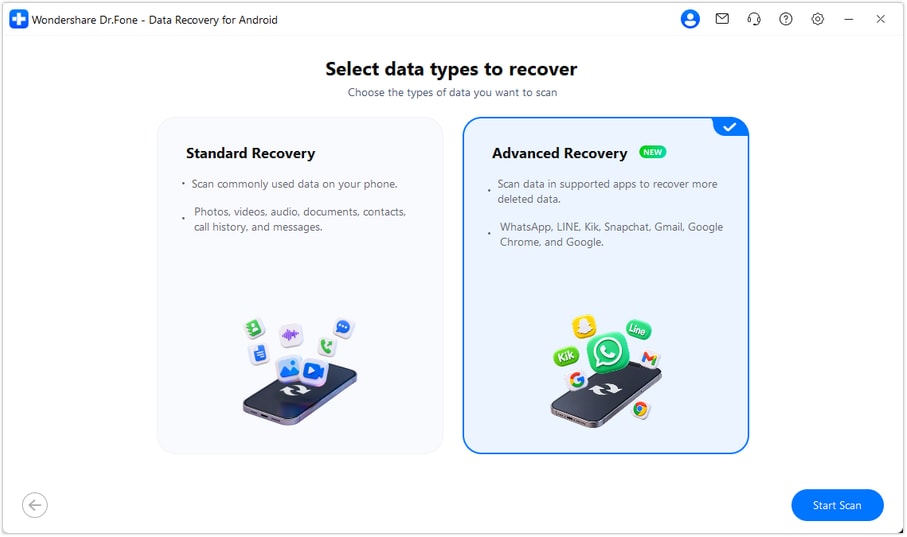
Open Dr.Fone on Windows and go to Toolbox > Data Recovery. Select Android > Recover Android Data, choose Advanced Recovery and click Start Scan. Connect the supported Galaxy S22 with a USB cable when prompted and complete the displayed detection instructions.
Step 2 Choose LINE data for scanning
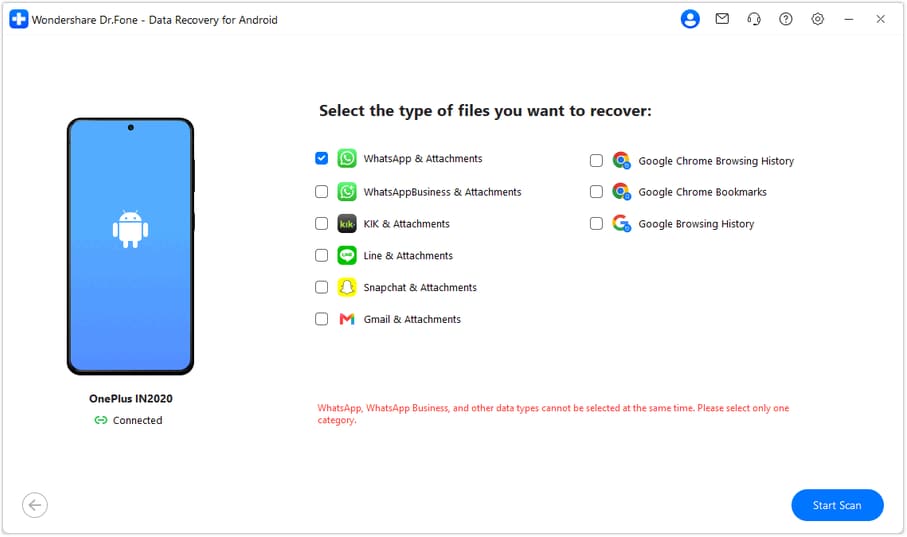
Select LINE from the supported app-data categories and click Start Scan. This is the app selection for looking for the missing referral conversation and its available attachments.
Step 3 Allow the device scan to finish
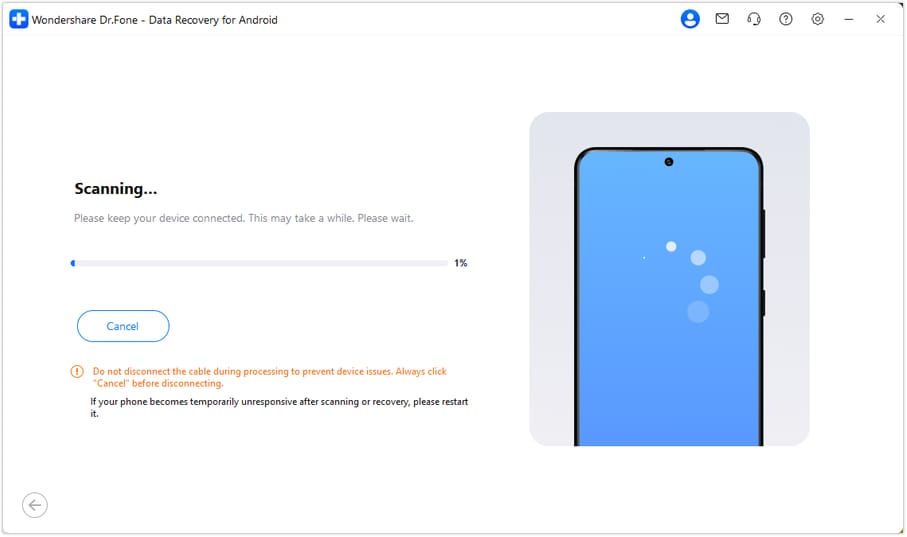
Keep the Galaxy S22 connected while Advanced Recovery scans. To stop the process, click Cancel before removing the USB cable. Follow the on-screen restart instruction if the phone becomes temporarily unresponsive after scanning or recovery.
Step 4 Preview referral messages and available work samples
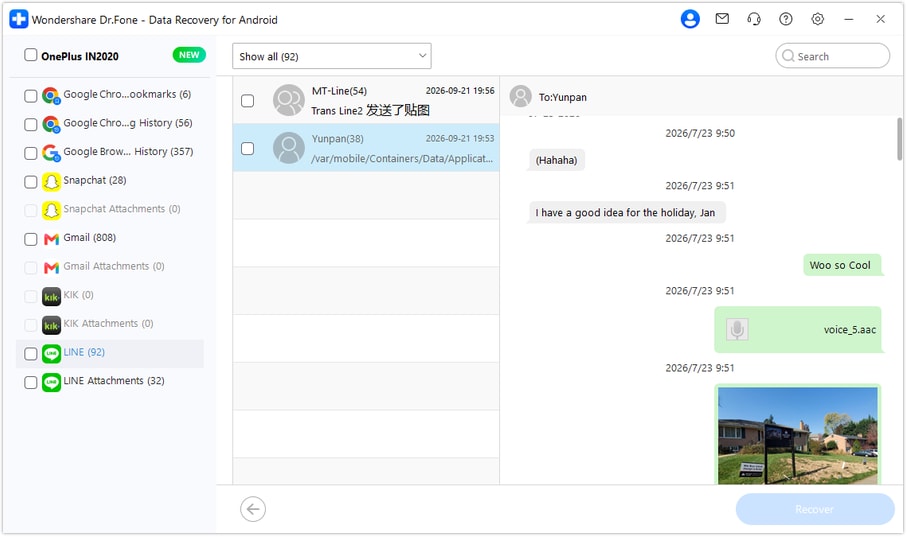
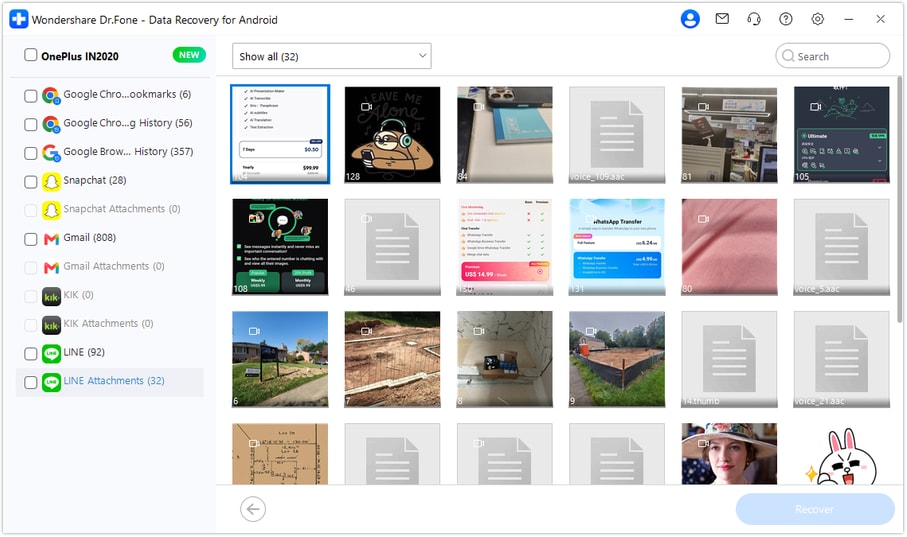
Choose LINE in the results sidebar to inspect the conversations found. Use available search or filters to locate the introduction and project terms. Select LINE Attachments separately to browse the available photos, videos and files, then select the records you want to keep.
Step 5 Recover the selected records to a PC folder
Click Recover, choose a computer folder through the displayed prompts and save your selection. Open the saved output and check the referral wording and files. Advanced Recovery creates a PC copy rather than restoring the messages to the Galaxy S22 chat list.




Conclusion
Recovering a useful referral means finding more than a familiar name: the introduction, role and supporting work sample may each matter. Dr.Fone - Data Recovery (Android) combines available LINE conversation preview, separate attachment inspection and selective PC saving for supported Galaxy S22 devices. Download Dr.Fone for Windows and start the guided scan to look for the project records you need.
FAQ
1. Can I recover deleted LINE messages on Samsung Galaxy S22 without a backup?
On a supported configuration, Dr.Fone - Data Recovery (Android) can scan for available LINE data without an existing chat backup. Use Advanced Recovery on Windows, review LINE and LINE Attachments separately, and save selected found records to PC. No scan guarantees every deleted message.2. Why does the same friend appear under a different name?
LINE names can come from synced phone contacts, the person's own LINE profile or a name you assigned locally. A locally changed name does not change how that person appears in everyone else's friend list. Check retained conversation context before deciding the old messages are gone.3. Does finding the friend profile restore the introduction?
No. A profile identifies an account to contact; it does not restore deleted message text or prove the person's historical role. Look for the actual introduction in retained messages, a participant's own copy or the available scan results.4. Can a new LINE backup recover my missing portfolio files?
A backup created after deletion does not recover the lost exchange. Standard Backup primarily covers text, while Premium Backup is not a manual-deletion rollback. Inspect existing file copies and the actual LINE Attachments scan results for the media you need.5. Does this workflow recover phone numbers or certify a contact's identity?
This article covers available LINE conversations and attachments, not guaranteed phone-number extraction or identity verification. Use an established contact channel to resolve an uncertain identity before acting on or distributing sensitive material.
 Add Wondershare Dr.Fone as a preferred source on Google