 Recover photos, messages, WhatsApp, and more — no backup
needed.


 100% Security Verified | No Subscription Required | No Malware


 :

 ChatGPT
 Perplexity
 Gemini
 Claude
 Grok
You are ready to resume a coding lesson, but the Gmail instructions and exercise sheet are missing from your Pixel 9 Pro, Pro XL or Pro Fold. The tutor also mentioned a starter ZIP, leaving two different questions: did you delete a file you previously received, or was a separate message containing the archive blocked before it reached your mailbox?
Dr.Fone - Data Recovery (Android) can help you look for available local Gmail records and attachments from previously received lesson correspondence on a supported phone. Preview the actual instructions and files found, then save useful selections to a Windows PC. A short delivery check first keeps the recovery focused on material that could have reached the device.
In this article
Before you start
Check the correct Pixel 9 Pro-family support row
The table below preserves separate entries for Google Pixel 9 Pro, Pixel 9 Pro XL and Pixel 9 Pro Fold. All three supplied records specify Android 15. Pro Fold has two listed Kernel entries, while Pro and Pro XL each list 6.1.157. Do not substitute the base Pixel 9's conditions or treat this as support for every Pixel and firmware.
Preserve Gmail and prepare a Windows destination
Advanced Recovery is Windows-only and saves selected discoverable results to a PC, not directly into Gmail. Prepare a Windows computer, a USB data cable and a destination folder. Do not remove the Gmail account, clear app storage, uninstall Gmail or reset the phone to pursue recovery. Follow product connection prompts without inventing Root, flashing or bootloader-unlock procedures.
List received learning material separately from the starter archive
Note which instructions you actually read, which exercise file you opened and which item was merely promised by the tutor. Record the tutor's address and lesson number. A message visible online is not proof that its attachment was stored on the phone, and a filename mentioned in an email is not evidence that the file was delivered.
Distinguish a deleted Gmail attachment from a security-blocked delivery
Lesson correspondence that refers to a code archive alongside ordinary text instructions, screenshots or an exercise sheet.
Step 1 Check the previously received correspondence online
In the correct Gmail account, search online by the tutor's address and a known lesson term. Add in:anywhere to include Spam and Trash, which ordinary searches exclude. Open the actual messages and identify which lesson files were attached, not just named in the text. If uncertain, compare the same account in Gmail on a computer.
Step 2 Ask the sender whether the separate archive message was blocked
If only the promised starter archive is absent, ask the tutor to check the original sending result and any actual error. Google documents the error 'This message was blocked because its content presents a potential security issue.' A sender's blocked attempt is different from a received email that you later deleted.
Step 3 Check the actual archive contents, not only the ZIP extension
Google's blocked-type list includes .js and .mjs, and restrictions can apply when prohibited files are inside an archive such as ZIP. This does not mean every ZIP is prohibited. Do not rename extensions, disable protection or repeatedly resend a blocked package as a recovery method.
Step 4 Choose the useful retained or local recovery target
Use retained lesson text or an available exercise sheet immediately. If a separate package never reached Gmail, request the instructions as ordinary text and obtain course materials through the institution's normal approved system. Continue to the local scan for previously received records or files that remain missing, not for an undelivered archive.
- Offline Gmail searches cover only synced messages, so an offline no-result search is not a complete delivery check.
- A delivery warning is not a deleted-attachment diagnosis. Keep Gmail's security controls in place and use trusted sender verification.
- A file retained in an authorized course system is a separate source, not a file recovered from that system by the Gmail scan.
Retrieve a retained lesson email from Gmail Trash
An ordinary received lesson message or worksheet email you deleted recently.
Step 1 Inspect the actual Trash item
Open Menu > Trash in the account that received the lesson. Ordinary deleted messages remain for up to 30 days from deletion, unless permanently deleted or removed by emptying Trash earlier. The lesson's age or the date a starter archive was promised is not the start of this window.
Step 2 Move the existing email and inspect its file
Touch and hold the relevant email, choose More > Move to and select the destination. Open its real contents and any available exercise sheet. Moving retained mail back through Gmail is separate from the PC-only recovery workflow below.
- A discarded draft cannot be recovered from Gmail Trash.
- If the received lesson text or worksheet is still missing, preserve the phone and inspect available local Gmail data with the supported scan.
Pixel 9 Pro, Pro XL and Pro Fold: exact recovery conditions
| Approved device | Listed Android condition | Listed Kernel entries |
|---|---|---|
| Google Pixel 9 Pro | Android 15 | 6.1.157 |
| Google Pixel 9 Pro XL | Android 15 | 6.1.157 |
| Google Pixel 9 Pro Fold | Android 15 | 6.1.157 / 6.1.162 |
Common problems and fixes
The tutor confirms the archive message was blocked before delivery
Treat that package as undelivered, not deleted from the Pixel. Request the needed lesson instructions and use the approved course-material source for the package. Focus Dr.Fone on separate messages or exercise files that were previously received; it does not fetch the tutor's computer files or bypass Gmail blocking.
You find lesson text but not the exercise sheet
Preview the Gmail record for the exact lesson number and exercise instructions. If the scan finds Gmail Attachments, inspect that category separately. Save useful instructions even if the sheet is absent, then ask for the missing sheet rather than treating a reference to it as an actual recovered file.
An attachment result has the expected name but you cannot assess its contents
Save only relevant selections and inspect the output with an appropriate trusted application on the PC. A name alone does not establish a complete worksheet or a safe, usable archive. Dr.Fone's Gmail workflow does not promise archive repair, malware certification, executable safety or a particular recovered format.
How to use Dr.Fone - Data Recovery (Android)
Dr.Fone - Data Recovery (Android) gives supported Pixel 9 Pro, Pro XL and Pro Fold users a focused way to look for locally discoverable Gmail lesson records and attachments. Its Windows-only Advanced Recovery workflow lets you inspect the actual email content found, review any separate Gmail Attachments and save selected items to a PC. Useful results can include the tutor's instructions, a readable exercise sheet or a relevant screenshot that helps you resume the lesson.
- Locate candidate Gmail records by name, title and date, then verify the actual lesson and exercise details.
- Inspect found attachments separately to identify usable learning material rather than a promised filename.
- Keep selected correspondence and available files on your PC without saving every unrelated scan result.
 Scan Android phones and tablets directly.
- Preview and recover only what you want.
- Supports WhatsApp, photos, videos, contacts, and more.
- Works with 6000+ Android devices.

Follow the official Advanced Recovery workflow
Step 1 Connect the supported Pixel to Advanced Recovery
Launch Dr.Fone on Windows and open Toolbox > Data Recovery. Select Android > Recover Android Data, choose Advanced Recovery and click Start Scan. Connect the supported Pixel by USB when prompted and follow the displayed instructions until it is detected.

Step 2 Select Gmail for the lesson-data scan
Choose Gmail from the available app-data categories and click Start Scan. WhatsApp and WhatsApp Business must be scanned separately from other categories under the guide's selection rule; neither is needed for these Gmail lesson records.

Step 3 Wait while the local-data scan runs
Keep the Pixel connected during scanning. To stop, click Cancel before disconnecting the USB cable. If the phone is temporarily unresponsive after scanning or recovery, follow the product's on-screen restart instructions.

Step 4 Preview instructions and any received exercise attachments
Choose Gmail in the results sidebar and locate likely records by name, title and date. Use search or filters where available, then open the actual preview to check the lesson number and exercise instructions. If Gmail Attachments are found, preview them separately and select useful worksheets or screenshots along with the relevant records.
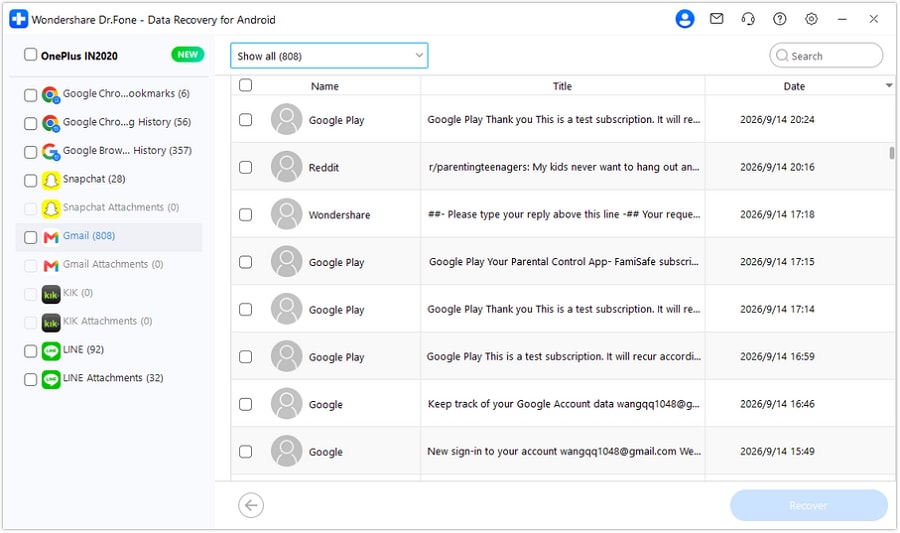
Step 5 Recover the useful selections to a PC folder
Click Recover and follow the prompts to choose the computer destination. Open the saved output and assess the available lesson text and files. This saves selected PC copies; it does not repopulate Inbox, recreate Google's mailbox or deliver an archive previously blocked by Gmail.




Conclusion
Recovering useful lesson material starts with knowing whether it was received, retained or actually deleted. Dr.Fone - Data Recovery (Android) helps you preview available local Gmail instructions, inspect found attachments and keep selected learning records on a PC. Download Dr.Fone - Data Recovery (Android) for Windows and start the guided scan on your compatible Pixel 9 Pro, Pro XL or Pro Fold to preserve the material you find.
FAQ
1. Can I recover deleted Gmail emails on Pixel 9 Pro, Pro XL and Pro Fold under identical Kernel conditions?
The supplied records specify Android 15 for all three models, but the Kernels are not identical. Pixel 9 Pro and Pro XL each list 6.1.157; Pixel 9 Pro Fold lists 6.1.157 / 6.1.162. Preserve those model-specific conditions rather than borrowing a base Pixel 9 record or extending the list to arbitrary firmware.2. Does Gmail block every ZIP attachment?
No. Google's rules can block prohibited file types, including .js and .mjs, when they are inside archives, but the ZIP extension alone does not establish that an archive is blocked. Ask the sender about the actual error and use normal approved material-delivery channels rather than renaming files or disabling protections.3. Can Dr.Fone recover an archive that never reached my Gmail account?
A phone-local Gmail scan is not a way to retrieve a package blocked before delivery or stored only on the sender's computer. Use it for discoverable local records and attachments from received correspondence. Ask the tutor for the missing material through the approved course system when the original delivery did not occur.4. Where will recovered Gmail lesson records be saved?
Advanced Recovery saves selected findings to the computer folder you choose in the Windows workflow. It does not import them into Inbox, reverse Google's permanent server deletion or guarantee an absent attachment's format or completeness. Open the selected output to assess the useful content actually available.
 Add Wondershare Dr.Fone as a preferred source on Google





