Recover photos, messages, WhatsApp, and more — no backup
needed.


 100% Security Verified | No Subscription Required | No Malware

 :

 ChatGPT
 Perplexity
 Gemini
 Claude
 Grok
The sample's front is visible in a video thumbnail, but its handwritten rear code appears only when the object turns. Meanwhile, the LINE message explaining which revised label belongs to that sample has vanished from your Motorola Razr 60 Ultra. A familiar image or a readable code may identify the reference without telling you which labeling change was actually agreed.
Dr.Fone - Data Recovery (Android) gives you a focused way to look for the missing wording without an earlier LINE backup. Its Windows-only Advanced Recovery previews found conversations and available photos, videos and files, then saves useful selections to PC. If a separate demonstration video already exists on another Android device, an optional frame export there can make a visual reference easier to inspect while leaving the recovery phone untouched.
In this article
Before you start
Use the exact Razr 60 Ultra support entry
The approved Motorola Razr 60 Ultra entry, named Moto Razr 60 Ultra in the frozen Guide, lists Kernel 6.6.118. No Android-version restriction is listed for this named model. Do not substitute Razr Fold or generalize the entry to every Razr firmware. Retain the current device identifiers without updating, downgrading or flashing to force a match.
Keep the recovery phone unchanged
Prepare a Windows PC, reliable USB data cable and writable destination folder. Keep the original LINE installation, login and local storage intact. Do not clear data, reinstall, log out, reset or unlock the bootloader. Follow the product's displayed access instructions rather than a guessed Root procedure. Avoid creating new screenshots, edited videos or exported frames on the Razr while trying to preserve its recoverable data.
Use a separate retained video only if one already exists
The optional frame check assumes the actual video is already accessible in an existing Google Photos installation on another Android device. It is not a chat-backup requirement, and no new upload, copy from the recovery phone, installation or update is needed. Use only a feature already available there; Google excludes non-Pixel Android 9 devices from video editing. Otherwise skip it and proceed to the LINE scan.
Optionally export a visual reference from a video already held elsewhere
Use this for a real existing demonstration video on another accessible Android device, not a thumbnail, expired LINE media reference or new recording made after deletion.
Step 1 Inspect the actual retained clip rather than its thumbnail
On that other Android device, open Google Photos and the existing video. Watch the actual content to see whether it includes the sample turning and the relevant side. An attractive cover frame does not show every view, and a filename or message saying a clip was sent is not the clip itself.
Step 2 Use Export frame only in the existing supported interface
Google's video-editing help documents opening the video and tapping Export frame to export a still. If that option is available in your existing interface, use it on the separate device and inspect the still actually produced. Do not trim, recolor, stabilize, mute or overwrite the source video for this check, and do not create the derivative on the Razr being recovered.
Step 3 Keep the derived image with its actual source limits
Check whether the exported still really shows a readable code and enough of the object to identify the view. If it does not, it has not supplied the missing detail. A still has no clip audio or movement sequence and is not the original camera photograph. Keep the existing video unchanged and use the actual LINE wording to determine which label revision was discussed.
- Frame export is an ordinary Google Photos action on an independent retained video. It is not Dr.Fone frame extraction, OCR, blur repair or recovery of an absent original photo.
- Any reference you derive now is new output from an existing source. Its export time is not the original recording time or the LINE message date, and it cannot establish that a labeling change was accepted.
Keep the sample view, the label change and the found conversation distinct
| Result available | Useful information | What it does not establish |
|---|---|---|
| An existing demonstration video | The views and movement actually captured, with audio only if present and usable | An uncaptured side, an unreadable code or a later written label instruction |
| A still exported on the separate device | The actual visible sample view and readable details in that derived image | The source audio, motion sequence, original photograph or message date |
| A found LINE label-change message | The actual code, revised wording and qualification written | Which image belongs with it unless the available context supplies the connection |
| Found LINE photos, videos or files | The actual usable references available for selective PC saving | A filename, thumbnail or scan order does not prove that a revision was accepted |
Common problems and fixes
Only a thumbnail survives, not a playable video
The optional export requires an actual existing video. Do not record a new clip or treat a thumbnail as the missing original. Continue with the supported LINE scan and inspect LINE Attachments separately for actual found media; a message reference and a usable file can have different outcomes.
Export frame is absent or the resulting code is unreadable
Skip the frame branch instead of installing or updating software on the recovery phone. Keep any existing video unchanged. A blurred or unsuitable still does not become an exact code through assumption, and this workflow does not promise image enhancement or automatic recognition. Look for actual readable wording in LINE results.
The code is visible but the correct revised label is still unclear
A code can identify a visual reference without choosing a wording revision. Review the found LINE exchange for the explicit change, its scope and any response. Save useful actual images and text separately; do not pair them automatically by filename or make a new label and call it the recovered instruction.
How to use Dr.Fone - Data Recovery (Android)
Dr.Fone - Data Recovery (Android) helps you look for the missing written label instruction on a supported Motorola Razr 60 Ultra. Its Windows-only Advanced Recovery scans local LINE app data without a previous chat backup, previews conversations and attachments in their own views, and saves selected records to PC. Read the actual revision wording, inspect useful found sample media and preserve a focused reference without editing the recovery phone's files.
- Inspect discoverable LINE messages for the code, requested change and any qualifying reply.
- Preview found photos, videos and files separately instead of assuming a thumbnail contains the original.
- Save selected useful text and media to PC while keeping newly derived references distinct from recovered records.
 Scan Android phones and tablets directly.
- Preview and recover only what you want.
- Supports WhatsApp, photos, videos, contacts, and more.
- Works with 6000+ Android devices.
Follow the official Advanced Recovery workflow
Step 1 Start Advanced Recovery and connect Razr 60 Ultra
Launch Dr.Fone on Windows and go to Toolbox > Data Recovery. Choose Android > Recover Android Data, select Advanced Recovery and click Start Scan. Connect the supported Motorola Razr 60 Ultra by USB when prompted and follow the on-screen instructions until it is detected.
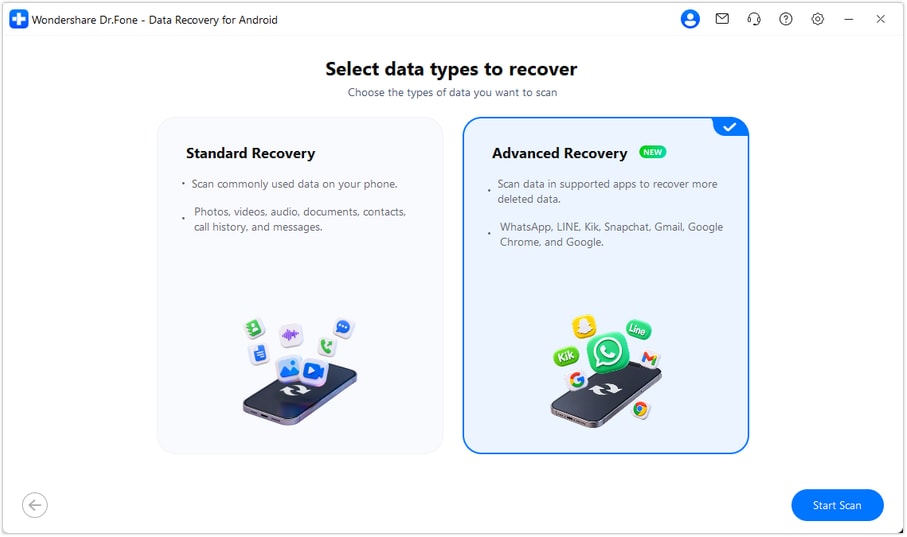
Step 2 Choose LINE as the app data to scan
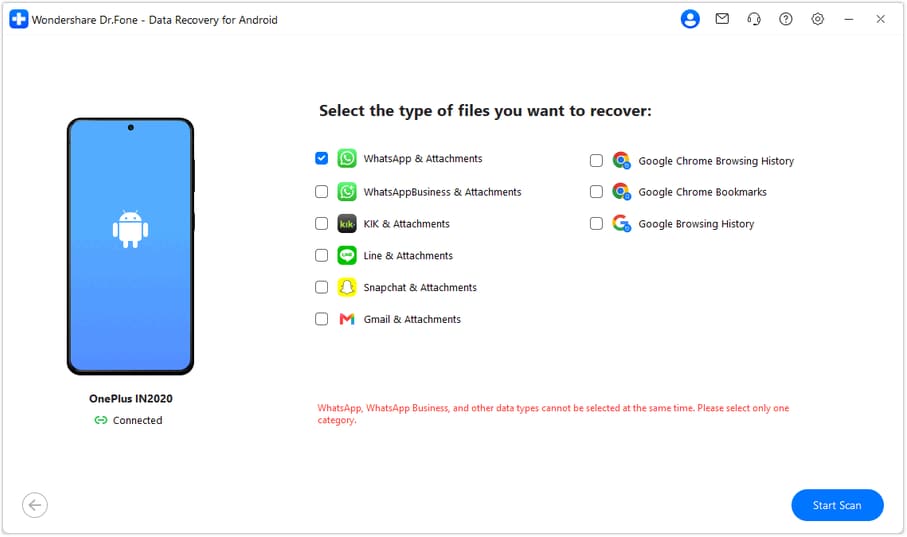
Select LINE from the available categories and click Start Scan. WhatsApp and WhatsApp Business must each be scanned separately from other categories; this does not require separate scans for every non-WhatsApp category. No retained video or earlier LINE backup is required.
Step 3 Keep the device connected throughout scanning
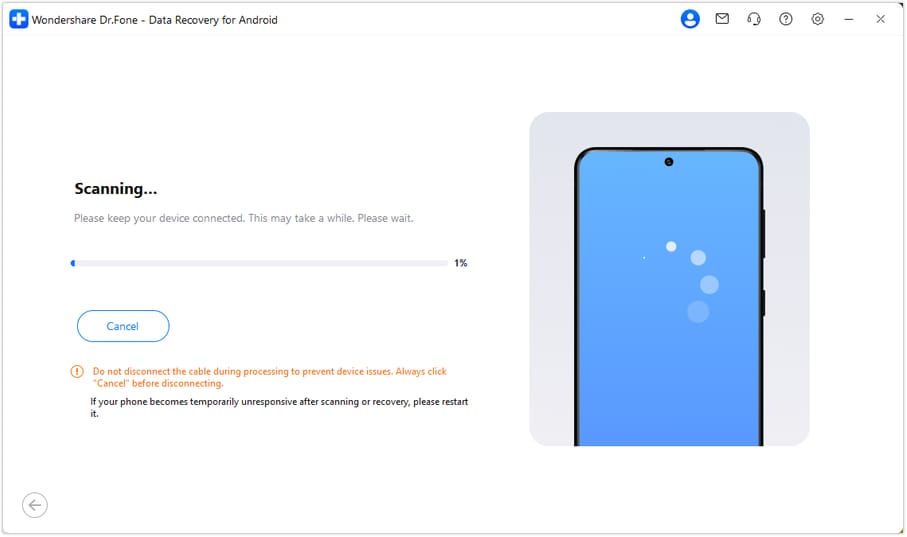
Maintain the USB connection while Advanced Recovery scans the selected data. To stop, click Cancel before unplugging the cable. If the phone is temporarily unresponsive after scanning or recovery, follow the restart instruction displayed by the product.
Step 4 Preview the label wording and actual sample attachments
Choose LINE in the sidebar and review available conversations for the actual sample code and revision. Use search or filters where offered. Select LINE Attachments separately to browse found photos, videos and files, then select useful wording and usable references. Check the actual content rather than assuming a file name or result order supplies the connection.
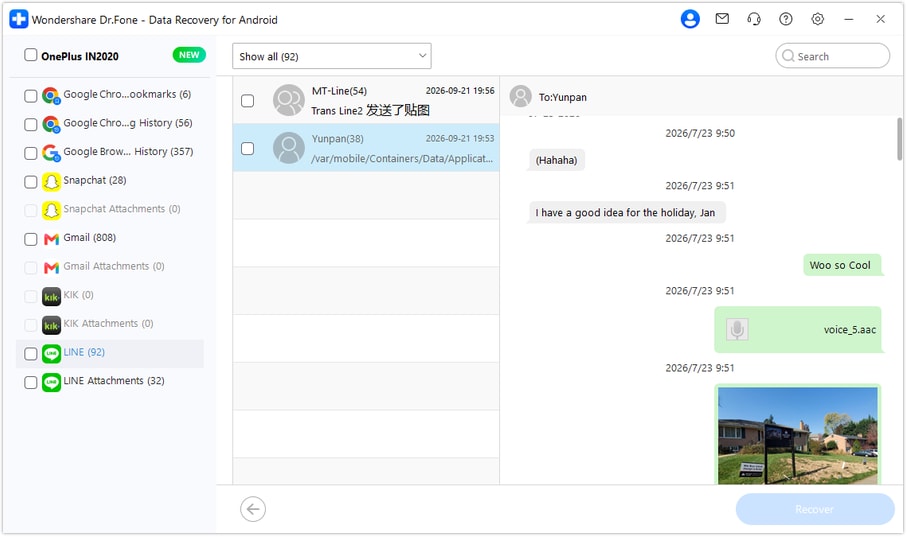
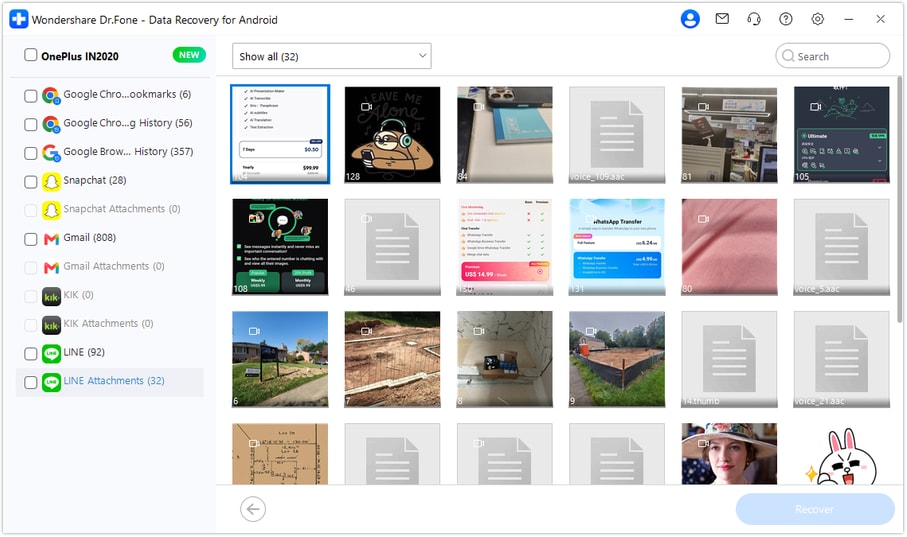
Step 5 Recover selected LINE results to your computer
Click Recover and follow the prompts to choose a PC folder and save the selected data. Open the saved output to inspect the actual text and usable files. These are separate PC copies, not messages placed into LINE, a cloud upload or automatically edited labels.




Conclusion
Dr.Fone - Data Recovery (Android) gives supported Motorola Razr 60 Ultra users focused LINE scanning, separate conversation-and-media previews and selective PC saving. Download Dr.Fone for Windows, connect your compatible phone and start looking for the actual label-change wording and useful sample files you want to keep.
FAQ
1. Can I recover deleted LINE messages on Motorola Razr 60 Ultra without a backup?
Dr.Fone - Data Recovery (Android) offers a Windows local-scan route for supported Motorola Razr 60 Ultra data without an earlier LINE backup. Retain its listed Kernel 6.6.118; no Android-version restriction is listed for this named model. Preview LINE and LINE Attachments separately and save selected discoverable results to PC.2. Does a video frame restore the original LINE photo or its explanation?
No. A frame exported from a video you already hold is a new still derived from that clip. It may preserve useful visible details, but not the original camera photo, clip audio or missing LINE instruction. Perform this optional export only on a separate device already holding the video, not on the Razr being recovered.3. Can Standard or Premium Backup undo the manual deletion now?
A suitable Standard Backup must have existed before deletion. It saves text only and supports same-OS transfer; LINE says a Standard copy made afterward or Premium Backup does not roll back that manually deleted history. Creating a backup now is not this no-backup recovery method.4. Will every deleted LINE photo, video and file return to the chat?
No. Review LINE Attachments for actual discovered media and choose useful usable items to save to PC. Advanced Recovery does not put them back into LINE, guarantee an expired original without discoverable local data or automatically match a reference image to a message.
 Add Wondershare Dr.Fone as a preferred source on Google