 Recover photos, messages, WhatsApp, and more — no backup
needed.


 100% Security Verified | No Subscription Required | No Malware


 :

 ChatGPT
 Perplexity
 Gemini
 Claude
 Grok
An illustrator's missing Gmail brief can mean losing the panel corrections just when the artwork is due. A surviving storyboard link may make the situation more confusing if it opens to You need access. When you need to recover deleted Gmail emails on iQOO Z9, the deleted correspondence, a locally stored attachment and a restricted Google file are different targets.
Dr.Fone - Data Recovery (Android) helps you look for available local Gmail notes and attachments on the supported Z9. You can read the correction text a scan finds, preview a found reference document separately and keep selected useful results on a Windows PC. First make the access check below so a permission issue does not send you searching for a file that was never a local attachment.
In this article
Before you start
Match the iQOO Z9 and Kernel entry
The approved support entry names iQOO Z9 with Kernel 5.15.178; no Android-version restriction is listed for this named model. Match the exact device and Kernel condition to the phone's displayed software information, then follow Dr.Fone's detection prompts. Do not extend the entry to other Z9 variants or interpret it as a guarantee for every deleted email or file.
Keep local recovery separate from Google file permissions
Prepare a Windows computer, a reliable USB data cable and a folder for the selected results. Advanced Recovery is Windows-only and saves selected discoverable data to a PC; it does not restore messages into Gmail. Access to a restricted Google file remains subject to its owner's sharing permissions. The phone scan does not download the remote file just because it finds a link to it.
Preserve the device and the available source material
Keep Gmail and its local storage intact. Do not clear storage, remove the account, reset the phone or follow unlocking, flashing or downgrade instructions. Follow the product's on-screen access instructions without inventing a Root procedure. Note the client, the project and which actual item you need: the correction text, a previously attached document or the authorized current Google file.
Resolve You need access without calling it attachment recovery
Use this check for a known legitimate Google Docs, Sheets, Slides or other supported Google file linked from the correspondence. Google's access warning means the current account does not have permission to view that file; it is not evidence that a Gmail attachment was deleted.
Step 1 Check the Google account used to open the file
If you have more than one account, open the relevant Google Drive, Docs, Sheets or Slides app on Android, tap the profile photo or account image at the top right and select the account the file was shared with. Recheck the known project file using that authorized account. Do not remove Gmail accounts or change phone storage for this permission check.
Step 2 Request permission from the owner if needed
If you still cannot open the known file, open it on Android and tap Request access. The owner receives an email with your request. If the owner approves and you are notified, the email arrives in the account used for the request with a link to the file. Requesting access is not approval; use the owner's response to determine whether you can read the storyboard.
Step 3 Inspect the permitted file and separate the missing brief
Read the actual file if access is granted. Viewer permission can let you read the content; it is different from permission to comment or edit. Check whether the file contains the panel notes you need. If the explanation was only in the missing email, an accessible storyboard alone does not recreate that explanation, so continue with the Gmail checks and local scan.
- Use a known project source and normal sharing controls; do not bypass warnings or seek access to someone else's private material.
- This check opens an existing authorized cloud source. It neither undeletes the email nor turns a remote link into a recovered local attachment.
Look for the retained brief and any real attachment in Gmail
Use this for the actual client message and files that were delivered with it, rather than only a shared-file access notification.
Step 1 Search the correct mailbox beyond the Inbox
Search Gmail online for the client and a distinctive project word. Open Menu > All mail for archived messages, and use in:anywhere with a known term to include Spam and Trash. If an attachment-only restriction hides the brief, remove it: an email containing a shared link may still contain useful instructions. Offline searches cover only mail synced to the device.
Step 2 Move a surviving brief out of Trash
In Gmail for Android, open Menu > Trash. Touch and hold the relevant message, select More > Move to and choose the destination. Deleted messages can remain in Trash for up to 30 days from deletion, but they may be permanently deleted earlier. Discarded drafts are not recoverable from Trash.
- A sharing notification and the client's creative explanation are different messages even if they refer to the same storyboard.
- If the email or a document is already accessible, inspect that retained source first; a scan is for the local data still available to it.
Which storyboard material do you actually have?
| Result | Useful interpretation | Next step |
|---|---|---|
| The Google file opens in the authorized account | The current shared source is accessible | Read its actual content and check whether it contains the missing panel instructions. |
| Request access is still pending | The owner has not yet granted access through that request | Wait for the owner's decision or contact them; scanning the phone does not grant permission. |
| A local Gmail entry contains the client's corrections | The available text may resolve the creative instruction | Preview it fully enough to identify the relevant panel and select it for PC saving. |
| An actual local reference document is found | A usable file may remain independently of the email or cloud source | Preview the file and inspect its revision; keep it as the copy it actually is. |
Common problems and fixes
The owner approved access, but the file still shows the warning
Check which Google account made the request and which account is now opening the file. Google's access notification goes to the requesting account. Use the appropriate account through the app's profile menu, then contact the owner if the correct account still lacks access. Do not treat an approval sent to another account as permission for all accounts.
A Gmail result contains a storyboard URL but no attachment
Read any available correction text and save the selected record if useful. Open the remote file only through normal authorized sharing. The URL is a reference, not the file bytes, and Gmail Attachments should be assessed only if the scan actually finds attachment data.
The recovered reference looks older than the current shared file
Inspect the actual pages and visible revision information yourself. Keep the local document as the version it contains, and use the authorized client or current shared source to confirm later changes. The workflow does not compare revisions automatically or reconstruct missing panel instructions.
How to use Dr.Fone - Data Recovery (Android)
Dr.Fone - Data Recovery (Android) gives you a focused Windows-only route for available local Gmail data on a supported iQOO Z9. Preview the actual client text, separately inspect attachment files when found and save selected useful results to a PC. This lets you keep the creative instructions and usable reference material the phone scan discovers, while the shared storyboard remains a separate authorized cloud source.
- A Gmail-focused local scan helps you look for the missing creative explanation rather than only the shared-file notice.
- Entry-content and separate attachment previews let you distinguish useful corrections from a link or familiar document name.
- Selective PC saving keeps the relevant text and found reference files available for careful review.
 Scan Android phones and tablets directly.
- Preview and recover only what you want.
- Supports WhatsApp, photos, videos, contacts, and more.
- Works with 6000+ Android devices.

Follow the official Advanced Recovery workflow
Step 1 Connect the Z9 to Advanced Recovery
Launch Dr.Fone on Windows and open Toolbox > Data Recovery. Choose Android > Recover Android Data, select Advanced Recovery and click Start Scan. Connect the supported iQOO Z9 by USB when prompted and follow the on-screen device-detection instructions.

Step 2 Choose Gmail data to scan
Select Gmail from the available app-data categories and click Start Scan. If needed, scan WhatsApp or WhatsApp Business separately from Gmail and the other categories, in accordance with the official guide.

Step 3 Keep the phone connected during the scan
Wait while Advanced Recovery scans the connected Z9. To stop, click Cancel before removing the USB cable. Follow the displayed restart instruction if the phone becomes temporarily unresponsive after scanning or recovery.

Step 4 Preview the actual correction and found document
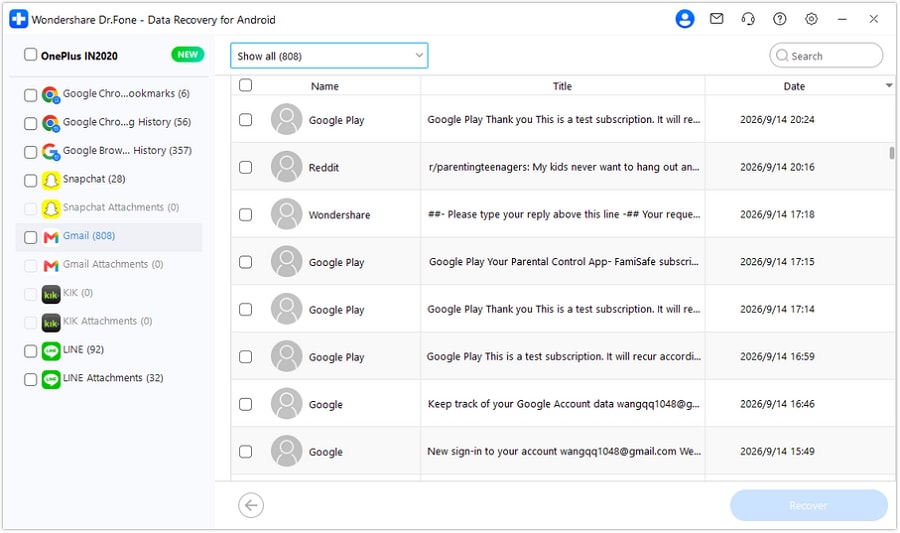
Choose Gmail in the results sidebar. Locate candidate entries using name, title and date, then open them and inspect the actual available content for the client's panel corrections. Use search or filters where available. If the scan finds Gmail Attachments, review that category separately and preview the actual reference file, not just its name or the storyboard link. Select the useful entries and files.
Step 5 Save selected useful results to a PC
Click Recover, choose a folder on your computer and complete the save prompts. Inspect the saved text and documents for readability and relevance. Advanced Recovery saves the PC copy; it does not import it into Gmail or change Google Drive sharing.




Conclusion
For a supported iQOO Z9, Dr.Fone - Data Recovery (Android) helps you review available local client correspondence, preview found reference files and preserve selected useful material on your PC. Download Dr.Fone for Windows and start a focused Gmail scan to bring the readable corrections and usable documents you find back into your project workflow.
FAQ
1. Can I recover deleted Gmail emails and attachments on iQOO Z9 without a backup?
Dr.Fone - Data Recovery (Android) provides a supported-device local scan that does not require an existing email backup. On Windows, use Advanced Recovery for Gmail, preview the available entries and files, and save selected results to a PC. The approved Z9 entry retains Kernel 5.15.178 with no listed Android-version restriction for this exact model.2. Does You need access mean my Gmail attachment was deleted?
Not necessarily. For the Google files described here, that warning means the account opening the file lacks permission to view it. Check the account the file was shared with or request access from the owner. A remote shared file and a file actually attached to a Gmail message are different sources.3. Can Dr.Fone recover the linked storyboard from Google Drive?
Not through this local Gmail Advanced Recovery workflow. It can save selected discoverable phone-local data to a PC, but it does not fetch the remote storyboard, grant permission or recreate its current contents from a URL. Use normal authorized Google file access for that source.4. What if the document is available but the client's correction email is missing?
Read the document for what it actually contains and separately inspect Gmail entry results for the explanation. If the correction is not available, request it from the client rather than deriving it from the drawing or filename. A useful reference file can be worth preserving without answering every missing instruction.5. Will the scan put the recovered brief back into Gmail?
No. Windows-only Advanced Recovery saves selected results to your chosen PC folder. It does not write back to Gmail's Inbox or reverse permanent deletion on Google's servers. A message still present in Trash uses Gmail's own Move to workflow instead.
 Add Wondershare Dr.Fone as a preferred source on Google





