Recover photos, messages, WhatsApp, and more — no backup
needed.


 100% Security Verified | No Subscription Required | No Malware

 :

 ChatGPT
 Perplexity
 Gemini
 Claude
 Grok
You may still have the model-kit diagram but lose the LINE sentence changing the number of parts to exchange. Or the text may remain while the annotated image disappears after a storage cleanup. If that happened on your Samsung Galaxy A53 5G, restoring a useful reference starts with identifying which piece of the exchange is actually missing.
Dr.Fone - Data Recovery (Android) helps you look for available deleted LINE text and supporting attachments without requiring an older backup. Separate previews let you find the parts correction, inspect diagrams or demonstration clips, and save selected useful records to a PC. A short cleanup-scope check can also reveal information that is still readable before you scan.
In this article
Before you start
Check the Galaxy A53 5G support condition
The confirmed Samsung Galaxy A53 5G entry lists Kernel 5.10.237. No Android-version restriction is listed for this named model. Check the phone's model and software details under About phone and Software information. Keep this exact model and Kernel condition; the A36 5G and other A-series phones have separate records.
Stop further cleanup and prepare Windows
Advanced Recovery is Windows-only. Keep LINE installed, preserve its storage and prepare a reliable USB data cable and a private PC folder. Do not repeat Delete data, clear app storage, factory-reset the phone or follow an unverified Root or bootloader procedure. Follow the product's actual device-access prompts. Scanning can save only discoverable records, and selected output goes to a PC rather than back into LINE.
Identify the parts reference you need
Note the kit name, part or sprue code, approximate discussion date and whether you need the written quantity, an annotated drawing or a video. A complete parts inventory should keep the printed manual, the agreed exchange and your own count separate. Recovery does not automatically calculate quantities or determine which parts were delivered.
Separate a LINE content cleanup from a deleted conversation
Use this check when the loss followed storage management. The purpose is to read what remains and identify the missing data type, not to repeat a deletion action as troubleshooting.
Step 1 Recall the scope of the completed cleanup
LINE provides deletion controls for selected content as well as Delete all data and, within individual chats, Delete all chat data and messages. Consider which action you already used. Do not open a deletion confirmation or press Delete to test it. If you cannot remember, inspect the surviving conversation rather than assuming everything was erased.
Step 2 Read the surviving parts discussion
Open the relevant chat if it is still accessible. Check whether the typed part code, quantity change and later acknowledgement remain. A missing image does not by itself mean those messages were removed. Preserve the useful wording in a private reference before concentrating on the absent diagram.
Step 3 Check an existing attachment without deleting or resending it
At the top of the chat, open the menu > Photos & videos. Inspect the Photos & videos and Files tabs for the relevant content. For a retained file, its options include Jump to message, which can take you to available context. Open the actual item if possible; a listed file or thumbnail alone does not establish that the full content is usable.
- LINE warns that deleted chat data cannot be restored through its deletion controls. Do not treat cleanup as reversible or use additional cleanup to improve a recovery scan.
- A separately saved diagram or existing Album/Note is a retained copy, not recovery of deleted message text. If both text and media are missing, continue with the app-data scan.
Choose the useful result for a missing parts exchange
| What remains or is found | Useful next step | What it tells you |
|---|---|---|
| The typed correction still opens in LINE | Preserve the complete part code and revised quantity | The written instruction is retained even if its supporting image is absent. |
| Only the printed diagram remains | Look for the actual exchange in LINE conversation results | A manual's illustrated quantity is not necessarily the quantity two people agreed to exchange. |
| The scan finds LINE conversation text | Save the relevant proposal, correction and available acknowledgement | You can keep the wording found without reconstructing a missing delivery record. |
| The scan finds usable LINE Attachments | Select the matching annotated drawing, clip or parts file | The content can support the reference; identical-looking images may show different stages. |
| Only a current participant confirmation is available | Keep it as a new statement with its date | It can resolve today's exchange but is not the deleted historical message. |
Common problems and fixes
The chat is readable, but the diagram will not open
Keep the available text and check whether you already saved the image separately. LINE's Android help lists downloaded images under Internal storage > Images > LINE and videos under Internal storage > Videos > LINE, with labels varying by device and OS. Check those locations only for actual earlier downloads; do not assume a folder contains every shared item.
A message lists six parts, while the drawing shows eight
Read the complete available sentence and any later correction. One may describe the full kit and the other only the exchange quantity. Save both sources if useful, then label your own comparison separately. Do not merge the numbers into an automatically reconstructed inventory.
The scan finds a reference image but no acknowledgement
Save the usable image and any relevant text found. Mark the acknowledgement as absent rather than treating an image, download or filename as proof of receipt. If you need to complete an active exchange, request a current confirmation from the participant.
How to use Dr.Fone - Data Recovery (Android)
Dr.Fone - Data Recovery (Android) lets you look for the pieces of a LINE exchange that a cleanup check cannot supply. Its Windows-only Advanced Recovery mode scans selected app data on a supported Galaxy A53 5G without requiring a previous backup. You can preview the quantity correction under LINE, inspect supporting media under LINE Attachments and selectively save useful results to a PC for a clearer parts reference.
- Target the missing information: look for conversation text rather than relying on a gallery search for the written agreement.
- Review diagrams and clips separately: inspect available LINE attachment results alongside the message context.
- Keep useful records together on a PC: select the correction and relevant reference material instead of exporting unrelated data.
 Scan Android phones and tablets directly.
- Preview and recover only what you want.
- Supports WhatsApp, photos, videos, contacts, and more.
- Works with 6000+ Android devices.
Follow the official Advanced Recovery workflow
Step 1 Start Advanced Recovery for the A53 5G
Launch Dr.Fone on Windows and open Toolbox > Data Recovery. Choose Android > Recover Android Data, select Advanced Recovery and click Start Scan. Connect the Galaxy A53 5G by USB when prompted and follow the on-screen instructions until it is detected.
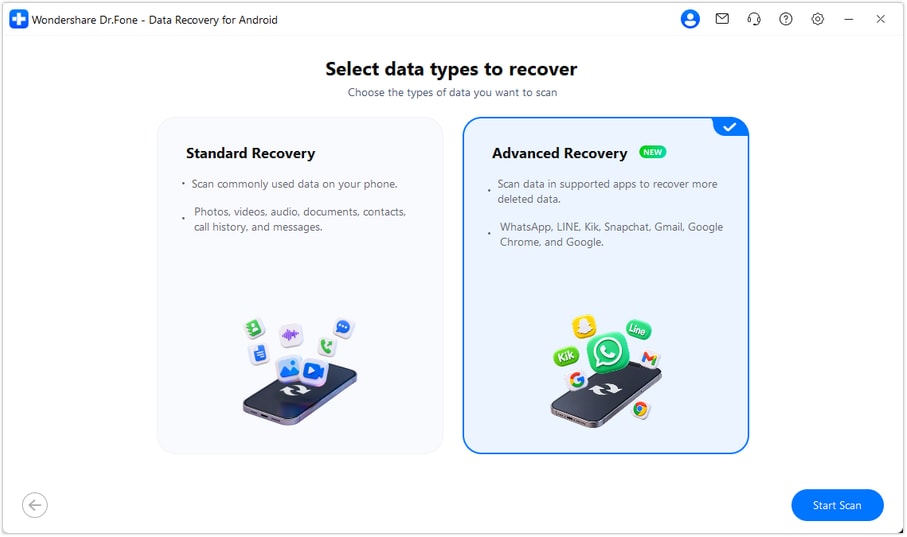
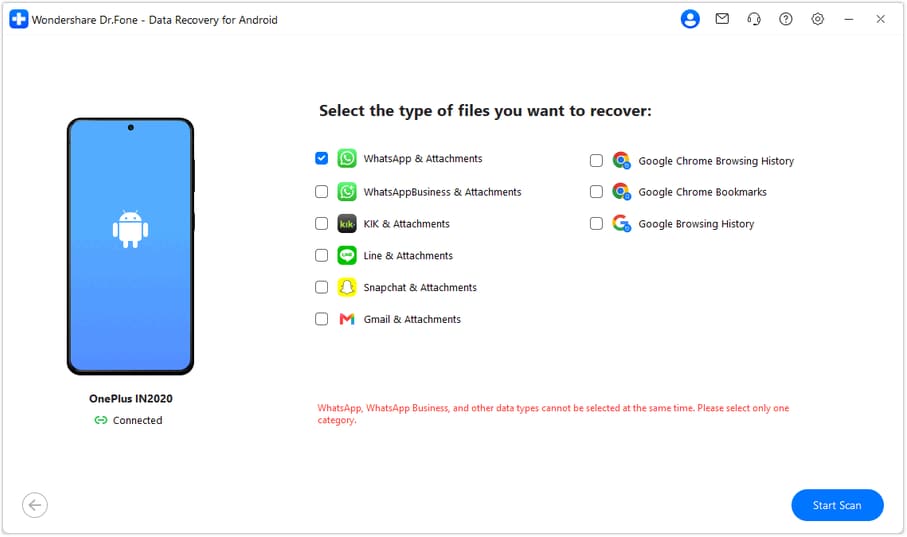
Step 2 Select the LINE app data
Choose LINE from the available categories and click Start Scan. This is the app-data route for the missing discussion and related attachment results, rather than a backup-restoration procedure.
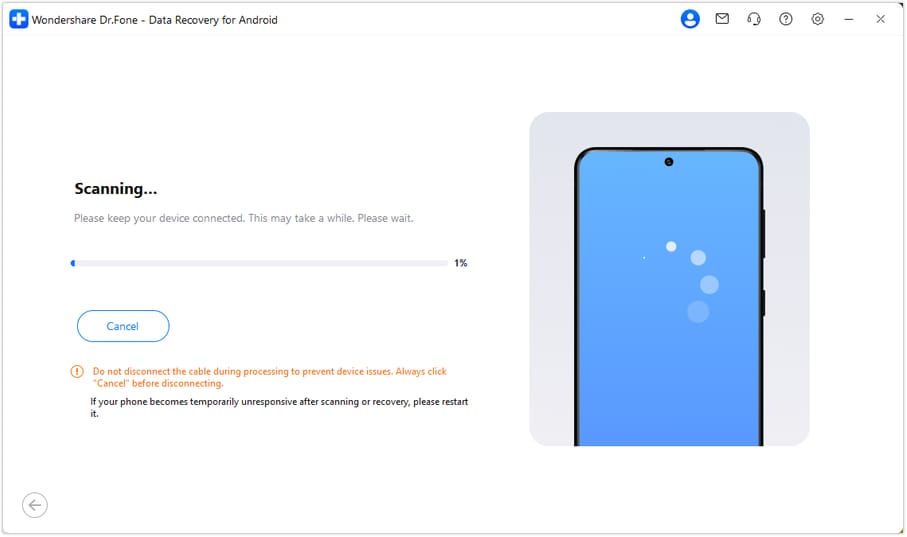
Step 3 Wait while the selected data is scanned
Keep the USB connection stable during scanning. To stop, click Cancel before disconnecting the phone. If the device becomes temporarily unresponsive after scanning or recovery, restart it as instructed on screen.
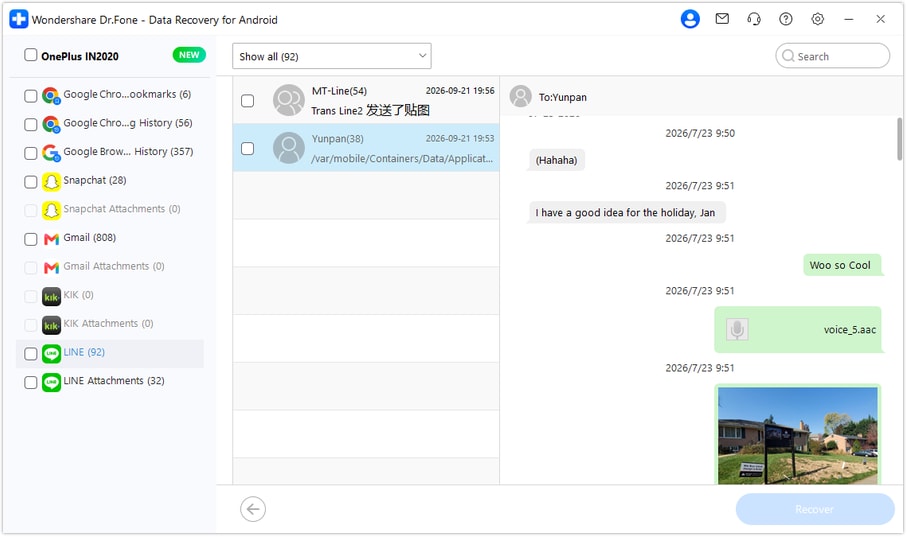
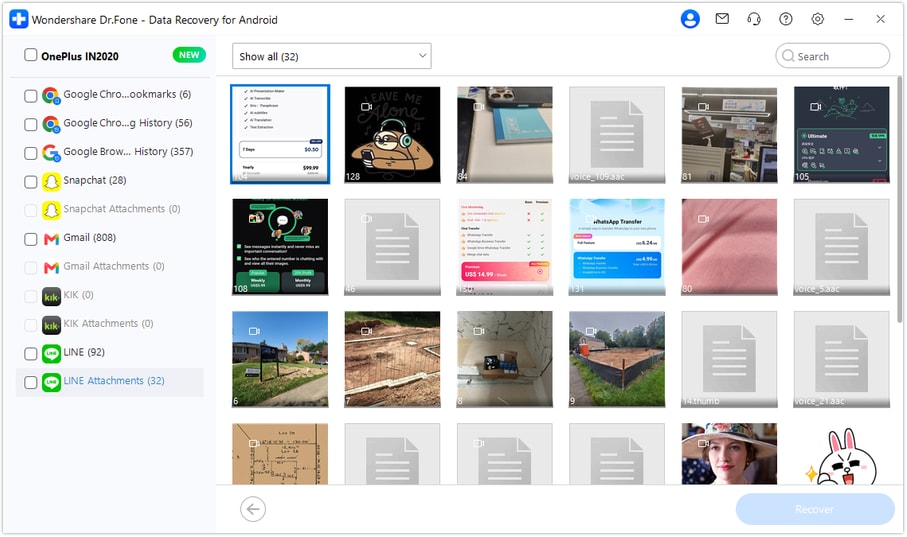
Step 4 Preview the parts correction and attachment results
Open LINE in the sidebar and read the available conversations, using search and filters where provided. Look for the full part code, changed quantity and any available response. Then select LINE Attachments to inspect the relevant images, videos and files separately. Choose the useful results; this view does not establish recovery of a dedicated Note or Album database.
Step 5 Recover selected LINE records to your PC
Click Recover, choose a computer folder through the save prompts and complete the process. Open the output to review the saved wording and usable files. The selected data remains a PC copy rather than being written into LINE on the phone.




Conclusion
A useful parts reference needs the right quantity as well as the right picture. Dr.Fone - Data Recovery (Android) helps you look for missing LINE messages, preview related diagrams and media, and save selected useful records to your PC. Download the Windows version, connect your supported Samsung Galaxy A53 5G and start a focused scan for the information your exchange needs.
FAQ
1. Can I recover deleted LINE messages on Samsung Galaxy A53 5G without a backup?
Dr.Fone - Data Recovery (Android) provides a Windows device-scan route for the supported model with the listed Kernel 5.10.237 condition. It does not depend on an older LINE backup. The usable outcome is the conversation and attachment data found by the scan and selected for PC saving.2. Does deleting media mean the whole LINE chat was deleted?
Not necessarily. LINE has controls for content categories and broader controls that include messages. Read the actual surviving chat to establish what is missing. Do not repeat a delete action to test its effect.3. Should I clear LINE's data again if the recovery result is incomplete?
No. Preserve the remaining local data and inspect the correct result view. LINE's own cleanup is not an undelete feature, and clearing app storage or reinstalling can remove local history. Use the actual product prompts or contact support with a specific error instead.4. Can LINE Attachments restore a deleted Album or Note?
This guide uses LINE Attachments to inspect attachment results found by scanning; it does not claim a dedicated deleted Album or Note recovery function. Check an existing accessible Album or Note separately if it contains a retained copy. An expired original or deleted board item is not guaranteed to be present.5. Why not make a new backup or use Premium Backup to undo cleanup?
A new backup cannot supply messages that were already absent. LINE's official recovery of a manually deleted chat requires suitable earlier Standard Backup data, and Standard Backup covers text rather than the complete media collection. Premium Backup is not a manual-deletion rollback. Neither is used as the working no-backup method here.
 Add Wondershare Dr.Fone as a preferred source on Google