Recover photos, messages, WhatsApp, and more — no backup
needed.


 100% Security Verified | No Subscription Required | No Malware

 :

 ChatGPT
 Perplexity
 Gemini
 Claude
 Grok
The shared exhibition folder has disappeared, and the LINE message explaining which catalog entry refers to a replica rather than a loaned original is deleted too. Losing both reference points makes it difficult to interpret the labels you still have. To recover deleted LINE messages on iQOO Neo11 without a backup, look for the actual distinction and the supporting index or object photographs.
Dr.Fone - Data Recovery (Android) provides a focused way to inspect available local LINE conversations, preview found photos, videos and files separately, and keep selected useful records on a Windows PC. If you created the index inside someone else's Google Drive folder, your file may still exist even though that folder is gone. Check that optional source if relevant, or go straight to the phone scan.
In this article
Before you start
Keep the exact Neo11 and Kernel condition
The confirmed record lists iQOO Neo11 with Kernel 6.6.89. No Android-version restriction is listed for this named model. Retain the Kernel condition and do not infer support for every Neo-series phone or firmware. Check the detected model and Kernel information and follow Dr.Fone's actual eligibility prompts.
Preserve the original phone data
Keep LINE installed and signed in on the phone that held the exchange. Do not clear storage, reinstall, reset, flash firmware or unlock the bootloader as recovery experiments. Prepare a Windows computer, USB data cable and private output folder. Follow the product's displayed access instructions rather than an unverified Root procedure.
Identify the source, not just its former folder
The optional Drive check applies to a file you own that you created in another person's folder. A file owned by that person is a different case; the query does not grant access or recreate a deleted folder. A cloud link is not itself a downloaded LINE attachment. Keep file ownership separate from the owner of the physical exhibit and the author of its description.
Use the no-backup scan for local LINE data
Standard Backup saves LINE text only and is for same-OS restoration from a suitable copy made before manual deletion. A Standard copy made afterwards or Premium Backup does not roll manually deleted history back. The Windows-only scan below saves selected discoverable results to PC, not back into LINE or Drive. Unavailable expired originals are not guaranteed.
Find your own retained file after another person's folder disappears
An optional Google Drive check for the specific ownership case in which you created the file inside someone else's folder. It locates an existing file, not deleted LINE messages.
Step 1 Search the account that actually owns the file
On your computer, open Google Drive with the existing account that created and owns the index. Enter is:unorganized owner:me in the search bar and run the search. Google's search help documents this case: when someone deletes their folder containing your file, your file is not deleted and is automatically moved to My Drive.
Step 2 Inspect matching files rather than recreating the folder
Open a relevant accessible result and check its actual contents. If you apply a Type or People search chip to narrow the results, remove it or use Clear filters if it wrongly excludes the file. Do not create a replacement folder, move the file or change sharing permissions simply to test where it went.
Step 3 Keep the retained index and missing instruction separate
Read the actual object code and description. Owning the digital index does not establish that you own the physical object or that its description is the final loan arrangement. A current entry may not contain the replica-versus-original correction that was only in LINE. Use the phone scan for that missing wording, whether or not the cloud file is located.
- The query is a native Drive retained-file lookup, not permanent-deletion recovery, an ownership transfer or access to another person's files.
- No Drive file is required for the LINE scan. A found cloud document is not automatically a local attachment, and the scan does not extract a remote file merely from its old URL.
Separate the missing folder, retained index and actual exhibit instruction
| What you find | Useful outcome | What remains separate |
|---|---|---|
| Your own retained file found by the unorganized-file query | Read the accessible index without recreating the former folder | A deleted folder or another person's owned file |
| No matching owned file | Recognize that this ownership-specific check did not locate the reference | Whether the missing LINE message is discoverable locally |
| An index entry or object photograph | Identify the actual code and visible reference | Physical ownership, loan status or replica identity inferred from a filename |
| A found LINE correction | Read the original visible distinction and qualification | Any missing earlier or later wording not found by the scan |
| Available LINE photos, videos or files | Keep usable supporting references with the selected exchange | A cloud link treated as a guaranteed downloaded original |
Common problems and fixes
A colleague owned the index, so owner:me returns no useful result
Do not interpret the empty ownership-specific search as proof that the file or LINE conversation was deleted. This method does not retrieve another person's owned file or bypass permissions. Use an already authorized accessible source if available and continue reviewing the phone's LINE results independently.
The recovered index still uses an ambiguous object label
Read available LINE conversations for the actual replica-versus-original correction and inspect supporting media separately. Digital-file ownership and a familiar object image cannot establish a loan agreement. Save useful records individually and leave the unresolved identification explicit if the wording is absent.
Advanced Recovery is not available on the connected Neo11
Use Windows and compare the detected configuration with iQOO Neo11, Kernel 6.6.89. Keep the product's actual access or compatibility message for Dr.Fone support. Do not alter firmware, reset the phone or borrow another model's conditions to force the scan.
How to use Dr.Fone - Data Recovery (Android)
Dr.Fone - Data Recovery (Android) helps you look for the instruction that a missing folder or a surviving index cannot supply. Its Windows-only Advanced Recovery mode scans supported local LINE data on iQOO Neo11, lets you read available conversations and inspect LINE Attachments separately, and saves selected results to PC. You can preserve the actual correction and useful object references without reorganizing Drive or requiring a LINE backup.
- Local LINE discovery independent of whether the cloud reference file can still be located.
- Separate conversation and attachment previews to assess the correction, object photos, clips and index files on their own merits.
- Selective PC recovery to keep the useful exchange and references rather than every unrelated record.
 Scan Android phones and tablets directly.
- Preview and recover only what you want.
- Supports WhatsApp, photos, videos, contacts, and more.
- Works with 6000+ Android devices.
Follow the official Advanced Recovery workflow
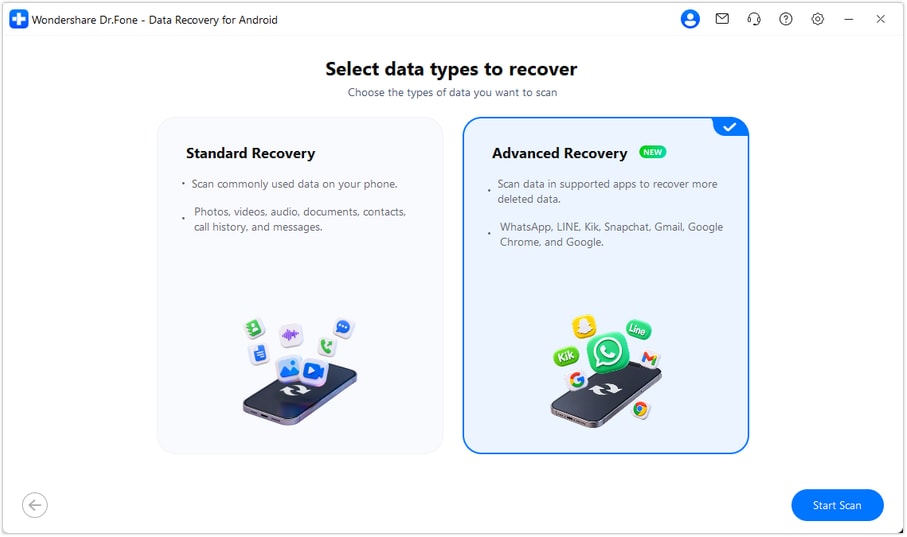
Step 1 Choose Advanced Recovery for the iQOO Neo11
Launch Dr.Fone on Windows and navigate to Toolbox > Data Recovery. Select Android > Recover Android Data, choose Advanced Recovery and click Start Scan. Connect your supported iQOO Neo11 by USB when prompted and follow the on-screen instructions until detected.
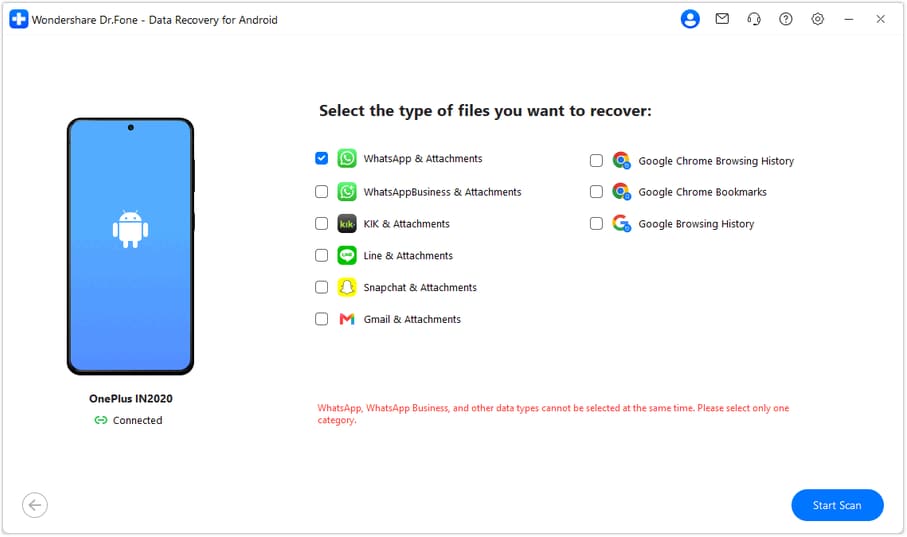
Step 2 Select LINE as the app data
Choose LINE from the supported categories and click Start Scan. This is a local LINE scan, not a Google Drive search. If you also need WhatsApp or WhatsApp Business, scan those categories separately from the other data types as the official guide requires.
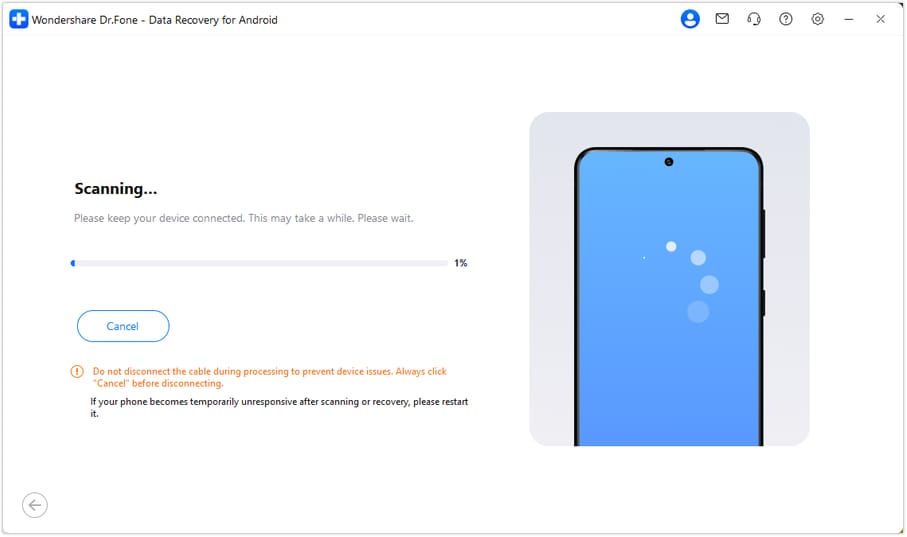
Step 3 Keep the device connected while scanning
Let Advanced Recovery scan with the USB connection intact. Click Cancel before disconnecting if you need to stop. If the phone is temporarily unresponsive after scanning or recovery, restart it as instructed on screen.
Step 4 Read the object correction and inspect the references
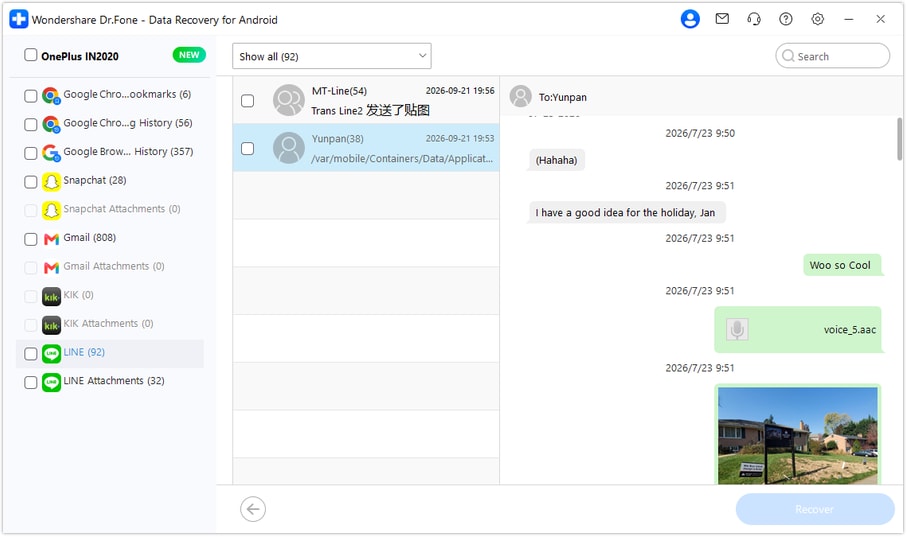
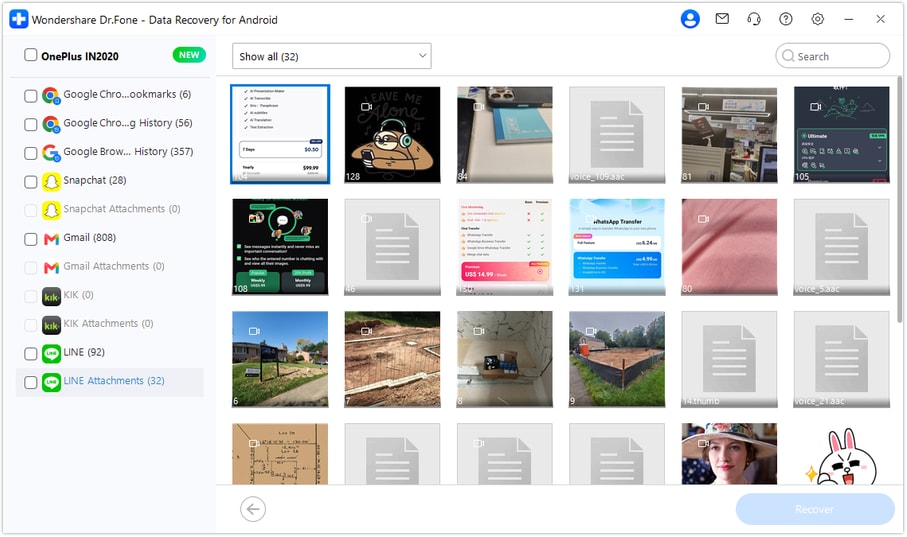
Choose LINE in the results sidebar and inspect available conversations for the object-code correction. Use search or filters where available and read the complete visible qualification. Open LINE Attachments separately to browse found photos, videos and files, then select useful wording and supporting content.
Step 5 Recover selected records to your computer
Click Recover and follow the prompts to choose a PC folder. Save and inspect the selected output there. These are separate computer copies of discoverable LINE records, not restored phone history or recovered remote Drive files.




Conclusion
A clear exhibit reference needs the actual explanation as well as an identifiable file. Dr.Fone - Data Recovery (Android) brings available LINE conversation reading, separate photo and file previews, and selective PC saving into one practical workflow. Download it for Windows, connect your supported iQOO Neo11 and start looking for the correction and references you want to keep.
FAQ
1. Can I recover deleted LINE messages on iQOO Neo11 without a backup?
Dr.Fone - Data Recovery (Android) offers a local scan route for the supported iQOO Neo11 entry with Kernel 6.6.89 and no Android-version restriction listed for this model. Use Advanced Recovery on Windows, select LINE, preview available results and save selected discoverable records to PC without an earlier LINE backup.2. Does a missing shared folder mean my own Drive file was deleted?
Not necessarily. Google documents that a file you created in someone else's folder remains yours and moves to My Drive when that folder is deleted. The is:unorganized owner:me search applies to that retained-file case, not permanent deletion or another person's owned documents.3. Can a LINE scan retrieve the cloud document behind an old URL?
This guide does not claim remote Drive extraction. A cloud link and actual local LINE attachment data are different sources. Inspect LINE Attachments for the photos, videos and files the phone scan actually finds; an inaccessible cloud target is not guaranteed.4. Will the selected results return to LINE or recreate the folder?
No. This Windows-only workflow saves selected discoverable data to a PC folder. It does not import LINE messages, change file ownership, recreate a Drive folder or certify the status of an exhibit.
 Add Wondershare Dr.Fone as a preferred source on Google