 Recover photos, messages, WhatsApp, and more — no backup
needed.


 100% Security Verified | No Subscription Required | No Malware


 :

 ChatGPT
 Perplexity
 Gemini
 Claude
 Grok
You saved a contributor's recipe PDF to Drive, then lost the Gmail message explaining the corrected quantities for a community cookbook. On your Vivo X200, X200 Pro or X200 Ultra, a missing file and a missing explanation can look like one problem even though they have different recovery paths.
Dr.Fone - Data Recovery (Android) can help you look for available local Gmail records, read the correction that is actually previewable and save selected records and found attachments to your PC. First check whether the previously saved PDF is still in Drive or its Trash. Recovering that independent file may solve the document gap while leaving only the contributor's email to find.
In this article
Before you start
Match your X200 model to its own Kernel
The support table below covers exactly Vivo X200, X200 Pro and X200 Ultra. No Android-version restriction is listed for each named model, but their Kernel entries differ. X200 Pro does not inherit the base X200's Kernel; X200 Ultra retains both of its supplied entries. These are recovery support conditions, not instructions to install a particular firmware.
Preserve local data and prepare a Windows destination
Use a Windows PC, stable USB data cable and a folder for the selected output. Advanced Recovery is Windows-only and saves discoverable selected data to PC, not back into Gmail or a cloud folder. Do not clear Gmail storage, remove the account, reset the phone or follow generic Root, unlock or flashing instructions to attempt recovery.
Track the two deletion clocks separately
Gmail Trash normally keeps a deleted message for up to 30 days from deletion, unless permanently deleted earlier; discarded drafts cannot be recovered from Trash. Drive files moved to Trash are deleted forever after 30 days, and Empty trash ends that retained-file route earlier. A local scan does not reverse Google server-side permanent deletion. The email's receipt date and the PDF's revision date are not either Trash clock.
Recover a previously saved attachment from Drive, not from Gmail
You actually saved the attachment to your own Drive account before losing it; the filename merely appearing in the email is not enough.
Step 1 Identify the independent Drive copy
Use the Drive account where you previously saved the PDF and inspect any accessible candidate's contents. Check the recipe name, quantities and revision, not just a familiar filename. This route concerns an existing saved file; an email containing a remote document link does not establish that you saved a separate copy.
Step 2 Open Drive Trash and restore a retained file
In the Google Drive app for Android, open Menu > Trash. Next to the file you want to recover, tap More and choose Restore. Use this only for an eligible file still present in Trash. Do not choose Delete forever or Empty trash while looking for something you need.
Step 3 Read the restored PDF and list the remaining gap
Open the restored file and check whether it contains the corrected ingredient amounts or only the earlier recipe. Restoring a saved file in Drive does not recreate the contributor's Gmail message, comments that existed only in that email, or an absent later attachment. Keep the actual missing correction as the target for Gmail search and local preview.
- Drive recovery here is an action in Google's app, not a feature of the Dr.Fone phone scan. Do not import a cloud file or Drive account into the Advanced Recovery workflow.
- A sharing or access problem with someone else's document is different from your own saved file being in Trash. Do not use this route to bypass the owner's permissions.
Look for the contributor's retained email before scanning
The independent PDF is present, but the quantities or editorial explanation are still missing.
Step 1 Search Gmail broadly by contributor and recipe
Confirm the receiving Gmail account and search in:anywhere with the contributor or recipe name. Drop a guessed filename if it narrows the search too far: the correction may have been plain email text without an attachment. A message found in archived mail or another retained location can be read now; that is not deleted-data recovery.
Step 2 Move an eligible Gmail message out of Trash
Open Gmail Menu > Trash, touch and hold the relevant message, then use More > Move to and choose the destination. Read the actual correction and compare it with the saved PDF. If the email is absent, use the Windows scan to look for available phone-local Gmail data.
- Corrected quantities and permission to publish are separate facts. A recipe file alone does not establish the contributor's missing approval.
Vivo X200 Gmail recovery: exact model support conditions
| Approved model | Android condition | Listed Kernel | How to use the row |
|---|---|---|---|
| Vivo X200 | No Android-version restriction is listed for this named model. | 6.6.89 | Use this base-model entry rather than the Pro entry. |
| Vivo X200 Pro | No Android-version restriction is listed for this named model. | 6.6.57 | Retain the Pro-specific Kernel when checking the connected phone. |
| Vivo X200 Ultra | No Android-version restriction is listed for this named model. | 6.6.89 / 6.6.127 | Keep both supplied Kernel entries without inventing firmware pairings. |
Common problems and fixes
The file returns in Drive, but the contributor's explanation is still missing
Treat the Drive result as a recovered independent document. Search Gmail without requiring an attachment and inspect readable local message previews for the quantities and explanation. The saved file need not contain everything that was written in the accompanying email.
A Gmail result looks right, but the PDF is not in Gmail Attachments
Read whatever actual correction text is available, then check the independent Drive copy separately. If the scan finds attachment results, inspect their real contents; a title or a Drive URL is not the PDF bytes. Do not treat the absence of an attachment as proof that the email text is also unavailable.
The file is no longer in Drive Trash
Do not repeat a Restore instruction on an absent file or promise that a phone scan can recover it from Google's servers. Check any other independently saved copy you already have, or ask the contributor for the required document. Continue the local Gmail scan for the separate email target.
Advanced Recovery is unavailable on an X200 variant
Use Windows, confirm which of the three named models is connected and retain its own Kernel condition from the table. Follow the product notice or contact Dr.Fone support with those details instead of changing firmware.
How to use Dr.Fone - Data Recovery (Android)
Dr.Fone - Data Recovery (Android) is a practical next step when you need the email explanation as well as a usable recipe document. Its Windows-only Advanced Recovery workflow scans available local Gmail data on a supported Vivo X200, X200 Pro or X200 Ultra. Read the previewable message content, inspect found Gmail Attachments independently and save only the relevant results to your PC for side-by-side reference.
- Gmail entry names, titles and dates help locate likely contributor correspondence before reading the available content.
- Content inspection distinguishes a useful quantities correction from an earlier recipe announcement with a similar subject.
- Conditional attachment review and selective PC saving keep the actual useful text and files together without claiming cloud restoration.
 Scan Android phones and tablets directly.
- Preview and recover only what you want.
- Supports WhatsApp, photos, videos, contacts, and more.
- Works with 6000+ Android devices.

Follow the official Advanced Recovery workflow
Step 1 Connect your supported X200 model to Advanced Recovery
On Windows, launch Dr.Fone and open Toolbox > Data Recovery. Choose Android > Recover Android Data, select Advanced Recovery and click Start Scan. Connect your supported X200, X200 Pro or X200 Ultra by USB when prompted and follow the on-screen device-detection instructions.

Step 2 Choose Gmail app data
Select Gmail from the available categories and click Start Scan. WhatsApp and WhatsApp Business require separate selection from the other categories under the official guide; neither is needed to look for this Gmail correction.

Step 3 Allow the local scan to finish
Keep the phone connected while Advanced Recovery scans. If stopping is necessary, click Cancel before removing the USB cable. Follow the displayed restart instruction if the phone becomes temporarily unresponsive after scanning or recovery.

Step 4 Read the correction and inspect found attachments
Choose Gmail in the results sidebar and locate likely records by name, title and date. Use search or filters where available and read the actual content preview for the corrected amounts. If Gmail Attachments has results, inspect the actual PDF or other file separately before selecting it. Do not infer recipe contents from a filename or remote link.
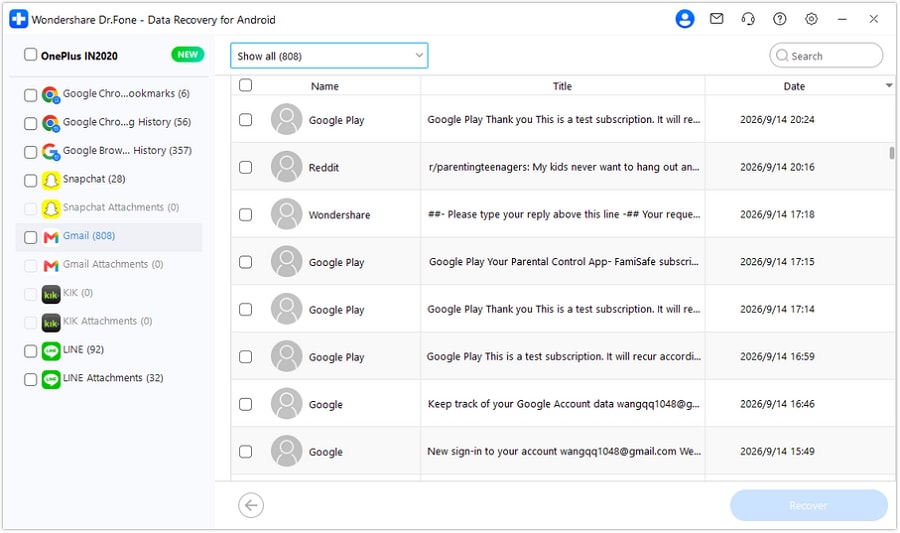
Step 5 Recover the selected useful records to PC
Click Recover, choose a folder on your Windows computer and complete the save prompts. Check the saved output for readable correction text and usable files. This creates selected PC copies; it does not repopulate Gmail Inbox or restore files into Google Drive.




Conclusion
A saved Drive PDF and its explanatory Gmail message deserve separate checks, so you can recover what is useful without overlooking the correction itself. Dr.Fone - Data Recovery (Android) helps you preview available local Gmail content, inspect found attachments and preserve selected results on your PC. Download the Windows version, connect your supported Vivo X200, X200 Pro or X200 Ultra and begin the guided Gmail scan.
FAQ
1. Can I recover deleted Gmail emails and attachments on Vivo X200 Pro?
For a supported X200 Pro with the supplied Kernel 6.6.57 condition, Dr.Fone - Data Recovery (Android) offers Windows Advanced Recovery to inspect available local Gmail records and found attachments and save selected results to PC. No Android-version restriction is listed for this named model. What is recoverable depends on the scan's actual results.2. Does restoring a PDF from Drive Trash also restore the Gmail email?
No. It restores the retained independent Drive file, not its explanatory email. Search the receiving Gmail account and eligible Gmail Trash separately. Both Trash windows concern their own deletion events; restoring one item does not extend the other's retention.3. Does the local recovery workflow need me to import Google Drive?
No. This workflow scans the connected phone's available Gmail data and saves selected results to a Windows PC. The Drive Trash check is a separate Google app action for a file you previously saved, not cloud import or remote-file extraction by Dr.Fone.4. What if the email has only a recipe filename or document link?
A filename or remote link can help you identify the source, but it does not supply the actual document contents. Read the available message text and inspect real found files under Gmail Attachments when present. Access a remote file through its legitimate account and permissions separately.5. Can Gmail Trash recover a draft or an email deleted permanently before 30 days?
No. Discarded drafts cannot be recovered from Gmail Trash, and permanent deletion ends Trash recovery even before the normal up-to-30-day period. A local scan cannot reverse Google's server-side permanent deletion or write recovered messages back into Inbox.
 Add Wondershare Dr.Fone as a preferred source on Google





