Recover photos, messages, WhatsApp, and more — no backup
needed.


 100% Security Verified | No Subscription Required | No Malware

 :

 ChatGPT
 Perplexity
 Gemini
 Claude
 Grok
The private commission brief no longer appears in ordinary file search, and the LINE exchange explaining a delivery-format exception has disappeared too. If you once moved the downloaded brief into Safe folder, its absence from search may be intentional protection rather than deletion. Even finding that file will not supply a later exception that existed only in the chat.
For supported users who need to recover deleted LINE messages on Google Pixel 8a without a backup, Dr.Fone - Data Recovery (Android) provides a focused next step. Read available conversation records, preview found photos, videos and files separately, and save the relevant selection to a PC so you can keep a useful private reference without exporting unrelated conversations.
In this article
Before you start
Use the exact Pixel 8a support conditions
The supplied Google Pixel 8a record lists Android 14 and Kernel 6.1.157. Do not infer this phone's eligibility from Pixel 8 Pro or a newer Pixel a model. Advanced Recovery is Windows-only and saves selected discoverable LINE results to a PC, not into LINE or a protected file container.
Preserve the local sources and their privacy
Prepare a Windows computer, USB data cable and a private output folder. Keep LINE installed and avoid clearing storage or cache, uninstalling apps, resetting the phone or using cleanup tools. Do not reset Safe folder, move encrypted storage between phones or follow bootloader-unlock, flashing or Root tutorials to reach missing data. Use the product's displayed instructions for your supported configuration.
Distinguish a protected file from a chat backup
The optional Safe folder check is only for a separate file you deliberately saved and moved there, using your own existing PIN or pattern. It is not a container for the installed LINE app or an automatic archive of conversations. Standard Backup is text-only and would need to predate deletion; Premium Backup does not roll manually deleted chats back. The main LINE scan below requires neither.
Check your existing Safe folder without changing its protection
Use this retained-file check only if you remember moving your own downloaded brief into Files by Google's Safe folder. Skip it if you never used that feature or cannot access it normally.
Step 1 Open the existing folder through Files
On Android, open Files by Google, scroll to Collections and tap Safe folder. This is the app's documented route for checking protected files. Do not create a new folder or change its lock to test whether an old LINE attachment appears.
Step 2 Unlock only with your own existing credential
If PIN is set, enter your PIN and tap Next. If a pattern is set, draw that pattern. Google states that a forgotten PIN or pattern prevents access. Do not treat the Windows LINE scan as a way to bypass that lock or recover encrypted Safe folder contents.
Step 3 Identify the protected reference separately from the missing chat
Check the files available inside the unlocked folder and identify the actual brief if it is there. Google excludes Safe folder files from ordinary search results and categories, so a failed normal search did not establish deletion. Compare only information the accessible file really contains with the delivery-format discussion you need; leave the protection unchanged.
- Safe folder has its own encryption and access limits: third-party apps cannot open its files, and sharing, Drive backup and screenshots are unavailable there. This check does not ask you to move files out or make an insecure copy.
- A missing or corrupt encrypted file is not the same problem as a deleted local LINE exchange. The recovery workflow below scans supported LINE data and does not promise Safe folder decryption, forgotten-lock recovery or reconstruction of an unavailable protected brief.
Choose the useful result without confusing protected files and chat text
| What is available | What you gain | What remains separate |
|---|---|---|
| Your brief is in the existing unlocked Safe folder | An authorized retained reference inside its protected location | The later delivery-format exception that may have existed only in LINE |
| The file is missing from ordinary search | A reason to check a protection choice you actually made | Not proof of deletion, nor permission to reset or bypass the folder |
| A LINE scan finds the exception discussion | Actual available wording saved selectively to PC | Whether a separate protected file can be accessed |
| LINE Attachments finds a usable local file or image | An available reference copy selected for PC saving | Not an extraction of encrypted Safe folder contents or proof it is the final brief |
| Only one side of the proposed exception is found | A partial record that can be preserved accurately | Acceptance or a completed delivery cannot be invented from the proposal |
Common problems and fixes
The brief still does not appear in ordinary file categories
Files by Google deliberately excludes Safe folder content from normal search and categories. If you know you moved the brief there and can unlock normally, inspect that existing source. Do not clear storage or change protection settings to make it searchable.
You cannot remember the Safe folder PIN or pattern
Stop that optional branch. Google says forgotten credentials prevent access, and the LINE scan is not a credential-recovery or decryption tool. Keep the protected source unchanged and focus the supported scan on the separate missing LINE wording and any other actual local attachments.
The scan finds an earlier brief but not the later format exception
Keep the earlier brief labeled as an earlier reference. Review readable LINE results for the actual requested exception and reply. If only a proposal is available, preserve it as a proposal rather than silently presenting it as the final agreement.
How to use Dr.Fone - Data Recovery (Android)
Dr.Fone - Data Recovery (Android) helps you look for the missing private conversation on a supported Pixel 8a while keeping the recovery target clear. Its Windows-only Advanced Recovery mode scans LINE app data, lets you read available conversations and inspect LINE Attachments separately, and saves selected found records to a PC. Focus on the actual delivery-format wording and useful local reference files; protected-folder access is a separate matter.
- Conversation previews help locate the precise exception and any response rather than relying on an earlier brief.
- Photo, video and file previews help you choose actual available local references without assuming every attachment survived.
- Selective PC saving lets you keep the relevant exchange and supporting files without collecting unrelated private conversations.
 Scan Android phones and tablets directly.
- Preview and recover only what you want.
- Supports WhatsApp, photos, videos, contacts, and more.
- Works with 6000+ Android devices.
Follow the official Advanced Recovery workflow
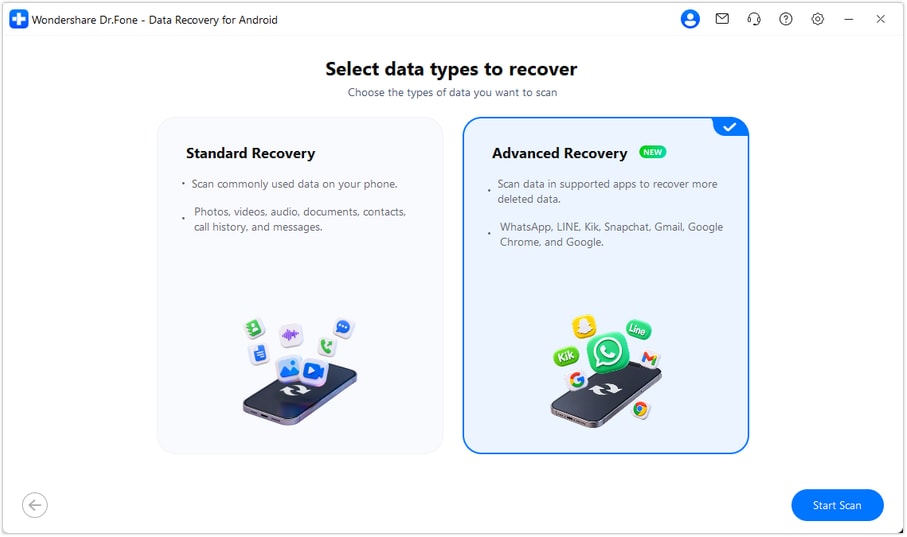
Step 1 Open Advanced Recovery and connect Pixel 8a
Launch Dr.Fone on Windows and go to Toolbox > Data Recovery. Select Android > Recover Android Data, choose Advanced Recovery and click Start Scan. Connect the supported Pixel 8a by USB when prompted and follow the on-screen instructions until it is detected.
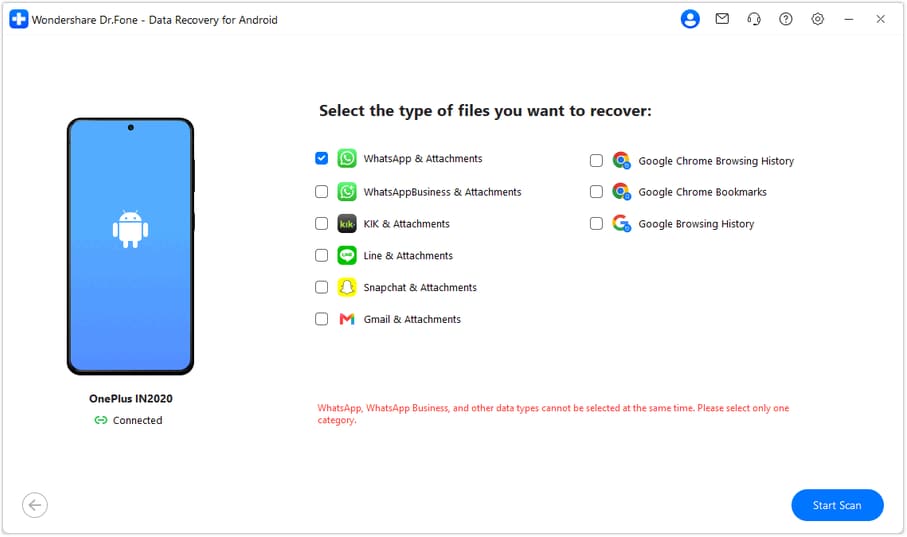
Step 2 Select LINE as the app-data target
Choose LINE and click Start Scan. WhatsApp and WhatsApp Business must each be scanned separately from the other categories under the official guide. That rule does not require a separate-only LINE selection from other non-WhatsApp categories.
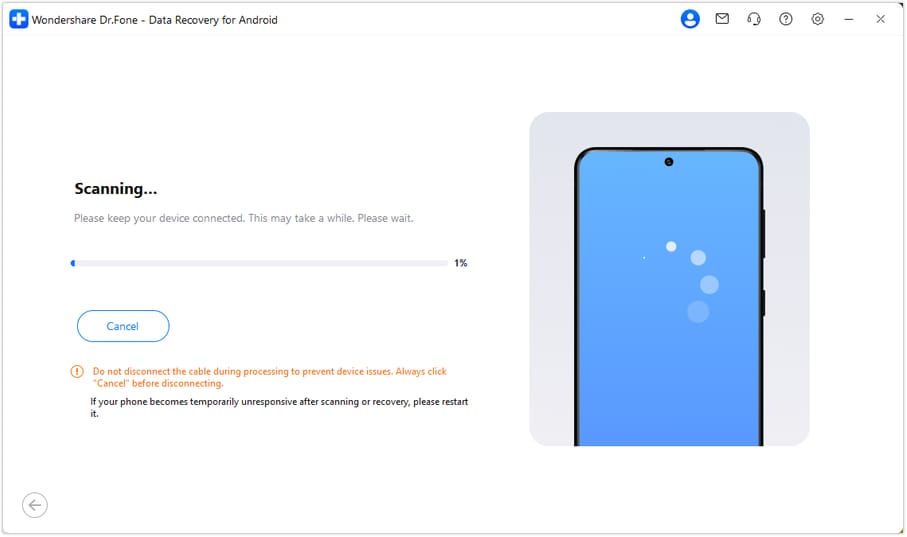
Step 3 Keep the phone connected while scanning
Allow Advanced Recovery to scan with the USB cable connected. If you need to stop, click Cancel before disconnecting. If the device is temporarily unresponsive after scanning or recovery, restart it as instructed on the product screen.
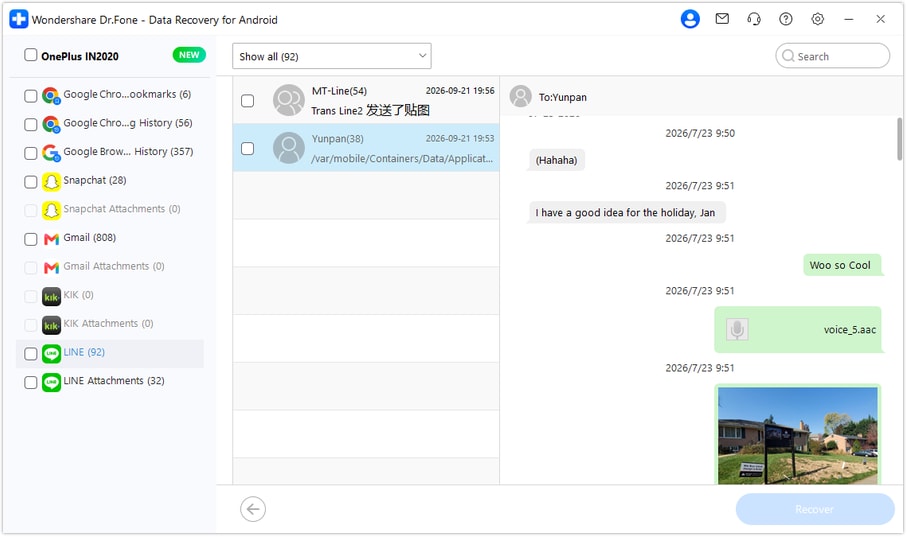
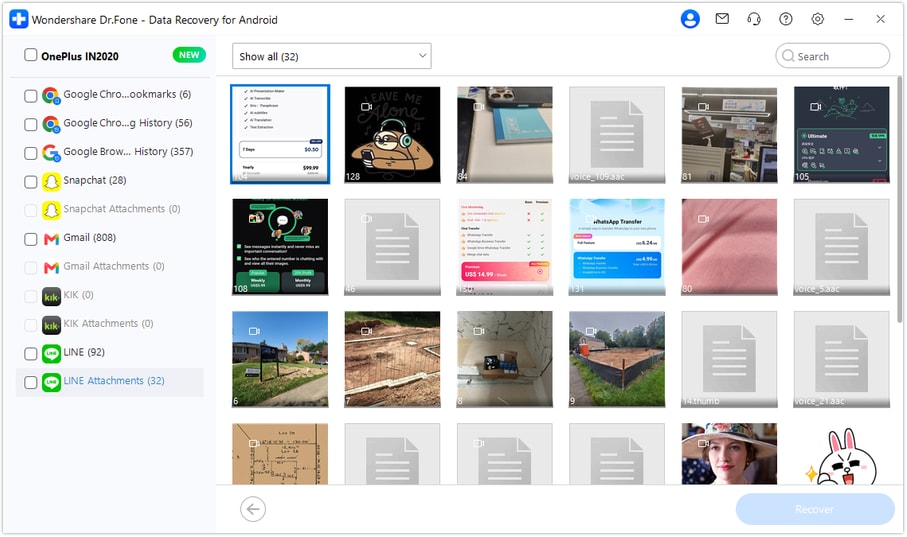
Step 4 Review the private wording and available attachments
Select LINE in the sidebar and read the available conversations, using search or filters where available. Look for the precise exception and response. Select LINE Attachments separately to inspect found photos, videos and files, then select only the useful records. Do not interpret these results as access to encrypted Safe folder files.
Step 5 Recover selected results to your private PC folder
Click Recover and follow the prompts to choose a folder on your Windows PC. Save the selected available records there for your own review. The workflow does not insert them into LINE, decrypt a protected folder or change the commission brief.




Conclusion
Dr.Fone - Data Recovery (Android) gives supported Google Pixel 8a users a focused way to look for missing LINE wording, inspect available supporting media and files, and preserve a private selection on a PC. Download the Windows version, connect your compatible Pixel and start the guided LINE scan to keep the useful conversation and reference material within reach.
FAQ
1. Can I recover deleted LINE messages on Google Pixel 8a without a backup?
Dr.Fone - Data Recovery (Android) provides a local device-scan route for supported configurations. Use Advanced Recovery on Windows, preview available LINE conversations and LINE Attachments, and save selected found records to a PC. It does not require a prior LINE chat backup or guarantee every missing message.2. Why does a file in Safe folder disappear from normal Files search?
Files by Google intentionally leaves Safe folder files out of ordinary search results and categories. If you deliberately moved your own downloaded file there, open Collections > Safe folder and use your existing PIN or pattern to check that retained source. Search absence alone is not deletion.3. Can the LINE scan bypass a forgotten Safe folder PIN?
No such capability is documented. Google says you cannot access Safe folder files if you forget the PIN or pattern, and third-party apps cannot open those files. Dr.Fone's LINE workflow should not be treated as Safe folder decryption, lock recovery or an extraction of corrupt encrypted files.4. Does finding the private brief recover the deleted delivery exception?
Only if the file itself actually contains that wording. A separately retained brief is not an automatic copy of the LINE conversation. Read the actual found message and response where available, and keep a proposed exception distinct from an accepted final arrangement.5. Where are selected LINE results saved, and which Pixel 8a conditions apply?
They are saved to the folder you choose on your Windows PC, not imported into LINE or Safe folder. The supplied exact-model Pixel 8a record lists Android 14 and Kernel 6.1.157. Follow the product's actual device-detection and access prompts for that configuration.
 Add Wondershare Dr.Fone as a preferred source on Google