 Recover photos, messages, WhatsApp, and more — no backup
needed.


 100% Security Verified | No Subscription Required | No Malware


 :

 ChatGPT
 Perplexity
 Gemini
 Claude
 Grok
A wildlife survey email has vanished just when you need the observation sheet and video evidence for the report. You remember a large clip, but cannot tell whether it was attached to the email or shared from Drive. To recover deleted Gmail emails and attachments on your Samsung Galaxy A53 5G, separate those sources before assuming the missing clip must be inside an attachment scan.
Dr.Fone - Data Recovery (Android) helps you look for available local Gmail records, inspect what each candidate actually contains and save selected found attachments to a Windows PC. A useful recovery may be the observation sheet, the email explaining the survey, a locally found file, or a reference that helps you request the right footage.
In this article
Before you start
Check the Galaxy A53 5G support condition
The supplied record lists Samsung Galaxy A53 5G with Kernel 5.10.237; no Android-version restriction is listed for this model. Check the phone's model and Kernel information before using the route. Do not substitute another Galaxy A model's condition or change firmware to match it. Follow the product's access instructions without inventing a Root or bootloader-unlock procedure.
Protect existing Gmail data and prepare Windows
Keep Gmail and the account in place; do not clear app storage, uninstall, reset the phone or remove the account while preserving local records. Prepare a Windows PC, USB data cable and destination folder. Advanced Recovery is Windows-only and saves selected discoverable data to the PC, not back into Inbox. It does not rebuild Google server mail or guarantee all historical messages, full headers or a particular export format.
Identify both the email and the actual files
Note the survey site, sender, approximate email period and any filename you remember. A Drive link and an email attachment have different storage sources, even when both were accessed from Gmail. Signing into the mailbox is not evidence that the video was stored on this phone. For a genuinely deleted email, Trash may retain it for up to 30 days from deletion unless permanently deleted earlier; discarded drafts cannot be restored from Trash.
Check whether the large survey clip was sent as a Drive link
The email included large footage, while an attachment-only search finds only a small observation sheet or no result.
Step 1 Use the correct size-limit distinction
For personal Gmail accounts, the attachment sending limit is 25 MB in total. Google's current help says that when the total attachment size exceeds the applicable limit, Gmail removes the attachment and adds a Google Drive link. Work and school account limits are set by the administrator, so do not apply the personal limit universally. Size is a clue; inspect the actual email to determine how the material was sent.
Step 2 Search for a Drive reference as well as an attachment
In the correct Gmail account while online, try in:anywhere has:drive followed by a distinctive survey term. Separately, use in:anywhere filename:csv or the known filename for a possible observation-sheet attachment. Then remove the file restriction and search the survey name broadly. Standard searches exclude Spam and Trash; in:anywhere includes them.
Step 3 Open the retained source you actually find
If a legitimate retained email contains an attached sheet, check that file. If it contains a Drive link, use your authorized access to check the remotely stored footage. If access is unavailable, contact the owner for access or a replacement. A phone-local Gmail scan is not a way to bypass Drive permissions or retrieve a remote file solely from its link.
Step 4 Retrieve a surviving deleted email from Trash
On Android, open Gmail Menu > Trash, select the matching email and tap More > Move to, then choose a destination. Inspect the moved email's actual contents rather than assuming it includes the video file. An archived or differently labelled message is retained mail, not a deleted email.
- Gmail filename and has:drive syntax is for mailbox search; use only the search and filters actually offered in the Dr.Fone result view.
- Offline searching only covers mail already synced to the phone. For an empty search, check the account and network, refresh Gmail and verify Sync Gmail without clearing storage.
Which survey results can you put to use?
| Material available | Useful review | Next practical step |
|---|---|---|
| Email text describing the survey | The site, observation context and references actually readable | Save the relevant correspondence for the report's source notes. |
| A readable observation-sheet file | The actual rows and which survey they belong to | Keep a copy and compare it with your existing field notes. |
| An actual locally found video file | Whether the saved clip opens and shows the material you need | Retain the useful clip and note any missing coverage separately. |
| Only a Drive reference or filename | Which remote item or original file to request | Use authorized access or ask the owner; do not treat the reference as the video itself. |
Common problems and fixes
The attachment search finds a sheet but not the large clip
Remove the attachment-only restriction and check for a Drive reference in the actual email. The applicable sending-size limit may have changed how the clip was shared. Keep the useful sheet while checking the footage's actual source instead of assuming both must appear in Gmail Attachments.
The Gmail message is retained, but a legitimate attachment still will not download
Check the connection and whether the same authorized attachment opens in Gmail on a computer. Google notes that an administrator or internet provider may block the attachment-hosting domain; report the actual error to them if appropriate. Do not disable security protection or clear Gmail storage to test access.
A saved clip does not open or a sheet has missing content
Check the actual saved output before using it in the report. Preserve any usable records and ask the original sender for the missing material. This recovery workflow does not promise to repair a damaged video, complete absent spreadsheet rows or derive observations from missing footage.
How to use Dr.Fone - Data Recovery (Android)
Dr.Fone - Data Recovery (Android) gives supported Galaxy A53 5G users a focused way to recover useful local Gmail material for a survey report. Its Windows-only Advanced Recovery workflow lets you inspect candidate email records, review attachment data when found and save selected results to a PC. You can prioritize the observation sheet and actual available files while retaining useful email context for locating anything still held by the sender.
- Names, titles and dates help you locate survey correspondence among unrelated mail.
- Email-content review and separate found attachment results help distinguish a useful local file from a reference to a remote item.
- Selective PC saving keeps the available survey records together so you can open the output and assess what is ready to use.
 Scan Android phones and tablets directly.
- Preview and recover only what you want.
- Supports WhatsApp, photos, videos, contacts, and more.
- Works with 6000+ Android devices.

Follow the official Advanced Recovery workflow
Step 1 Start Advanced Recovery and connect the A53 5G
Launch Dr.Fone on Windows and open Toolbox > Data Recovery. Choose Android > Recover Android Data, select Advanced Recovery and click Start Scan. Connect the Galaxy A53 5G by USB when requested and follow the on-screen instructions until the phone is detected.

Step 2 Select Gmail for the scan
Choose Gmail from the available app-data categories and click Start Scan. This scan targets data on the connected phone; it is not a download of everything linked from the mailbox.

Step 3 Keep the device connected throughout scanning
Wait while Advanced Recovery scans with a stable USB connection. If you need to stop, click Cancel before disconnecting. Follow the on-screen restart instructions if the phone becomes temporarily unresponsive after scanning or recovery.

Step 4 Preview survey emails and any actual attachment results
Open Gmail in the sidebar and review available entries by name, title and date. Use search or filters where available, then inspect the displayed survey content. If attachment data is found, open Gmail Attachments separately and examine the actual available files rather than treating a filename or Drive reference as a recovered file. Select the useful email records and attachments.
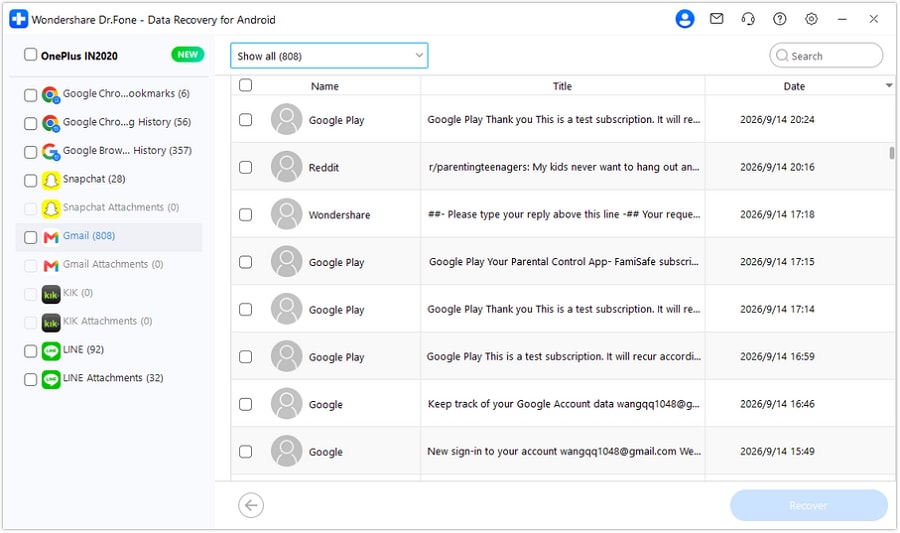
Step 5 Recover the selected survey material to the PC
Click Recover, choose a computer folder and follow the save prompts. Open the saved output to check which records and files are usable for your report. The selected data is saved to the PC, not imported into Gmail on the A53 5G.




Conclusion
A useful survey recovery separates readable observations, actual footage and references to material held elsewhere. Dr.Fone - Data Recovery (Android) helps you scan local Gmail data, preview the available records and files, and save a focused selection to your PC. Download Dr.Fone for Windows, connect your compatible Samsung Galaxy A53 5G and start retrieving the available material that supports your report.
FAQ
1. Can I recover deleted Gmail emails and attachments on Samsung Galaxy A53 5G?
Look for retained messages and Trash copies first. Dr.Fone - Data Recovery (Android) provides a Windows-only route to scan discoverable local Gmail entries and attachment data, preview what was found and save selected items to PC.2. Does Gmail always attach a video directly to an email?
No. Google's current Android help says that exceeding the applicable total attachment sending limit adds a Google Drive link instead. Personal Gmail's limit is 25 MB; work and school limits depend on the administrator. Check the actual message rather than inferring the storage source from the subject or remembered size.3. Can Gmail Attachments recover a Drive video from its link?
A Drive reference is not the remote video itself. This local Gmail workflow does not retrieve the remotely stored file merely because its link appears, or bypass the owner's access settings. Check the actual attachment data found and use authorized Drive access separately.4. Does finding the observation sheet mean the whole survey delivery is recovered?
No. Check the actual sheet and each needed file independently. The sheet may be useful even if the footage is missing; a video filename, thumbnail or message reference is not a usable video file.5. Which A53 5G support condition and destination apply?
The supplied record lists Samsung Galaxy A53 5G with Kernel 5.10.237 and no Android-version restriction for this model. Advanced Recovery runs on Windows and saves selected results to a PC folder, not back into Inbox or Google's cloud mailbox.
 Add Wondershare Dr.Fone as a preferred source on Google





