 Recover photos, messages, WhatsApp, and more — no backup
needed.


 100% Security Verified | No Subscription Required | No Malware


 :

 ChatGPT
 Perplexity
 Gemini
 Claude
 Grok
You saved a newsletter for an embroidery chart, but the message is missing from Gmail on your POCO X6 Pro just when you want to use it. Or the email still opens, yet the diagram area is blank and the printable file cannot be found. Those situations look similar on a small screen, but they call for different checks: locate the email, inspect image display, and find the actual chart file.
Dr.Fone - Data Recovery (Android) adds a focused local recovery option when the email or attachment really is gone. On a supported connected phone, you can preview the Gmail records and attachment data found by the scan and save selected results to a PC. This guide helps you recover deleted Gmail emails on POCO X6 Pro without confusing a picture reference in an email with the usable diagram you need.
In this article
Before you start
Keep the POCO X6 Pro's own Kernel conditions
No Android-version restriction is listed for POCO X6 Pro in the confirmed support entry. The supplied Kernels are 6.1.115 / 6.1.138. Retain both listed values as the model's conditions; do not turn them into support for arbitrary firmware or another POCO variant, and do not change the phone's firmware to match a recovery example.
Prepare Windows and preserve the original Gmail data
Advanced Recovery is Windows-only and saves selected results to a PC. Prepare a Windows computer, a reliable USB data cable and an output folder. Do not clear Gmail storage, remove the account, reinstall the app or reset the phone while preserving local data. Follow the product's access prompts; this guide does not supply a Root mechanism, bootloader procedure or lossless-access guarantee.
Define whether you need email text, a displayed picture or a file
Note the newsletter sender, issue subject and chart name. A message-body image, a remote image reference and a separately attached printable document are different targets. A Google account does not ensure recoverable local data, and a result title does not guarantee a complete body or original image. Inspect actual files and content rather than assuming a scan can fetch a remote asset, recreate layout or return a particular format.
Check the newsletter and its image display separately
Use these checks before classifying a blank diagram or an email missing from a filtered view as deleted data.
Step 1 Search the correct account without an unread-only restriction
Confirm the selected Gmail address. In Search in mail, enter the newsletter sender or a distinctive chart phrase. If the Is unread chip is active, remove it when looking for something you have already read. Use the From chip to narrow the sender when helpful, rather than relying on a remembered notification.
Step 2 Look outside the Inbox and current search
Open Menu > All mail for archived messages and search in:anywhere with relevant words to include Spam and Trash. If the message exists in the same account's online mailbox but not on the phone, check the connection, refresh by swiping down in the Inbox and inspect Menu > Settings > your account > Sync Gmail. Offline searches include only synced messages.
Step 3 Inspect image display in a message that still exists
For a trusted newsletter that opens but lacks images, check Gmail Menu > Settings > your account > Images. Google provides Always show and Ask before showing settings; with the latter, an existing message can offer Show pictures. Only load images when you trust the source. Gmail may also withhold images from suspicious messages, so do not treat overriding a warning as a recovery step.
Step 4 Check the actual printable source
Inspect any real attachment and any chart file you previously saved outside Gmail. If the newsletter refers to an image or a publisher page instead, check that legitimate source while it remains available to you. Displaying an existing picture or obtaining a retained publisher copy is different from recovering a deleted attachment from the phone.
- Changing image display cannot restore a deleted email. It only helps diagnose images in a message you can still open.
- Do not assume that a diagram displayed inside a newsletter is also a downloadable attachment or that a remote picture reference contains the image's bytes.
Restore a newsletter still present in Trash
An accidentally deleted issue can be moved back through Gmail if it remains in Trash.
Step 1 Check the actual issue in Trash
Tap Menu > Trash and inspect the newsletter's subject and content to identify the relevant issue. The retention window is up to 30 days after deletion, not after publication or the email's original date. An older issue deleted recently may still be there.
Step 2 Move the retained message and inspect its contents
Touch and hold the message, tap More > Move to and choose the desired destination. Open it again to check the text, displayed images and any actual attachment. Do not empty Trash during the search. Permanently deleted messages and deleted drafts cannot be restored by this Trash procedure.
- If the issue or file is still absent, Advanced Recovery searches a separate source: discoverable local Gmail data on the supported connected phone.
Which chart result is actually usable?
| What you have | Useful check | Meaning of the result |
|---|---|---|
| An existing email with pictures not displayed | Check the trusted source and Gmail's Images setting. | This may be a display issue, not deletion. |
| A recovered Gmail entry containing readable instructions | Preview the content that is actually available. | Useful text does not establish that the diagram or original layout was recovered. |
| A remote image reference or publisher link | Check the legitimate source if access remains available. | The reference is not itself a recovered image file. |
| An attachment found by the scan | Open the saved file and check that the needed chart is readable. | A usable file is a different result from a matching email title or small preview. |
| A previously saved printable copy | Inspect that existing copy directly. | You have retained material outside the deleted message, not a restored mailbox. |
Common problems and fixes
The message appears only after removing Is unread
You found an existing read message that the earlier search excluded. Inspect and preserve the useful chart source you can actually access. There is no need to run a deletion recovery scan solely because an unread-only view did not show it.
The email title is recovered, but the diagram is still blank
Check the available content and any Gmail Attachments results separately. The record may identify the issue without containing the image data. If a legitimate publisher source still exists, use that retained source rather than assuming a PC export can rebuild or download the missing remote picture.
A small picture is visible but the chart cannot be read
Inspect the actual file offered by the scan and the selected PC output. A small preview is not proof of readable symbols, full detail or an original printable document. If no usable file was found, request the specific chart from the publisher instead of enlarging the preview and calling it a recovered original.
How to use Dr.Fone - Data Recovery (Android)
Dr.Fone - Data Recovery (Android) helps you move from a remembered newsletter subject to the actual local material available for recovery. Its Windows-only Advanced Recovery workflow shows Gmail entries for preview and found attachment data in Gmail Attachments. On a supported POCO X6 Pro, you can select useful instructions or a readable chart file and save them to a PC, focusing on what helps you continue the project.
- Locate likely newsletter records using the names, titles and dates shown in Gmail results.
- Preview available content before deciding whether the result contains useful instructions or only identification clues.
- Inspect discovered attachments separately and selectively save actual useful files and records to a PC.
 Scan Android phones and tablets directly.
- Preview and recover only what you want.
- Supports WhatsApp, photos, videos, contacts, and more.
- Works with 6000+ Android devices.

Follow the official Advanced Recovery workflow
Step 1 Start Advanced Recovery and connect the POCO X6 Pro
Launch Dr.Fone on Windows and select Toolbox > Data Recovery. Open Android > Recover Android Data, choose Advanced Recovery and click Start Scan. Connect the phone with USB when prompted and follow the device-recognition instructions on screen.

Step 2 Select Gmail for the scan
Choose Gmail among the available app-data categories and click Start Scan. The target is the phone's available local Gmail data relevant to the missing newsletter and chart.

Step 3 Wait with the phone connected
Keep the USB connection in place throughout scanning. If the operation must be stopped, click Cancel before disconnecting the cable. If the phone is temporarily unresponsive after scanning or recovery, restart it as instructed by the product.

Step 4 Preview the newsletter candidates and any found chart files
Choose Gmail in the results sidebar and review visible names, titles and dates. Use available search or filters to locate candidates, then preview their actual content. Check Gmail Attachments separately if the scan finds attachment data. Select useful records and real files, keeping a picture reference or small preview distinct from an available readable chart.
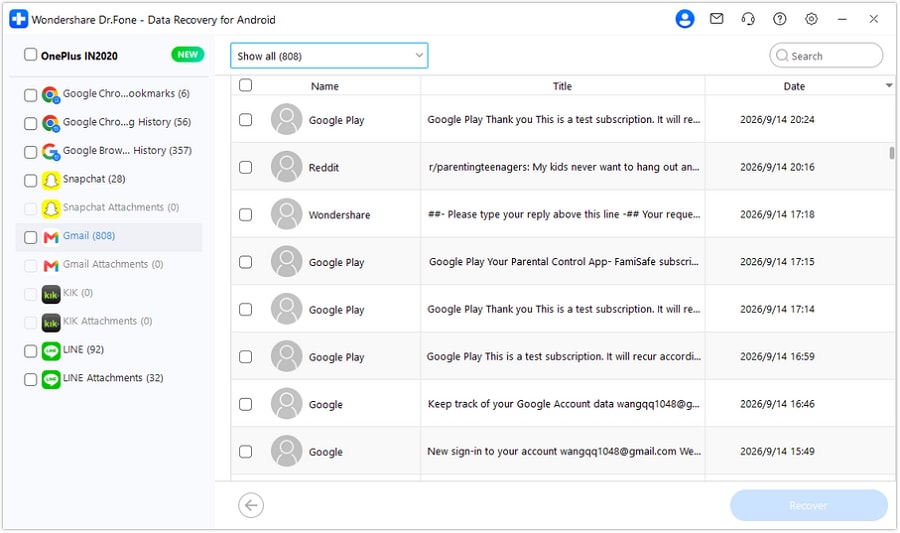
Step 5 Save selected useful results to the computer
Click Recover and choose a computer folder through the on-screen prompts. Save the selected results and inspect the output for readable instructions or the actual wanted file. The workflow saves to a PC; it does not recreate Gmail's Inbox, newsletter layout or missing remote images.




Conclusion
The useful goal is to preserve material you can read and use, whether that is the newsletter's available instructions or an actual chart attachment. Dr.Fone - Data Recovery (Android) combines a focused local Gmail scan, result preview and selective PC saving on a supported POCO X6 Pro. Download Dr.Fone for Windows and start checking for the available email records and files that help you continue your project.
FAQ
1. How can I recover deleted Gmail emails on POCO X6 Pro?
Check the correct account, broaden the search, inspect All mail and restore a retained Trash message if available. For a local scan, use Dr.Fone - Data Recovery (Android) on Windows, preview discoverable Gmail records and save selected results to a PC. The model's listed Kernels are 6.1.115 / 6.1.138.2. Does a blank image mean the newsletter or attachment was deleted?
No. An existing email may not display pictures because of the Images setting or Gmail's handling of suspicious content. Check the trusted message and its actual attachments separately. Image display settings cannot restore a deleted email or guarantee a missing image file exists.3. Can I recover deleted Gmail attachments on POCO X6 Pro when only a diagram reference remains?
Inspect Gmail Attachments if Advanced Recovery finds attachment data. A remote image reference does not establish that a local image or printable attachment was recovered. Open the actual available file before deciding whether it contains the readable chart.4. Which Android versions are listed for POCO X6 Pro?
No Android-version restriction is listed for this exact model in the confirmed support data. Its Kernel conditions remain 6.1.115 / 6.1.138. That entry does not guarantee arbitrary firmware compatibility, readable chart files or every deleted email.5. Will the recovered newsletter look exactly like Gmail and return to the Inbox?
This Advanced Recovery route saves selected discoverable local results to a PC, not back into the mailbox. It does not guarantee a particular file format, full email layout, remote images or a complete body, and it does not recover Google's permanently deleted server messages.
 Add Wondershare Dr.Fone as a preferred source on Google





