Recover photos, messages, WhatsApp, and more — no backup
needed.


 100% Security Verified | No Subscription Required | No Malware

 :

 ChatGPT
 Perplexity
 Gemini
 Claude
 Grok
Only one hand-lettering sheet appears in Photos, while the LINE messages explaining the corrected letter shapes have disappeared. You may be missing both an image variant and the written feedback, but the two gaps need different checks. A photo stack can conceal another retained sheet behind its cover; it cannot tell you which correction the tutor actually described in a deleted message.
If you need to recover deleted LINE messages on Google Pixel 8 Pro without a backup, Dr.Fone - Data Recovery (Android) helps supported users look for the actual discussion. Read found conversation text, preview photos, videos and files separately, then save the useful selection to a PC so the explanation and available visual references are easier to compare.
In this article
Before you start
Keep Pixel 8 Pro's exact software conditions
The supplied Google Pixel 8 Pro record lists Android 14 and Kernel 6.1.157. Use that exact model and configuration rather than borrowing conditions from Pixel 8a or a later Pro generation. Advanced Recovery is Windows-only, and its selected discoverable output is saved to a PC rather than written into LINE or Google Photos.
Protect existing messages and media
Prepare a Windows computer, a USB data cable and a private output folder. Do not uninstall LINE, clear storage or cache, reset the phone, delete photo stacks or run cleanup while trying to preserve missing data. Follow the product's displayed access prompts; do not unlock the bootloader, flash firmware or invent Root steps.
Use only an existing optional Photos source
Google Photos stacks are available in the Photos app for backed-up photos. The check below applies only if the relevant image was already saved independently and a stack is already present; do not enable backup, upload files or wait for fresh stacking as a recovery procedure. No prior LINE chat backup is needed for the device scan. Standard Backup is text-only and must predate deletion; Premium Backup does not roll manually deleted chats back.
Look behind an existing Google Photos stack's top pick
Use this non-deletion check if similar practice-sheet photos were already retained in Google Photos. It is separate from LINE Albums, a media Trash folder and deleted conversation recovery.
Step 1 Identify a stack rather than a single image
Open the Google Photos app on Android and inspect the relevant area of your Photos view. A stack has a photo-stack indicator at the upper right of its cover image. Google Photos automatically chooses a top pick for that cover; seeing one picture there does not establish that it is the only retained variant.
Step 2 Open the stack and scroll its filmstrip
Tap the existing stack. At the bottom, scroll through its filmstrip to inspect the other items. Compare the actual marks and corrections on each sheet rather than assuming the top pick is the latest or the one the tutor discussed. This reveals already retained images; it does not restore a deleted LINE message.
Step 3 Check the selected image, not only the old shared cover
Google's help distinguishes actions applying to Selected items only from actions that Include photo stacks; selected-only actions from Photos view apply only to the top pick. A previous single-image share therefore need not have contained every variant. Identify the useful existing sheet without sharing again, changing the top pick or using any delete or cleanup action.
- Stacking organizes similar backed-up photos; it does not create missing images, expand storage or reconstruct the LINE conversation that accompanied them.
- A retained marked sheet, a demonstration clip, the tutor's written explanation and your later interpretation are different records. Keep those distinctions when reviewing scan results.
Match the visual reference with the actual written correction
| What you find | Useful outcome | What it cannot establish alone |
|---|---|---|
| Another sheet inside an existing Photos stack | An already retained image variant to inspect | Which variant was sent in the deleted exchange or what the tutor meant |
| Only the stack's top pick in a previous share | The particular image that share included | That all other stack items were deleted |
| A readable LINE feedback exchange in the scan | Available wording about the specific letter or correction | Missing visual detail if its original image is not found |
| A usable photo or video in LINE Attachments | A selected visual reference saved to PC | The exact explanation or order of revisions without supporting records |
| Both matching text and media are found | A more useful pair of references for personal review | An automatically reconstructed lesson, edited document or guaranteed complete history |
Common problems and fixes
No stack appears around the expected practice date
This optional method needs a stack that already exists for backed-up photos. Its absence is not evidence that LINE text was deleted, nor a reason to enable backup or wait for new indexing. Continue with the local LINE scan for the missing exchange and available attachments.
The top pick looks like the corrected sheet, but the feedback disagrees
Read the actual found wording and compare visible details across the retained variants. Top pick is a cover choice, not a marker of teacher approval or revision order. Preserve a clear match if available, and leave an uncertain image-to-message match unresolved.
The scan finds feedback but not the original demonstration video
Save the useful text and inspect LINE Attachments separately for any available clip. A text mention, thumbnail or remembered demonstration does not supply a playable original. Keep any usable photo as a photo rather than describing it as video recovery.
How to use Dr.Fone - Data Recovery (Android)
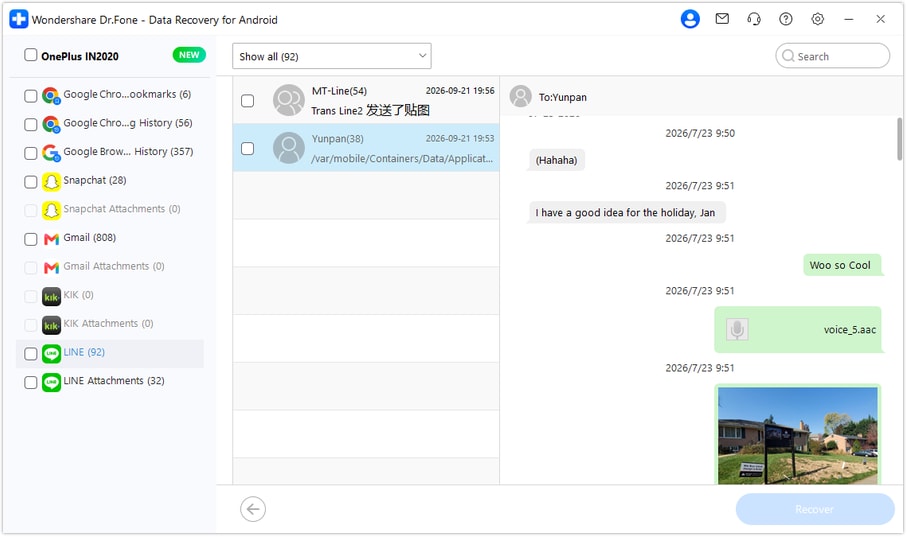
Dr.Fone - Data Recovery (Android) helps you look for the words behind a visual correction on a supported Pixel 8 Pro. Its Windows-only Advanced Recovery mode scans LINE app data, lets you read available conversation records and preview found photos, videos and files in LINE Attachments, then saves selected results to a PC. That gives you a practical way to preserve useful feedback and the actual available references without relying on a chat backup.
- Readable message previews help locate the specific correction instead of inferring it from a similar practice image.
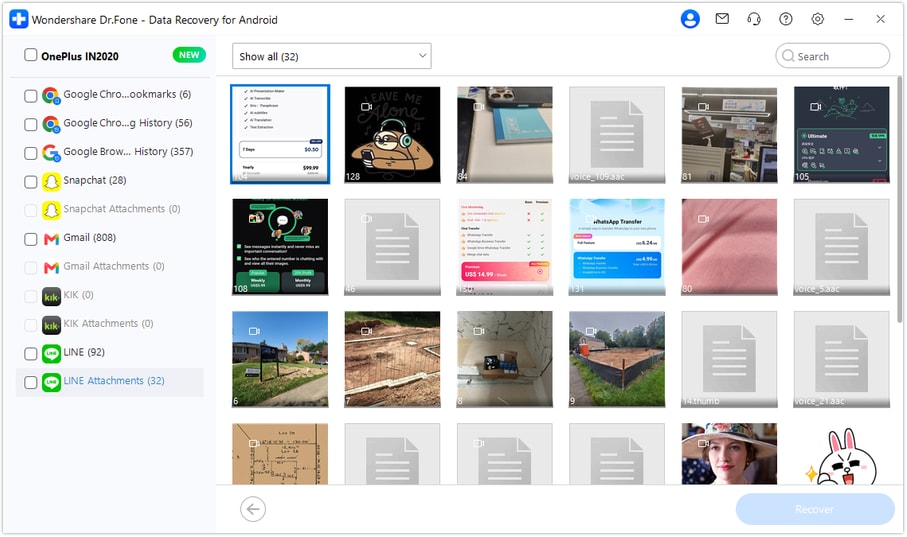
- Separate attachment review lets you distinguish marked sheets, demonstrations and supporting files.
- Selective PC recovery keeps the useful text and media available together for your own focused review.
 Scan Android phones and tablets directly.
- Preview and recover only what you want.
- Supports WhatsApp, photos, videos, contacts, and more.
- Works with 6000+ Android devices.
Follow the official Advanced Recovery workflow
Step 1 Launch Advanced Recovery and connect Pixel 8 Pro
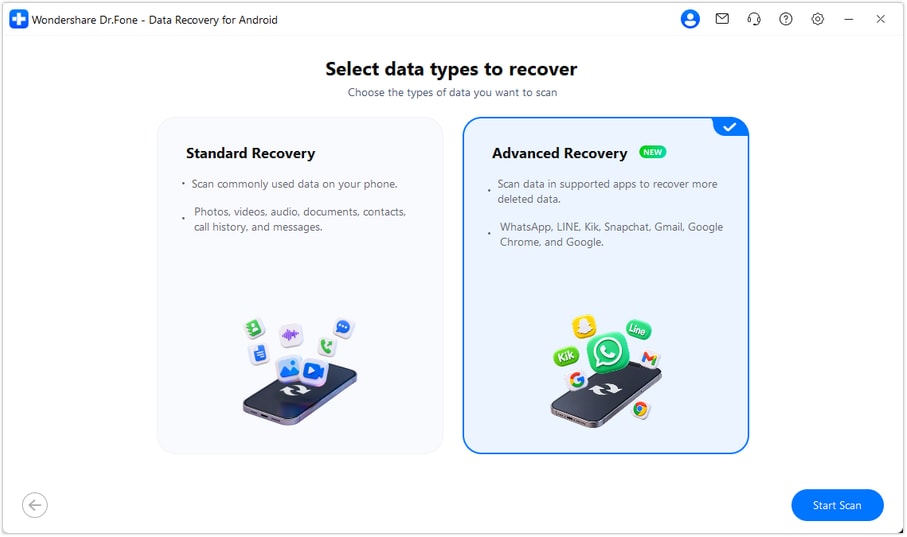
On Windows, open Dr.Fone and go to Toolbox > Data Recovery. Select Android > Recover Android Data, choose Advanced Recovery and click Start Scan. Connect the supported Pixel 8 Pro by USB when prompted and follow the device-detection instructions on screen.
Step 2 Select LINE app data to scan
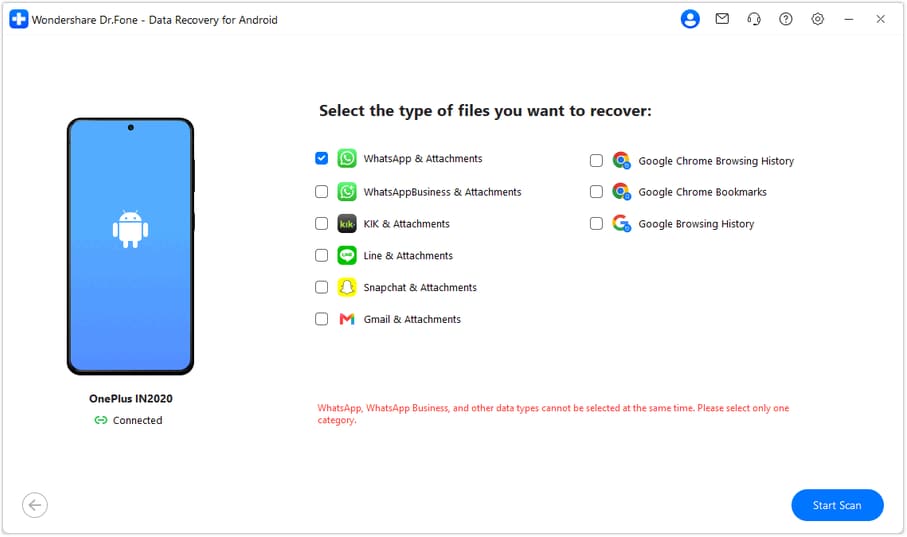
Choose LINE and click Start Scan. Follow the guide's separate-scan requirement for WhatsApp or WhatsApp Business if you use those categories in another scan. That requirement does not prohibit selecting LINE alongside other non-WhatsApp categories.
Step 3 Wait for the connected scan to complete
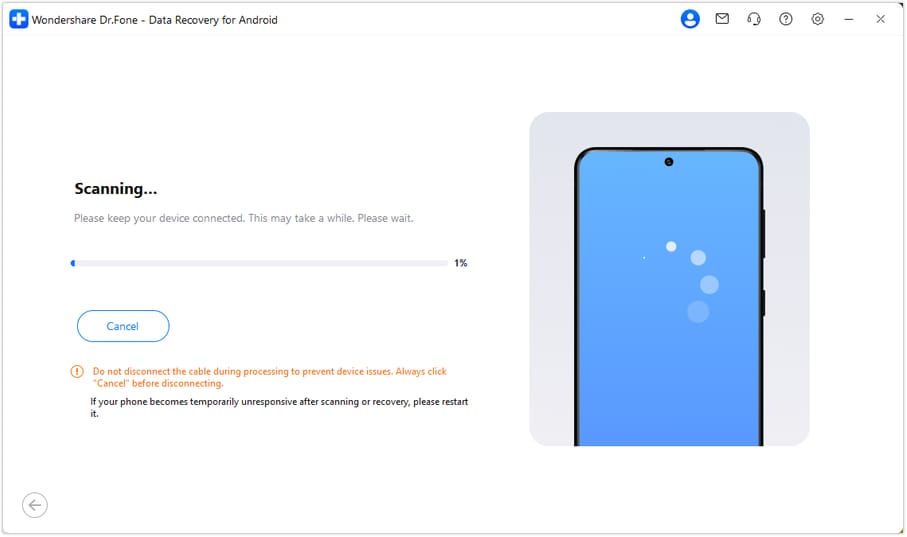
Keep the phone connected during scanning. If stopping is necessary, click Cancel before disconnecting the USB cable. If the phone is temporarily unresponsive after scanning or recovery, restart it as instructed by the product screen.
Step 4 Read the feedback and compare attachment previews
Choose LINE in the sidebar to inspect available conversations, using search or filters where available. Read the actual correction and surrounding context. Select LINE Attachments separately to browse found photos, videos and files. Choose the useful wording and media that actually match your reference.
Step 5 Save selected feedback and references to PC
Click Recover and follow the prompts to choose a folder on your Windows PC. Save the selected available records there. This produces a separate PC copy rather than importing messages into LINE, changing Photos stacks or rebuilding a lesson.




Conclusion
Dr.Fone - Data Recovery (Android) gives supported Google Pixel 8 Pro users a focused way to find missing LINE feedback, inspect actual photo and video references, and keep selected useful results on a PC. Download the Windows version and start the guided scan to bring readable corrections and available supporting media together for your next review.
FAQ
1. Can I recover deleted LINE messages on Pixel 8 Pro without a backup?
On a supported configuration, Dr.Fone - Data Recovery (Android) can scan local LINE app data through Advanced Recovery on Windows without an earlier LINE chat backup. Preview available conversations and LINE Attachments and save selected found items to your PC. Results depend on what the scan can discover.2. Why does Google Photos show only one of several similar images?
An existing photo stack displays its top pick as the cover. Tap the stack and scroll the filmstrip at the bottom to inspect other retained items. This applies to backed-up photos in the Google Photos app; the cover is not proof that the other images were deleted.3. Is the stack's top pick the last version approved in LINE?
No. Google Photos chooses a cover image, and that choice does not establish a LINE message's meaning, sending history or approval. Compare visible details with actual retained or recovered wording rather than treating the cover as a final-version label.4. Does the optional Photos check make this a backup-restore method?
No. It only inspects separately retained images that were already backed up in Photos, if such a source exists. It does not restore LINE chat history. The main no-chat-backup method is the supported phone's local LINE scan, with selected output saved to a PC.5. Which Pixel 8 Pro configuration is listed?
The supplied record lists Google Pixel 8 Pro with Android 14 and Kernel 6.1.157. Retain those exact-model conditions and follow the product's actual device-detection prompts. A different Pixel's record does not establish support for this phone's configuration.
 Add Wondershare Dr.Fone as a preferred source on Google