 Recover photos, messages, WhatsApp, and more — no backup
needed.


 100% Security Verified | No Subscription Required | No Malware


 :

 ChatGPT
 Perplexity
 Gemini
 Claude
 Grok
A missing work email can leave you with an unfinished handover: you remember receiving the agreed leave dates and a coverage spreadsheet, but neither is where you expect it. If you need to recover deleted Gmail emails on iQOO 13, first distinguish a misplaced message from a deletion, and a personal mailbox from an employer-managed account.
Dr.Fone - Data Recovery (Android) provides a focused way to look for available local Gmail records and attachments on a supported iQOO 13. You can inspect the actual handover wording, preview a spreadsheet if its file data is found, and save selected useful results to a Windows PC. If your organization manages the mailbox, make the administrator check promptly as well; that is a different recovery opportunity, not a feature of the phone scan.
In this article
Before you start
Match the iQOO 13 support entry
The supplied device list names iQOO 13 with Kernel 6.6.89; no Android-version restriction is listed for this named model. Keep the model and Kernel conditions together rather than applying them to every iQOO phone. Check the phone's displayed software information against this entry and follow Dr.Fone's device-detection prompts. A listed device does not guarantee that a particular deleted email or file remains discoverable.
Keep work information within your authorization
For a managed mailbox, follow your organization's rules before connecting the phone or saving business correspondence. Prepare a Windows computer, a reliable USB data cable and an approved PC destination. Advanced Recovery is Windows-only and saves selected discoverable results to a PC, not to the Gmail Inbox or Google cloud mailbox.
Preserve the device and note two different dates
Keep Gmail installed and do not clear its storage, reset the phone or follow bootloader-unlock, flashing or downgrade instructions. Note the approximate message date and, separately, when it was deleted or permanently removed, if known. Those dates answer different questions: the first helps identify the correspondence; the second matters for Gmail and administrator recovery windows. Follow the product's displayed access instructions without inventing a Root procedure.
Check the mailbox before treating the handover email as deleted
Use this check whether the message belongs to a personal Gmail account or a managed work account. It can reveal an existing email without a recovery scan.
Step 1 Search the correct account while online
Confirm the Google account that received the handover. In Gmail, search for the colleague or a distinctive project word, and open Menu > All mail to check archived correspondence. For a wider mailbox search, enter in:anywhere followed by a known word in Gmail's search box; this includes Spam and Trash. An offline search covers only messages synced to the phone.
Step 2 Move an available message out of Trash
In Gmail for Android, open Menu > Trash. If the required email is present, touch and hold it, tap More > Move to and choose the appropriate destination. Gmail keeps deleted messages in Trash for up to 30 days from deletion, but permanent deletion can happen earlier. A discarded draft is not recoverable from Trash.
- An archived message remains in the mailbox; finding it is not recovery of deleted data.
- Read the actual coverage dates and responsibilities. A subject such as Handover does not identify which version was agreed.
Ask a Workspace administrator about a separate restoration window
This route is only for a Google Workspace account managed by an organization, not an ordinary personal gmail.com account. Contact an authorized administrator promptly instead of waiting for a phone scan to finish.
Step 1 Send the administrator the account and deletion timeline
Give the exact managed email address, the approximate removal dates and enough context to identify the missing handover. Google's administrator guidance describes an additional 25-day restoration period after the normal 30-day Trash period. It also specifies that the Admin console can restore data permanently deleted within the past 25 days. The message's original sent or received date does not start that recovery clock; ask the administrator to assess the actual deletion history.
Step 2 Leave Restore data to the authorized administrator
With the required User management privilege, the administrator opens the Google Admin console, goes to Directory > Users, finds the user and selects More options > Restore data. They select the relevant deletion date range within the last 25 days, choose Gmail and click Restore. This is a date-range Gmail restoration tool, not a sender, subject or single-attachment search.
Step 3 Confirm the restored content in Gmail
Check the user's Gmail Inbox for restored messages, then inspect the handover itself and any accessible spreadsheet. The administrator route does not restore deleted drafts, deleted Spam messages, deleted labels or label nesting, or messages still in Trash. If the required item is outside that route, continue with the local-data workflow for the iQOO 13 and assess what it actually finds.
- The administrator process restores eligible server-side Gmail data. Dr.Fone's device scan and PC output are separate from it.
- Do not interpret the extra window as indefinite retention or a universal 55-day promise for every deletion.
Choose the useful result, not just a familiar handover title
| What you find | What it gives you | What to do next |
|---|---|---|
| The email is in All mail or Trash | An existing mailbox source that may contain the handover | Read the exact dates; move the Trash item if needed and permitted. |
| The administrator restores an eligible email | A server-side message returned through the organization's Gmail process | Check the restored wording and accessible attachment rather than assuming every missing item returned. |
| A local Gmail result contains the coverage instructions | Available text you can inspect and select for PC saving | Keep the relevant responsibilities and dates as a readable reference. |
| A spreadsheet is found without the approval email | A potentially useful working file, not proof of approved leave or cover | Open its actual contents and request confirmation of the missing decision. |
Common problems and fixes
The email is old, but the deletion was recent
Give the administrator the deletion or permanent-removal timeline, not only the year on the message. Google's admin window is about removal, not the age of the correspondence. Separately use the old message context to recognize the right record in Gmail or the scan preview.
Work mail appears on a computer but not on the iQOO 13
Use the accessible authorized mailbox source first. For an ordinary signed-in Gmail account, check Menu > Settings > the account > Sync Gmail and refresh the Inbox by swiping down from the top. Do not clear Gmail storage as a recovery experiment. A display or sync problem and a permanently deleted message require different responses.
The preview finds a roster but no agreement
Inspect the roster's actual names and coverage dates and save it if useful. Keep the missing approval as an unresolved question rather than treating a filename or colleague's name as the decision. Ask the appropriate colleague for the approval wording while retaining the readable material you found.
How to use Dr.Fone - Data Recovery (Android)
Dr.Fone - Data Recovery (Android) helps you look beyond the mailbox view for available local Gmail records on the supported iQOO 13. Its Windows-only Advanced Recovery workflow lets you inspect relevant email content, separately review Gmail attachment data when found, and save selected results to a PC. For a handover, that means concentrating on the actual responsibilities and a usable roster instead of collecting every vaguely related result.
- Gmail-focused local scanning gives you another place to look for the missing handover information.
- Content and attachment previews help distinguish the agreement you need from an earlier working roster.
- Selective PC saving keeps the useful correspondence and found files together in your chosen destination.
 Scan Android phones and tablets directly.
- Preview and recover only what you want.
- Supports WhatsApp, photos, videos, contacts, and more.
- Works with 6000+ Android devices.

Follow the official Advanced Recovery workflow
Step 1 Connect the iQOO 13 through Advanced Recovery
Launch Dr.Fone on Windows and open Toolbox > Data Recovery. Choose Android > Recover Android Data, select Advanced Recovery and click Start Scan. Connect the supported iQOO 13 by USB when prompted and follow the on-screen instructions until it is detected.

Step 2 Select Gmail data for the scan
Choose Gmail among the available app-data categories and click Start Scan. If you also need WhatsApp or WhatsApp Business, scan either of those separately from Gmail and the other categories as the official guide requires.

Step 3 Keep the connection stable while scanning
Leave the phone connected while Advanced Recovery scans. To stop, click Cancel before disconnecting the USB cable. If the phone is temporarily unresponsive after scanning or recovery, follow the restart instruction shown by the product.

Step 4 Preview the handover text and any found roster file
Choose Gmail in the results sidebar. Use the available name, title and date to locate candidate entries, then open them and read the actual available content for the coverage dates and duties. Use search or filters only where provided. If the scan finds Gmail Attachments, review that category separately and preview the actual roster file; its name alone does not establish its contents. Select the useful records and files.
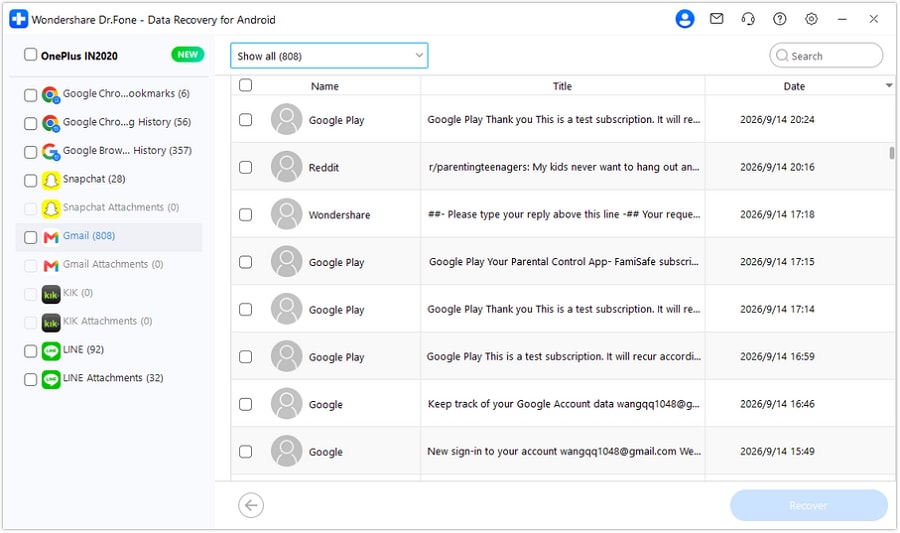
Step 5 Save selected Gmail results to your PC
Click Recover and follow the prompts to choose an approved folder on your computer. Save the selected results, then inspect the saved text and files for usability. This output is a PC copy, not a restoration into the phone's Gmail Inbox.




Conclusion
For missing handover emails on a supported iQOO 13, Dr.Fone - Data Recovery (Android) offers a practical way to inspect available local correspondence, check a found roster file and preserve selected useful results on your PC. Make any eligible Workspace administrator request promptly, then download Dr.Fone for Windows and start a focused Gmail scan to recover the information you can use.
FAQ
1. Can I recover deleted Gmail emails on iQOO 13 without an existing backup?
Dr.Fone - Data Recovery (Android) offers a supported-phone scan that does not require an existing email backup. On Windows, select Advanced Recovery and Gmail, inspect the available entries and attachment results, and save chosen items to a PC. Recoverability depends on what the scan finds, not merely on the support entry.2. Does every Gmail account have an extra administrator recovery window?
No. The Admin console route is for a managed Google Workspace account and requires an authorized administrator with the relevant privilege. It is not a personal gmail.com recovery feature. The administrator checks eligibility and deletion dates; the phone scan neither opens nor extends that server-side window.3. Can an administrator restore a discarded draft or my deleted labels?
Google's Gmail administrator guidance excludes deleted drafts, deleted Spam messages, deleted labels and label nesting. It also excludes messages still in Trash, which the user should check directly. A local scan is not a promise to reconstruct discarded wording or the mailbox's former organization.4. Will the recovered roster prove that my leave was approved?
Not on its own. Read the actual available approval email for the decision and dates, and inspect the roster as a separate file. A working spreadsheet or filename can be useful without establishing that the requested leave or cover arrangement was accepted.5. Where does Dr.Fone save recovered Gmail attachments?
Advanced Recovery saves selected discoverable attachment data to the folder you choose on the Windows PC. It does not import it into Gmail or recover a remote spreadsheet merely because a message contains its link. Preview an actual found file separately before selecting it.
 Add Wondershare Dr.Fone as a preferred source on Google





