 Recover photos, messages, WhatsApp, and more — no backup
needed.


 100% Security Verified | No Subscription Required | No Malware


 :

 ChatGPT
 Perplexity
 Gemini
 Claude
 Grok
You were reading a household WhatsApp group on your Pixel Tablet when the discussion containing a delivery receipt, family plans and a shared video disappeared. Without a usable backup, it is tempting to connect the tablet and search for everything there. But the screen where you last read a message is not enough to identify the right recovery source.
Dr.Fone - Data Recovery (Android) offers a focused way to preview and save available WhatsApp messages and attachments from an eligible Android source. For Pixel Tablet users, the key first step is checking the actual app setup and where the relevant records may exist. Once that configuration is confirmed, the Windows workflow below helps you look for useful records without relying on a backup.
In this article
Before you start
Identify the source device and app configuration first
Record whether you read WhatsApp in a browser or an installed app, whether the app is linked to a phone, and which device held the conversation before it disappeared. An installed tablet app may still be a linked-device app; installation does not prove that the required local records exist or are scannable. Confirm with Dr.Fone support whether the specific source device, personal WhatsApp setup and app version qualify. If the source is the paired Android phone, check that phone's own eligibility instead of substituting the tablet's device record.
Check the Pixel Tablet build without assuming all listed combinations
In Settings > About tablet, note the current Android version and full build. The supplied Root record lists Android 14, kernels 6.1.99 / 6.1.157 and builds BP1A.250405.007 / CP2A.260705.006, without a model code. These parallel lists do not establish every possible pairing, and the Build-to-Android mapping needs verification. The public Advanced Recovery guide covers Android 9-13; neither the reference entry nor an eligible phone proves tablet-app support.
Preserve the current app sessions and remaining records
Do not unlink devices, reinstall WhatsApp, clear app or browser storage, or factory-reset the tablet as a recovery experiment. Avoid bootloader-unlock, flashing and generic Root instructions. Keep the identified source unchanged while its access requirements and possible data effects are checked.
Prepare Windows and a clear destination
Have a Windows PC, a USB data cable for the confirmed eligible source device and a destination folder ready. Note the group, approximate dates and the receipt, message, photo, video or other attachment you want. Advanced Recovery saves selected available results to PC; it does not restore or synchronize them across the tablet and phone.
Locate retained WhatsApp records before choosing a tablet recovery source
The missing chat was last viewed on Pixel Tablet, and you need to establish whether it is hidden, still present elsewhere or genuinely deleted.
Step 1 Check the current account and conversation
In the WhatsApp interface you were using, confirm that you are viewing the expected account. Search for the household group or contact and inspect Archived where available. Finding the conversation here means you can read the retained data without a deleted-data scan.
Step 2 Inspect the paired phone independently
If the tablet is linked to a phone, open WhatsApp on that phone and check whether the required conversation or attachment is still visible. Do not assume that a missing tablet view means the phone's copy is gone, or that a visible phone history is completely stored on the tablet.
Step 3 Check an attachment you previously saved
Look for a receipt, photo or video in the tablet's file or photo app only if you saved a separate copy. Open the file to confirm its contents. An existing local file can solve the attachment need without proving that the deleted WhatsApp message is recoverable.
Step 4 Take the source details into the eligibility check
If the records are truly missing, give Dr.Fone support the source device, Android build, WhatsApp version and linked/browser/app setup. Use the five-step scan only for the device and app configuration confirmed eligible, not automatically for whichever screen you used last.
- Browser sessions, linked-app records, separately saved files and the paired phone's history are different data sources.
- These checks locate existing information. They do not reconstruct deleted chats, and a backup restore is not used as a no-backup method.
Which WhatsApp source should a Pixel Tablet user investigate?
| What you used or found | Useful next check | What you must not assume |
|---|---|---|
| WhatsApp in a browser | Check retained messages there and identify the paired phone | A personal WhatsApp app scan will recover that browser session |
| An installed linked tablet app | Confirm tablet-local records and exact app eligibility with Dr.Fone | Installation means the phone's complete deleted history is stored locally |
| The conversation remains on the paired phone | Read the existing phone records and preserve the useful information | Missing tablet content proves deletion on the phone |
| A separately saved receipt, photo or video | Open and keep that existing file | The file also reconstructs deleted message text |
| A source configuration confirmed for Advanced Recovery | Scan personal WhatsApp, preview available results and select records | The scan restores or synchronizes WhatsApp on either device |
Common problems and fixes
The tablet app is installed, but no eligible WhatsApp scan is available
Confirm whether the app is linked and whether that exact tablet/app configuration is supported. Installing the app does not prove that the required local data exists. Provide the setup details to Dr.Fone support rather than relinking or resetting the tablet to force access.
The paired phone has older messages that the tablet does not show
Treat the phone as a separate source. Review any retained records there, and check its own model, software and app eligibility if deleted-data recovery is needed. A tablet scan is not evidence that the full phone history was searched.
You were using WhatsApp in a browser, not the tablet app
Do not treat personal WhatsApp app recovery or a general browsing-history category as a promise to restore browser chat messages. Identify the relevant paired phone and confirm a supported source route before scanning.
Saved results appear on the PC but not on the tablet
That is the intended output location for this workflow. Open the chosen PC folder to inspect the selected records. Advanced Recovery does not import the saved output into the tablet app or synchronize it with a paired phone.
How to use Dr.Fone - Data Recovery (Android)
Dr.Fone - Data Recovery (Android) helps you turn a missing tablet conversation into a focused search on the right, confirmed eligible source. Its Windows-only Advanced Recovery workflow scans supported personal WhatsApp app data without a backup, lets you inspect available messages and attachment categories, and saves your chosen results to a PC. For Pixel Tablet users, identifying that source first keeps the recovery effort focused on the useful records rather than confusing a browser view, linked app and phone history.
- A personal WhatsApp scan focuses on the supported app source instead of assuming every device displaying the conversation holds the same recoverable records.
- Conversation and attachment previews help you look for the household message, receipt, photo or video you actually need.
- Selective PC recovery gives you a separate copy of the useful results found without presenting the output as tablet-phone synchronization.
 Scan Android phones and tablets directly.
- Preview and recover only what you want.
- Supports WhatsApp, photos, videos, contacts, and more.
- Works with 6000+ Android devices.

Follow the official Advanced Recovery workflow
Step 1 Connect the confirmed eligible source device
Launch Dr.Fone on Windows and open Toolbox > Data Recovery > Android > Recover Android Data. Select Advanced Recovery and click Start Scan. When prompted, connect the source device whose device and app configuration was confirmed eligible, then follow the detection instructions. Use the Pixel Tablet here only if its specific configuration qualifies; otherwise a paired Android phone requires its own separate eligibility confirmation.

Step 2 Select personal WhatsApp separately
Choose WhatsApp and click Start Scan. Do not combine WhatsApp with WhatsApp Business or the other categories. This selection scans the eligible connected app source; it is not a request to retrieve every linked device's history.

Step 3 Wait with the source device connected
Keep the USB connection in place while scanning. If you need to stop, click Cancel before disconnecting. If the source device becomes temporarily unresponsive after scanning or recovery, use the restart instructions displayed by the product.

Step 4 Preview the available WhatsApp records
Open the WhatsApp results from the sidebar and inspect available conversations. Use search or filters where offered, then review photo, video, audio and other attachment categories. Select the records that match the message or file you need from this source.
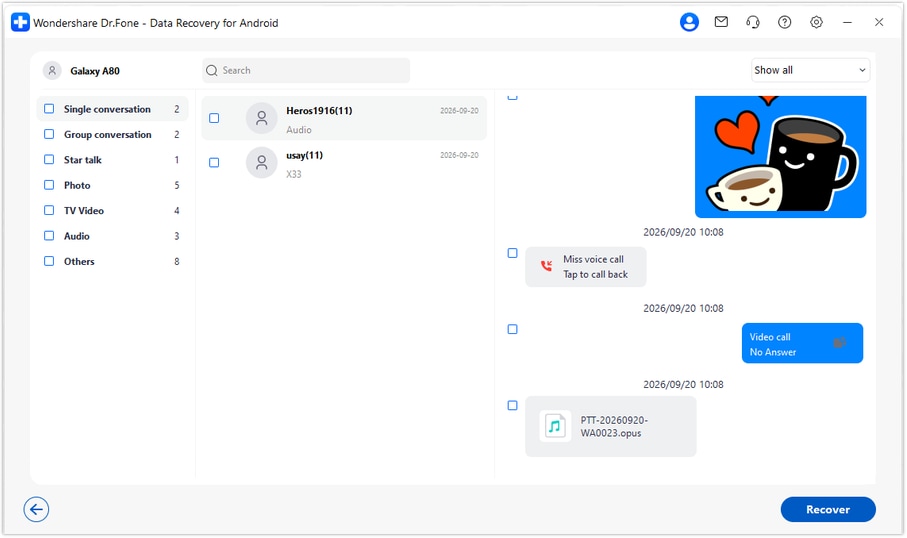
Step 5 Recover the selections to your PC
Click Recover and follow the prompts to choose a computer folder. Open the saved output to review the selected records. The result is a PC copy, not a restored tablet chat or a synchronization of phone and tablet histories.




Conclusion
For WhatsApp records missing while using a Pixel Tablet, the most useful recovery plan starts with the right source. Dr.Fone - Data Recovery (Android) provides eligible configurations with a focused app scan, clear previews and selective PC saving without an existing backup. Download Dr.Fone for Windows and begin the guided workflow with the source device and app setup confirmed for your case.
FAQ
1. Can I recover deleted WhatsApp messages on Google Pixel Tablet without a backup?
There is a conditional device-scan route with Dr.Fone - Data Recovery (Android), but you must first identify and confirm the eligible source device and app configuration. A browser session or installed linked tablet app is not automatically supported. On a confirmed eligible source, use Windows Advanced Recovery to scan personal WhatsApp and save available selected records to PC.2. Does installing WhatsApp on Pixel Tablet make it eligible for recovery?
No. The installed app may still operate as a linked device, and installation does not establish that the required local deleted data exists or can be scanned. Confirm that specific device, app version and configuration before using the recovery workflow.3. Does scanning my tablet search the paired phone's complete deleted WhatsApp history?
No such result is established. Tablet-local records and phone history are different sources. If the phone is the relevant source, inspect its retained data and check its own recovery eligibility separately.4. Can this app-scan method restore WhatsApp Web messages?
Do not assume it can. Personal WhatsApp app recovery and browser-session chat recovery are not interchangeable. Identify the relevant phone or other supported app source and confirm its eligibility instead of treating a browser-history scan as WhatsApp recovery.5. Can I recover deleted WhatsApp photos and videos from the tablet setup?
Only if the relevant source configuration is eligible and the scan finds the attachments. Preview the available photo, video and other categories, then save selected records to PC. Separately saved files may already exist, but those are not proof that the original deleted messages were recovered.6. Does the Pixel Tablet Android 14 Root entry prove this workflow is supported?
No. The supplied entry needs Build-to-Android and tablet-app verification, and its multiple kernels and builds cannot be freely paired. The public Advanced Recovery guide covers Android 9-13; a listed tablet reference does not establish linked-app support or extend that public range to every Android 14 configuration.
 Add Wondershare Dr.Fone as a preferred source on Google





