 Recover photos, messages, WhatsApp, and more — no backup
needed.


 100% Security Verified | No Subscription Required | No Malware


 :

 ChatGPT
 Perplexity
 Gemini
 Claude
 Grok
You organized years of family-history correspondence under Gmail labels, but after a cleanup the collection looks empty on your Redmi K80. The missing items might include a relative's explanation of a surname and an attached scan of a handwritten record. Losing the label view and losing those underlying messages are not the same problem.
When you need to recover deleted Gmail emails on Redmi K80, Dr.Fone - Data Recovery (Android) helps you look for available local correspondence and attachments, preview useful matches and save selected results to a PC. First search beyond the label so retained mail is not mistaken for deleted data, then judge scan results by the family information and actual files they contain.
In this article
Before you start
Keep the exact Redmi K80 support condition
The supplied recovery record names Redmi K80 with Kernel 6.1.138; no Android-version restriction is listed for this model. Retain that Kernel condition and do not infer support for other K80 variants or arbitrary firmware. Note the model and software information for the product's compatibility check.
Prepare Windows without replacing the local mail data
Advanced Recovery is Windows-only and saves selected discoverable results to a PC. Have a USB data cable and a destination folder ready. Keep Gmail installed and preserve its storage and account: do not clear app data, remove the account, reinstall or reset the phone as a recovery fix. Follow the product's access prompts; the precise Root mechanism and data impact are not established here, so do not assume lossless access or improvise bootloader-unlock or flashing steps.
Search for people and facts, not only your former label names
Note correspondents, surname spellings, place names and approximate email dates. Your personal research label may not appear in the message's subject or content. A local scan can inspect only discoverable phone data; it does not recover Google server-side permanently deleted mail, rebuild mailbox labels or guarantee a complete email body or attachment collection.
Find Gmail messages outside an empty research label
Use this check after changing label organization or when a newer reply seems absent from the labeled collection.
Step 1 Open the correct account and All mail
Confirm the Google account that received the research correspondence. In the Gmail app, open Menu > All mail to inspect retained mail, including archived messages. Gmail labels are different from folders; a missing label view is not evidence that every related email is gone.
Step 2 Search without requiring the original label
Search a correspondent or a distinctive surname or place name, then try other known spellings separately. Use the From chip where useful. Do not start with the Attachment chip if the fact you need was written in the email body. Google notes that a conversation's label applies to existing messages, not automatically to new replies, so the latest response may be outside the expected labeled view.
Step 3 Include Trash and check the specific message
Enter in:anywhere with relevant terms to include Spam and Trash, which standard search excludes. If the matching email remains in Menu > Trash, touch and hold it, choose More > Move to and pick a destination. That recovery window is up to 30 days after deletion unless permanently deleted earlier; the historical date described in a family record is unrelated to the email's deletion date.
- Deleting an email removes it from every label and Inbox, not just from the label you happen to be viewing. Another label is not an independent backup copy.
- Repeat an offline search online because offline search covers only messages synced to the device. If the phone view is stale, check the internet connection and swipe down from the top of Inbox to refresh.
- These checks locate retained mail or recover eligible Trash messages; they do not restore a permanently deleted cloud mailbox.
An empty label, a deleted message and a saved PC result
| Situation | What it means | What to do |
|---|---|---|
| The label view is empty but a sender search finds the mail | The matching message is retained | Read it directly; treat label organization separately from deleted-data recovery. |
| A newer reply is outside the expected label | Labels do not automatically apply to every new reply in a conversation | Search without the label requirement and inspect the actual reply. |
| A message deleted from one label is absent from other labels too | The labels were not separate copies of that email | Check eligible Trash mail, then consider the local-data scan. |
| The scan finds a research entry or a record image | Selected available local content can be saved to a PC | Inspect the actual information or file; the old Gmail label collection is not reconstructed. |
Common problems and fixes
A surname search returns nothing
Try the known correspondent, a place name or another spelling without the label restriction. Your organizing label is not necessarily a word in the email, and an image of handwriting is not the same as searchable message text. Broaden the retained-mail search rather than concluding that a single empty result proves permanent deletion.
A record image is found without the relative's explanation
Save and inspect the actual available file, but keep the unresolved context separate. A photographed record does not establish which family member it describes or recover a missing explanation. Review available Gmail entries as well, and ask the correspondent to clarify any interpretation you cannot confirm.
Many related scan entries look alike
Use the available name, title and date to narrow candidates, then preview actual content before selecting. A similar subject or an old family name is only a clue. Check attachments separately if available, and choose the useful evidence instead of treating every matching record as a complete research thread.
How to use Dr.Fone - Data Recovery (Android)
Dr.Fone - Data Recovery (Android) helps supported Redmi K80 users look for missing local Gmail information after retained-mail and label checks. Its Windows-only Advanced Recovery workflow scans the connected phone, displays available Gmail records and attachment results for review, and saves selected data to a PC. You can concentrate on the correspondence and actual record images that matter, rather than expecting the software to rebuild your personal mailbox organization.
- Compare available Gmail names, titles and dates to identify likely correspondents and research exchanges.
- Preview available content and inspect found attachments separately so an image is not mistaken for its missing explanatory email.
- Save selected useful records and files to a PC for review alongside the research material you already retain.
 Scan Android phones and tablets directly.
- Preview and recover only what you want.
- Supports WhatsApp, photos, videos, contacts, and more.
- Works with 6000+ Android devices.

Follow the official Advanced Recovery workflow
Step 1 Open Advanced Recovery and connect Redmi K80
Launch Dr.Fone on Windows and open Toolbox > Data Recovery. Choose Android > Recover Android Data, select Advanced Recovery and click Start Scan. Connect the supported Redmi K80 by USB when prompted and follow the device-detection instructions.

Step 2 Select Gmail data to inspect
Choose Gmail from the available app-data categories and click Start Scan. WhatsApp and WhatsApp Business require separate scans from the other categories under the official guide; this walkthrough uses the Gmail results.

Step 3 Keep the phone connected throughout scanning
Allow Advanced Recovery to scan with the USB connection intact. Click Cancel before disconnecting if you need to stop. If the phone becomes temporarily unresponsive after scanning or recovery, follow the product's displayed restart instructions.

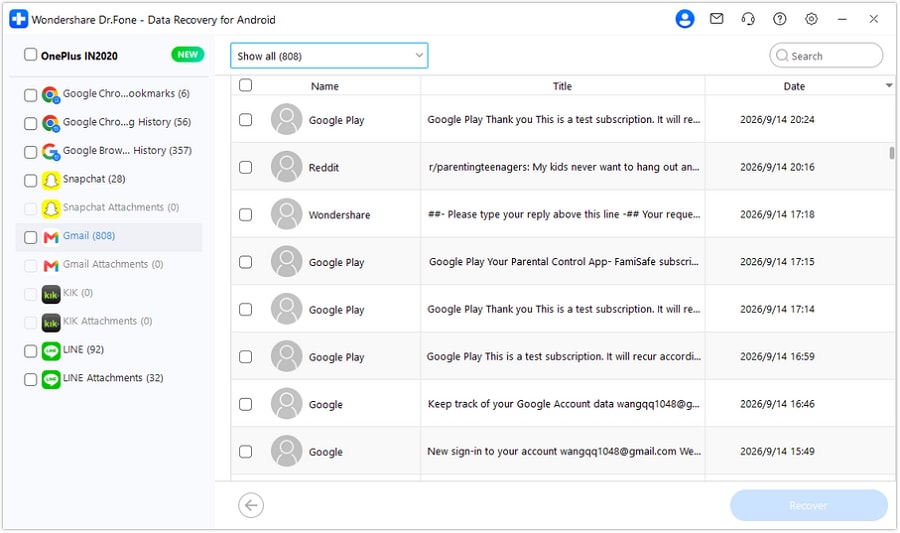
Step 4 Preview research correspondence and available attachments
Select Gmail in the results sidebar and compare the available names, titles and dates with your correspondent notes. Use search and filters where offered, then inspect the actual preview content. Check Gmail Attachments separately if attachment data was found and select useful records and files.
Step 5 Save the selected data to your computer
Click Recover and follow the prompts to choose a PC destination folder. Save the selected output and inspect the information and files. The results are computer copies, not emails imported into Gmail or a reconstruction of the original labels.




Conclusion
The goal is to preserve useful family information, whether the missing item is an explanation in an email or an actual record attachment. Dr.Fone - Data Recovery (Android) gives supported Redmi K80 users a focused local Gmail scan, previews for selecting relevant results and PC saving for the items found. Download Dr.Fone for Windows, connect your compatible Redmi K80 and start looking for the correspondence and files that can support your research.
FAQ
1. How do I recover deleted Gmail emails on Redmi K80 after label cleanup?
Search the correct account outside the affected label and check All mail and Trash first. If you still need deleted-data recovery, use Dr.Fone - Data Recovery (Android) on Windows to inspect discoverable local Gmail data on a supported Redmi K80. Preview available entries and attachments and save selected results to a PC.2. If an email had two Gmail labels, is one label a backup?
No. Gmail labels are not independent folder copies. Google says deleting the email removes it from every label and Inbox. Check Trash rather than assuming another label still contains a separate copy.3. Why is a new reply missing from my research label?
Google explains that a label on a conversation applies to existing messages, not automatically to new replies. Search the sender or a memorable phrase without requiring the label. An unlabeled reply is retained mail, not necessarily a deleted-message recovery case.4. Will Dr.Fone restore my old labels and the complete family-history thread?
No label reconstruction or complete-thread recovery is promised. Advanced Recovery saves selected discoverable local records and available attachments to a PC. Inspect actual content and keep missing explanations or absent files separate from the results you can use.5. Which Redmi K80 software conditions are listed?
The supplied record lists Redmi K80 with Kernel 6.1.138 and no Android-version restriction for this exact model. Keep the Kernel condition and follow the product's compatibility and access prompts rather than extending it to unlisted variants.
 Add Wondershare Dr.Fone as a preferred source on Google





