 Recover photos, messages, WhatsApp, and more — no backup
needed.


 100% Security Verified | No Subscription Required | No Malware


 :

 ChatGPT
 Perplexity
 Gemini
 Claude
 Grok
You arranged a donation collection through a charity's shared Gmail account, but the donor's access instructions and item inventory have disappeared from your phone view. Searching your own Inbox may turn up only a colleague's short summary. To recover deleted Gmail emails on iQOO Neo10 Pro and Neo10 Pro Plus, first establish whether the original belongs to your mailbox or a mailbox you manage as a delegate.
Dr.Fone - Data Recovery (Android) helps you inspect available local Gmail records on the supported phone, preview a found inventory file and save selected useful material to a Windows PC. Pair that focused scan with a check of any delegated inbox you are already authorized to open. The goal is the donor's actual collection instructions and a usable inventory, not merely a matching charity name.
In this article
Before you start
iQOO Neo10 Pro: retain its own support condition
The approved iQOO Neo10 Pro entry lists Kernel 6.6.89; no Android-version restriction is listed for this named model. Match the exact device and Kernel condition to the phone's displayed software information, then follow Dr.Fone's detection instructions. Do not apply this entry to an unlisted Neo10 variant.
iQOO Neo10 Pro Plus: check this member separately
The approved iQOO Neo10 Pro Plus entry also lists Kernel 6.6.89; no Android-version restriction is listed for this named model. It has its own confirmed entry rather than inheriting support from the Pro. These device conditions establish the listed scope, not a promise that every deleted record or attachment will be found.
Use an authorized Windows recovery setup
Prepare a Windows computer, a stable USB data cable and a PC destination suitable for the donor's information. Advanced Recovery is Windows-only and saves selected discoverable results to a PC, not directly into Gmail. Respect the mailbox owner's rules and your organization's permission requirements for scanning or retaining shared correspondence.
Preserve the phone without changing mailbox access
Keep Gmail and its local storage intact. Do not clear storage, remove the account, reset the phone or follow unlocking, flashing or downgrade tutorials. Use the product's on-screen access instructions rather than an invented Root process. The delegated-mailbox check below uses access you already have; it does not require adding a delegate or sharing anyone's password.
Open the already-authorized delegated inbox, not an old bookmark
Use this check if the charity or another mailbox owner previously granted you Gmail delegation. A delegate can read, send and delete the owner's email, so the owner's mailbox is the relevant source to inspect.
Step 1 Use Gmail's account switcher on a computer
On your computer, sign in to your own Gmail account and click the profile picture at the top right. Find the account marked Delegated and click its name. Gmail opens the owner's inbox in a new tab; check the email address at the top to confirm which mailbox you are viewing. This is the computer route documented by Google, not a request to add the owner's account to your phone.
Step 2 Look for the donor's original in the owner's mailbox
Search that authorized mailbox for the donor and a distinctive collection word, then read the available original correspondence and inspect the actual inventory if accessible. Compare it with the summary in your personal mailbox. The summary may omit an entry code, item count or later correction; it is a separate message, not a second copy of everything in the owner's account.
Step 3 Resolve access trouble without altering the recovery source
Google recommends the account switcher because a bookmarked delegated-inbox link can change. If the delegated account is missing or inaccessible, contact the owner or organization administrator about your authorized access. Do not infer that the donor's email was deleted from a broken bookmark or an absent Delegated menu entry. Close the owner's tab when you want to return to your own mailbox.
- Delegation permits mailbox management; it does not establish that the owner's complete mailbox was stored locally on this iQOO.
- Finding an accessible original can solve the information gap directly. It is not deleted-message recovery, and a phone scan is not a delegated-mailbox importer.
Check your own retained Gmail copy and Trash on the iQOO
Use this for messages that actually reached your signed-in account on the phone, such as a forwarded inventory or a direct donor reply.
Step 1 Search beyond the Inbox while online
In the correct Gmail account, open Menu > All mail for archived messages. Search for a known collection detail; enter in:anywhere with that detail to include Spam and Trash. If you search offline, only mail already synced to the phone is covered. A missing result in your own account does not describe the contents of the separate owner's mailbox.
Step 2 Move an available Trash item
Open Gmail's Menu > Trash. Touch and hold the relevant message, tap More > Move to and choose the destination. Trash availability is up to 30 days from deletion, with earlier permanent deletion possible; discarded drafts are not recoverable from Trash. If the item is no longer available, move to the supported local scan rather than removing or reinstalling Gmail.
- Read a forwarded message's actual instructions and inspect its available files; do not assume the inventory was included.
- Keep the original owner's mailbox, your received copy and the phone-local scan results as three distinct sources.
Interpret the collection records by their actual source
| Available source | Useful information to inspect | Next decision |
|---|---|---|
| The authorized owner's original email | Donor instructions and any later collection correction | Use the accessible source within your permissions; no scan is needed to read it. |
| A summary or forward in your personal account | The details and files actually included in that copy | Resolve omitted access instructions with the owner rather than filling them in. |
| A phone-local Gmail entry found by Dr.Fone | Available text about the address, access or collection arrangement | Preview its content and select the useful record for PC saving. |
| An actual inventory file without the original email | The items listed in that file | Save a usable inventory, then separately confirm the missing collection instructions. |
Common problems and fixes
The old delegated-inbox bookmark no longer opens
Use your own Gmail profile menu on a computer and select the existing Delegated account. The access link can change, so the bookmark failure is not evidence that the owner's messages disappeared. If the account still cannot be opened, ask the owner or administrator to check access instead of trying recovery through someone else's credentials.
A delegated mailbox was visible, but its attachment is absent from the scan
Inspect the accessible original in the authorized mailbox. Merely having delegation does not mean that attachment data exists locally on the phone. In Dr.Fone, assess Gmail Attachments only when the scan actually finds that category and inspect each useful file separately.
You recognize the donor name but not the missing instructions
Read the actual available entry for the collection location, access instructions and relevant arrangement. If the content is only an acknowledgement or a colleague's summary, keep it as that source. A matching name or date cannot supply omitted text or identify a missing file's contents.
How to use Dr.Fone - Data Recovery (Android)
Dr.Fone - Data Recovery (Android) gives supported iQOO Neo10 Pro and Neo10 Pro Plus users a focused Windows-only workflow for available local Gmail data. You can locate candidate entries, read the content the scan makes available, review found attachments separately and save selected results to a PC. For the donation collection, this helps you retain useful instructions and an inspectable inventory without treating a brief summary as the whole exchange.
- An app-focused Gmail scan looks for available records on the connected supported phone.
- Separate entry and attachment inspection helps you identify a useful collection message and an actual inventory file.
- Selective PC recovery lets you keep the relevant material without saving every unrelated donor message.
 Scan Android phones and tablets directly.
- Preview and recover only what you want.
- Supports WhatsApp, photos, videos, contacts, and more.
- Works with 6000+ Android devices.

Follow the official Advanced Recovery workflow
Step 1 Start Advanced Recovery and connect your iQOO
Open Dr.Fone on Windows and go to Toolbox > Data Recovery. Select Android > Recover Android Data, choose Advanced Recovery and click Start Scan. When prompted, connect the supported Neo10 Pro or Neo10 Pro Plus with a USB data cable and follow the device-detection instructions.

Step 2 Choose Gmail among the available app categories
Select Gmail data and click Start Scan. If you also want WhatsApp or WhatsApp Business, run either of those separately from Gmail and the other categories, following the official selection rule.

Step 3 Let the phone scan finish
Keep the iQOO connected during scanning. If you need to stop, click Cancel before removing the cable. Follow the product's displayed restart instruction if the phone becomes temporarily unresponsive after scanning or recovery.

Step 4 Read the found Gmail entry and preview an actual inventory
Open Gmail in the results sidebar and use name, title and date to locate promising entries. Open a candidate and inspect the actual available collection text, rather than selecting it only because the donor's name matches. Use search or filters where available. If Gmail Attachments is found, open it separately and preview the actual inventory file for useful item details. Select the records and files you want to keep.
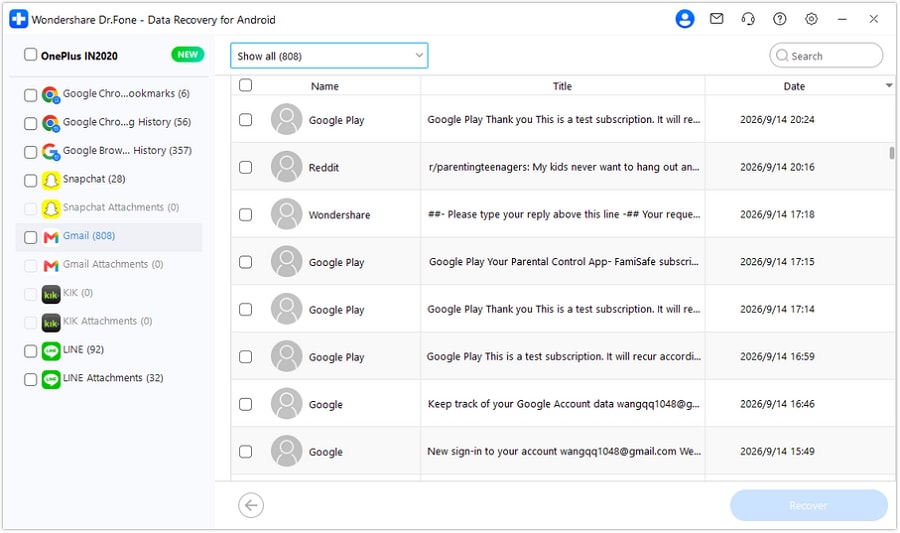
Step 5 Recover the selected material to a PC folder
Click Recover, choose your permitted destination folder on the computer and complete the save prompts. Inspect the saved results for readable instructions and usable files. The workflow saves a PC copy; it does not place the donor's message back into either Gmail account.




Conclusion
For a supported iQOO Neo10 Pro or Neo10 Pro Plus, Dr.Fone - Data Recovery (Android) helps you inspect available local collection correspondence, preview found inventory files and keep selected useful results on your PC. Download Dr.Fone for Windows and start the Gmail recovery workflow with a clear target: the actual instructions and files that make the collection easier to complete.
FAQ
1. Can I recover deleted Gmail emails on both iQOO Neo10 Pro and Neo10 Pro Plus?
Both exact models have approved entries with Kernel 6.6.89 and no listed Android-version restriction for each named model. Dr.Fone - Data Recovery (Android) can scan a supported phone for available local Gmail data on Windows, with selected results saved to a PC. The support entries do not guarantee that a specific deleted message remains.2. Does access to a delegated inbox mean its email is backed up on my phone?
No. Delegation gives authorized access to manage the owner's mailbox; it is not evidence of a complete local copy. Open an existing delegated inbox through your Gmail profile menu on a computer to inspect retained originals. The phone scan can only offer the data it actually finds on the supported connected device.3. Will Dr.Fone download the owner's delegated cloud mailbox?
That is not this workflow. Advanced Recovery scans available phone-local data and saves selected results to a Windows PC. It does not import a delegated cloud mailbox, bypass permissions or restore Gmail's server-side permanently deleted mail.4. What if the inventory is found but the entry instructions are not?
Preview the actual inventory and save it if useful, then ask the donor or authorized mailbox owner for the missing access information. The item list and the collection instructions are separate pieces of information; a familiar filename cannot establish both.
 Add Wondershare Dr.Fone as a preferred source on Google





