 Recover photos, messages, WhatsApp, and more — no backup
needed.


 100% Security Verified | No Subscription Required | No Malware


 :

 ChatGPT
 Perplexity
 Gemini
 Claude
 Grok
You saw a Gmail alert about a client's pronunciation correction, dismissed it and later discovered that the email and reference audio were missing. Remembering half a notification is not enough to record the right line. If you need to recover deleted Gmail emails on iQOO Neo11, a retained alert may help identify the source, while the actual email wording and audio still need their own checks.
Dr.Fone - Data Recovery (Android) helps you look for available local Gmail records and attachments on the supported Neo11. Previewing a found entry can reveal the correction you need; separately inspecting an actual found audio file can give you a useful listening reference. Save the selected material to your Windows PC so you can work from readable instructions and usable files rather than a remembered snippet.
In this article
Before you start
Check the exact Neo11 support condition
The approved iQOO Neo11 entry lists Kernel 6.6.89; no Android-version restriction is listed for this named model. Match the exact model and Kernel with the phone's displayed software information and follow Dr.Fone's detection prompts. This entry does not extend to every Neo-series device or guarantee that a specific email or audio file is recoverable.
Treat notification history as optional
Google states that some devices do not have notification history and that notification settings vary by device. Do not assume a particular Neo11 menu layout or a full retained history. Check only what your phone currently makes available; a history setting changed now is not a way to recreate an earlier dismissed alert. Sensitive notification text may also be hidden.
Prepare Windows without erasing local Gmail data
Use a Windows computer, a reliable USB data cable and a destination folder for the selected records. Advanced Recovery is Windows-only and saves discoverable selected data to a PC, not back to the Gmail Inbox or Google mailbox. Keep Gmail installed and do not clear its storage, remove the account, reset the phone or follow unlocking, flashing or downgrade tutorials. Follow the product's on-screen access instructions instead of inventing a Root procedure.
Use a retained notification to identify the missing email
Try this if you remember seeing the Gmail alert recently. It is an identification check for information still displayed by Android, not a deleted-email restoration method.
Step 1 Look at the current notification shade first
Swipe down from the top of the screen and look for the Gmail notification if it is still present. Note whatever sender, subject or text is actually visible. Do not tap an Archive or Reply action merely to test it; those actions change the message state or start a response rather than preserve a missing source.
Step 2 Check notification history only if your device provides it
Open the phone's Settings and look under Notifications for notification history. Google's Android help describes recently dismissed notifications and a last 24 hours area, but availability and settings differ between devices. Inspect any retained Gmail entry you can actually see. If the feature or the relevant alert is absent, skip this branch rather than searching for a universal Neo11 history-recovery menu.
Step 3 Turn the visible clue into a mailbox search
Write down a distinctive displayed word or sender and search the correct Gmail account manually. An excerpt that says a line changed can help you choose a search term, but it does not supply the complete replacement wording. Likewise, the notification time is when an alert appeared, not proof of the client's deadline or the audio's contents.
- An empty history does not prove that the email was never received; the feature or the particular notification may not be available.
- Notification text does not recreate attachment bytes. Look for an actual audio file separately.
Find the correction in Gmail before scanning the phone
Use the clue from the alert, or your own knowledge of the client, to check retained messages and Trash.
Step 1 Search online and include mail outside the Inbox
In Gmail, confirm the receiving Google account and search for the distinctive word or client. Open Menu > All mail for archived correspondence. Enter in:anywhere with a known term to include Spam and Trash. If a date restriction based on the notification gives no useful result, remove that restriction and inspect a broader set. Offline search covers only messages synced to the device.
Step 2 Restore an available Trash message to the mailbox
Open Menu > Trash in Gmail for Android. If the correction is present, touch and hold the message, tap More > Move to and choose the destination. Gmail's Trash window is up to 30 days from deletion, and a message may be permanently deleted earlier. A discarded draft is an exception and cannot be recovered from Trash.
- Read the actual correction rather than treating an earlier script with a similar subject as the answer.
- If the complete email is already readable, use that source directly; notification history has only helped you find it.
From notification clue to a usable recording reference
| What remains available | What it can help with | What to inspect next |
|---|---|---|
| Only a displayed notification excerpt | Identify a sender, subject or distinctive phrase | Find the actual email; do not complete the missing sentence from memory. |
| The correction text in Gmail or a local scan result | Read the available replacement wording | Check which line it changes and keep the relevant text. |
| A found reference audio file | Provide a listening reference if the saved file is usable | Listen to the actual content; a filename is not a pronunciation guide. |
| An earlier script but no correction or reference audio | Retain the material you already know is available | Ask the client for the missing correction before treating the script as final. |
Common problems and fixes
There is no Notification history option on this Neo11
Skip that optional check. Google does not promise notification history on every device, so its absence does not change the supplied Dr.Fone model and Kernel entry. Use known client details for the mailbox search, then inspect the supported local Gmail scan results.
The alert shows Gmail but hides the correction
Use only the information actually visible, such as a subject or sender if shown. Do not treat privacy-hidden text as deleted text or change lock-screen exposure just to guess an old alert. Search the mailbox and inspect the actual available content instead.
The audio name looks right, but the useful sample is missing
Review the available attachment preview and, after saving a selected result, inspect whether the actual file is usable. If only a filename, an email reference or an unrelated clip is available, ask for the correct sample. The recovery workflow does not synthesize audio or transcribe a missing pronunciation.
How to use Dr.Fone - Data Recovery (Android)
Dr.Fone - Data Recovery (Android) helps turn the search for a missing Gmail correction into a focused local-data workflow on a supported iQOO Neo11. Its Windows-only Advanced Recovery mode lets you inspect available Gmail entries, separately review attachment data when found, and save selected useful results to a PC. You can concentrate on the actual correction and a usable sample instead of relying on the small amount an alert happened to display.
- A Gmail-focused scan looks for available phone-local correspondence beyond your current Inbox view.
- Previewing the entry content helps identify the correction rather than only its subject.
- Separate attachment review and selective PC saving let you retain a found sample alongside the useful instructions.
 Scan Android phones and tablets directly.
- Preview and recover only what you want.
- Supports WhatsApp, photos, videos, contacts, and more.
- Works with 6000+ Android devices.

Follow the official Advanced Recovery workflow
Step 1 Open Advanced Recovery for the Neo11
Launch Dr.Fone on Windows and open Toolbox > Data Recovery. Choose Android > Recover Android Data, select Advanced Recovery and click Start Scan. Connect the supported iQOO Neo11 by USB when prompted and follow the on-screen instructions until the device is detected.

Step 2 Choose Gmail app data
Select Gmail from the available categories and click Start Scan. WhatsApp and WhatsApp Business require their own separate scans from Gmail and the other categories if you also need those apps.

Step 3 Wait with the phone connected
Keep the Neo11 connected while scanning progresses. If you need to stop, click Cancel before disconnecting the cable. Follow the product's displayed restart instruction if the phone becomes temporarily unresponsive after scanning or recovery.

Step 4 Preview the correction and any actual found audio
Choose Gmail in the results sidebar. Locate candidate entries by name, title and date, then open a candidate and read its actual available content for the changed line. Use search or filters where available, without assuming Gmail search operators are Dr.Fone filters. If Gmail Attachments is found, review it separately and preview the actual available sample file rather than relying on its name. Select the useful entries and files.
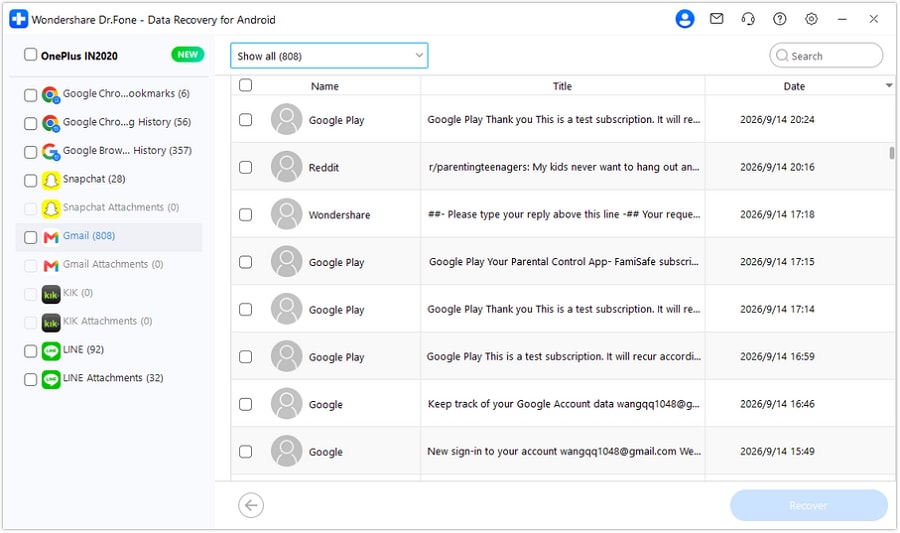
Step 5 Recover selected results to the computer
Click Recover, choose a folder on your PC and complete the save prompts. Inspect the saved correspondence and any selected audio for usability. The output remains on the computer; it is not inserted into Gmail on the Neo11.




Conclusion
For a supported iQOO Neo11, Dr.Fone - Data Recovery (Android) gives you a practical way to review available local Gmail corrections, inspect found reference files and keep selected useful material on your PC. Download Dr.Fone for Windows and start a focused Gmail scan so your next recording can use the readable instructions and usable samples you recover.
FAQ
1. Can I recover deleted Gmail emails on iQOO Neo11 from notification history?
Notification history is not Gmail recovery. On devices that provide it, a retained alert may display a useful clue such as a sender or excerpt. Use that clue to find the original email. For available phone-local Gmail records and attachments, use the separate Dr.Fone - Data Recovery (Android) Windows workflow and inspect what the scan finds.2. Will turning on notification history now bring back yesterday's alert?
Do not rely on that. This guide checks history already displayed by your device and makes no retroactive-history promise. If the alert is not available, continue with known client details, Gmail's retained messages and the supported phone-local scan.3. Can a notification recover the reference audio attachment?
No. An alert or a filename is not the audio file. Inspect an accessible original attachment or a file actually found under Gmail Attachments in Dr.Fone, then save the selected useful result to a PC. The scan does not fetch remote audio just because an email mentions it.4. Does a dismissed Gmail notification mean the email was deleted?
Not by itself. Android distinguishes dismissing a notification from actions such as Archive or Reply. Check the actual mailbox state in the correct account, including All mail and Trash, before classifying the message as deleted.5. Will Dr.Fone restore permanently deleted server mail to my Inbox?
No. This Windows-only Advanced Recovery route scans the supported connected phone for available local Gmail data and saves selected results to a PC. It does not reverse Google server-side permanent deletion, reconstruct unavailable notification history or write the output into your Inbox.
 Add Wondershare Dr.Fone as a preferred source on Google





