 Recover photos, messages, WhatsApp, and more — no backup
needed.


 100% Security Verified | No Subscription Required | No Malware


 :

 ChatGPT
 Perplexity
 Gemini
 Claude
 Grok
The email with a project's delivery photos is gone, and the few images you remember seeing in Gmail are not enough to hand the work over. You may need the email's explanation, several separate photos or a short clip rather than just one familiar thumbnail. This guide shows how to recover deleted Gmail emails on Xiaomi 15 and 15 Pro while checking whether the files you need are actually available.
Dr.Fone - Data Recovery (Android) helps you inspect available local Gmail records and attachment results on supported phones, then save selected items to a PC. Its separate Gmail and attachment views are useful when the missing email and its media have different outcomes. Start with retained-mail checks, then use the five-step scan to look for material you can open and use.
In this article
Before you start
Xiaomi 15 (Global): Android 15 and Kernel 6.6.77
The supplied Xiaomi 15 support entry is specifically Xiaomi 15 (Global), with Android 15 and Kernel 6.6.77. Check the phone's model and software information. Do not extend this entry to unlisted regional versions just because the shorter marketing name looks the same.
Xiaomi 15 Pro: Android 15 and Kernel 6.6.77
Xiaomi 15 Pro has its own supplied recovery entry: Android 15 and Kernel 6.6.77. This article covers these two named entries, not additional Xiaomi 15-family models. Use the actual phone's entry when checking support; the merged article is not permission to assume every variant is compatible.
Prepare Windows and preserve the source phone
Advanced Recovery is Windows-only and saves selected results to a PC. Have a stable USB data cable and enough destination space ready. Keep Gmail installed and its local storage intact; do not clear storage, remove the account, reinstall Gmail or reset the phone to pursue missing attachments. Follow displayed product access instructions rather than attempting an unverified Root or bootloader procedure.
Define the media you actually need
Note the sender, project phrase and approximate email date, then distinguish a required photo, a video clip and an email description. Only data found on the connected phone can be selected in this workflow; cloud-account access alone does not establish that the phone retained the files. A visible thumbnail or a link in an email is not confirmation that the original file was recovered.
Look for retained Gmail messages carrying the delivery media
Use Gmail's account search and Trash before treating the whole project email or its attachments as lost.
Step 1 Search the right account by sender and project
Confirm the Google account that received the delivery email. Search for the sender or a distinctive project term. On Android, the From, Attachment and Date chips can narrow the results. Begin broadly enough to find separate messages if the sender split the media across several emails.
Step 2 Check archived mail and search outside the Inbox
Open Menu > All mail for archived messages. Search in:anywhere followed by the sender or project phrase to include Spam and Trash, which a standard search does not include. If the attachment filter gives no useful result, remove that filter and look for the explanatory email too; it may identify where the files were shared.
Step 3 Refresh online before concluding the media email is missing
Use an internet connection and swipe down in the Inbox to refresh. If an account is not syncing, check Menu > Settings > the relevant account > Sync Gmail under Data usage. Offline searches only cover synced messages, so incomplete offline results do not establish that the email was deleted.
Step 4 Restore an eligible Trash message
Open Menu > Trash, touch and hold the relevant message, then tap More > Move to and choose the destination. Gmail keeps deleted messages in Trash for up to 30 days from deletion unless permanently deleted earlier. Open a retained message and check the actual attachments you need.
- Finding an archived delivery email is access to retained content, not deleted-file recovery.
- The original message date does not determine the Trash deadline. Do not empty Trash or delete other project mail while checking the set.
Is the recovered delivery material usable?
| What you can access | What to verify | Practical meaning |
|---|---|---|
| A Gmail entry with project details | Inspect the available content, not only its title and date. | It may provide context even if the media files are not available. |
| A photo or video attachment found by the scan | Save the selected item and open the output on the PC. | You have the particular accessible file, not proof that the complete original delivery set was found. |
| A small image preview | Check whether a usable file is also present in the attachment results. | A preview alone does not establish the original image's resolution, completeness or availability. |
| A link to a shared folder | Use the legitimate sharing source if access remains available. | Recovering a link does not retrieve the folder's contents or grant access to it. |
Common problems and fixes
You found one image, but the delivery included several files
Review other Gmail entries around the same exchange and inspect available Gmail Attachments separately. Save and open each relevant found item rather than assuming a single result represents the entire delivery. If part of the set is absent, request those specific files from the sender.
A message refers to a clip, but there is no usable video
Check whether the accessible message refers to an actual attachment or to externally hosted media. Review attachment results if found, then open the selected PC output. An email reference does not establish that video data survived locally, and a phone scan does not download the contents of a cloud link.
How to use Dr.Fone - Data Recovery (Android)
Dr.Fone - Data Recovery (Android) helps you look beyond a missing Gmail conversation and assess the useful material still discoverable on a supported Xiaomi 15 (Global) or Xiaomi 15 Pro. Its Windows-only Advanced Recovery workflow presents Gmail records separately from available Gmail Attachments, so you can review correspondence and media on their own merits. Save only the relevant results to a PC, then check whether the actual files meet your handover needs.
- A targeted Gmail scan looks for supported local app data when retained-mail checks do not provide the delivery email.
- Review by available name, title and date helps identify related project messages without requiring a complete mailbox export.
- Attachment review and selective PC saving let you concentrate on the photos, clips or other files actually found.
 Scan Android phones and tablets directly.
- Preview and recover only what you want.
- Supports WhatsApp, photos, videos, contacts, and more.
- Works with 6000+ Android devices.

Follow the official Advanced Recovery workflow
Step 1 Choose Advanced Recovery for the connected Xiaomi phone
Launch Dr.Fone on Windows and navigate to Toolbox > Data Recovery. Choose Android > Recover Android Data, select Advanced Recovery and click Start Scan. When prompted, connect the supported Xiaomi 15 (Global) or Xiaomi 15 Pro by USB and follow the device-detection instructions on screen.

Step 2 Choose Gmail in the app-data selection
Select Gmail from the available categories and click Start Scan. Gmail is the target of this workflow. WhatsApp and WhatsApp Business require separate scans from other data categories if you also need those apps; do not combine them into this Gmail selection.

Step 3 Let the scan finish with USB connected
Keep the phone connected while Advanced Recovery scans. If you must interrupt the scan, click Cancel before removing the cable. Follow the on-screen restart instructions if the phone becomes temporarily unresponsive after scanning or recovery.

Step 4 Review delivery emails and found attachments
Open Gmail in the results sidebar and inspect available entries by name, title and date. Use search and filters where available to locate the project exchange. If attachment data is found, check Gmail Attachments separately, review the available items and select the records and files you want to save.
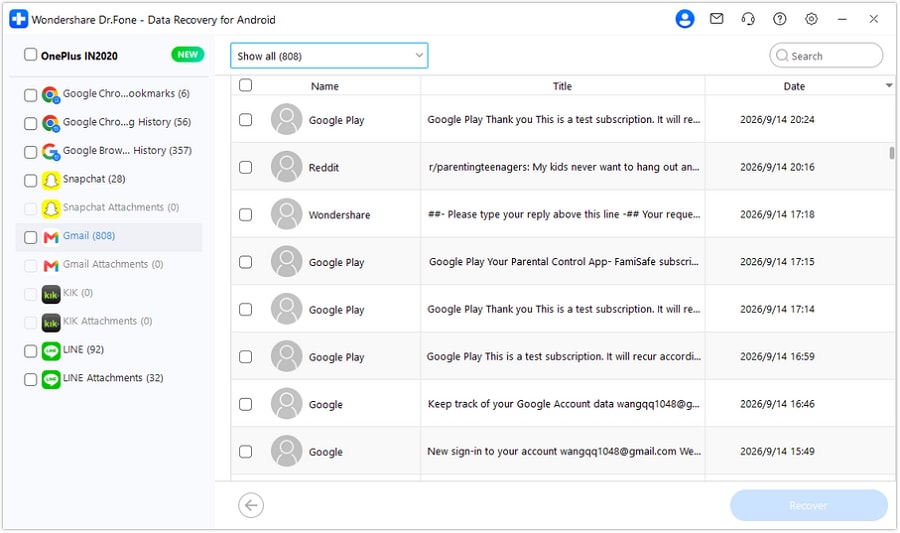
Step 5 Recover the selected material to your PC
Click Recover, select a computer folder through the displayed prompts and save the chosen data. Inspect the output on your PC to see which records and files are usable. The selected results are saved to the PC, not imported into Gmail on the phone.




Conclusion
For a missing project delivery, useful recovery means locating the right correspondence and checking the actual files, not stopping at a familiar thumbnail. Dr.Fone - Data Recovery (Android) helps supported Xiaomi 15 (Global) and Xiaomi 15 Pro users preview local Gmail records, review available attachments and keep selected results on a PC. Download Dr.Fone for Windows and start the guided scan to look for the email context and media your handover needs.
FAQ
1. How do I recover deleted Gmail emails on Xiaomi 15 and 15 Pro?
Check the correct account, All mail and Trash first. For the listed supported configurations, Dr.Fone - Data Recovery (Android) provides a Windows Advanced Recovery route to scan available local Gmail records and attachments. Preview the results and save the useful selections to a PC.2. Does this guide cover every regional Xiaomi 15 version?
No. The base-model entry is Xiaomi 15 (Global), Android 15, Kernel 6.6.77. Xiaomi 15 Pro is separately listed with Android 15 and Kernel 6.6.77. These supplied recovery conditions should not be generalized to an unlisted regional version or another family member.3. Can I recover deleted Gmail photo and video attachments?
Check Gmail Attachments if the scan finds attachment data. You can select available items and save them to your PC, but an email mentioning a photo or clip does not guarantee that the corresponding file remains locally. Open the saved file to assess the actual result.4. Does an image preview mean the original-quality photo was recovered?
No. A preview is not a guarantee of the original file's resolution or completeness. Check for an available attachment and inspect the saved output. This workflow does not promise original-quality media, every attachment or a fixed export format.5. Can Dr.Fone restore the whole project thread into my Inbox?
No. Advanced Recovery saves selected discoverable phone-local results to a PC. It does not rebuild the Gmail mailbox, retrieve permanently deleted mail from Google's servers or bypass the Trash retention period.
 Add Wondershare Dr.Fone as a preferred source on Google





